

Matelski Logs 2,000 Points, Aims Higher
February 5, 2016
By Dennis Chase
Special for Second Half
BOYNE FALLS – It's been one milestone after another for Marcus Matelski in 2016.
 In the last four weeks, the Boyne Falls senior has eclipsed the school's single-game scoring record three times, while becoming the 36th player in MHSAA state basketball history to score 2,000 points in his career.
To top it off, Matelski led the Loggers to a 53-50 win over previously unbeaten Alanson last Friday to forge a tie atop the Northern Lakes Conference. Earlier in the month, Alanson handed Boyne Falls its first league loss in five years, a streak that stretched nearly 60 games.
Matelski, who scored a school record 50 points in Monday's win over Traverse City Christian, has been instrumental in the Loggers’ success over those five years since he started on varsity as an eighth-grader. Because of the school's enrollment – Boyne Falls has fewer than 40 students – the MHSAA allowed Matelski to play on the varsity as a 13-year-old. He scored more than 200 points that season, although those numbers are not included in his high school career totals.
A two-time Associated Press all-state player, the 6-foot-2 Matelski is averaging 38 points, 11 rebounds, 8.0 steals and 4.5 assists per game for the 12-2 Loggers. He currently ranks 11th on the MHSAA’s statewide all-time scoring list with 2,226 points and is on track to break the single-season steals record of 131 set by three different players.
Records to gloat about, right?
Matelski, though, is not the attention-seeking type.
"I don't like to think about (records) too much," he said. "That way I don't get overwhelmed by it. I just like to go out there and play."
The night he surpassed 2,000 career points, officials stopped the game for a brief presentation. Matelski's reaction? He asked his coach, Tim Smith, how long it would take because he wanted to get back to the game.
Matelski spent the post-game posing for pictures with family and friends and talking with the media. There was no celebration in the locker room.
"Marcus would not have wanted that," his friend and teammate Andrew Campbell said. "He's humble. He's an under-the-radar type of guy. You talk to him about his accomplishments and he acts like it's nothing."
Matelski's averages speak volumes. So does his team's success. In his five years on varsity, Boyne Falls is 91-10. They are seeking a fifth consecutive league title and a third straight District championship.
For Smith, Matelski is a once-in-a-lifetime player.
"Marcus could be an impact player for any school in northern Michigan, no matter the level," he said. "He's a coach's dream. What I'm most proud of is how hard he makes those around him work, including me. He demands you coach him. He demands you make him better. I haven't played many rounds of golf the last four years because he's calling me every night, saying, 'Can I get in the gym and put up 500 to 600 shots?'”
Smith describes Matelski, a National Honor Society student, as a quiet leader, a hard worker who leads by example.
"Marcus is the type of kid who will work eight hours in the mill (at the family’s lumber yard), deliver a couple truckloads of wood afterwards, go mow his grandmother's grass and then call me around 8 or 9 at night wanting to get in the gym," Smith said.
The fact that Smith is there for his players is not lost on the 17-year-old.
"We're very lucky to have a coach like coach Smith because he will not say no," Matelski said. "If I call, or a couple of the other guys call and ask if we can get in the gym, he'll be there in five minutes. That's pretty special."
Smith, who has coached for more than 20 years at four schools, is a Boyne Falls graduate. He played on the basketball team in the early 1980s with Marcus Matelski's father, Chris. Smith scored nearly 1,400 points in his three years on varsity and held the school's single-game scoring record of 43 points until Matelski tossed in 44 in a win over Alba in early January. Three weeks later, Matelski went off for 48 against Central Lake. Then 50 on Monday.
 "Marcus is the most well-rounded player I've ever coached," Smith said.
"He's so athletic. The night he hit 2,000 he didn't miss a shot (at the start). He scored on a crossover pull-up. He scored on an offensive rebound. He scored on a back cut. He scored on a two-handed dunk. He scored on a 3."
Matelski needed 16 points in that mid-January contest with Harbor Light Christian to reach 2,000. A deep 3 with two minutes left in the first quarter put him over.
"We knew he was going to get it that night," Campbell said. "But in the first quarter? That was crazy. I guess if the well's not dry you keep going to it."
Matelski admitted it was a "surreal" night, one that brought out a flood of emotions as he started recalling "everything that went into" making that moment so special. At the top of his list? All the support he's received from his family, community, coaches and, of course, teammates.
"I get all this recognition for putting the ball in the hoop, but they do the behind-the-scenes work," he said of his teammates. "And I thank them for that."
That gratitude is a two-way street because his teammates contend Matelski makes them better players.
"He averages insane numbers, but it's not like he has the basketball all the time," Campbell, who also averages in double figures, said. "He gets everybody involved. Marcus expects just as much from us as coach does. He wants us to be on top of our games, too, so we can have success as a team."
Opponents try to make it difficult, double- and triple-teaming Matelski in order to slow Boyne Falls down. Alanson held Matelski to 30 points last Friday, but Leszek Wasylewski, Shea Ross and Cody Milbrandt all hit key fourth quarter baskets in the Loggers' comeback win.
"I take it as a compliment and as a challenge," Matelski said of the double- and triple-teaming. "I like to see what I can do (in those situations), to see if I can still deliver for the team."
His analytical approach to the game might be his greatest strength as a player – that and his mid-range jumper.
"I always try to get a feel for the game, try to decipher what's going to happen," he said.
The gym is Matelski's home away from home. He started playing in elementary school and was the varsity team manager as a seventh grader. His two older sisters, Kristen and Emily, played as well.
Although Matelski is known for his scoring, it's another aspect of his game that his father Chris appreciates.
"Defense," he said. "Marcus has great hands."
That partly explains why Matelski is nearing the state's single-season steals record.
Smith said Matelski plays with an even keel, never letting his emotions get the best of him.
 "You can talk to anyone who has ever officiated our games and they'll tell you he's never given anybody a hard time," Smith said. "I looked at his twitter page (after he scored 2,000 points) and I couldn't believe the number of opponents who were congratulating him. A kid doesn't get that kind of respect from the people he plays against unless he handles himself with class."
Turns out, Matelski's scoring average is not all that's been heating up since the start of the new year. His recruitment is picking up, too. Most of the interest is from Division III and NAIA schools, although Division I South Carolina Upstate has been in contact.
Smith said the biggest challenge is convincing college coaches that although Matelski is playing Class D competition in the north, he has the tools, especially the athleticism, to succeed at the collegiate level.
"(Recruiters) say, 'We don't have any video of him dunking the ball,’" Smith said. "So I’ll say, 'Hey Marcus, when you get a breakaway why don't you dunk the ball.' He'll say, 'Coach, I don't want to dunk the ball if we're up 30 points.' We all know he can dunk the ball, but now we have to prod him a little, saying it's OK to showcase your stuff. You're the one who did those power cleans and squats for hours to get yourself that athletic.
“I think everyone is a little gun shy about a kid from Boyne Falls. There were those who said Chris Hass couldn't play because he basically played the same caliber of competition."
Hass, who prepped at Pellston, is now a standout at Bucknell, where he averages a team-high 18 points a game.
Hass is currently third on the state's all-time scoring list with 2,522 points, and that mark is within range for Matelski. Mio's Jay Smith (2,841) and Hastings' Mark Brown (2,789) are the top two scorers.
Boyne Falls has six regular season games remaining before a tough District that features state-ranked Bellaire.
“Bellaire is very good,” Smith said. “If we don't play anything but our best we won't win the District."
A year ago, the Loggers reached the Regional Final before losing to Frankfort. Boyne Falls has never won a Regional, which is something Matelski and Campbell have dreamed about.
March Madness is still a month down the road, though. But if this last month is any indication, there could be more special nights ahead.
 Dennis Chase worked 32 years as a sportswriter at the Traverse City Record-Eagle, including as sports editor from 2000-14. He can be reached at [email protected] with story ideas for Manistee, Wexford, Missaukee, Roscommon, Ogemaw, Iosco, Alcona, Oscoda, Crawford, Kalkaska, Grand Traverse, Benzie, Leelanau, Antrim, Otsego, Montmorency, Alpena, Presque Isle, Cheboygan, Charlevoix and Emmet counties.
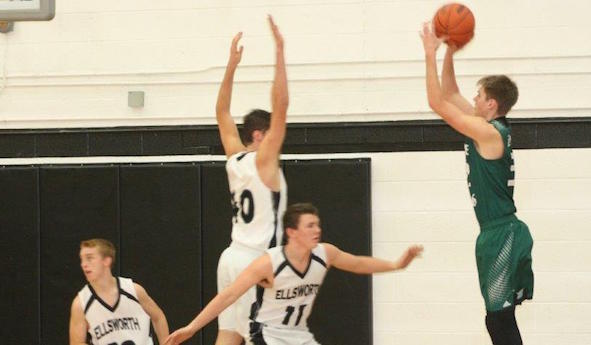
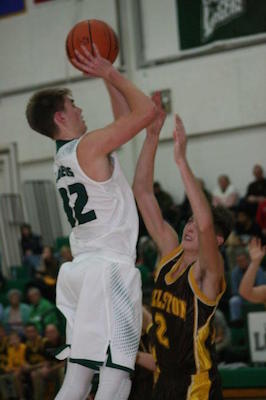
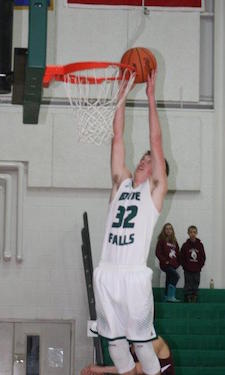
PHOTOS: (Top) Boyne Falls’ Marcus Matelski fires a jumper as three Ellsworth defenders shade to his side of the court. (Middle) Matelski pulls up for a shot over a Pellston defender. (Below) Matelski dunks for another two of his more than 2,000 points. (Photos courtesy of Rachel Lange.)
Be the Referee: Held Ball or Traveling?
February 13, 2020
This week, MHSAA officials coordinator Sam Davis offers a basketball "You Make the Call" that comes into play when defensive and offensive players wind up in a stalemate.
Be The Referee is a series of short messages designed to help educate people on the rules of different sports, to help them better understand the art of officiating, and to recruit officials.
Below is this week's segment - Held Ball or Traveling - Listen
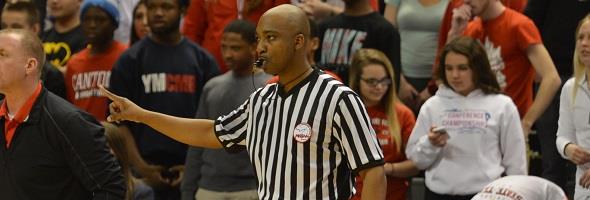
Let’s try a basketball “You Make the Call” play today. The offensive player jumps in an effort to either take a shot or make a pass. The defensive player reaches out and is able to place his or her hands on the ball to keep the offensive player from releasing it, and the offensive player returns to the floor with the ball.
You Make the Call? There was no contact, so there is no foul. Is it a traveling violation, or is it a held ball with the ball going to the team with the possession arrow in its favor?
Some old-timers out there might remember that up until about 1990, a traveling violation would have been called on this play. But the rules now call for a held ball in the situation with the possession arrow, which had just been introduced five years earlier in 1985, prevailing.
Past editions
Feb. 6: Hockey Rules Chart - Listen
Jan. 30: Cheer Safety - Listen
Jan. 23: Goaltending - Listen
Jan. 16: Wrestling Tie-Breaker - Listen
Jan. 9: Pregame Meeting - Listen
Dec. 19: Alternating Possession - Listen
Dec. 12: Ratings - Listen
Dec. 5: Video Review Success - Listen
Nov. 28: More Injury Time - Listen
Nov. 21: Football Review - Listen
Nov. 14: Sideline Safety - Listen
Nov. 7: Officials Playlist - Listen
Oct. 31: Most Important Line - Listen
Oct. 24: Automatic 1st Downs - Listen
Oct. 17: Catch Momentum - Listen
Oct. 10: Golf Rules Changes - Listen
Oct. 3: No Tackle Box - Listen
Sept. 26: You Make the Overtime Call - Listen
Sept. 19: Swimming Finishing Touch - Listen
Sept. 12: Curbing Gamesmanship By Substitution - Listen
Sept. 5: Football Safety Rules Changes - Listen
Aug. 29: 40-Second Play Clock - Listen