

North Central Legend Continues to Grow
February 8, 2017
By Dennis Grall
Special for Second Half
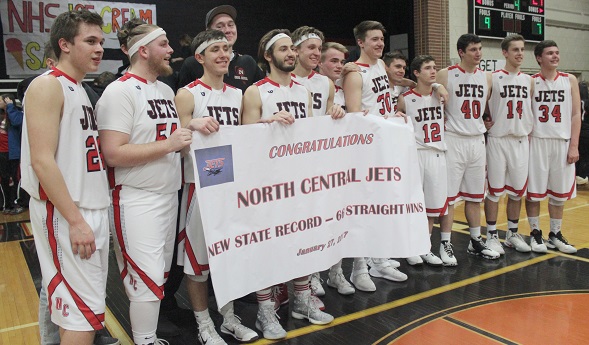
ESCANABA – There was no drama because the game had virtually been decided by halftime, so the North Central Jets merely exchanged hugs and pats on the back after erasing a 59-year-old state record Jan. 27.
 The Jets shelled neighbor and arch-rival Bark River-Harris 76-29 for their 66th consecutive win. That snapped the MHSAA record set for consecutive wins by fellow Upper Peninsula quintet Chassell from 1956-58, and they reportedly carry the longest active winning streak in the nation with 69 straight victories.
The capacity-plus crowd of about 1,000 cheered the record-setting performance, but the running clock had been going since the first minute of the third quarter and everyone knew the only thing to be determined was the final score.
The only other major excitement also came early, when Jets senior Dawson Bilski converted a three-point play with 17 seconds left in the first half to enter the 1,000-point club. He finished the night with 21 points and 1,002 career points.
The build-up to the win streak had taken precedence over Bilski’s approach primarily because this time of the season spawns several 1,000-point producers, while Chassell’s iconic mark had been in the discussion stages since North Central won its second straight Class D championship in March.
The Jets broke the record the same way they have waltzed through the past four seasons, with stifling defense, balanced scoring and another dunk by 2016 Associated Press Class D Player of the Year Jason Whitens.
Surprisingly some on-lookers have downplayed North Central’s streak, with coach Adam Mercier indicating there were questions about the competitive level of the schedule. Mercier simply pointed out the Jets were 4-0 in back-to-back trips to MHSAA Finals weekend at Michigan State University’s Breslin Center en route to consecutive Class D championships.
Teams can only play the schedule given them, and North Central is enjoying a fourth straight unbeaten regular season, in a conference annually considered the most competitive and balanced in the Upper Peninsula. The only loss during that span came March 18, 2014, when Cedarville won a Class D Quarterfinal 81-79 in Marquette.
The Jets own a 78-game regular season winning streak and are a stunning 94-1 since 2013-14. Their last regular season loss was Feb. 18, 2013, against Munising.
While the regular season success is hard enough to fathom, building a winning streak that is into its third straight season with a different cast each time helps put the record in better perspective.
Not only have the Jets defeated teams in their conference and their region, they have rolled through the district, regional and state tourney rounds unchecked.
In 2014-15, the Jets were 7-0 in the postseason highlighted by lopsided victories over Fulton (71-46) and Morenci (67-47) in East Lansing.
In 2015-16, the Jets were 8-0 in the postseason, crushing Fulton (64-23) and Waterford Our Lady (59-48) at the Breslin Center.
Perhaps the biggest question may never be answered. Will anyone eclipse North Central’s record, wherever it ends? After all, it took 59 years to surpass Chassell’s vaunted 65-win figure. If the Jets reach 80 straight, and the chance of that happening is pretty good, what are the odds of anyone else being that fortunate? This is a record that could realistically never be exceeded with just about everything stacked against such an attempt as the seasons unfold.
While the Jets now possess the state record boys streak, they are only second among schools in Menominee County for the longest win streak in state history.
Carney-Nadeau High School, just six miles south of Powers, owns the state girls record of 78 straight wins (from 1989-91). The Wolves won an amazing 127 consecutive regular season games until falling to Cooks Big Bay de Noc in 1993.
Even more astonishing, North Central and its 115 students own the MHSAA record of 26 straight victories in 8-player football. The Jets, with many athletes on that team who also play basketball, have won the past two 8-player football championships to cap back-to-back 13-0 finishes to the only seasons they have played that version of the gridiron game.
 Denny Grall retired in 2012 after 39 years at the Escanaba Daily Press and four at the Green Bay Press-Gazette, plus 15 months for WLST radio in Escanaba; he served as the Daily Press sports editor from 1970-80 and again from 1984-2012. Grall was inducted into the Upper Peninsula Sports Hall of Fame in 2002 and serves as its executive secretary. E-mail him at [email protected] with story ideas for the Upper Peninsula.
PHOTO: The North Central Jets hold a banner marking their state record 66th consecutive boys basketball victory Jan. 27 after beating Bark River-Harris 76-29. Chassell held the mark of 65 straight wins that was set from 1956-58.
Past Teams of the Month, 2016-17
December: Dundee boys basketball - Report
November: Rockford girls swimming & diving - Report
October: Rochester girls golf - Report
September: Breckenridge football - Report
Clarkston Earns 1st Shot at Dream Finish
March 24, 2017
By Geoff Kimmerly
Second Half editor
EAST LANSING – Dan Fife dreamed of playing for an MHSAA basketball championship at Jenison Field House while a student at Clarkston 50 years ago.
Thursday afternoon, the current Wolves made similar dreams come true – and offered their coach that opportunity he never was able to achieve as a player.
Clarkston’s 78-35 win over league rival West Bloomfield in Friday’s first Class A Semifinal earned the program its first appearance in an MHSAA boys basketball championship game.
The Wolves have had piles of success under Fife, the fourth winningest coach in state hoops history with 676 wins since taking over the program before the 1982-83 season. He’s led Clarkston to 30 District and 12 Regional titles, with Friday’s Semifinal the second during his tenure.
“Coach Fife, I don’t think he’ll admit how much it means to him. But it’s everyone’s goal at the beginning of every season; your ultimate goal is to finish out with a win,” Clarkston junior guard Foster Loyer said. “For Coach Fife, and the community of Clarkston, that would just mean the world to all of us, just motivate us to keep working even more.”
Clarkston (26-1), which entered the postseason tied for No. 3 in The Associated Press’ final regular-season Class A poll, will finish this season against Grand Rapids Christian at noon Saturday at the Breslin Center.
The Semifinal was the third ever in Wolves history. And the rare opportunity to advance to Saturday came with an even rarer opportunity to face a familiar opponent in this late round of the tournament.
Clarkston had beaten West Bloomfield (17-9) by 11 and seven during the regular season on the way to winning the Oakland Activities Association Red championship; the Lakers tied for third in the league.
And they knew what to expect from Loyer, a junior already committed to play at Michigan State. But it didn’t help much this time.
 Loyer’s first shot of the game, an attempted layup, sailed over the rim. His second shot, a 3-pointer, touched nothing but net.
Making 10 of 17 shots from the floor and 5 of 8 3-pointers, Loyer finished with 32 points, to go with seven assists. Senior forward Dylan Alderson added 27 points, and sophomore center Taylor Currie had 10 points and 16 rebounds as Clarkston hit 57 percent of its shots from the floor – including an incredible 69 percent during a first quarter that ended with the Wolves carrying a 24-13 lead.
Clarkston took an 18-point advantage into halftime.
Senior guard Kevin McAdoo led the Lakers with 22 points, but as a team they made only 22 percent of their shots from the floor, and had just one steal as Clarkston had only four turnovers but 17 assists.
“It’s a tough one to swallow today, especially with the ride we were on to get here,” said seventh-year West Bloomfield coach Jeremy Denha. “What a fun, fun time to get here with the ups and downs and the way the kids battled. We hadn’t sniffed a District Final, let alone a District title, since I’d been here – we hadn’t won one since 2003. For us to make this magical run, get to Breslin, play Clarkston a third time … yeah, the outcome is disappointing, but it’s about the journey too.”
Fife has been on a lot of these trips. So he'd likely quickly agree with his OAA colleague. And especially with how this journey has a chance to end for the first time.
“I’m not worried about what it means to me. I have an expectation; I’ve always had one no matter what I’m doing. If I’m playing something, I’m going to compete,” Fife said. “The reality is, I dreamed of playing in the state championship when I was in high school. I wanted to get to Jenison. That was always my dream, and I’m just trying to instill in the kids to have the same dream – to play basketball and get to this point. They’ll remember this day the rest of their lives, and tomorrow’s game, regardless of what happens.”
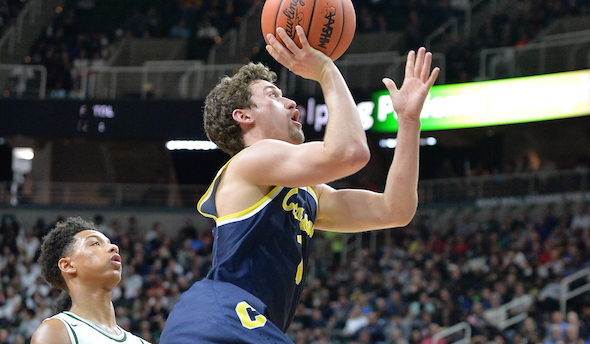
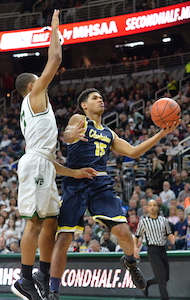
PHOTOS: (Top) Clarkston’s Foster Loyer breaks past West Bloomfield defenders to get a shot up during Friday’s first Class A Semifinal. (Middle) The Wolves’ Tieler Houston (15) gets position on West Bloomfield’s Daniel Wrack.