

North Central Legend Continues to Grow
February 8, 2017
By Dennis Grall
Special for Second Half
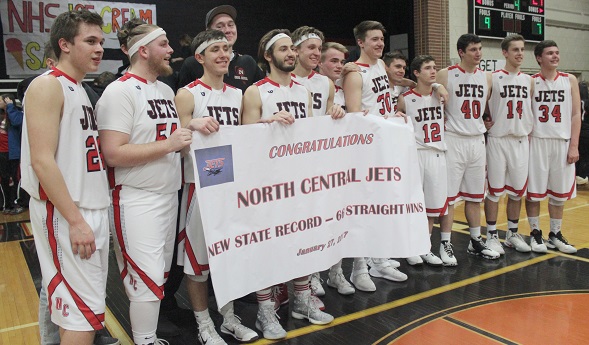
ESCANABA – There was no drama because the game had virtually been decided by halftime, so the North Central Jets merely exchanged hugs and pats on the back after erasing a 59-year-old state record Jan. 27.
 The Jets shelled neighbor and arch-rival Bark River-Harris 76-29 for their 66th consecutive win. That snapped the MHSAA record set for consecutive wins by fellow Upper Peninsula quintet Chassell from 1956-58, and they reportedly carry the longest active winning streak in the nation with 69 straight victories.
The capacity-plus crowd of about 1,000 cheered the record-setting performance, but the running clock had been going since the first minute of the third quarter and everyone knew the only thing to be determined was the final score.
The only other major excitement also came early, when Jets senior Dawson Bilski converted a three-point play with 17 seconds left in the first half to enter the 1,000-point club. He finished the night with 21 points and 1,002 career points.
The build-up to the win streak had taken precedence over Bilski’s approach primarily because this time of the season spawns several 1,000-point producers, while Chassell’s iconic mark had been in the discussion stages since North Central won its second straight Class D championship in March.
The Jets broke the record the same way they have waltzed through the past four seasons, with stifling defense, balanced scoring and another dunk by 2016 Associated Press Class D Player of the Year Jason Whitens.
Surprisingly some on-lookers have downplayed North Central’s streak, with coach Adam Mercier indicating there were questions about the competitive level of the schedule. Mercier simply pointed out the Jets were 4-0 in back-to-back trips to MHSAA Finals weekend at Michigan State University’s Breslin Center en route to consecutive Class D championships.
Teams can only play the schedule given them, and North Central is enjoying a fourth straight unbeaten regular season, in a conference annually considered the most competitive and balanced in the Upper Peninsula. The only loss during that span came March 18, 2014, when Cedarville won a Class D Quarterfinal 81-79 in Marquette.
The Jets own a 78-game regular season winning streak and are a stunning 94-1 since 2013-14. Their last regular season loss was Feb. 18, 2013, against Munising.
While the regular season success is hard enough to fathom, building a winning streak that is into its third straight season with a different cast each time helps put the record in better perspective.
Not only have the Jets defeated teams in their conference and their region, they have rolled through the district, regional and state tourney rounds unchecked.
In 2014-15, the Jets were 7-0 in the postseason highlighted by lopsided victories over Fulton (71-46) and Morenci (67-47) in East Lansing.
In 2015-16, the Jets were 8-0 in the postseason, crushing Fulton (64-23) and Waterford Our Lady (59-48) at the Breslin Center.
Perhaps the biggest question may never be answered. Will anyone eclipse North Central’s record, wherever it ends? After all, it took 59 years to surpass Chassell’s vaunted 65-win figure. If the Jets reach 80 straight, and the chance of that happening is pretty good, what are the odds of anyone else being that fortunate? This is a record that could realistically never be exceeded with just about everything stacked against such an attempt as the seasons unfold.
While the Jets now possess the state record boys streak, they are only second among schools in Menominee County for the longest win streak in state history.
Carney-Nadeau High School, just six miles south of Powers, owns the state girls record of 78 straight wins (from 1989-91). The Wolves won an amazing 127 consecutive regular season games until falling to Cooks Big Bay de Noc in 1993.
Even more astonishing, North Central and its 115 students own the MHSAA record of 26 straight victories in 8-player football. The Jets, with many athletes on that team who also play basketball, have won the past two 8-player football championships to cap back-to-back 13-0 finishes to the only seasons they have played that version of the gridiron game.
 Denny Grall retired in 2012 after 39 years at the Escanaba Daily Press and four at the Green Bay Press-Gazette, plus 15 months for WLST radio in Escanaba; he served as the Daily Press sports editor from 1970-80 and again from 1984-2012. Grall was inducted into the Upper Peninsula Sports Hall of Fame in 2002 and serves as its executive secretary. E-mail him at [email protected] with story ideas for the Upper Peninsula.
PHOTO: The North Central Jets hold a banner marking their state record 66th consecutive boys basketball victory Jan. 27 after beating Bark River-Harris 76-29. Chassell held the mark of 65 straight wins that was set from 1956-58.
Past Teams of the Month, 2016-17
December: Dundee boys basketball - Report
November: Rockford girls swimming & diving - Report
October: Rochester girls golf - Report
September: Breckenridge football - Report

Breslin Bound: Boys Report Week 7
January 27, 2014
By Geoff Kimmerly
Second Half editor
Well, the weather outside is frightful … but inside the gym it’s warm as ever, especially for teams able to avoid the freeze outs that have made scheduling and re-scheduling an adventure this month.
This week’s list includes a number of teams from northern Michigan, where they are used to braving the cold – and some from downstate that probably feel they are doing it more than usual lately.
1. Bellaire (9-0, Class D) – The Eagles are among three contenders atop the Ski Valley Conference, and a win over Mancelona this week would give Bellaire at least a one-game edge on the other two.
2. Grand Ledge (7-2, Class A) – After winning four games two seasons ago and eight in 2012-13, the Comets lead the Capital Area Activities Conference Blue thanks to a six-point win over favorite Holt on Friday.
3. Detroit Osborn (9-3, Class A) – The Knights opened this season 1-3 but haven’t lost since mid-December and are 5-0 in the Detroit PSL East Division 2.
4. Crystal Falls Forest Park (9-0, Class D) – The Trojans edged third-place Carney-Nadeau by four points to keep pace with Powers North Central atop the Skyline Conference.
5. Hillman (10-1, Class D) – The Tigers have won three straight by at least 24 points, including a nonleague victory over Posen, the other North Star League team without a loss this winter (they meet in league play Feb. 27).
6. Ironwood (11-1, Class C) – The Red Devils’ lone loss this season was to a team from Wisconsin; 10 of 11 wins have come by double digits.
7. Fulton-Middleton (7-1, Class D) – The Pirates opened up the Central Michigan Athletic Conference race by edging leader and favorite Pewamo-Westphalia by three to move into a tie for the top spot.
8. Suttons Bay (7-1, Class D) – The Norsemen haven’t lost since opening night and lead the Northwest Conference with second-place Benzie Central coming up next week.
9. Belleville (7-3, Class A) – The Tigers must play catch-up behind Western Wayne Blue leader Romulus, but notched a nice overtime win over Southeastern Conference White leader Ypsilanti Lincoln on Thursday.
10. Lansing Eastern (6-5, Class A) – The Quakers bounced back from a four-game losing streak to beat CAAC Blue contenders Okemos and Lansing Sexton last week.
PHOTO: Detroit Osborn, here against Detroit Collegiate Prep, leads its division of the Detroit Public School League. (Photo courtesy of the Detroit PSL).