

Romulus Summit Academy Continuing Impressive Climb
By
Tom Markowski
Special for Second Half
March 17, 2021
As a co-founder of Romulus Summit Academy, Leann Hedke was intent on creating an atmosphere conducive to academic achievement.
 Summit opened its doors in Flat Rock in 1996 for grades K-5, soon expanding to K-12 once the school moved to Romulus the following year. According to Hedke, in the last 10 years 100 percent of those graduating were accepted to a college or university.
Also, according to a 2017 report, Summit had the highest graduation rate among charter schools in Michigan and was ranked in the top 50 by graduation rate during the 2015-2016 school year. Summit, rated No. 17, had a graduation rate of 98.58 percent, nearly 20 percent better than the state average of 79.65.
Mission accomplished.
But something was missing: a competitive athletics program. Often a viable athletic program will enhance academics. A competitive athletic program can generate enthusiasm and give students a reason to be proud of their school, in addition to academics.
Summit Academy North High School didn’t sponsor varsity sports until the early 2000s and, frankly, they weren’t very good, particularly in the sports of boys basketball and football. From 2004-2016 the football team boasted three winning seasons and made the playoffs once (2007). Until the 2019-20 season, the most wins the basketball team totaled was 10.
“Our focus has been on the scholar-athlete,” Hedke said. “We focus on academics. Our GPA (grade-point average) requirements are higher than what the (Michigan High School Athletic Association) requires.”
Hedke said there’s been quite of bit of turnover in the coaching ranks in boys basketball over the years. Part of this is due to the lack of success, as far as wins and losses, but some of this can be attributed to the high standards Hedke and her fellow administrators demand. Swearing is taboo, and a coach is expected to be a stickler for discipline, and must adhere to a strict decorum.
With the backing of Summit athletic director William McKoy, veteran coach Mark White, less than a month before the start of the season, was hired in November of 2018. Summit was 9-12 during White’s first season before showing vast improvement last winter finishing 16-4. Highlighting that season was the school’s first division title (within the Charter School Conference) and a spot in a Division 2 District Final against Flat Rock. Summit has never won a District title so this game loomed as the most important in school history.
Then COVID-19 hit, ending the season.
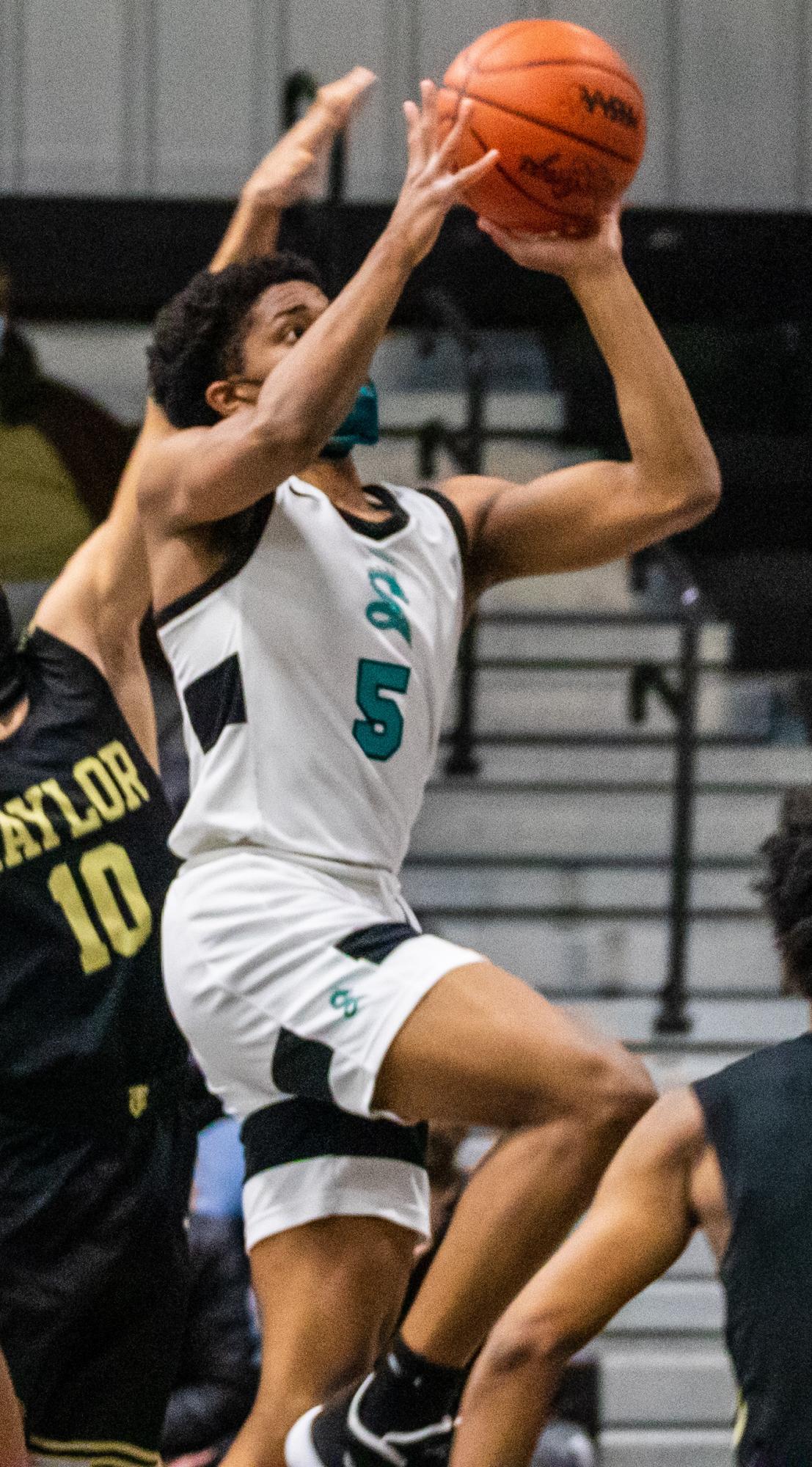 Summit returned four starters from that team and is off to a 15-0 start with the MHSAA Tournament less than a week away. Most of its victories have been by double digits including last Saturday’s 71-53 victory over Taylor, a Division 1 school, and Tuesday’s 72-46 victory over Detroit Community in a conference tournament quarterfinal. Summit’s semifinal is scheduled for Thursday.
Two wins stand out in particular, and both came on the road. Summit defeated Harper Woods Chandler Park Academy, 54-51, on March 1 and then upset No. 3-ranked (in Division 2) Detroit Edison, 49-46, on March 8. Edison’s only other loss this season was to Warren De La Salle Collegiate, a Division 1 school, 72-68. Both Chandler Park and Edison are Charter School Conference members and have had strong programs over the years.
White starts one senior, guard Jamel Johnson, who’s averaging 10 points per game and was selected second-team all-conference. Sophomore James Wright averages 17 points and nine rebounds. White’s top player is junior and three-year starter Orlando Lovejoy, Jr., a 6-2 guard who was selected conference player of the year. His 23 points led Summit in its victory over Community. Lovejoy averages 21 points, 10 rebounds and seven assists per game.
“All of our players got better during the offseason,” Lovejoy said. “(White) is an intense coach. He’s demanding. He’s constantly pushing us. He’s a perfectionist.”
Much of the credit goes to White for the recent success, but one can’t overlook the talented players within the school. Take the recent success of the football program for example. The football team was 0-9 in both 2015 and 2016. The Dragons went 5-4 the next two seasons before finishing 8-3 in 2019, a run which included an 18-12 victory over Redford Union in a Division 4 District opener, the program’s first playoff win. This past regular season was shortened to six games because of the pandemic, and Summit won two playoff games finishing 7-2.
“Summit is an excellent school,” White said. “They’re in line with what I want to be as a coach.
“There are more accolades for a team that hasn’t been that good in the past. (Winning) has never been done before here. I feel the best is yet to come, and not just for the team, but for the school as well. Gaining recognition in basketball helps promote the school. People will find out about how good Summit is as a school.”
Winning is anything but new for White. His first season as a head coach was at his alma mater Detroit Renaissance in 1998. In 2000 Renaissance, which had never played for a Detroit Public School League title, won the PSL defeating Detroit Redford, 41-37, in the championship game. Renaissance won the title again in 2002 and 2003. Renaissance then won two MHSAA Class B titles (2004, 2006) under White.
White left Renaissance after the 2005-06 season to become head coach at Adrian College, another alma mater. He spent seven seasons there before returning to the high school level at River Rouge. White guided River Rouge to the Class B Semifinals in 2017 and 2018.
White said he couldn’t be happier, at this time in his professional life, than he is now at Summit. In addition to his duties as the boys basketball coach, White is also the school’s academic interventionist and assistant athletic director.
 Lovejoy is aware of the success his coach has had at other schools. And even though Summit hasn’t achieved that type of success, he said anything is possible.
“We want to win our conference tournament, a District and Regional title, and the states,” Lovejoy said. “To some that’s farfetched, but it is realistic. We’re with a coach who’s done it before.
“This is special. (Summit) has never won a District, and here we are undefeated. We’re soaking it all in. We want to give the school something to cheer about.”
Lovejoy and his teammates recently gave Hedke a gift from their hearts. It’s a poster, a collage of sorts, with photos of the team in addition to pictures the players painted. This was in response to Hedke being a cancer survivor. She was diagnosed with breast cancer this past November and now is cancer-free.
“Mark is a wonderful coach,” Hedke said. “He focuses on what (the players) do well. He talks about who they are and what they represent. He teaches them to be aware. When I was going through my cancer, he told the players that we’re fighting on the court to win a game. She’s fighting for her life.”
The players have since dedicated their season to Hedke.
 Tom Markowski is a correspondent for the State Champs! Sports Network and previously directed its web coverage. He also covered primarily high school sports for the The Detroit News from 1984-2014, focusing on the Detroit area and contributing to statewide coverage of football and basketball. Contact him at [email protected] with story ideas for Oakland, Macomb and Wayne counties.
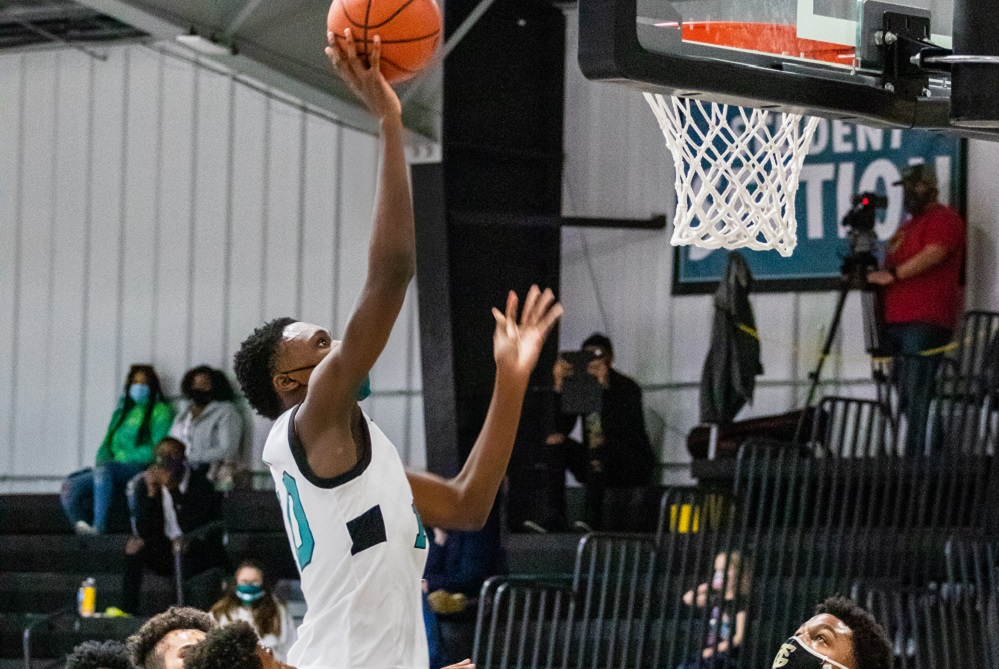
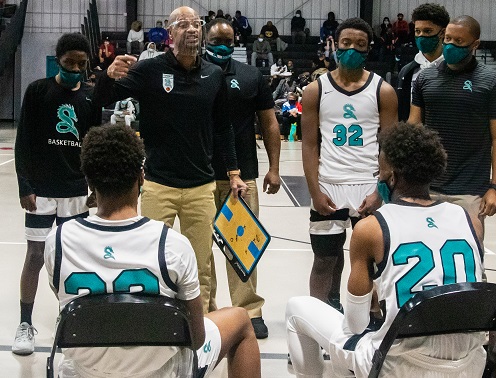
PHOTOS: (Top) Raevon Thomas (10) gets up a shot during Summit Academy’s Senior Night win over Taylor. (Middle) Summit’s Orlando Lovejoy makes a move to the basket Saturday. (Below) Dragons coach Mark White huddles his team. (Photos by Aaron Goodman.)
Finally ... Romulus Reigns in Class A
March 23, 2013
By Geoff Kimmerly
Second Half editor
EAST LANSING – Romulus coach Nate Oats called it abnormal rather than rare for his players to show up at school at 6 a.m. this season to take extra shots before class.
Point guard Wesley Clark made himself familiar with a few hills too as he took the extra steps necessary to avoid leaving Breslin Center again without a championship trophy.
This weekend’s trip to Michigan State was the Eagles’ fourth in six seasons, and they played in their first championship game Saturday since finishing runner-up in 2005. But those early mornings and extra shots became all worth it when, in Oats’ words, “We finally got this thing done.”
Romulus led the Final from start to finish in defeating Detroit Southeastern 61-49 to claim its first Class A title since 1986 and cap one of the finest seasons by a Class A team in recent memory.
“As a junior, it was my first time being here to the Breslin, and I didn’t understand what type of feeling it was to lose at Breslin,” Clark said. “Coming into senior year, I knew I didn’t want to feel that again. So I took that on in the offseason and in the spring, ... just to make sure this wouldn’t happen again.”
Romulus finished 27-1, its only loss to Detroit Pershing – which the Eagles then avenged in Tuesday’s Quarterfinal.
Of those 27 wins, all but six were by 10 or more points.
“Our theme of the year was ‘dominate,’ and dominating is mainly just winning and winning by a large margin,” Clark said. “We took that on as a statement and challenge. That’s what we tried to do, is dominate.”
Oats broke it down Saturday much like his team broke down opponents all season.
It started with talent, and the Eagles obviously weren’t lacking. Oats called the Missouri-bound Clark the most competitive player he’s coached. Rhode Island recruit E.C. Matthews is one of the biggest “gym rats” he’s had, and Louisiana Tech signee Leonardo Edwards showed in spurts that he might’ve been the top big man in Michigan. Plus, “we played harder than everybody,” Oats said.
“If you’re more talented than everybody, and played harder, you’re not going to lose most of the time,” he added. “If you’re not in our program, nobody has any idea how many hours these guys put in at the gym. … They’ve made themselves into really good players."
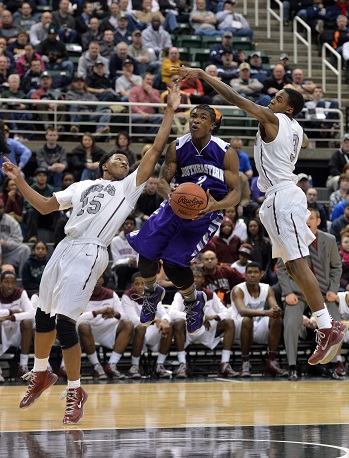 Matthews scored 20 points and grabbed 10 rebounds in the Final, giving him 86 points and 27 rebounds over three games this week. Edwards had 13 points and nine rebounds Saturday, and Clark had 12 points and five assists.
Similar to the Semifinal, Romulus jumped to a 7-0 lead off the opening tip. Southeastern got within four with a minute to play in the first half, but the Eagles led by double figures for all but 47 seconds of the second.
“They get the ball up the floor quickly, and they can shoot the basketball. They do it with precision. I said it (Friday), they do what they do probably better than anybody in the Midwest,” Jungaleers coach George Ward, Jr., said. “Is it unstoppable? Of course not. We just didn’t follow the game plan, so to speak. Once the heat of battle came, we kinda forgot about exactly what it was we really wanted to do to them defensively. And our frustrations really initiated off the fact that we didn’t score like we wanted to.”
Senior guard Jovone Haynes – whose last-minute steal made him the hero of Southeastern’s Semifinal win – led the Jungaleers again with 16 points and six steals.
Junior forward Daryl Bigham had 10 points and senior guard Kwesi Williams had 10 points and six rebounds. But Southeastern made only 27 percent of its shots from the floor and only 16 percent from 3-point range.
Southeastern finished 21-6 and with a second runner-up finish in three seasons. The Jungaleers also advanced to the Final in 2011.
“Toughness with some good talent is very important. Our guys showed mental toughness during the course of this season,” Ward said. “We always play a very good schedule, and if you just do things the right way, you’ll always be in position to win.
“Some kind of way, we always manage to win basketball games and get kids to college. … The toughness really can supersede some of the talent levels. We had some toughness, and that helped carry us.”
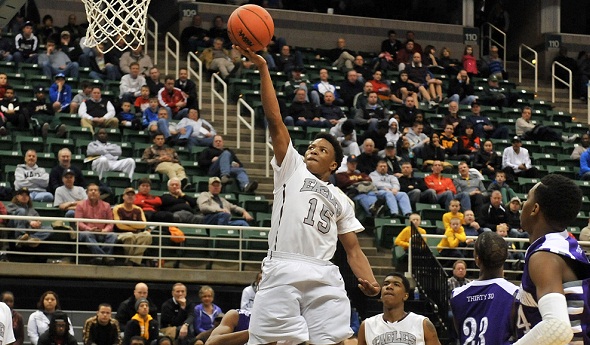
PHOTOS: (Top) Romulus’ Wesley Clark (15) drives for two of his 12 points in Saturday’s Class A Final. (Middle) Mays and teammate Juwan Clark (3) form a shell over a driving Jovone Haynes. (Click to see more at HighSchoolSportsScene.com.)