

As Stockbridge Learns, Swoverland Earns 400
January 28, 2016
By Geoff Kimmerly
Second Half editor
STOCKBRIDGE – The new coach had won a lot of games. He must know what he’s doing, Mason Gee-Montgomery figured.
 And that’s all he knew about Randy Swoverland when the latter took over Stockbridge’s boys basketball program two years ago.
But by the end of their first summer workout, Gee-Montgomery realized how hard the Panthers would be working that winter. And although the team finished only 8-13 that first season of 2014-15 (solid, actually, considering the team returned only one player with varsity experience), the now-junior point guard recognized his coach was putting the team in position to win – as long as he and his teammates held to what Swoverland was teaching them, and despite the fact some classmates didn’t stick around to help.
“It’s definitely a lot different than any coach we’ve had,” Gee-Montgomery said. “He takes the intensity to another level, and he expects things done a certain way. And if you don’t get them done that way, he’ll let you know.
“He definitely holds us accountable for the way we play, and I think that style of coaching suits the team we have because we hold each other accountable and he holds us accountable for ourselves. It just makes us play at another level.”
He could’ve been speaking for many of the teams Swoverland has led over the last four decades. And many of those players have been on the coach’s mind since his 400th career win Jan. 19, a 49-47 Stockbridge victory over Lansing Christian.
Swoverland has coached basketball at nine high schools over 37 years, building a record of 402-332. He also coached two seasons of boys and girls tennis, three of football and two seasons of men’s basketball at Adrian College since starting his coaching career in the fall of 1977 at Greenville High.
“When I got the win, I was happy. My guys were excited for me. But I also think back to all of the guys I coached in the 70s, 80s, 90s; they’re as much a part of it as what we’re certainly doing right now,” Swoverland said. “My thoughts and memories go all the way back to all of those teams.”
Although most in his new school’s community probably weren’t familiar with the past successes, Swoverland wasn’t exactly a stranger in a strange land when he picked up the milestone win on his newest team’s home court – Stockbridge is only 17 miles from Dexter, where he lives, has a son in high school and led teams to 245 of those victories.
He certainly has left an imprint on communities all over the Lower Peninsula and Ohio border, with 11 stops combined at those nine high schools and one college.
Stops along the way
Swoverland coached boys and girls tennis and also served as a boys basketball assistant at Greenville after finishing a four-year basketball career at Adrian College, where he was a captain as a senior. After Greenville came his first head coaching job, for a season at Edmore (now Blanchard) Montabella. He spent 1979-80 coaching Deckerville’s boys before heading back to Adrian College as an assistant men’s basketball coach; the head coach got fired and he lost his job there two years in. At the same time, Swoverland had been teaching and coaching football at Evergreen High School in Metamora, Ohio, and took over the girls basketball program there for one season. (He taught mathematics for 38 years total, retiring from the classroom after the 2013-14 school year.)
 Swoverland moved on to coach Hudson’s boys basketball varsity from 1983-91, leading the Tigers to a league championship in 1989, a District title in 1991 and a 102-72 record. Then came his first tenure at Dexter from 1992-2001 – his teams finished a combined 131-90 with four league and four District titles and posted a 22-2 record in 1997-98. A need for something new led him to Adrian High School for three seasons from 2002-04 – and realizing Dexter was a better fit led him back to coach the Dreadnaughts from 2005-13, during which time they finished 114-90 and won two District titles.
Swoverland then took 2013-14 off from coaching – and missed it too much. He applied for and received the Stockbridge job that spring, taking over for Joe Wenzel, who also was the school’s athletic director and had coached in the district 11 seasons and the varsity during his last two.
The Panthers finished last winter with four losses over their final five games, but a combined eight points from finishing 12-9 instead. They also handed one of only two league losses to eventual Greater Lansing Activities Conference champion Lake Odessa Lakewood. This winter, the varsity has only nine players – but also nine wins, off to a 9-2 start and tied for second in the GLAC with a championship over holiday break at the Parma Western Holiday Hoops tournament.
“His level of consistency with the kids (impresses me); he’s very organized. Clearly he’s been doing it for a long time, so that helps with areas like that,” Wenzel said. “He has high expectations for the kids, and he holds them to it, and they rise to the occasion.”
But Swoverland gives them that opportunity to rise as well.
Dexter girls basketball coach and athletic director Mike Bavineau got his high school coaching start assisting Swoverland and worked with and around him for more than 20 years, getting a first-hand look at the strategist in action.
“I loved being on the sidelines with him. I watched him develop a system of play that always seemed to maximize his team’s ability,” Bavineau said. “The players may have never known it, but he is such a strategist that he will find a way to put you in the right place at the right time. Dexter and I were very fortunate to have him as a mentor and as a coach.
“You do not find many people who are (more) committed to his players and his program than Coach. I have the utmost respect for him as a coach and a friend.”
The branches of Swoverland’s coaching tree stretch broadly, considering both those who played for and coached under him and also those he’s affected during 31 years running the well-attended summer team camps at Adrian College and Siena Heights University.
His lessons through the years and many stops boil down to a few key points:
He teaches players to compete not against the opponent, but against their own potential – and measure against that, win or lose.
He emphasizes a unified front and working within the group, even when disagreeing with some of the decisions or direction – players aren’t allowed to stick out by wearing things like headbands with their uniforms, and his system isn’t built to create stars on the court, as all five starters this season average between eight and 13 points per game.
Finally, there are the life lessons he hopes they take with them like commitment and hard work – the ones he still hears about from former players when they’ve figured out what he meant years later.
“Coach has the best basketball mind I have encountered in 20 years of coaching. (And) his value system is beyond reproach,” said Brooklyn Columbia Central boys hoops coach Jason Rychener, who played for Swoverland at Hudson in 1989-90 and 1990-91 and coached under him at Dexter from 1995-2005. “I find myself still using the W.W.C.D (What would Coach do?) approach to issues that arise in my own program. In my view, he reached ‘legend’ status long before his 400th win.”
“Kids are still kids. They still want to play basketball. They still want to get something out of it,” Swoverland reflected. “You’re still teaching them life lessons. All of that stuff carries over, whether you’re coaching a Class B team or a Class A team.”
Making another impact
Stockbridge’s most notable sports success of late came on the football field over the last two seasons, as Gee-Montgomery – also a quarterback – set or tied three MHSAA passing records this fall with junior receiver/shooting guard Kolby Canfield hauling in 90 of those tosses and both in position to finish with some of the flashiest career numbers in this state’s history.
The boys basketball program, meanwhile, was coming off four straight sub-.500 seasons when Swoverland was hired and didn’t quite seem like a destination for a coach climbing toward 400 victories.
But he got a lay of the land both from Katherine Kuzma, the girls soccer coach and a former student of his at Dexter, and Josh Nichols, a teacher and former coach at the school who played at the University of Minnesota. Swoverland came away with an impression that Stockbridge athletes were competitive and would work hard, and the scenario has been similar to when he was at Hudson and also had a number of three-sport athletes while coaching in more of a football-type town. He also had a team of only nine players for a season with the Tigers, and has used all of that past experience during this one. He also brought along assistant Rick Weaver, who played for him at Dexter in 1998-99 and 1999-2000.
The biggest challenge has been getting a new school’s athletes to buy in to his “old-fashioned” style which emphasizes man-to-man defense and shot selection, and he’s working to get more offseason buy-in as well so he can help develop their skills. His system is based in large part on conversations with hundreds of coaches over the years, and Swoverland recalls specifically when his Hudson and Dexter teams hit a groove where their experience and execution resulted in wins over more talented opponents. Stockbridge isn’t there yet, but it’s moving in the right direction.
But not during the first half Tuesday. The Panthers were struggling against Jackson Northwest, playing below their potential, and Swoverland let them know – although he didn’t have to say a word. A look his players have come to recognize said it all.
Stockbridge pulled away for a 51-41 win.
“Last year we struggled with some of the things he had us doing, but we returned almost everybody and we’re all more familiar with the system and what he expects of us,” Gee-Montgomery said. “Winning makes everything better, and when we all play well, and we get praise from him, that’s when it feels really good."
 Geoff Kimmerly joined the MHSAA as its Media & Content Coordinator in Sept. 2011 after 12 years as Prep Sports Editor of the Lansing State Journal. He has served as Editor of Second Half since its creation in Jan. 2012. Contact him at [email protected] with story ideas for the Barry, Eaton, Ingham, Livingston, Ionia, Clinton, Shiawassee, Gratiot, Isabella, Clare and Montcalm counties.
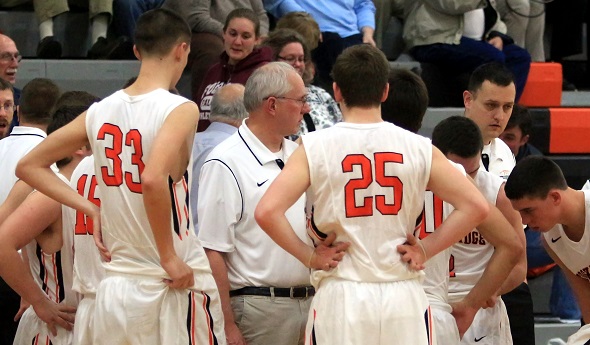
PHOTO: Stockbridge boys basketball coach Randy Swoverland huddles with his players during a break in the action this season. (Photo courtesy of Frazzini Photography.)
Be the Referee: Instant Replay in Basketball
March 25, 2019
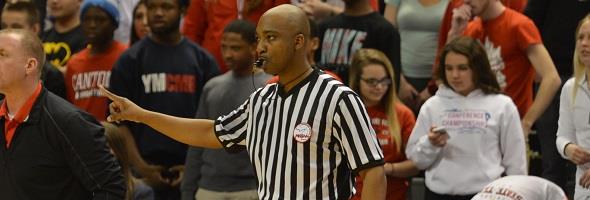
This week, MHSAA officials coordinator Sam Davis explains when instant relay is available to be consulted during the girls and boys basketball tournaments.
Be The Referee is a series of short messages designed to help educate people on the rules of different sports, to help them better understand the art of officiating, and to recruit officials.
Below is this week's segment – Instant Replay in Basketball - Listen
When watching a college or NBA game, the last two minutes of the game can seem like they take forever – especially in recent years where more and more judgment calls made by officials are subject to instant replay.
At the high school level, video is not used to make a ruling or confirm or overturn a call made during the course of the contest. The only time video review is used in basketball at the high school level is at the MHSAA Semifinal and Final games.
In these games, video review can be used only to determine if a shot was released in time at the end of the fourth quarter or overtime or if that shot was a 2-point or 3-point field goal attempt. The MHSAA believes that this very limited use of replay in these games at the very end of the tournament series in boys and girls basketball is the right call.
Past editions
March 14: Basket Interference - Listen
March 7: Primary Areas - Listen
February 28: Under the Bus - Listen
February 21: You Make the Call - Listen
February 14: Because They Love It - Listen
February 7: Coach/Official Communication - Listen
January 31: Backcourt Violation? - Listen
January 24: Required Hockey Equipment - Listen
January 17: You Make the Call: 10-Second Clock - Listen
January 10: Tripping in Hockey - Listen
January 3: Sliding in Basketball - Listen
December 27: Stalling in Wrestling - Listen
December 20: Basketball: You Make the Call - Listen
December 13: Basketball Uniform Safety - Listen
December 6: Coaching Box Expansion - Listen
November 29: Video Review, Part 2 - Listen
November 22: Video Review, Part 1 - Listen
November 15: You Make the Call - Sleeper Play - Listen
November 8: 7-Person Football Crews - Listen
November 1: Overtime Differences - Listen
October 25: Trickery & Communication - Listen
October 18: Punts & Missed Field Goals - Listen
October 11: What Officials Don't Do - Listen
October 4: Always 1st-and-Goal - Listen
September 27: Unique Kickoff Option - Listen
September 20: Uncatchable Pass - Listen
September 13: Soccer Rules Change - Listen
September 6: You Make the Call: Face Guarding - Listen
August 30: 40-Second Play Clock - Listen
August 23: Football Rules Changes - Listen