

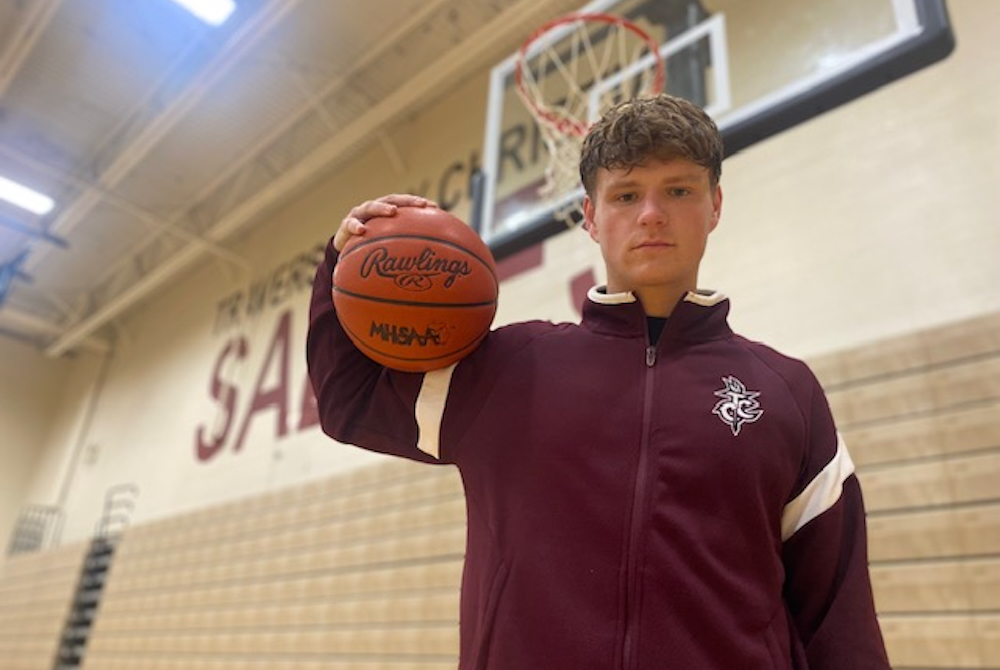
TC Christian's Broderick Approaching Records, But Team Goals Top His List
By
Tom Spencer
Special for MHSAA.com
January 10, 2025
If Reese Broderick falls short of the main goal this season, he may never forgive himself.
 Rest assured he‘ll likely go easier on his Traverse City Christian basketball teammates.
Broderick is the Sabres’ senior sharpshooter with defensive prowess. The most career 3-pointers in MHSAA history and the school’s scoring record could be his when the dust settles on this season.
But neither feat is at the top of his season goal list.
Broderick has his eyes set on helping his team win the school’s first boys basketball District championship. That outcome might also include a postseason win over the school’s biggest rival, Lake Leelanau St. Mary.
The Eagles ended Broderick’s freshman and sophomore seasons. They also ended his older brother Brock’s career in 2022 as the Brodericks were playing varsity together as a freshman and senior, respectively.
The older Broderick finished that season as the school’s all-time scoring leader, setting the bar at 1,528 career points.
The younger Broderick entered the 2025 calendar year with 284 career 3-point shots made is about to top the 1,300 career scoring mark. He connected on four 3-pointers in the first game of 2025 in a loss to Onekama. He had six the next time out in a win over Leland and finished this week with three more in a win at Bear Lake.
He is now at 297 career 3-pointers made, ranking him fifth in MHSAA history. Matt Kitchen, who starred for Mayville and Unionville-Sebewaing, owns the career mark of 340.
But hosting a District trophy is of far greater importance to Broderick. The Sabres are 9-2 on the season and collecting wins is their focus.
 “I am already on the list, so that’s not too high of a priority and it’s an honor to be on the list,” said Broderick, who joined the 1,000-point club a year ago. “As a school, we haven’t won a District yet, so that’s definitely the big goal and after that just keep going."
Points from Broderick, a second-team all-state selection the past two seasons, are not counted on as much this winter.
“His points are probably 12 points per game — it could be 25, but we’re not worried about (that),” said Sabres coach Rene LaFreniere. “We’re got four guys that any one of them could be all-state selections if we made the push — with Reece being one of them — but at the end of the day, they want to win the District trophy. That’s their focus.’
LaFreniere, now in his fourth year at the school with an enrollment barely topping 100, has seen the Sabres rotate scoring leaders all season. Senior guard Austin Miller – who gets points in transition and is considered the team’s top defender – junior power forward Garret Schultz, and sophomore Asher Coates, a newcomer who can score but focuses on distributing the ball, have all had a few double-digit nights already this season.
Schultz led the Sabres in scoring in their win over Bear Lake with 18 points. Coates kicked in 17.
The team’s stingy defense though has been a bigger contributor to the Sabres’ success, noted LaFreniere. They held Bear Lake to just 32 points this week.
“We’re holding teams to 38-42 points per game,” LaFreniere said. “Right now defensively is what they’re more focused on.”
And while the Sabres play tough defense, Broderick draws the opponent’s best defender every time. It’s not really anything new though.
And while the Sabres are not focused on Broderick getting the career mark, they’ll take every 3-pointer he can muster. The offense relies on screen actions and inbound passes to get the 3-point opportunities.
“I get the ball, but it’s tough,” said Broderick, who missed two games due to illness this season. “I’ll take whatever I can get at the end of season.”
Broderick is rarely hesitant to take the shot whenever it presents itself on the court. He always takes a look at how the team is set for rebounding before making the shot decision.
“The thought is I want to shoot it every time,” he said with a little laugh. “Honestly, it’s just flow — whatever I am feeling.”
 Mistakes and shortfalls are tolerated a lot more for teammates than by Broderick himself. “I am pretty easy going — hard on myself though,” he said. “But easy on others, I think.”
LaFreniere loves the intensity his quiet leader plays with at both ends of the court.
“He doesn’t say much,” LaFreniere said. “He’s definitely hard on himself, but most people don’t realize that Reece is one our better defenders on the floor. He likes to play defense. He understands the little nuances of the game.”
The Sabres have 11 games left during regular season. They’d love to ride some hot shooting and strong defense deep into the postseason. Suttons Bay will host the District, which also features Leland, Buckley and Frankfort in addition to St. Mary.
Traverse City Christian will try to take one game at a time, but is looking ahead to a rematch with the rival Eagles. Christian will host them Feb. 7, a part of their unwritten agreement to play each other twice during the regular season. In addition to each school gaining a quality local opponent, the need is greater as neither school currently competes in a league.
St. Mary won 36-27 in front of a large audience in December, as the Sabres shot as they often do in their rival’s gym.
“They got us up there at their place because historically we never shoot well in their gym, and I don’t know why,” LaFreniere said. “But the good side is they don’t shoot well in our gym either. We can’t wait to see.”
A full gymnasium is expected when the Eagles venture south to Traverse City.
“I think it’s a good rivalry – it’s healthy and it’s respectful, and we kind of feed off of it — it’s fun,” LaFreniere said. “When we go to their place it’s a packed house, and when they come to our place it’s a packed house.”
 Tom Spencer is a longtime MHSAA-registered basketball and soccer official, and former softball and baseball official, and he also has coached in the northern Lower Peninsula area. He previously has written for the Saginaw News, Bay County Sports Page and Midland Daily News. He can be reached at [email protected] with story ideas for Manistee, Wexford, Missaukee, Roscommon, Ogemaw, Iosco, Alcona, Oscoda, Crawford, Kalkaska, Grand Traverse, Benzie, Leelanau, Antrim, Otsego, Montmorency, Alpena, Presque Isle, Cheboygan, Charlevoix and Emmet counties.
PHOTOS (Top) Traverse City Christian’s Reese Broderick is approaching the MHSAA record for career 3-pointers. (Middle) Broderick looks for an open dribbling lane this winter against Manton. (Below) Broderick gets up a shot last season against Bear Lake. (Top photo courtesy of Traverse City Christian High School. Action photos by TC Rick Sports Photography.)
After Leading Glen Lake Girls to Title, Bradford Brings Boys Into Final Week
By
Tom Spencer
Special for MHSAA.com
March 15, 2024
Eight is Enough.
Or is it?
For Jason Bradford growing up on the farm of Arden and Lynn Bradford as one of their eight children, it probably was enough. Bradford’s upbringing may have been slightly similar to “Eight Is Enough,” a comedy-drama television series about a family with eight children that aired on ABC from March of 1977 to May of 1981.
But the show didn’t depict pick-up basketball being played in the barn like it was for Bradford and his siblings. And surely eight would not be enough Regional basketball championships for Jason Bradford, nor enough District titles either.
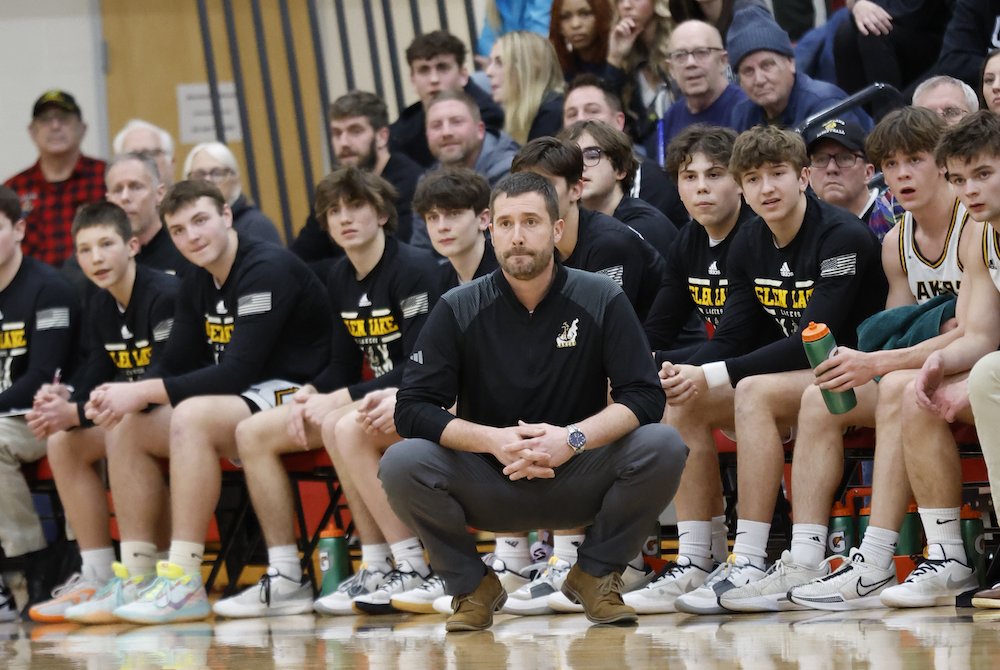
After leading Maple City Glen Lake to the Division 4 girls basketball championship last year, Bradford stepped down from coaching. At the time his teams had won five Regional and six District titles.
Now his teams have won six Regional and seven District championships. He took over Glen Lake’s boys program during the holiday break this winter as the Lakers were off to a 4-2 start. They finished the season 22-5.
It was the Lakers boys’ first 20-win campaign since the 2018-19 season, and they clinched their first Regional title since 2018.
Glen Lake went 19-5 last year losing to Traverse City St. Francis in the District Final. The season before that ended with a first-round loss to Elk Rapids and 15-6 record.
Bradford led his girls teams four times to the MHSAA Semifinals and almost got their a fifth time this year with the boys. Their run ended Tuesday with a tough loss in the Division 4 Quarterfinals to Mount Pleasant Sacred Heart, 63-51.
“We’re licking the wounds of that one,” he said. “We’ve got to remember to look at the big picture – they are young men becoming men.”
 But Bradford already has turned his thoughts to next season and is making plans for summer basketball.
“Having the summer with them if it goes the way we want is going to be huge,” Bradford said. “There are a few things going through my head I can change or adjust.
“We want to continue to build on what our philosophy of what Glen Lake is and my philosophy of what Glen Lake is.”
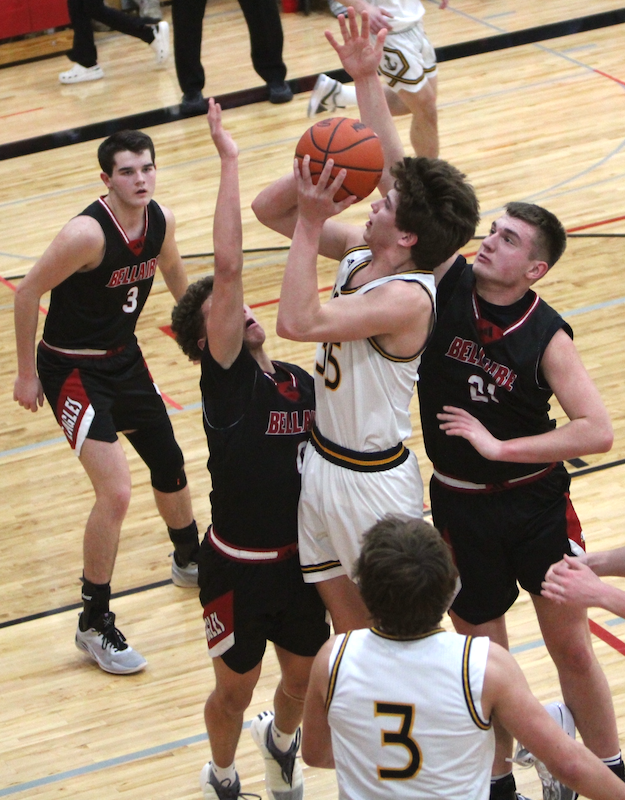
The Lakers will graduate Cooper Bufalini, Gage Baker, Dylan Cundiff, Tyler Bixby and Jamie Blondia. But they’ll have their top two scorers back, sophomore Jacob Plamondon and junior Benji Allen. Plamondon kicked in almost 20 points per game and led the team in rebounding with more than 10 per contest. Allen averaged more than 11 points per game and led the team in assists.
Glen Lake finished second in the Northwest Conference behind Benzie Central, which was undefeated in league play. The Lakers knocked off league opponents Frankfort in the Division 4 District title match and Buckley in the Regional Semifinal.
The battles with Benzie for the conference title may have been the highlights of the season, Bradford noted. Those were Glen Lake’s only losses in league play, and a share of the title was within their grasp late in the second game with the Huskies.
The Lakers lost 60-51 on their home court in the first meeting but took Benzie to the limit in the rematch before falling, 41-39, on the road.
“We had a lot of great games and a lot of great memories,” Bradford said. “Going for conference it pretty much came down to the last few seconds with lead changes.
“We were up by one point with less than 30 second lefts, and that was the high point,” he continued. “We came up short, but we learned from that game.”
Also among highlights for Bradford this year was the chance to coach against his brother Nathan for the first time in their careers.
 The Bradfords started coaching girls varsity basketball 16 years ago, but their teams were in different conferences at the time. Nathan coached the Onekama girls but moved to the boys program before Onekama and Glen Lake had a chance to compete against each other in the Northwest Conference.
The Bradford coaches often talk after their games and learn from one another. They have also seen their parents frequently in the bleachers as they rotate home game sites to see their grandchildren play and their sons coach.
When Onekama and Glen Lake played this year, eight Bradfords were on the rosters as players or coaches. Jason’s son Toby, a freshman, played on the Glen Lake junior varsity team, as Nathan’s son Carson played for the Portagers’ JV squad. The Onekama JV team is coached by another Bradford, Jason and Nathan’s brother Nick. And there were three more Bradfords on the varsity – Nathan’s son Caden and his cousins Luke and Arden.
Glen Lake won both varsity games, 38-36 at Onekama and 61-33 at home.
Jason and his wife Jackie have five children. Their youngest son, Drew, is now a sixth grader at Glen Lake. His oldest son, J.J., is at Michigan Tech and has begun officiating basketball after his senior season at Glen Lake cut short by the pandemic while the Lakers were preparing to play in a 2020 District Final. Daughters Maddie and Grace are playing basketball for Lake Superior State University.
Maddie and Grace were big parts of Glen Lake’s deep postseason runs with Jason as girls coach. With many games played on Saturdays and not conflicting with coaching, Jason, Jackie and the younger boys were able to travel to see the Upper Peninsula’s Lakers play regularly.
This season, the Glen Lake girls – under first-year head coach Brad Fosmore – went 16-8 and won Northwest Conference and District titles before losing a nail-biter, 45-42, to league rival Frankfort in the Regional Semifinal.
“Jason did a good job, and it felt good to carry on the tradition,” said Fosmore, who previously served as a Lakers JV coach. “We took it one game at a time.
“Jason worked hard to build a great girls program,” he continued. “It made it pretty simple because they had that winning tradition and kind of kept it rolling.”
Tom Spencer is a longtime MHSAA-registered basketball and soccer official, and former softball and baseball official, and he also has coached in the northern Lower Peninsula area. He previously has written for the Saginaw News, Bay County Sports Page and Midland Daily News. He can be reached at [email protected] with story ideas for Manistee, Wexford, Missaukee, Roscommon, Ogemaw, Iosco, Alcona, Oscoda, Crawford, Kalkaska, Grand Traverse, Benzie, Leelanau, Antrim, Otsego, Montmorency, Alpena, Presque Isle, Cheboygan, Charlevoix and Emmet counties.
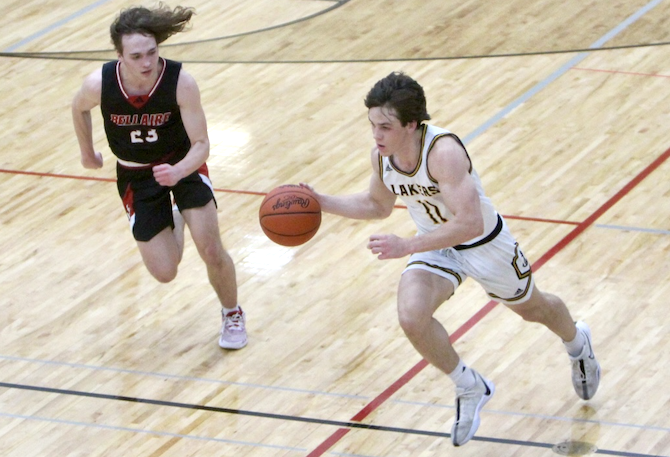
PHOTOS (Top) Jason Bradford, kneeling, coaches the Maple City Glen Lake boys varsity after taking over the program earlier this season. (Middle) Glen Lake’s Cooper Bufalini (11) pushes the ball upcourt during a 65-49 District Final win over Bellaire. (Below) The Lakers’ Jacob Plamondon (35) makes a strong move to the basket. (Top photo by RD Sports Photo/Rob DeForge, additional photos by Nicole Bixby.)