

Tri-Captains Pace Striving Spring Lake
February 8, 2018
By Tom Kendra
Special for Second Half
Things are looking up for the Spring Lake boys basketball team.
 The Lakers have raised the bar in recent years, making their mark on the statewide level with two appearances in the MHSAA Class B Quarterfinals over the last three seasons.
This winter, led by a trio of tall, versatile and extremely intelligent captains in Sam Johnson (6-foot-8), Griffin Lorimer (6-4) and Jack VanWingen (6-2), Spring Lake has stepped up its schedule and its game in its quest to get back to the quarters – and perhaps further.
“When it gets to tournament time, it comes down to playing your best basketball of the year and making a run,” said Johnson, who scored a game-high 16 points on Wednesday as Spring Lake doubled up host Sparta, 50-25, for an Ottawa-Kent Conference Blue win.
“A big key in March is experience and leadership, and we definitely have plenty of that.”
Spring Lake (12-3, 6-2 in the O-K Blue), which hosts Allendale on Friday night in another conference game, showed it was going to be a force to be reckoned with early this year when it posted back-to-back tight wins over a pair of bigger schools in Rockford (48-46) and rival Grand Haven (69-66 in double overtime).
Bill Core, in his 17th year as Spring Lake’s head coach, said that in addition to good height on the front line, this may also be the smartest team he’s ever coached. Core said that intelligence helps this team make adjustments on the fly and smart decisions when the game is on the line.
 “Those three captains are all 4.0 kids, and they’re great role models,” said Core, who is assisted by Randy White. “They have high basketball IQs, and I trust them to make decisions and figure things out.”
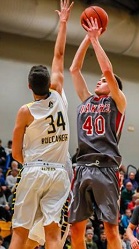
Johnson is the player who draws the most attention from opposing teams at 6-8, with the ability to post up and step out and knock down mid-range jump shots.
Johnson, who plans to play basketball next year at Claremont McKenna College in California, leads the Lakers with 12 points and 7.5 rebounds per game. And don’t try to hack him and send him to the free-throw line. Johnson is shooting a team-best 80 percent on free throws.
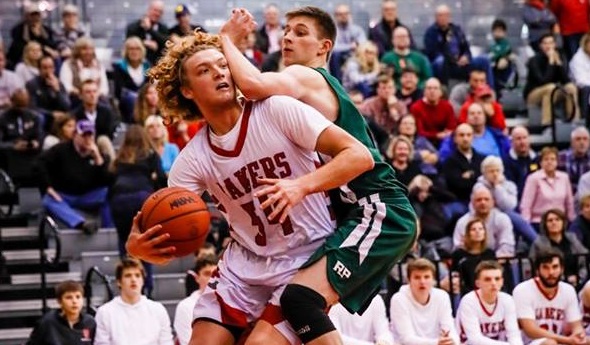
The most versatile of the three captains is Lorimer, who is hard to miss with his curly blonde hair and red shoes. He creates matchup problems with his inside-outside game, and currently averages 10 points and seven rebounds per contest.
Johnson and Lorimer are a 1-2 punch up front that most teams can’t match.
“We know one of the strengths of this team is that we’re deep in the post, and that makes it hard for teams to just focus on one guy,” explained Lorimer. “It’s good to have that balance. Plus, we’ve played together so long that we just know where the other guys are going to be.”
Lorimer’s versatility was perhaps best displayed last year at team camp in Rockford, where he was assigned to guard one of the state’s best big men in 6-9 Xavier Tillman (now at Michigan State) one day, then came back the next day and had to check standout guard Matt Beachler (now at Central Michigan).
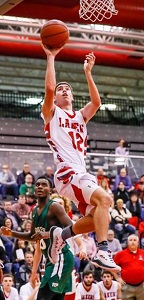
But the most important of Spring Lake’s three captains might be VanWingen, a slasher who is the team’s best at breaking down defenses. VanWingen is adept at finding Johnson and Lorimer inside as well as kicking the ball back out to the arc to shooters Ben Arteaga, Kyle Wiersma and sophomore Cayden Ball.
“I think we’re a very well-balanced team,” said VanWingen, the top returning scorer off last year’s who is currently averaging 11.2 points, five rebounds and three assists per game. “Our big guys get a lot of attention, but we also have guards who can shoot it. It’s important that we trust each other and know that everyone is going to do their job.”
 Spring Lake’s senior trio has been too much for almost everybody to handle, with the main exception being conference rival and possible Regional opponent Grand Rapids Catholic Central, which is ranked No. 6 in Class B.
The two teams met on Jan. 5 at Spring Lake in a much-anticipated showdown, but the Cougars swarmed the hosts in a lopsided 80-39 victory. The Lakers were much more competitive when the two teams played last week in Grand Rapids, but still lost, 59-40.
“We improved by 22 points the second game, and if we improve by another 22 points in the next game, we’ll win by three,” quipped Core, who knows his team will be a huge underdog if it’s fortunate enough to win the District it is hosting next month and possibly get another shot at GRCC in the Class B Regional opener at Grand Rapids West Catholic.
The Lakers can gain confidence by looking back to last year, when they lost to GR Catholic twice during the regular season, then stunned the Cougars in the Regional championship game. That win put Spring Lake in the Quarterfinals for the second time in three years, after it made a surprise run to the school’s first-ever boys basketball Quarterfinals appearance in 2015.
Lorimer believes this year’s team has the potential to make it three Quarterfinal appearances in four years.
“I really do think we have another level we haven’t reached yet,” said Lorimer, who plans to play next year at Trine University in Angola, Ind. “We may have for short stretches, but we haven’t strung it together for a whole game. That’s what we’re working on.”
 Tom Kendra worked 23 years at The Muskegon Chronicle, including five as assistant sports editor and the final six as sports editor through 2011. E-mail him at [email protected] with story ideas for Muskegon, Oceana, Mason, Lake, Oceola, Mecosta and Newaygo counties.
PHOTOS: (Top) Spring Lake senior Griffin Lorimer battles along the baseline in a victory earlier this season against Muskegon Reeths-Puffer. (Middle) Spring Lake senior Jack VanWingen glides in for a bucket in a victory over Muskegon Reeths-Puffer. (Below) Spring Lake senior Sam Johnson goes up for a shot during the Lakers' thrilling double-overtime win over neighboring rival Grand Haven earlier this season. (Photos by Tim Reilly.)
'The Watcher' Becomes Must-See Star
By
Tom Markowski
Special for Second Half
February 1, 2018
DETROIT – David DeJulius is not your typical teenager.
 DeJulius doesn’t eat junk food, he doesn’t drink carbonated soda and he attends yoga classes regularly.
He’s also one of the best basketball players in the state.
A 6-foot guard at Detroit East English, DeJulius, who has signed with University of Michigan, was rated as one of the top players before this season – and it’s safe to say that few players, in any class, are having a better season at this point. He’s averaging 28 points, 7.5 rebounds and 7.5 assists per game, and his team is ranked in the top 10 in Class A by every news organization that releases weekly rankings.
The candidates for the coveted Mr. Basketball Award won’t be announced for about a month. But it’s difficult to imagine DeJulius’ name won’t be on that short list.
DeJulius, 18, might not be the best basketball player in what is a strong senior class, and he might not win Mr. Basketball. But it won’t be because he didn’t work hard enough or have the proper guidance from those close to him.
As for his nutrition intake, DeJulius credits his father, Dave, for the basics. The elder DeJulius also played basketball in the Detroit Public School League at two eastside high schools (Denby and Osborn).
“He told me to put the right food in my body,” DeJulius said. “I eat healthy. I haven’t drank pop in three years. It’s beyond basketball. I want to create a healthy lifestyle. I want to check every box.”
In addition to the workouts he receives from East English coach Juan Rickman, DeJulius works with three personal trainers to hone his body and improve his knowledge of the game. One of those trainers is former Detroit Pershing coach A.W. Canada. Another is one of Canada’s former assistants, James Cleage, and the third is Tony Harrison, who specializes in boxing and footwork beneficial in athletics.
During the season DeJulius watches game film with Canada, and the two go over nuances to improve DeJulius’ knowledge of the game. Cleage attends the majority of East English’s games, and the two talk afterward about what DeJulius did right and how his play could be improved.
“During the season it’s more to do with strategy,” DeJulius said of the time spent with personal trainers. “During the offseason it’s more physical.
“I do cross training with my boxing workouts. It helps me a lot. Conditioning-wise, you have to give it your all. With Tony, it’s more core work. I only spend about 15 minutes in the ring.”
 On Sundays during the season, when many basketball players take the day off, DeJulius attends a yoga class. During the offseason he practices yoga three to four times a week.
“It stretches me out,” he said. “It keeps me limber. And it’s good for my hips.”
DeJulius spent the first two years of high school at Detroit Edison Public School Academy, a charter school located in the city’s Eastern Market area. He was a highly-publicized player when he enrolled at Edison, and his team reached a Class C Regional Final his freshman season and lost in a District Semifinal to Pershing when he was a sophomore. DeJulius was labeled a scorer who had yet to reach his potential when he transferred to East English.
“I knew of him vaguely before he got here,” Rickman said. “I remember him having a high skill set and a good work ethic, or so I heard. But when he came here I wanted him to put it all together. I wanted him to learn how to play a complete game. I wanted him to pass more. I don’t think he understood or knew how to get his teammates involved. He didn’t understand where the defense was at.
“He’s improved on his defense, and that becoming a better defender has improved his offense as well, because he’s now able to predict the positioning of the defenders which allows him to be more efficient and also allows him to make more plays for his teammates.”
Physically, DeJulius was developing. And with the help of Canada, Rickman and others, DeJulius was also gaining a better understanding of the game and what it took for him to become more of a complete player.
“The biggest change for me was here, at East English, its family oriented,” he said. “I’m getting tremendous support on and off the court.”
DeJulius also rid himself of an unflattering nickname given to him when he first came to East English.
“They called me ‘the watcher’ when I first got here,” he said. “As far as rebounding and playing off-the-ball defense, I used to watch a lot. (Rickman) told me I’m too strong, too fast not to rebound.
“Now, as a senior, I’m much better. I’m a senior. I have to get it done now. Physically, I’ve improved my jump shot and I rebound better. My passing has improved. I see the floor much better now, and I’m able to create for my teammates.”
Two current players have had a significant impact on DeJulius and his maturation process. One is his former East English teammate Greg Elliott, who plays for coach Steve Wojciechowski at Marquette University. The other is former U-M point guard Derrick Walton, Jr., who played at Harper Woods Chandler Park Academy, located just a few miles from East English.
As a junior at East English, Elliott helped the Bulldogs capture the school’s first PSL title.
“I learned a lot from Greg,” DeJulius said. “It’s the intangibles. At Marquette, he’s not their first option (offensively) but he’s their best defender. Derrick and I talked about a week ago. I can be that type of player at Michigan. He passes the ball better than I do. I shoot it better. I think I can affect Michigan much the same way he did.”
Should DeJulius win Mr. Basketball, he would be the first player from the PSL to win the award since Pershing’s Keith Appling in 2010.
Riding an 11-game winning streak, East English is 12-2 overall and, at 7-1, has clinched first place in the PSL East Division 1. The Bulldogs will have one of the top two seeds when the PSL playoffs begin next week.
“I believe my chances are very good,” DeJulius said of the possibility of winning the award. “First of all, we’re winning. There’s the stat line I’m putting up against some of the best competition.
“It would mean a lot to me. It would mean a lot to me and the school.”
 Tom Markowski is a columnist and directs website coverage for the State Champs! Sports Network. He previously covered primarily high school sports for the The Detroit News from 1984-2014, focusing on the Detroit area and contributing to statewide coverage of football and basketball. Contact him at [email protected] with story ideas for Oakland, Macomb and Wayne counties.
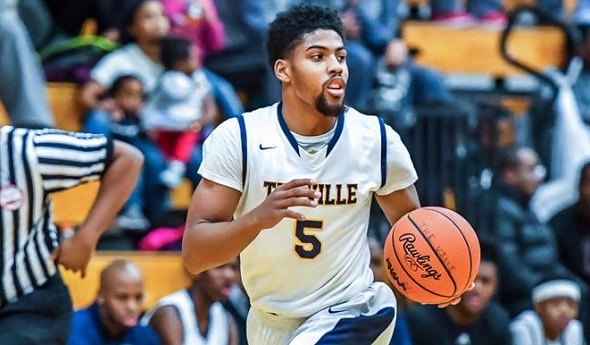
PHOTO: Detroit East English’s David DeJulius pushes the ball upcourt this season. (Photo by David Donoher.)