

Martin Makes Home in Goal for Monroe St. Mary's Boys Lacrosse, Ice Hockey Teams
By
Doug Donnelly
Special for MHSAA.com
April 29, 2025
Lacrosse isn’t the best sport to choose if you don’t like coming home with bruises every once in a while.
 For Chloe Martin, the bruises are just part of the deal.
“I love it,” Martin said of lacrosse. “It’s a fast game and a challenge. I love that.”
Martin is a senior on the Monroe St. Mary Catholic Central boys lacrosse team. SMCC doesn’t offer girls lacrosse, so she plays on the boys team. That’s nothing new to her, either. She was also a member, representing SMCC, of the Downriver Unified cooperative boys ice hockey team this past winter.
“I didn’t expect to enjoy (lacrosse) as much as I did, but once I started playing and started playing with the boys, I fell in love with the sport,” Martin said.
Martin picked up ice hockey at the age of 8 while a student at Triumph Academy, a K-8 school near Monroe. She was hooked, but under one condition – she wanted to be in the net.
“When I was younger, I played forward and defense, but I didn’t really enjoy it,” she recalled. “When someone on the team said they needed a goalie, I raised my hand right away. It’s a lot of fun. I don’t think I would be playing if I wasn’t playing goalie.
“I like getting shots coming at me. It’s fun.”
Martin, from Monroe, joined the SMCC lacrosse team as a high school freshman. She played ice hockey as a sophomore and again as a senior. “I played travel hockey my junior year and, to be honest, I kind of regret it,” she said.
As a sophomore, she was able to be teammates with her brother, Walker.
 “He was one of my biggest inspirations playing hockey,” she said. “We had a strong connection, and I wanted to play with him and his friends. That was one of my favorite teams to ever play on.”
Her brother also got her started in lacrosse.
“The reason I joined lacrosse was because of my older brother,” Chloe said. “Our coach saw that I was a goalie for hockey and wanted me to be a goalie for lacrosse. I agreed and played lacrosse.”
Lacrosse – for both boys and girls – is played in the spring in Michigan. The sport involves a ton of running and highly-skilled passing and catching. It also takes teamwork.
Martin prefers the boys game over the girls game. She’s tried both.
“I love playing against the boys. I tried playing girls lacrosse, and it wasn’t my thing,” she said. “For girls, there are different rules and I don’t really like it. I’m trying to get into it because I want to play either college hockey or lacrosse.”
She’s not sure which sport she likes better: “It’s not that big of a difference. There is more padding for hockey and less for lacrosse. You have a crease, and you are moving in the same type of direction. Lacrosse is less wear-and-tear on my hips. I have bad hips.”
While lacrosse has a bigger field, Martin said there is more action.
“Lacrosse is quicker than hockey,” she said. “You can have the ball in the other zone but three seconds later they can be down shooting on me.”
This season has been a strong one for Martin in net.
Earlier this month she helped the Falcons to a one-point win over Jackson at Albion College, recorded her first varsity shutout April 16 against Brownstown Woodhaven and made a school-record 19 saves on April 4 against Ypsilanti Lincoln. That save total was high enough to make the MHSAA record book.
“Nineteen is kind of a lot of shots,” Martin said. “I’ve faced more than that in hockey. I’d say facing 19 shots in lacrosse is kind of like facing 50 shots in hockey.”
SMCC athletic director Jared Janssen said Martin has been a key factor in the team’s success and that she’s an inspiration to others.
 “Chloe stands out as an excellent player with the boys and performs at a high level in both hockey and lacrosse,” he said. “She has been a leader for hockey and lacrosse, and that has led to more girls participation in both programs. Our girls lacrosse program has grown from only one girl to four this year.”
Goalie remains her favorite position.
“It’s a lot harder to be goalie than you think. You don’t expect the ball coming at you as hard and as quick as they are. You kind of get used to it. You don’t get used to getting hit, but you get used to seeing the ball and where the players are shooting from.”
The 17-year-old daughter of Alison and Nathan Martin loves mountain biking, fishing and baking. She has her sights on playing a sport in college and becoming a nurse. That stems from the time her dad got COVID and pneumonia at the same time.
“He was in the ICU for three months,” Martin said. “When that happened, I just decided I wanted to be a nurse and help people. That’s what I love doing.”
As for the bruises, Martin is getting used to them. She wears a chest plate, elbow pads, glove and mask. There are no shoulder pads in lacrosse and little other protection, especially for the legs.
After a recent game, she had a bruise the size of softball on her leg.
“It’s rough. I get a lot of bruises, but I love it,” she said. “It’s mostly on my legs. It hurts a lot, but after a few seconds it goes away. There are so many bruises I get in lacrosse. I’ve never gotten this bruised from hockey.”
 Doug Donnelly has served as a news and sports reporter at the Adrian Daily Telegram and the Monroe News for 30 years, including 10 years as city editor in Monroe. He's written a book on high school basketball in Monroe County and compiles record books for various schools in southeast Michigan. He is now publisher and editor of The Blissfield Advance, a weekly newspaper. E-mail him at [email protected] with story ideas for Jackson, Washtenaw, Hillsdale, Lenawee and Monroe counties.
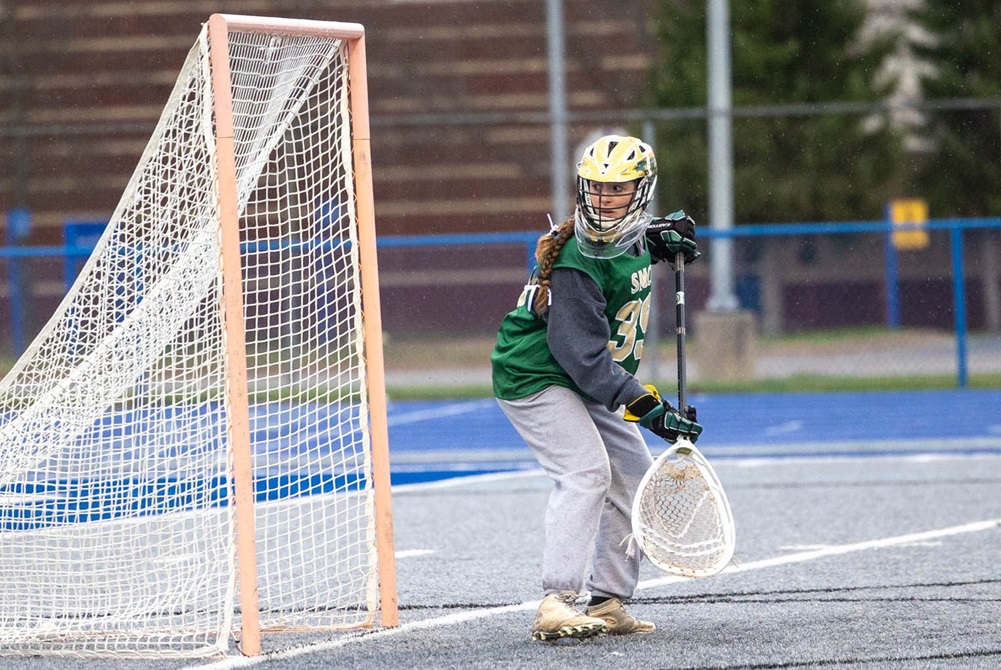
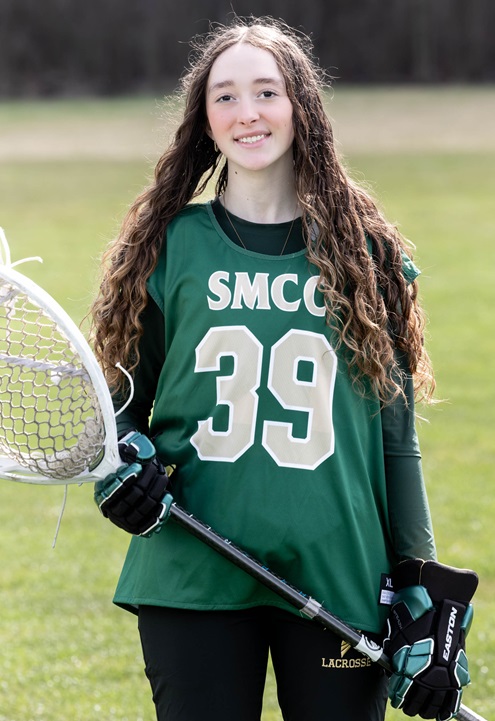
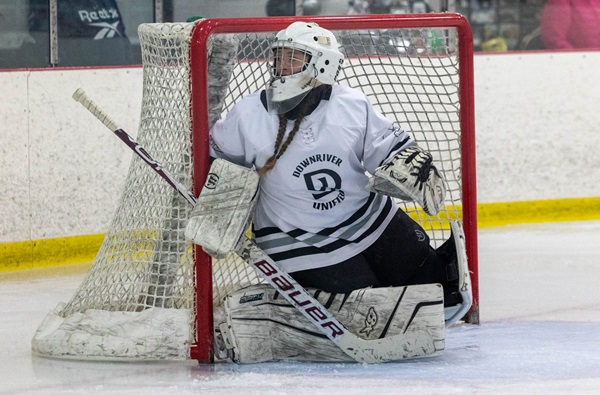
PHOTOS (Top) Monroe St. Mary Catholic Central’s Chloe Martin defends her team’s goal during a lacrosse game. (Middle) Martin, without a protective mask, which she wears for two sports. (Below) Martin monitors the puck while in net for Downriver Unified. (Action photos by Stephanie Hawkins; posed photo provided by Monroe St. Mary Catholic Central.)

Moment: OT Win Nets GP South's 1st Title
April 2, 2020
By Geoff Kimmerly
Second Half editor
Grosse Pointe South and Muskegon Mona Shores traded leads for three periods March 10, 2007, before taking the Division 2 championship game to overtime.
The following 6 minutes and 46 seconds belonged to the Blue Devils, who fired all seven shots on goal taken in extra time and clinched their first MHSAA Finals championship in ice hockey when Tim Shield rushed the net and wristed home the game-winner.
“It was unbelievable,” Shield told the Detroit Free Press after the 4-3 victory. “Unreal.
“Chance after chance, it wouldn’t go in. By that time, we knew it was coming.”
See below for coverage of the game-winner from the NFHS Network.