

Capac Standout Delivers 3-Letter Fall
November 14, 2013
By Geoff Kimmerly
Second Half editor
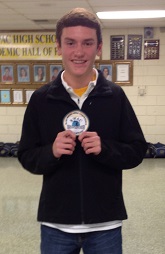
The Blue Water Area Conference, on the eastern side of the Thumb, created this fall a patch it will award to athletes who letter in three sports during a school year.
Winning a high school letter always has been a notable accomplishment. Earning two is a sign of a well-rounded athlete. And in these days of single-sport specialization, we celebrate those who continue to play three at the varsity level.
Then there’s the rare – if not unique – case of Capac junior Nick Geliske.
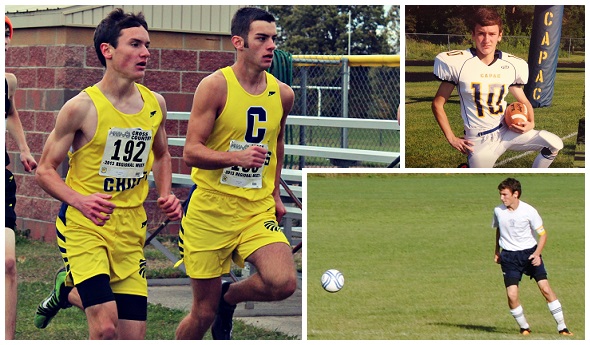
Earlier this week, he became the first to win the newly-minted BWAC award – after just one season. He finished his fall as an all-league midfielder for the soccer team, an all-league honorable mention cross country runner and the fulltime kicker for the football squad.
“I wasn’t sure how it would work out when I decided to go into it. I wanted to do all of them, but a year ago I wouldn’t have seen myself doing this,” Geliske said. “I was just hoping to help my teams this year.
"I’ve got bigger expectations for myself next year.”
Three-sport letterwinners are not a rarity in Geliske’s hometown. Despite an enrollment of 100 fewer students than all but one of the other schools in its eight-team conference, Capac has the most who play a sport every season. The Chiefs had 41 three-sport athletes during 2012-13, athletic director Arnie VandeMark said, and 33 athletes who earned letters in three sports played as part of the BWAC – 24 more three-sport athletes than the league school with the next-highest total.
Playing two sports during the same season, while uncommon, also occurs from time to time when an athlete can handle the added load and coaches can work out a flexible schedule. But VandeMark never had seen an athlete do what Geliske accomplished this fall – not to mention the success he had in the process. Geliske just kept finding ways to compete – and contribute to Chiefs teams alongside his friends.
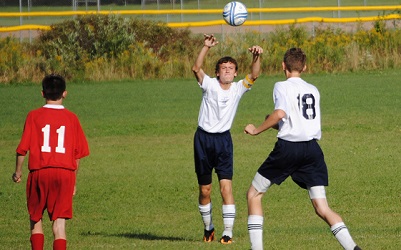
He has been a starter on the soccer team for three seasons and captain these last two, and that’s his primary sport. A midfielder, he led the team with five assists this fall to go with three goals as Capac – in its eighth season as a program – set a wins record in finishing 11-8.
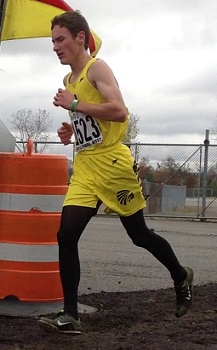
 Geliske decided to double in cross country this season at the urging of a few friends on that team. Great move on their part, as Geliske ended up the team’s regular second- fastest finisher. He took sixth at his Regional (in 17:52) and was part of the lineup that made the Lower Peninsula Division 3 Final at Michigan International Speedway.
But before practice for either of those sports began, Geliske had another request from his best friend on the football team. Capac needed a kicker. Geliske loves football but never had played at the high school level and never had kicked. No matter – two hours before the first practice he decided to give it a try, showed up and won the job.
“Nick was a huge part of our team qualifying for team states. He set an example for others to follow being a very busy athlete in soccer and football,” Capac boys cross country coach Tim Gross said. “He would show up for practice and set the standard for everyone else to follow. He was not only a great athlete, but a very organized person.”
On schedule
Geliske also holds a 3.85 grade-point average – after earning a 4.0 during the first quarter of this school year – and is involved with Capac’s student council and chapters of the National Honors Society and Business Professionals of America.
Pulling off the above plus participating on three athletic teams takes heavy doses organization and discipline both. Thankfully, the sports schedules just happened to fall into place.
 First-year soccer coach Jerry Parisot needed to hold his practices at 6 p.m., leaving the afternoon for Geliske’s other pursuits. Geliske ran with the cross country team from 3-4 p.m. and kicked with the football team until 5 before catching a quick meal and heading to the soccer field.
On cross country meet days, Geliske would run and usually make it back in time for soccer practice. On soccer game days, he’d kick with the football team right after school before switching uniforms.
The biggest challenge came on Friday, Oct 25, when Geliske ran in the cross country team’s Regional at Algonac – an hour trip south of Capac – then had to drive nearly two hours back north for a football game at Sandusky. He made it two minutes before kickoff.
But amid jumping through those hoops, Geliske continued to make academics a priority with study time from 8-10 p.m. most weeknights.
“Usually, for football I’d just talk to my coach and could schedule around because I’m the kicker, and I have awesome coaches. For soccer, my dad is the assistant coach so that worked out pretty well, and the varsity coach coached me at younger levels. And for cross country, he was an awesome guy too. They knew I’d be busy all the time,” Geliske said.
“My mom wasn’t so sure about (three sports), but she said as long as I keep my grades up I can play all of those sports. I gave myself studying time; I didn't want to let my teams or myself down.”
Before the season began, Geliske brought Gross a schedule detailing where he’d be every day over the next three months. Gross credits Geliske's parents for his runner's discipline, and Nick also credits Mom and Dad with instilling that trait – and a lot more.
Cracking the code
Geliske was so competitive as a kid, sometimes he’d get a little out of control and his parents would have to calm him down. That intensity hasn't faded much – “Even during pick-up games and stuff, people get mad that I’m so competitive,” he said. “I don’t like losing ... (but) I have to tone it down a little bit.”
“He's 200 percent competitive,” Parisot said. “It’s not really about winning or losing. It's more about trying as hard as you can.”
 That streak was ingrained by his father Barry Geliske, who along with coaching soccer and serving on the school board works on the chain gang for home football games and is “the most competitive and passionate guy about sports,” Nick said.
His athletic side? Geliske believes that comes from his mom Sandra. And then, matter-of-factly, he reveals a family line that backs his theory pretty well.
Among second cousins is former Marquette University basketball standout Travis Diener, who beginning in 2005 played for three NBA teams and now plays professionally in Italy. Sandra Geliske’s maiden name is Thome – as in Jim Thome, another cousin, and a likely future Hall of Famer who hit 612 home runs during a Major League Baseball career stretching two decades.
There’s another cousin, former NFL tight end Dave Casper, who made five Pro Bowls for the Oakland Raiders during the late 1970s. A great uncle named Ronald Jackson played seven seasons of pro baseball with the Chicago White Sox and Boston Red Sox from 1954-60.
Geliske will begin basketball practice Monday and plans to play baseball and run track this spring before coming back for all six sports as a senior. VandeMark has had an athlete finish high school with 13 letters – but Geliske hopes to graduate with 15.
That leads to another significant question – how will Geliske display them?
Like at most schools, some Capac athletes wear traditional letter jackets. They receive an actual letter for their first, then a series of pins and medals for each additional year on a varsity team.
Geliske’s mom wants instead to frame the awards. If that’s the decision, Geliske is looking for something sizable – and he’s got to fit that BWAC patch now as well.
It's been a fall full of other accolades too. He made the all-league soccer team and earned an all-league cross country award, and was part of an academic all-state team in the latter as well. But he’s got much higher expectations for fall 2014 since he’ll be settled into his balancing act. And no way does that include picking a favorite.
“I can’t imagine it for myself. I’ve been playing these sports my whole life,” Geliske said. “Sometimes someone might be really good in that (one) sport and stay with it, but I say doing more sports is better. It keeps you active. I just love competing, and that’s the big thing about it.”
PHOTOS: (Top) Capac’s Nick Geliske lettered as part of the school’s cross country, boys soccer and football teams this fall. (Middle) Geliske throws a ball in during a soccer game and turns a corner during a race this season. (Below) Geliske poses with his Blue Water Area Conference three-letter patch after becoming the first to earn the award. (Photos courtesy of Capac athletic department and Geliske family.)
Rockford's Lewis Aims to Finish On Top
October 16, 2012
By Geoff Kimmerly
Second Half editor
Dewey Lewis received two rare opportunities as a freshman at Rockford High School that helped set him up for a long and successful high school soccer career.
He was promoted to the varsity soccer team – something that usually doesn’t happen at a school as big as Rockford, or in a program as successful.
And he got the opportunity to play with his brother Sean, a senior at the time who now plays goalkeeper at Western Michigan University.
But Dewey had plenty of learning to do before setting himself apart as possibly the state’s top high school player this fall with the Rams heading into their Division 1 District opener tonight at Okemos.
“When I was a freshman, I didn’t want to put in the extra work. I was willing to do the minimum I needed to do to get by,” Lewis said. “But the past couple years I’ve become more mature. My effort has gotten better, and that’s allowed me to make the team better.
“You can be extremely skilled and everything, but if you don’t put in the effort, there’s not a good chance you’re going to succeed. A big part of that is having both the skill and effort, but you’ve got to be willing to put the team before yourself.”
And frequently, Lewis has put Rockford’s team on his shoulders as well.
The senior forward, a Second Half High 5 honoree, entered this week’s postseason play with 52 goals and 46 assists for his career. Last season he broke the team’s single-season scoring record with 20 goals and made the Division 1 all-state third team. Although the career assists just make the bottom of the MHSAA record book list, his body of work from a statistical standpoint doesn’t necessarily jump out compared to some of the ridiculous numbers put up by others over the years.
But context is important. Few players above him on those lists played four years for an MHSAA power, surrounded by similarly-skilled teammates and against competition to match.
 This season, bouncing all over the front line and midfield in order to avoid increased defensive attention, Lewis has 17 goals and 12 assists, and Rockford was ranked No. 2 in Division 1 heading into Monday’s games.
“This year his performance has been more dynamic because there’s been so much added pressure. Teams are trying to take him out of the game, but he has nearly the same stats,” Rockford coach Steve Thomas said.
“But that’s what’s great about Dew. He’s a pass-first guy. He’s so willing to give the ball up, to put the ball into a more dangerous situation. I would categorize him as one of the most unselfish kids I've been around.”
The two butted heads at times early in Lewis’ career. Partly, it was because of some of that immaturity that Lewis admits. He also came to the Rams playing at a high club level, but had to adjust to the more physical style of the high school game.
His first two seasons, Lewis was “just fitting in” to those teams, Thomas said. He’d talk with Lewis after practices and express his expectations for his young but talented forward. Sean also kept tabs on his brother, refusing to let him slack off.
At the end of his sophomore season, everything started to click. That next summer, Dewey played a significant role on a Grand Rapids Crew club team that won a U-17 national championship. Last fall, Lewis became the first junior Thomas knows of at Rockford to be named a captain.
He was selected for the same this fall, but not after making a major decision. For the first time, Michigan high school players were forced to pick between high school soccer and playing for U.S. Soccer Development Academy teams that also play during the fall. Lewis was among the elite with the option to do both.
Many from his grade, especially from the Detroit area, chose academy teams. But Lewis – who has committed to play at Michigan State University next fall – decided to stick with the Rams.
Part of his reasoning came down to the high school atmosphere – Rockford played East Kentwood in front of 2,000 fans last season. Part was influenced by the opportunity to play with his hometown friends one more time. And the biggest part likely came down to style of play – he considered the higher-skilled competition he’d see at the academy level, but thought he might benefit more from the harder work and effort he’d have to put in to succeed at the high school game.
And getting one last chance to succeed at this level is the biggest reason he’s back in orange and black this fall. Hailing from any other region of the state, Rockford could have made deep runs in the MHSAA tournaments his first three seasons. But the Rams fell to East Kentwood during the District tournament to end each one, and East Kentwood went on to win the Division 1 championship in 2010.
The Falcons are the only team ranked ahead of Rockford this week, and would be the District Semifinal opponent Thursday if the Rams can get past No. 7 Okemos tonight.
“I think I learned a lot from this season, and going forward it made me a better player in different areas that I wasn’t improving on before,” Lewis said. “There was a lot of pressure to be one of the stars on a high school team, and it helped me learn about dealing with the pressure.
“I don’t like leaving things half done. It was nice to come back and be able to finish things off."
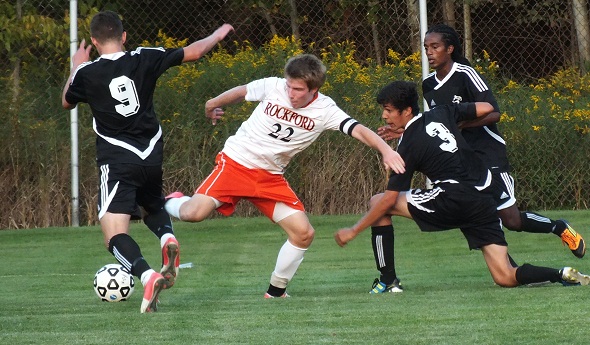
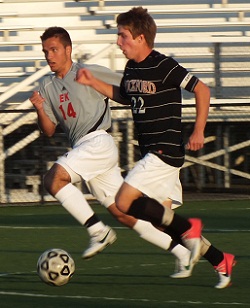
PHOTOS: (Top) Rockford's Dewey Lewis works between two defenders during a game earlier this season. (Middle) Lewis works to pass an East Kentwood player. Rockford could play East Kentwood in a District Semifinal on Wednesday.