

Lapeer Seniors Relish Long Walk Together
By
Paul Costanzo
Special for MHSAA.com
October 10, 2017
Senior Night is an emotional time for any team as it symbolizes the end of a four-year run, even if it doesn’t technically mark the finish of a season.
 For the Lapeer boys soccer team, however, it signaled the end was coming to a run that’s lasted much longer than four years for many of the players.
The core of the team and their coach, Deb Johnson, first joined forces as a recreation team in the Under-10 division, and has been building a remarkable chemistry for the past eight years.
“It didn’t really hit me until our senior night, then I was like, ‘Wow,’” senior midfielder Brian Morris, who joined the group as an 11-year old, said. “I’ve been walking out with them for seven years, and it was going to be my last time walking out with them.”
Fortunately for Morris and his teammates, the end isn’t here quite yet, and they feel it may be a while before it actually comes. The Lightning are 8-4-3 on the season and 8-2-1 in the Saginaw Valley League, and they host their Division 1 District. A District championship would be the first for the school since Lapeer East and West merged to make one high school in the district starting in fall 2014.
The main reason for optimism in Lapeer? Chemistry.
“The benefit of playing together for so long is we know each other really well,” senior center back Gabe Curiel said. “We can predict each other’s movements, and we know each other’s strengths and weaknesses. We know basically everything about each other.”
That chemistry started with a recreation team called the Renegades, and continued at the travel level with the Tri-County Nationals. In total, eight of the nine seniors on the current Lapeer team played for Johnson on those teams at one point or another. The other, Pablo Esteve, is a foreign exchange student.
“I had them all the way up through 13 and 14 (years old),” said Johnson, who is in her second year as varsity coach at Lapeer. “Now they’re all back together again for their final year. For me, it’s super exciting and sad all at the same time. They were babies, now they’re all going to play college soccer.”
Not only have the players been competing together for a long period of time, but their positions have remained fairly consistent, as well.
“My coaching style has changed, but as far as their position on the field, it didn’t really change that much,” Johnson said. “They got to understand and respect each role. They could be interchangeable if I need that, but they have a good idea of what they’re good at. They trust everybody to do their job. There’s not one superman coming in to save the day. Even if they’re not communicating (verbally), they’re communicating in a way that only a team that has played together this long would understand.
“They don’t argue with one another. They don’t fight with one another. If someone makes a mistake, they really rally that player back up. It’s nice to watch them work together.”
The thought the team could be special at the high school level was one that everyone had, albeit at different times. For Morris, it was when the players all came back together in high school that it dawned on him. For Curiel, it happened even earlier.
 “When I was like 12 or 13, I saw the way we progressed and I saw us building and bonding,” he said. “I had hope and faith that in the future, that when we would come back together for high school, that we could be good.”
Johnson also saw it early on, and when she looks back on old game film, she sees it even more.
“Sometimes I go back through and I see some of the stuff they still do today that they did when they were little, but it’s just better now,” she said. “It’s still some of the foundational stuff I taught them when they were 8, 9, 10 years old, but they do it better now.”
While the seniors – Harry Hirth, Nelson Gaunt, Michael Mejia, Chad Buike, Ethan Fike and Jack Vangel, along with Morris and Curiel – have a history of playing with one another and make up the core of the Lapeer team, they have integrated well with the classes below them. Sophomore Alex MacNaughton has fit in so well that he became a captain in his second year.
But making the program about more than this senior class is what Johnson has preached.
“I have four freshmen on the team, and (the seniors have) all taken them under their wing and really helped them,” she said. “That’s something I’ve instilled in them, that it’s their job to take care of the youngsters. It’s their job to leave something behind.”
There’s no question, however, that the class of 2018 always will have a special place in her heart.
“They’re my babies,” she said. “Not only on the field; I was hands-on off the field. With their grades, I ask for progress reports all the time. I go to their other events, I go to their basketball games. I want them to know that I’m involved as much as I possibly can be.”
It’s not time to say goodbye just yet, and that’s something the Lightning hope to put off for as long as possible.
“I don’t want to think about that until after it’s over, until the last whistle is blown,” Curiel said. “We’re not saying goodbye to the team; we’re saying goodbye to our family, basically.”
 Paul Costanzo served as a sportswriter at The Port Huron Times Herald from 2006-15, including three years as lead sportswriter, and prior to that as sports editor at the Hillsdale Daily News from 2005-06. He can be reached at [email protected] with story ideas for Genesee, Lapeer, St. Clair, Sanilac, Huron, Tuscola, Saginaw, Bay, Arenac, Midland and Gladwin counties.
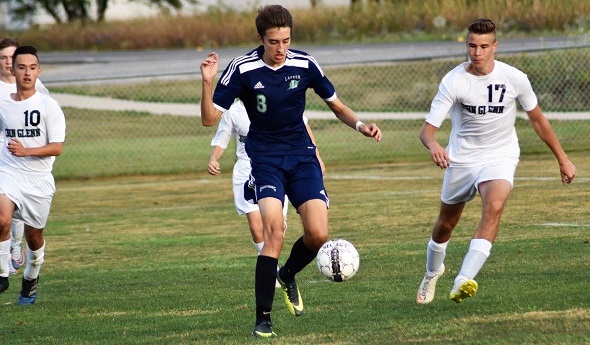
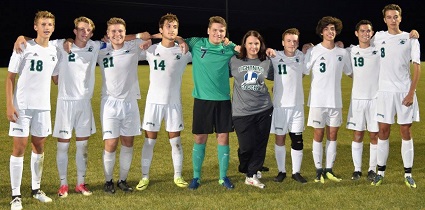
PHOTOS: (Top) Lapeer’s Nelson Gaunt (8) controls the ball against Bay City John Glenn during a 3-1 win Sept 27. (Middle) Lapeer’s seniors stand with coach Deb Johnson during Senior Night. (Photos courtesy of Lapeer’s boys soccer program.)
Cengic's First Goal Golden for Falcons
November 3, 2012
By Geoff Kimmerly
Second Half editor
TROY – Junior Emir Cengic had played defender all season. He wasn’t even sure why his coach made the snap decision to move him up front.
But that astute maneuver by East Kentwood coach John Conlon on Saturday helped set up Cengic for the most memorable moment of his high school career.
Cengic hadn’t scored this fall, and hadn’t really had an opportunity while lined up on the other side of the field. But 20 minutes into the MHSAA Lower Peninsula Division 1 Final, Cengic found himself in front of Grand Blanc’s goal receiving a 20-yard pass from teammate Josh Hagene, and then right-footing his own rebound into the net.
His first goal this season was the only goal East Kentwood needed to claim its fourth MHSAA championship. The Falcons outlasted the Bobcats over the final 65 minutes at Troy Athens to come away with a 1-0 win in the final soccer game this season.
“The ball just came. It was a lucky shot,” Cengic said. “I never imagined something like this. It’s unbelievable.
“This is probably the best thing that’s ever happened to me.”
East Kentwood most recently had won Division 1 in 2010, and this season’s title was its fourth in six seasons. The Falcons finished 22-1-4, giving them seven seasons in the last eight with at least 20 victories.
How they won this time bore some similarities to other recent title runs.
East Kentwood’s goal in the 2008 1-0 win over Livonia Stevenson also came from a primarily defensive player, Bung Jin Lee.
In 2010, then-sophomore Charlie Constantino played in the back as well, biding his time as many younger players in the program must before taking leading roles. He was the Falcons’ primary offensive player this fall, and Conlon expects Cengic to move up front fulltime as well next fall.
“I actually had him in class as a fifth grader, and the kid never gets rattled,” Conlon said. “I could put him anywhere on the field. I could probably put him in goal and he’d be fine. We just ask our guys to buy into their roles, and whatever their role is, to take advantage of it. And Emir had a great moment today.”
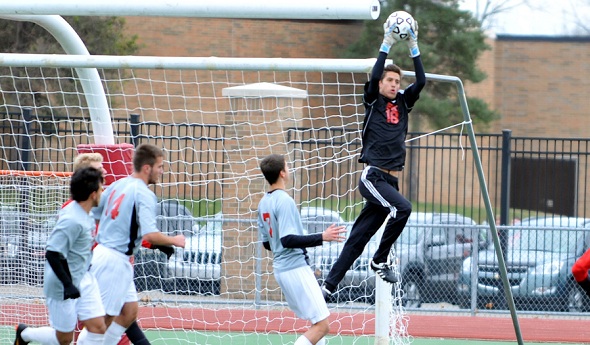 Only two minutes before, Grand Blanc had its best scoring opportunity. Junior midfielder Ali Mukhtar moved the ball ahead to junior forward Nick Berklich, who had a chance from point-blank range that was deflected by East Kentwood sophomore keeper Peyton Gonzalez.
Falcons back-up keeper Denis Duratovic also made a major impact. It was the senior’s suggestion that led to Conlon moving Cengic up on the far side as East Kentwood prepared to throw-in from the sideline side of the field.
The loss was another heart-breaker for a Grand Blanc team that total played in 13 one-goal games this season – but had won the last three and another by two goals in overtime over No. 4 Rochester Hills Stoney Creek in a Regional Semifinal. The Bobcats (16-7-2) could muster only six shots on goal this time, but freshman keeper Pearce Skinner had 11 saves and is one of nine players who should return in 2013.
This was Grand Blanc’s second championship game appearance, and first since 1987.
“I told the guys they’ll be disappointed (Saturday), maybe through the weekend. But when they reflect back on everything starting Aug. 9, the way we battled all year. I think they’ll be happy,” Grand Blanc coach Greg Kehler said. “To get to the Finals is a great accomplishment.
“The experience of this, you can’t replace it. And to have those kids get involved and be a part of this, I think is going to carry on to next year’s young kids. And obviously, that helps greatly.”
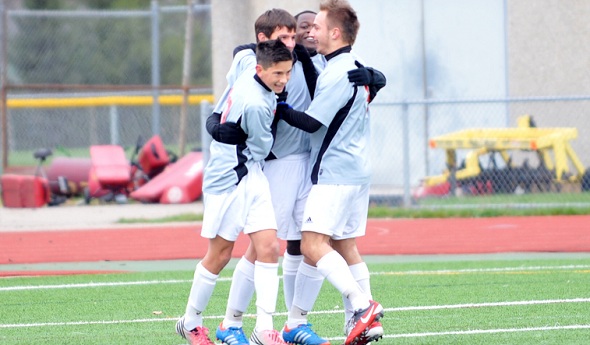
PHOTOS: (Top) East Kentwood’s Emir Cengic (second from left) celebrates his goal with teammates a little more than 15 minutes into the Division 1 Final. (Middle) Falcons sophomore Peyton Gonzalez goes high to make a save.