

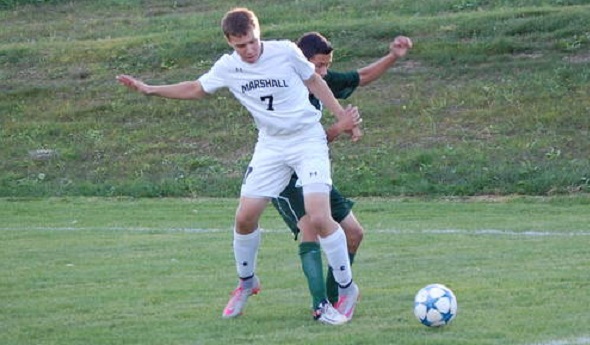
Marshall Standout Nears Finish of Fight
By
Pam Shebest
Special for MHSAA.com
November 17, 2015
MARSHALL — February 1 is a red-letter day for Andrew Shippell.
 However, the Marshall senior doesn’t have a huge celebration planned — not yet, anyway.
As a freshman in the fall of 2012, Shippell and his Redhawks teammates were pumped as they headed into the Division 2 Boys Soccer Districts.
But Shippell had been dealing with pain in his shoulder. It went away, but when it returned in his other shoulder a week later, his mother, Theresa, took him to the doctor to have it checked.
When the doctors got the results of his blood counts, they wanted the diagnosis confirmed, so the Shippells ended up at Bronson Methodist Hospital in Kalamazoo on Oct. 19, 2012.
“They knew before we went over that his blood counts looked like he had leukemia, but they wanted that confirmed by the oncologist,” Theresa Shippell said. “We knew by midnight that we were in for a long haul.”
Thankfully, the journey is nearly complete.
February 1, 2016, is the day Andrew is scheduled to end the maintenance phase of his chemotherapy and will be chemo and pill-free for the first time in three years.
‘Reasons to fight’
His diagnosis back in 2012 was acute lymphoblastic leukemia, and all of a sudden the soccer team was without its leading scorer.
“I just didn’t think it was possible,” his dad, Dale Shippell, said. “That kid, as strong as he was, being taken out like this was ridiculous.
“His eighth grade year, just three months prior to that, he was breaking school records in track and field. Seeing him lying in that bed after having his port put in was just devastating.”
That season, Marshall won the District title but lost in the Regional Semifinals.
“I really believe we won districts for Andrew,” said senior Alec Kraushaar, Andrew’s longtime friend and teammate. “We came together.
“We weren’t the best skilled team, but we fought and we had a reason to fight. We wanted to let Andrew know we had his back in this.”
Instead of heading back to Marshall following the 4-3 double overtime District win at Coldwater, the team went straight to Bronson Methodist.
“Alec and the whole team came up to see him after they won districts,” Dale Shippell said. “He literally was just out of recovery when they walked into the room with the trophy.”
Shippell was back on the soccer and baseball fields by his sophomore year and ended his high school soccer career this fall the way it started: with a District title.
The Redhawks lost 2-0 to Plainwell earlier this month in the Regional Semifinals.
“I think he played more minutes than he did all season in our very last game against Plainwell,” Marshall’s first-year coach Hans Morgan said. “I told him he was the best player on the field that day.
“I pushed him as long as I could push him because we needed him out there. His fitness was never less than anyone else’s. He’s a very, very talented player.”
Even though he never played 80 minutes straight, Shippell led the team in scoring this season. He and Matt Terry scored nine goals each, and Shippell added a team-high 14 assists “so he blew everybody out of the water in terms of total points,” Morgan said.
'A scary word'
Looking back to their freshman year, Kraushaar remembers the impact Shippell’s diagnosis had on the team when it first heard the news.
“I was at practice,” he said. “Coach Tony (Tartaglia) got a call and had us huddle up. He goes, ‘I have some news. Andrew has been diagnosed with leukemia.’
 “My reaction at first was ‘What’s leukemia?’ Someone said cancer. I immediately thought the worst. I broke down. I remember going to the bench and just sitting there and crying. What else could I do? Districts were that week.”
Said Theresa Shippell: “I have two boys and that was probably the worst news I’ve received my whole life. You think of the cancer. It’s not a pretty word. It’s a scary word.”
Andrew Shippell said his first thought was whether he would survive, but the doctors quickly assured him that the leukemia was found early enough and was treatable.
His parents also were assured that his twin brother, Ben, should not be affected.
“We asked the oncologist right away and he said no because fraternal twins don’t tend to have the same diagnosis,” their mother said.
During Andrew’s freshman year, the teen kept up with his school work via the Internet so “I’d be able to graduate on time with my class,” he said. “My teammates supported me through everything and made sure I’m pushing as far as I can go. They know my limit and, if not, I’ll let them know.
“Some teammates would cook food and bring it by the hospital and visit me at the hospital and make sure I was entertained instead of just sitting in a hospital bed watching TV.”
That first year, “One of the teachers (girls cross country coach Steve Wissink) had hair down to his shoulders and he cut it to raise money.
Students also sold “Andrew Strong” bracelets.
Morgan said he did not know about Shippell’s leukemia when he took over the coaching job this year.
He had a meeting with Shippell and Kraushaar during the summer to talk about the team and its goals.
“In the middle of the conversation, Alec mentioned Andrew’s going through chemo and recovering from leukemia,” Morgan said. “My jaw must have hit the floor because I had zero idea whatsoever. It was surprising, to say the least. It’s shocking he’s done so well.
“I remember I tried to save face a little bit that day and talked about how good it was that I knew it now and how we might have to manage minutes, play him in short bursts or something like that.
“Other than a few e-mails that Andrew might be late to practice that day because of medical stuff or practicing with their shirts off because you could see where the port was, outside of those two things, I would have had no idea.”
Looking back, looking ahead
Since his freshman year, “He’s had about 15 spinals since he was diagnosed where they treat his brain with a chemo,” Theresa Shippell said. “He’s had shots in the leg.
“He’s had three- and four-day stints of chemo through his port for 24 hours at Bronson, then flush it until his counts were back to normal. Usually two to four days there. He’ll be on pills (between 3 and 27 pills a day depending on the day) until February.”
In February, the port comes out but he will be checked monthly the first year and periodically over the next five.
 “I’m looking forward to it,” his dad said. “I just want to see him as him again without the extras. This year, he was his freshman year all over again and it was great to see.”
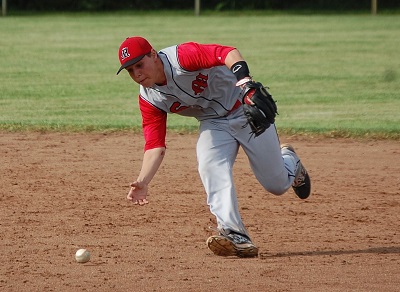
The athlete could not play baseball his freshman year and was on the junior varsity team as a sophomore. This season will be his second on the varsity squad.
Playing second base and shortstop, Shippell “is in the heart of a really good class,” said baseball coach Trevor Kelley, who resigned this year to coach at Albion College. “Watching him practice and prepare, you can see he has tremendous ability.
“Because of his medical issues, he didn’t come back so easily. Once he got confidence, his playing time began to increase and he became a starter.”
The journey has been a learning lesson for many.
“I just wanted to get back to my normal life and not let it affect me,” Andrew Shippell said. “I learned that you definitely have to push through some obstacles in life and no matter what gets thrown your way, you have to keep going and look at the bright side.”
Said Kraushaar: “Now he seems like his own self. For (the soccer team) to finish the way we started was by far amazing. Both of us had great seasons.
“I learned that being a friend, being there for each other, the small things, they go a long way. You have to be there, have to let them know you care. That means a lot to people in more ways than you can realize.”
Kraushaar’s brother, Kurt, a junior on the soccer team, said he was only in eighth grade when he heard the diagnosis and did not know anything about leukemia.
“I knew cancer was a deadly disease,” he said. “You hear how people are fighting it but you don’t expect it to happen so close to home, to one of your friends.
“It was hard knowing what Andrew was going through. Just being there for someone, knowing they have it worse than you. You can’t look at your bad things because there’s someone who has it worse.”
Shippell has a suggestion to anyone else going through medical challenges: “Just make sure you let your family and friends give you all the support they can and don’t block anybody out.
“Keep involved in activities and don’t shut down and let your life stop just because you’re diagnosed with such a horrible illness.”
 Pam Shebest served as a sportswriter at the Kalamazoo Gazette from 1985-2009 after 11 years part-time with the Gazette while teaching French and English at White Pigeon High School. She continues to freelance for MLive.com covering mainly Kalamazoo Wings hockey and can be reached at [email protected] with story ideas for Calhoun, Kalamazoo and Van Buren counties.
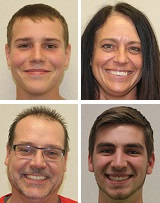
PHOTOS: (Top) Andrew Shippell (7) works to control the ball during one of Marshall's soccer games this season. (Middle) Clockwise, from top left: Andrew Shippell, Theresa Shippell, Alec Kraushaar, Dale Shippell. (Below) Andrew Shippell picks up a grounder; he'll play his second season on the varsity baseball team next spring. (Action photos courtesy of the Shippell family.)
Balanced Falcons Bring Title Back Home
November 9, 2012
By Geoff Kimmerly
Second Half editor
East Kentwood’s exit in the 2011 District Final was the team’s earliest from the MHSAA boys soccer tournament since 2003.
Although it came against a formidable opponent, Grand Rapids Forest Hills Central, that was ranked just a few spots lower and had beaten the Falcons earlier in the season, the loss still didn’t sit right for a team that had won three of the past four Division 1 Finals.
East Kentwood made the fixes this fall to push that championship run to four of the last six.
The Falcons get a Second Half High 5 this week after finishing another title push with a 1-0 win over Grand Blanc in Saturday’s Division 1 Final at Troy Athens. They finished this fall 22-1-4.
“Every team has a personality, and the personality of this team was unity,” Conlon said. “That’s not coach-speak. They bought into each other, bought into their roles, were very unselfish.
“Last year, we focused on the wrong things, and that bit us at the end of the season. When you play great teams like Grand Blanc and Novi, it comes down to trusting teammates. And we won a 1-nothing tight game … because we trusted someone up top, and he scored.”
East Kentwood totaled an impressive 85 goals this season, considering especially the strong schedule again this fall. That lone goal in the Final came from junior Emir Cengic, a defender who will be part of the attack in 2013 but hadn’t scored this season before tapping in the team’s final goal of 2012.
That ending was indicative of the balanced contributions from all over the field. Senior midfielder Charlie Constantino is perhaps the team’s best-known talent, and he had a solid 10 goals and 11 assists. But senior forward T.J. Ifaturoti led the team with 16 goals and senior defender Tyler Moorman also added 10. Senior midfielder Josh Hagene had a team-high 12 assists, with junior forward Erick Pizano also totaling 11.
The balance extended to the net, where senior Denis Duratovic had nine shutouts and a 1.0 goals-against average. But sophomore Peyton Gonzalez finished the run with shutouts in the Semifinal and Final, giving him four in eight games with a 0.38 GAA. Both were beneficiaries of a group that prided itself on defense although it was known more for its attack.
“There’s definitely a pressure on the guys. We have a bunch of our former players who come back and tell them how good they were, so the guys have expectations to live up to,” Conlon said. “Honestly, we don’t talk a lot about state championships. We talk about doing the right thing and focusing on the game at hand. It sounds like coach-speak, but really, that’s what we focus on
The Falcons final moments of 2012 were part another show of unity and tribute to one of many who helped establish the program’s success and expectations before them. They posed in the team photo with their trophy and medals wearing black T-shirts with the words “Seal Team Three” in honor of former player David Warsen. The Navy Seal played for East Kentwood from 2001-04 and died in August in Afghanistan. Two of his brothers also played for the Falcons; Ryan was the main keeper when the team won its previously most-recent title in 2010.
“Today was just a fun celebration,” Conlon said after the photos were taken. “That’s the way we looked at the day.”
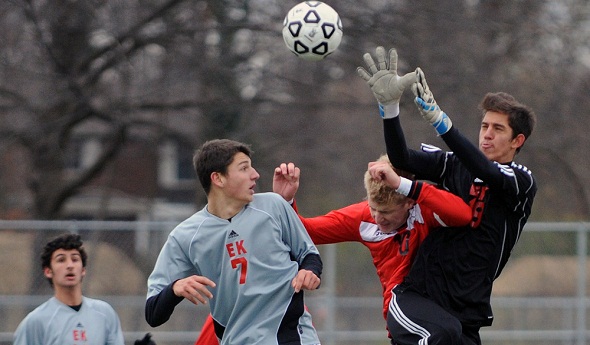
PHOTO: East Kentwood goalkeeper Peyton Gonzalez (far right) prepares to snag a shot amid teammates and Grand Blanc players during the Falcons' 1-0 win in the MHSAA Division 1 Final. (Click to see more from HighSchoolSportsScene.com.)