

Mason Comes Back, Comes Through in D2
November 7, 2015
By Butch Harmon
Special for Second Half
COMSTOCK PARK – The soccer season ended Saturday similarly to how it started for Mason.
The big difference was that the Bulldogs were hoisting the Division 2 championship trophy at the end.
Mason earned its fourth boys soccer championship with a 3-2 victory against Grand Rapids Forest Hills Northern in the Division 2 Final at Comstock Park. The teams played to a 2-2 tie through regulation and overtime before Mason outshot Forest Hills Northern 4-3 in a shootout.
Mason almost didn’t make it to overtime as Forest Hills Northern scored a late goal with 2:32 remaining in regulation to take a 2-1 lead. With time running down, however, Mason turned up the pressure in a frenzied effort to tie the match. That effort paid off when, with 38 seconds left, Christian Jordan knocked a shot in during a scramble in front of the Forest Hills Northern net that tied the game.
“We just went full out,” Jordan said. “After they scored to take the lead I thought we were about to lose. We just attacked the net. We made a play called number six, and Caleb Graham took a shot on goal. It bounced right to me, and I just poked it in. When I scored that goal, I just ran to our student section and was pointing at them. It was incredible.”
Fellow senior captain Holden Dippel had a little more confidence in the comeback than his teammate did.
“I knew we could come back,” Dippel said. “We’ve been down and have come back before this year. It happened to us in our first game of the season against Williamston. We fell behind by a goal and came back. We started the season this way, and we ended it with a comeback.”
To complete the comeback, however, the Bulldogs needed to go through a pair of 10-minute overtime periods that were scoreless, sending the match into the penalty-kick shootout.
Dippel gave Mason the early lead when he scored in the first round after Forest Hills Northern missed its first penalty kick.
 Both teams scored in the second round of the shootout with Travis Barrington scoring for FHN and John Kingman answering for Mason.
In the third round Forest Hills Northern missed again while Mason’s Tristan Pease scored to put Mason up 3-1 with two rounds left.
FHN then cut the margin to 3-2 on a goal from Hunter Barrington, and Mason was unable to answer. Northern’s Diego Compean kept the Huskies’ hopes alive with another score, but Mason’s Lirim Shefkiu then scored the deciding goal, setting off a wild Mason celebration for its first soccer title since winning Division 2 in 1997.
“It feels so good,” Dippel said. “We’ve been talking forever about getting a state title. This is just insane. To win it in our senior year like this is just crazy.”
Mason coach Nick Binder knew exactly what his players were feeling, as he was a member of that title team in 1997.
“As a coach I feel so great for these kids,” Binder said. “I’ve known a lot of these kids since they were 5 and 6 years old. This is exciting for the whole community. It’s always been a goal of this team to win a state title. Growing up playing soccer in Mason, it’s always a goal to win a state title.”
The title was hard-earned as Mason needed to battle from behind for almost the entire match.
Forest Hills Northern took the first lead at 15:13 of the first half when junior Evan VanNortwick scored.
Mason came back to tie the match at the 31:15 mark of the second half when Jordan scored on a header, making the score 1-1.
The two teams then battled it out as the second half wound down. Forest Hills Northern applied some heavy pressure late, and with 2:32 remaining in regulation Travis Barrington scored on a header giving the Huskies the 2-1 lead and pulling them within seconds of a first-ever soccer title.
“We just had 38 seconds to go but they got one on us,” Forest Hills Northern coach Daniel Siminski said. “It was a scramble in front of the net, and it’s hard to describe. (Mason) earned it. It is what it is. I have no regrets because the kids did all they could do. There were 118 teams that started the tournament in Division 2, and we ended up playing on the final day. We knew our season was going to end one way or another.”
Forest Hills Northern ended the season with a 22-2-3 overall record. Saturday’s appearance was its first in an MHSAA Boys Soccer Final.
Mason ended with a 24-3 overall record.
“Our guys just kept battling,” Binder said. “Even when we were down at halftime, they believed. They believed at the end of regulation and they believed in the shootout. Their confidence never wavered.”
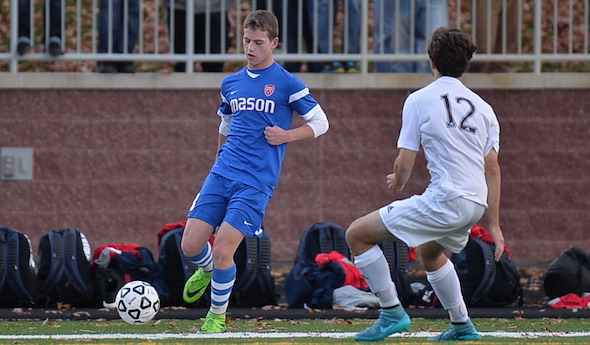
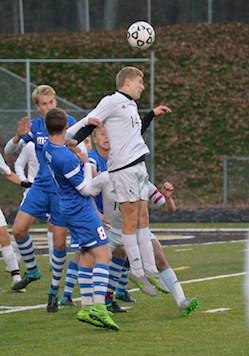
PHOTOS: (Top) A Mason player looks for an opening with Cameron Leitz (12) blocking the way. (Middle) Forest Hills Northern’s Hayden Strobel heads the ball while surrounded by Mason defenders.
Unity Strikes Again in Division 2 Final
November 3, 2012
By Dean Holzwarth
Special to Second Half
KENTWOOD – Less than two minutes into the second half of Saturday's MHSAA Lower Peninsula Division 2 championship game, Unity Christian senior goalkeeper Nick Woldyk saw Petoskey's Adam Bayer racing toward him on a breakaway.
Woldyk didn't flinch at the challenge, as he rushed out of the box and slapped away the attempt to preserve Unity's one-goal lead at the time.
The pivotal stop proved big for the third-ranked Crusaders, who went on to beat the Northmen 3-0 and win the title at Pat Patterson Athletic Field.
“I saw him coming at me, and pretty much what you have to do is come out and make the goal smaller and make your body big,” Woldyk said. “You hope to get a piece of it, and I did. It was pretty big because they were getting the momentum there.”
 Unity led 1-0 when Woldyk came up big, and Petoskey coach Zach Jonker pointed to the play as a turning point.
“That save their keeper made two minutes into the second half was probably the play of the game,” Jonker said.
Junior forward Joe Honderd, who tallied Unity's second goal of the game, said Woldyk's effort was key.
“Nick came out and made a great save that had to be made,” he said. “That really helped us out, and if they would've scored, I think it could've been a different outcome.”
The victory capped off another remarkable season for the state's perennial powerhouse, which finished 25-2.
It wrapped up the Crusaders' third MHSAA crown in the last six years after they also won in 2007 and 2009.
It was their fifth Finals appearance in the past eight years. They finished runner-up in 2005 and 2011 (Division 3).
“As a coach, you want to be peaking come tournament time, and that's exactly what this team did,” Unity coach Randy Heethuis said. “We were playing our best soccer as a team, and we defended very well. We really came along defensively and played a lot better together.”
Unity got on a roll after losing 3-1 to Holland last month.
It ripped off 10 straight wins, including upsets of No. 1 Spring Lake and No. 2 Ada Forest Hills Eastern in Regional play, and outscored opponents 37-5.
“I think that was the toughest region in the state for Division 2, and that was huge,” Heethuis said. “The entire tournament, we gave up one goal over the run of play, and we really came along and played a lot better together defensively.
“It took a lot of work to get through that region, and I'm happy to finish it off with the exclamation point today.”
Petoskey (17-9-2), which lost to Unity in the 2009 Final, 3-0, played well after allowing an early goal in the first half.
The second half was much different, however, as Unity used its size and speed to pepper the goal.
The Crusaders had eight shots on goal in the second half, compared to only two during the first 20 minutes.
“I thought once we absorbed the pressure, we settled in and looked OK,” Jonker said. “We knew (we) could not possess the ball, and maybe we should've played more direct, but it is the most imposing team we've played all season. We had a couple of breakdowns, and they converted.”
Unity senior Jake Love put the final touches on Unity's championship run with a beautiful goal in the right corner from 20 yards out.
“We really stepped it up in the tournament, and I'm proud of my boys,” Love said. “We had much more intensity than during the (regular) season, and going out like this my senior year is wonderful. I wouldn't want to leave any other way than winning a state championship. It's great.”
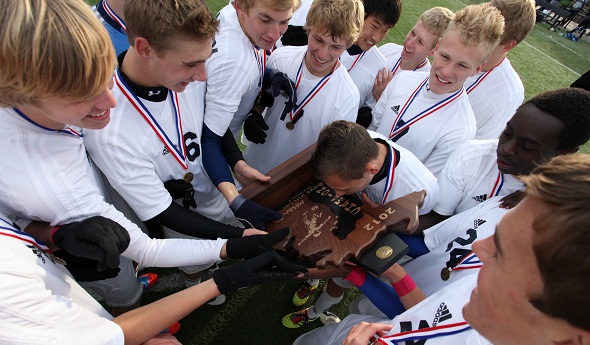
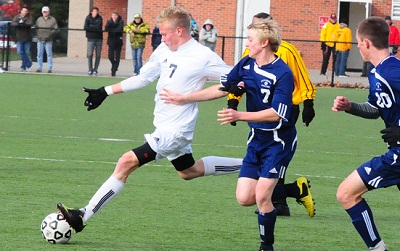
PHOTOS: (Top) Hudsonville Unity Christian players huddle around their newly-won Division 2 championship trophy. (Middle) Unity Christian's Jake Love (left) works the ball past Petoskey's Eric Hoffman (blue 7).