

Powers Writes End to Championship Story
November 2, 2013
By Greg Chrapek
Special to Second Half
TROY – When it comes to storybook endings, Flint Powers Catholic coach Tony Rowe has overseen one that is hard to beat.
With a 4-8 record at one point this season, Rowe and his Chargers were just hoping to climb to the .500 mark, let alone end up in the Lower Peninsula Division 3 championship game.
Not only did the Chargers right the ship, but they advanced to the Final in Troy where they defeated reigning champion Grand Rapids South Christian 1-0 after surviving overtime and prevailing 8-7 in a sudden-death penalty-kick shootout.
“It’s just unbelievable,” Rowe said. “It is a story book. We were 4-8 at one point this season. I told one of my friends that it was like a (ESPN) 30 for 30 feature. We just got on a roll at the right time and kept on rolling.”
Powers also played some air-tight defense in the title match. It survived heavy pressure from South Christian in the second half and overtime periods to get the game into a shootout, where anything can happen and did.
After 80 minutes of regulation and two 10-minute overtime sessions, the game went to a penalty kick best of five round. After both teams missed their first attempts, South Christian took a 1-0 lead on a made shot from Nick VanderHorst.
Powers then missed its second attempt and after two rounds trailed 1-0. Both teams scored in the next two rounds with Taylor Buist and Austin Clark scoring for South Christian and Alex Clark and Brad Tuttle scoring for Powers.
 Heading into the fifth round, South Christian was up 3-2 and needed just one more made shot to end the match.
The Sailors, however, came up short on their fifth shot, and on its last attempt Christian Mansour scored for Powers to tie the goals at 3-3 and force the match into penalty kick sudden death. Both teams scored in the next four rounds and the shootout was tied 7-7 heading into the fifth sudden death round.
That’s when Powers goalkeeper Stephen Wilbur came up with a diving save.
“I just tried to stay composed when everything is going crazy,” Wilbur said. “I go into a corner and keep quiet and try to keep focused.”
Wilbur’s save set the table for Powers sophomore Erich Ruth to win the game. Ruth stepped up to the ball and delivered as he sent a shot into the net.
“When I stepped up to the ball, I kept my eyes on one post the whole time,” Ruth said. “Then I shot it the other way. I just tried to keep my composure.”
After Ruth’s shot went in the Chargers erupted on to the field, their storybook finish complete.
“It’s just crazy,” Wilbur said. “It’s a dream come true.”
A dream the Chargers had to feel was far off when they were 4-8.
“We just kept working all season,” said Powers senior captain Charlie Emmert. “We went to practice every day and kept working. I told the guys the state finals are November 2 so keep your parking passes until November first.”
The Chargers also put in plenty of work on penalty kicks during their practices.
“We practice penalty kicks every day,” Emmert said. “Everyone practices them at the end of practice. That walk feels like a mile with everyone watching you take the kick.”
Powers had a couple of scoring opportunities during the first half. On its first opportunity, South Christian goalie Zac Medendorp used all of his 6-foot-7 frame when he made a diving stop and knocked a shot away.
South Christian (21-2-3) gained the momentum in the second half and applied heavy pressure on the offensive end. With seven minutes remaining in regulation, the Sailors came within inches of a go-ahead goal when VanderHorst whistled a shot that hit the crossbar dead on but bounced away.
The Sailors also carried the play in the two overtime sessions. Powers found it difficult to get the ball past midfield while coming under constant pressure from the South Christian offense.
“That’s the way it is; soccer can be a pretty cruel game at times,” South Christian coach Jason Boersma said. “These guys did everything they could. I thought the first half was evenly matched, but I thought we carried the play in the second half. They (Powers) didn’t get the ball over midfield much at all. We pressured them, and pressured them and pressured them but we could just not get one in the back of the net.
“Our guys feel like they won the game but lost the shootout. Give credit to Powers, they have a fantastic team and a fantastic program.”
The Chargers also had a defense that would bend but not break and a spirit that was the same.
“We played with all heart,” Mansour said. “We just never quit.”
Powers ended the season 14-8-2. The title was its first since winning in 1996.
“We didn’t think it was impossible to get to state,” Rowe said. “Anytime you play, you want to get to the state finals. These guys were just awesome.”
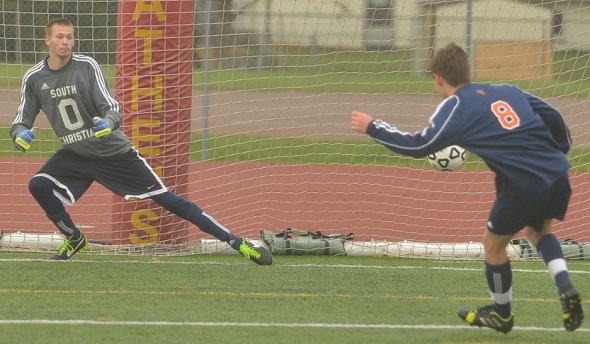
PHOTOS: (Top) Flint Powers' Erich Ruth (8) unloads what will become the winning shot in the Chargers' 1-0 sudden-death shootout win. (Middle) Powers' Reed Macksood (22) works past a pair of South Christian defenders including David Hubbard (21). (Click to see more from Hockey Weekly Action Photos.)
Balanced Falcons Bring Title Back Home
November 9, 2012
By Geoff Kimmerly
Second Half editor
East Kentwood’s exit in the 2011 District Final was the team’s earliest from the MHSAA boys soccer tournament since 2003.
Although it came against a formidable opponent, Grand Rapids Forest Hills Central, that was ranked just a few spots lower and had beaten the Falcons earlier in the season, the loss still didn’t sit right for a team that had won three of the past four Division 1 Finals.
East Kentwood made the fixes this fall to push that championship run to four of the last six.
The Falcons get a Second Half High 5 this week after finishing another title push with a 1-0 win over Grand Blanc in Saturday’s Division 1 Final at Troy Athens. They finished this fall 22-1-4.
“Every team has a personality, and the personality of this team was unity,” Conlon said. “That’s not coach-speak. They bought into each other, bought into their roles, were very unselfish.
“Last year, we focused on the wrong things, and that bit us at the end of the season. When you play great teams like Grand Blanc and Novi, it comes down to trusting teammates. And we won a 1-nothing tight game … because we trusted someone up top, and he scored.”
East Kentwood totaled an impressive 85 goals this season, considering especially the strong schedule again this fall. That lone goal in the Final came from junior Emir Cengic, a defender who will be part of the attack in 2013 but hadn’t scored this season before tapping in the team’s final goal of 2012.
That ending was indicative of the balanced contributions from all over the field. Senior midfielder Charlie Constantino is perhaps the team’s best-known talent, and he had a solid 10 goals and 11 assists. But senior forward T.J. Ifaturoti led the team with 16 goals and senior defender Tyler Moorman also added 10. Senior midfielder Josh Hagene had a team-high 12 assists, with junior forward Erick Pizano also totaling 11.
The balance extended to the net, where senior Denis Duratovic had nine shutouts and a 1.0 goals-against average. But sophomore Peyton Gonzalez finished the run with shutouts in the Semifinal and Final, giving him four in eight games with a 0.38 GAA. Both were beneficiaries of a group that prided itself on defense although it was known more for its attack.
“There’s definitely a pressure on the guys. We have a bunch of our former players who come back and tell them how good they were, so the guys have expectations to live up to,” Conlon said. “Honestly, we don’t talk a lot about state championships. We talk about doing the right thing and focusing on the game at hand. It sounds like coach-speak, but really, that’s what we focus on
The Falcons final moments of 2012 were part another show of unity and tribute to one of many who helped establish the program’s success and expectations before them. They posed in the team photo with their trophy and medals wearing black T-shirts with the words “Seal Team Three” in honor of former player David Warsen. The Navy Seal played for East Kentwood from 2001-04 and died in August in Afghanistan. Two of his brothers also played for the Falcons; Ryan was the main keeper when the team won its previously most-recent title in 2010.
“Today was just a fun celebration,” Conlon said after the photos were taken. “That’s the way we looked at the day.”
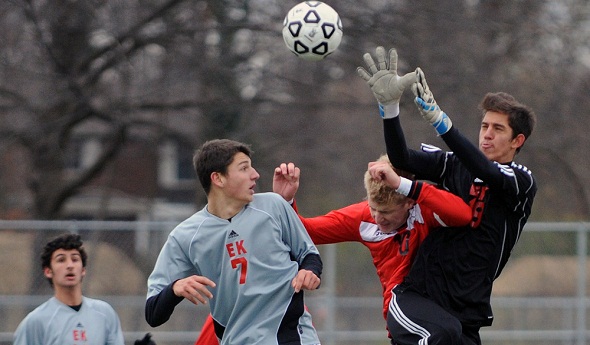
PHOTO: East Kentwood goalkeeper Peyton Gonzalez (far right) prepares to snag a shot amid teammates and Grand Blanc players during the Falcons' 1-0 win in the MHSAA Division 1 Final. (Click to see more from HighSchoolSportsScene.com.)