

Championship Memories, High School Tennis' Impact Stick with Hackett Pair
By
Pam Shebest
Special for MHSAA.com
July 12, 2023
KALAMAZOO — As a senior at Hackett Catholic Central, Luke Samra knew that season was his last chance to win a state title.
Enter freshman Alex Dombos.
 “When I saw Alex for the first time at Hackett, I said, ‘If you play tennis, we’ll win state,’” Samra said.
The senior nailed it.
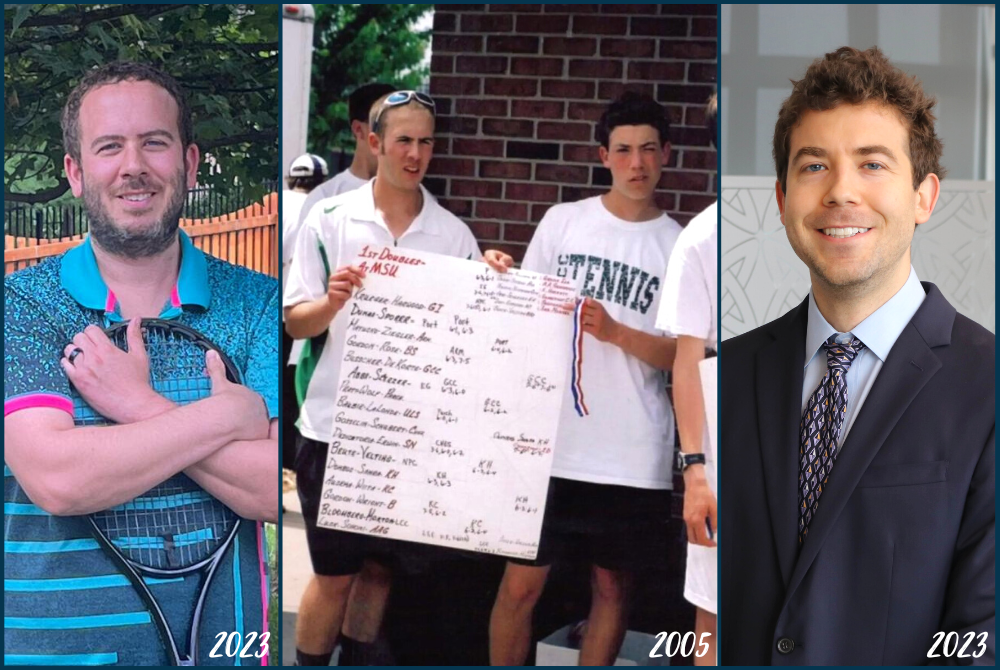
Coach Matt Boven paired the two, and they not only won the No. 1 doubles title, but helped lead the Irish to the 2005 MHSAA Lower Peninsula Division 4 team co-championship with Grosse Ile.
The pair defeated T.J. Busscher and Paul Dekorte, from Grandville Calvin Christian, 7-6(2), 6-2 to clinch their flight.
Eighteen years later, Dombos remembers it well.
“I’m pretty sure we were down a set point in the first set, and we saved at least one set point and won the set. The second was a little bit easier,” Dombos recalled.
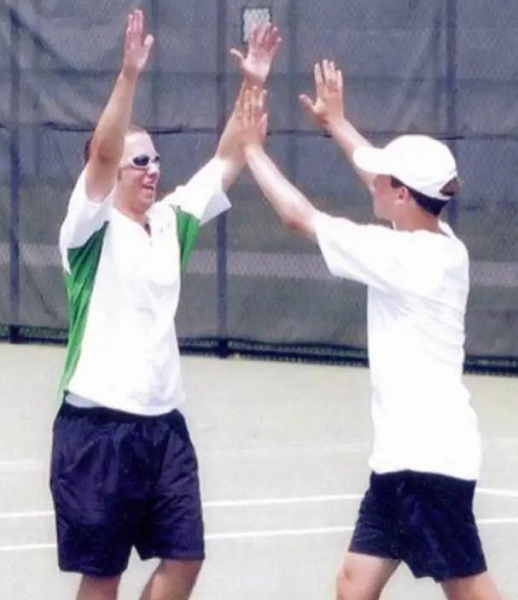
“I remember match point. I hit a backhand down the line for a winner, and then Luke and I looked at each then and I’m pretty sure we jumped up and did a Bryan Brothers chest bump.”
After graduation, Samra headed to Kalamazoo Valley Community College and then Marian University in Indianapolis, playing tennis and earning a bachelor’s degree in business management.
Dombos remained at Hackett, adding a Finals title at No. 2 singles as a sophomore and earning D4 first-team all-state honors.
“The experience I gained from playing doubles as a freshman was really beneficial,” Dombos said. “Playing doubles helped my net game in singles, where there’s a translation of skills.”
Although Samra and Dombos took different paths, they have kept in touch through texting and social media.
Samra and his wife, Adrianna Story Samra, live in Indianapolis where he is a teaching pro at Carmel (Ind.) Racquet Club after a similar position at Western Michigan University’s West Hills Athletic Club.
Dombos works in a data science role at Stryker Corporation in Kalamazoo, “applying a lot of the data analysis skills that I learned from high school, college and graduate school at Stryker.”
After Hackett, Dombos continued his tennis career at Kalamazoo College, earning a degree in physics with a minor in mathematics. He was a four-year letter winner and helped lead the Hornets to four Michigan Intercollegiate Athletic Association tennis titles.
Dombos spent study-abroad time in Aberdeen, Scotland, where he and his girlfriend Kelsey Hassevoort found a way to keep their tennis skills from atrophying.
Hassevoort, who is now his wife, played for the Hornets women’s tennis team and “very quickly we found the lone tennis court in the center of campus,” he said.
“When it got too dark too early in the day, we found the Aberdeen Tennis Center but to get there was a 45-minute trip through a lot of bus rides.”
After K-College, Dombos continued studying at Michigan State.
“They’ve got a lab on campus called the National Superconducting Cyclotron Laboratory, so I got my Ph.D. there in a six-year long program,” he said.
Next came three years at Notre Dame for a post-doctoral research associate position in physics and astronomy.
“My particular area of physics, there’s a lot of fundamental research part of it, but also practical applications,” he said. “A lot of the physics work I did, it’s common for people to go to a national lab.
“They’re doing research that’s usually funded by the government. Postdoctoral research associate positions are similar to the residency portion of medical school.”
With such in-depth studies, tennis has currently faded to the background, although Dombos has tried his hand at pickleball.
Looking back
Boven, currently the boys and girls tennis coach at Mattawan High School, remembers Hackett’s team title well.
“It was really Kyle Bedford at No. 2 singles and the No. 1 doubles team that gave us the (2005) title,” he said. “Alex and Luke seemed to complement each other. I knew Alex was a very gifted ground-stroker, and Luke’s volleys were improving. Alex was dominant at the baseline and could set up Luke at the net.”
Since Dombos rarely played doubles while competing in USTA events, he did not have many expectations as part of a doubles duo.
 “Having played singles for pretty much all of my tennis at that point, I didn’t see it as a setback, but had an open mind and open attitude: Let’s see where this goes,” he said.
“We ended up winning the state title, so that was exciting.”
Besides his high school tennis success — Dombos did not lose a set at the MHSAA Tournament his first two years — he said he continued learning from his experiences.
During USTA tournaments, Andrew Devlieger from Grand Rapids NorthPointe Christian was his nemesis.
“I had lost to him consistently,” Dombos said. “I ended up playing him in a high school match (in 2006), and I won. I was like, I can beat him now.
“In the (2006) finals at the state tournament, I played him and won again with a better score (6-1, 6-2). It was that belief of having won in the regular season that gave me the belief going into the state tournament.”
Dombos’ streak of not losing a set at the MHSAA Tournament ended during the 2007 No. 1 singles semifinals, where he fell to eventual champ Michael Calderone from Jackson Lumen Christi. Calderone was named Michigan’s Mr. Tennis and played collegiately at Western Michigan University.
Dombos said much of what he learned in high school has helped him in his career, including how to balance things in everyday life.
“As a student-athlete, you’re playing tennis and studying,” he said. “That’s really important for anything in life, especially in graduate school, having your attention pulled in a lot of different directions.”
Another advantage was learning teamwork.
“Working as part of a team and working with new people,” he said. “You’ll be doing that in any type of professional setting; learning that you don’t succeed alone.
“In general, there is also the importance of staying active for your physical and mental health.”
Advice he would give to young athletes today includes: “Hard work will be important for anything in life, and a lot of the lessons you learn on the tennis court will be very helpful later in life. They can be just as important as some of the lessons you learn in the classroom.”
Samra said tennis has changed since his high school days.
“The game is a lot faster now,” he said. “I tried to model my game on Pete Sampras and Andy Roddick, but you can’t play like that anymore.
“Serve and volley is out of the question, too. The ball comes back too fast.”
Samra said he can’t believe that with all the good players on his Hackett team, he is the only one who ended up with tennis as a career.
“My parents invested a lot of money in me growing up,” he said. “I’m glad they know it wasn’t a waste.”
Boven is not surprised by Samra’s career pursuit.
“I remember how intense Luke was and how much he cared about the team,” he said. “I’m so excited he stuck with it because he cared for it so much.”
Made in Michigan is powered by Michigan Army National Guard.
2023 Made In Michigan
July 6: Brother Rice Finals Hero Aiming to Ace Family Life, Financial World - Read
July 5: Lapeer West 4-Time Finals Winner Set to Build Champions at Oklahoma - Read
PHOTOS (Top) Luke Samra, left, and Alex Dombos hold up their championship bracket after winning the No. 1 doubles flight at the 2005 LP Division 4 Finals. (Middle) Samra and Dombos celebrate their victory. (Photos from 2005 courtesy of Luke Samra; current photos courtesy of Samra and Dombos.)
Troy Extends 1st-Day Lead to Take Back Title, Rochester's Anderson Completes Climb
By
Perry A. Farrell
Special for MHSAA.com
October 18, 2025
MIDLAND – It was the sweetest of Saturdays for the Troy High School boys tennis team at the Lower Peninsula Division 1 Finals.
Troy entered Saturday’s final rounds at Midland Tennis Center with a 23-17 lead over second-place Bloomfield Hills, with Detroit Catholic Central one more point back at 16.
By the time the flights were in championship matches, Troy had built an eight-point lead on the way to finishing with 32 points followed by the Black Hawks with 22.
The Colts, last Finals champs in 2021, ended Bloomfield Hills’ three-year reign after finishing runners-up the last two seasons.
Nate Wanstreet, part of Troy's No. 3 doubles team with sophomore Jackson Kraus, said the momentum for this year started last season.
 Wanstreet and Kraus defeated Troy Athens' Sahay Achar and Vikram Menon 6-0, 7-6, to win their flight.
"We only lost one player from last season,'' said Wanstreet. "We got off to a slow start this season, but we started to come on late and hopefully this will lead to a championship.
"All year we've gotten everyone's best at No. 1 doubles. Even teams that weren't playing well before they played us, we got their best shot. It kept us sharp all year.''
Troy also claimed No. 4 doubles as Raghav Karur and Zain Taqi defeated Novi's Vincent Maisano and Ronak Sharma, 6-1, 6-4.
In the featured match of the day, Rochester's Chad Anderson, the top seed at No. 1 singles, downed second-seeded Grant Miller of Ann Arbor Pioneer 7-5, 6-7 (0-7), 7-5.
Anderson suffered with cramps in his legs, thighs and quads after the first set.
"This is probably the happiest I've been on a tennis court,'' he said. "I'm still in a lot of pain, but it was worth it. I broke him in the second set, but he broke back. It was a struggle because of the pain I was in, but it's worth it.''
Anderson went up 5-1 in the first set, only to have Miller rally to tie the match at 5-5. Anderson regrouped to win the last two games and take the set.
Miller broke through to win the second.
"They were giving me mustard to help with the cramps,'' said Anderson, who had finished No. 1 singles runner-up last season and No. 2 singles runner-up as a sophomore.
 Troy's first flight championship came at No. 2 doubles with Varun Shetty and Sourish Darui downing Bloomfield Hills Sajan Doshi and Meyer Saperstein in straight sets 7-5, 6-1.
"We wanted revenge this year; we had lost to Bloomfield Hills the last three years. I agree that our momentum started last year,'' said Darui.
Added Shetty: "I wanted to get revenge from last year. We lost our last match. We just focused on the things we learned from last year. It'll be a great celebration tonight.''
Bloomfield Hills senior Jonah Chernett had the moment of the day.
Plagued with a disorder that prevented him from competing in singles and had him taking five trips to the Cleveland Clinic and one to Stanford this year, he and teammate Krish Reddy defeated top-seeded Ben Waechter and Spencer Seneker of Bloomfield Hills Brother Rice 6-4, 4-6, 6-4, at No. 1 doubles.
"It has been such an amazing journey,'' said Chernett, who had to sit in a special chair during the changeover. "I've been playing singles all my life and not being able to compete was tough. I love my team and being able to get out there ... I felt at the start of the season we had a chance.''
Novi's Kris Thomas captured No. 2 singles with a 6-3, 7-6, victory over Troy's Dheeraj Yelleti. At No. 3 singles, Bloomfield Hills' Zev Spiegel defeated Okemos' Kai Minamisono. 6-2, 3-6, 6-4, to clinch. No. 4 singles saw Troy's Anthony Wu and Detroit Catholic Central's Graham Long go three sets with Wu prevailing 5-7, 6-2, 6-3.
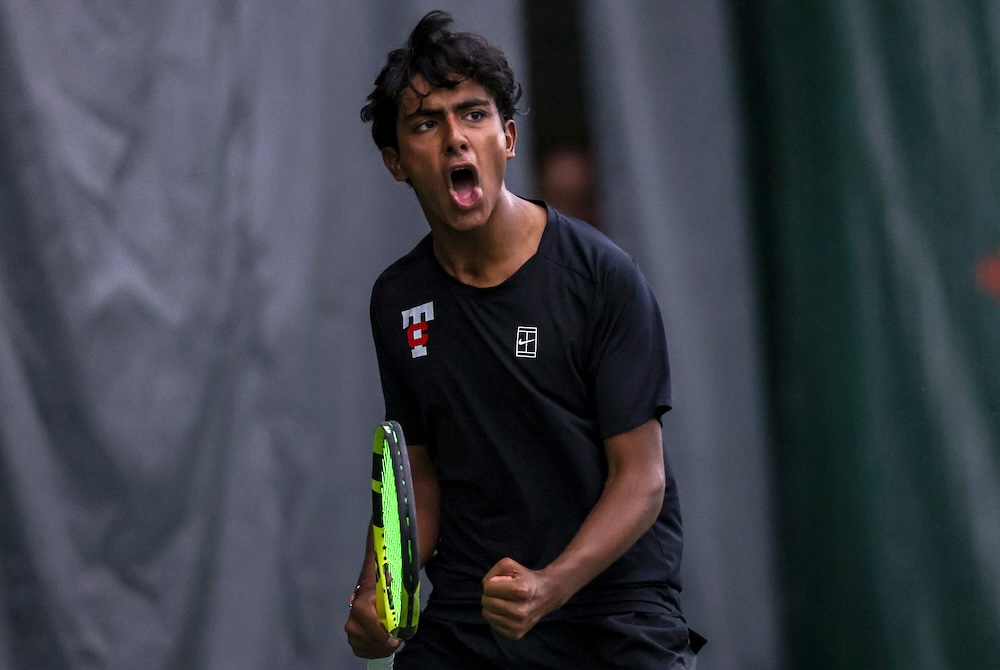
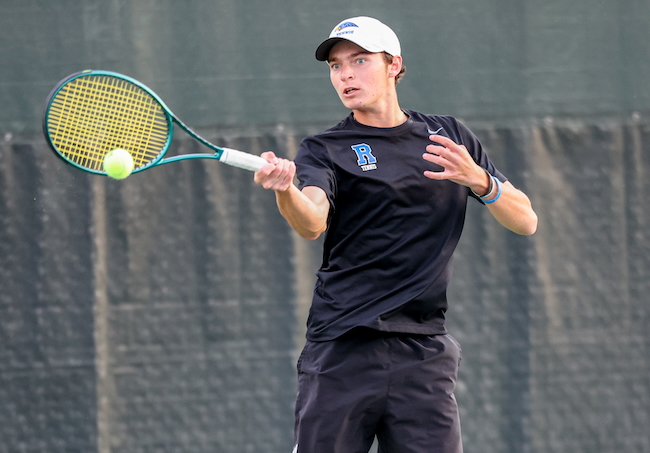
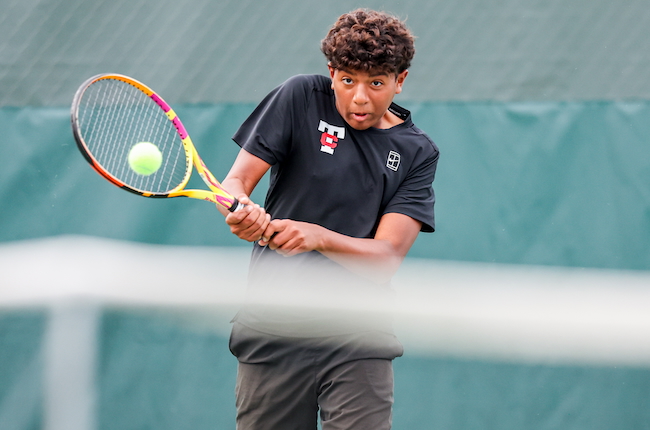
PHOTO (Top) Troy's Krish Gupta celebrates during Saturday's Division 1 second round at Midland Tennis Center. (Middle) Rochester's Chad Anderson returns a volley at No. 1 singles. (Below) Dheeraj Yelleti sends a forehand at No. 2. (Click for more from High School Sports Scene.)