

Accomplished College Coach Giving Back to HS Track at Salem
By
Doug Donnelly
Special for MHSAA.com
April 23, 2021
PINCKNEY – John Goodridge has coached athletes of just about every level imaginable.

"My passion for coaching is just as high as ever,” said Goodridge, 72, recently named the head boys track & field coach at Salem High School in Canton. “It’s been fun. You really do come full circle.”
It’s been a tremendous coaching journey over the past 50 years for Goodridge, a New York City native. It was not long after retiring from Eastern Michigan University in the fall that Goodridge got the coaching bug again. It started when he began attending cross country meets in the Ann Arbor area. Soon he realized he wanted to continue coaching and spoke to one of his former EMU athletes who was coaching at Salem and had found out the job as boys track coach was going to be open.
"At some point, late in my career, I had the notion that someday I’d come back and coach high school, where it all started,” Goodridge said. “In the fall, after I retired, an EMU alum who coached at Pinckney High School invited me to his home opening cross country meet.
"It was enough being out there and seeing the young kids that it brought me back to 40-50 years ago. I spent the fall, every week, going to various local cross country meets. Just observing, just to see if I thought it was something I wanted to do.”
Ultimately, Salem athletic director Tim Baechler hired Goodridge, who has an incredible resume as a track & field and cross country coach. From coaching Olympic athletes to the United States team at the World University Cross Country Championships in Austria, Goodridge has coached world class athletes and NCAA championship-level contenders for decades.
High school coaches have always had a special place in Goodridge’s heart. One reason is he interacted with coaches from across the country while recruiting athletes to compete for him at Michigan State University (1979-1982), Wake Forest University (1984-1999) and Eastern Michigan (2001-2020). Another reason is that he started out coaching at that level.
"It’s natural,” he said. “A lot of people think college is a higher level and that kind of stuff, but I’ve always told people that being a high school coach is such an important role and opportunity to work with young people.
"In many cases it’s the most special relationship. A high school coach sets the tone. You are introducing the sport to young kids. That’s quite a responsibility.”
Goodridge graduated from Long Island University in 1972. He and wife Francie (Kraker) met in the northeast while working for a shoe company. They returned to her native Ann Arbor while she was an elite world class athlete. Francie ran on U.S. Olympic teams in 1968 and 1972 and owned a world record in 1967.
While in grad school, Francie was offered the position of track coach at Ann Arbor Huron but couldn’t accept it because she was still an amateur athlete and couldn’t profit from that status and remain eligible for the Olympics.
Instead, she suggested to the Huron athletic director that the school hire her husband. His coaching career was launched.
"We were two young people, trying to get through school on part-time jobs,” Goodridge said. “We didn’t even have a car. (Coaching) was a source of income.”
While coaching high school track, they also coached younger athletes on club squads, before moving to the University of Wisconsin-Milwaukee where they both were hired as coaches – Francie as the women’s track coach and John the men’s. After a short stint there, they returned to Ann Arbor and both took on roles at Ann Arbor Greenhills.
Both coached for years. Goodridge had a long tenure at Wake Forest, coaching both cross country and track & field at a time when the Demon Deacons had unparalleled success in school history with 14 individual Atlantic Coast Conference champions and seven All-Americans. Francie coached at Wake Forest as well.
The couple returned to Michigan in the early 2000s, with Goodridge taking over the Eastern Michigan cross country program and serving as an assistant track coach. He later became the head track coach. During his time at Ypsilanti, he directed numerous Eagles squads in both sports to conference titles. During his distinguished career, he coached conference cross country championship teams in the Mid-American, Big Ten and Atlantic Coast Conferences. He was the MAC Coach of the Year 13 times in cross country and coached 22 NCAA track & field All-Americans.
This season he has more than 100 athletes on the Salem boys track & field team. He’s having a blast with it, especially with the freshmen athletes who are just starting out learning about track.
"Some of them may not be the most talented, natural athletes but they want to be part of the team,” he said. “They might not be able to make another team, but they want to be involved in athletics and be on a team. It’s been very intellectually challenging and inspiring to come up with new things for ninth graders, to make it fun and not let them get discouraged.
"They put a smile on my face just about every day. I hope it’s going to be keep me a young 72 and a young 73 and as long as I keep doing this.”
Goodridge also is building relationships with other area coaches. He’s not been afraid to seek out advice.
It’s been a long time since I designed workouts for the young ones,” he said. “It’s fun to sort it out, to my own approach to training, with that age group. All athletes respond differently to training and intensity and what you give them. The age of the athlete is a factor in that. It’s been a long time since I had experience working with freshmen. That’s been fun.”
 Doug Donnelly has served as a sports and news reporter and city editor over 25 years, writing for the Daily Chief-Union in Upper Sandusky, Ohio from 1992-1995, the Monroe Evening News from 1995-2012 and the Adrian Daily Telegram since 2013. He's also written a book on high school basketball in Monroe County and compiles record books for various schools in southeast Michigan. E-mail him at [email protected] with story ideas for Jackson, Washtenaw, Hillsdale, Lenawee and Monroe counties.
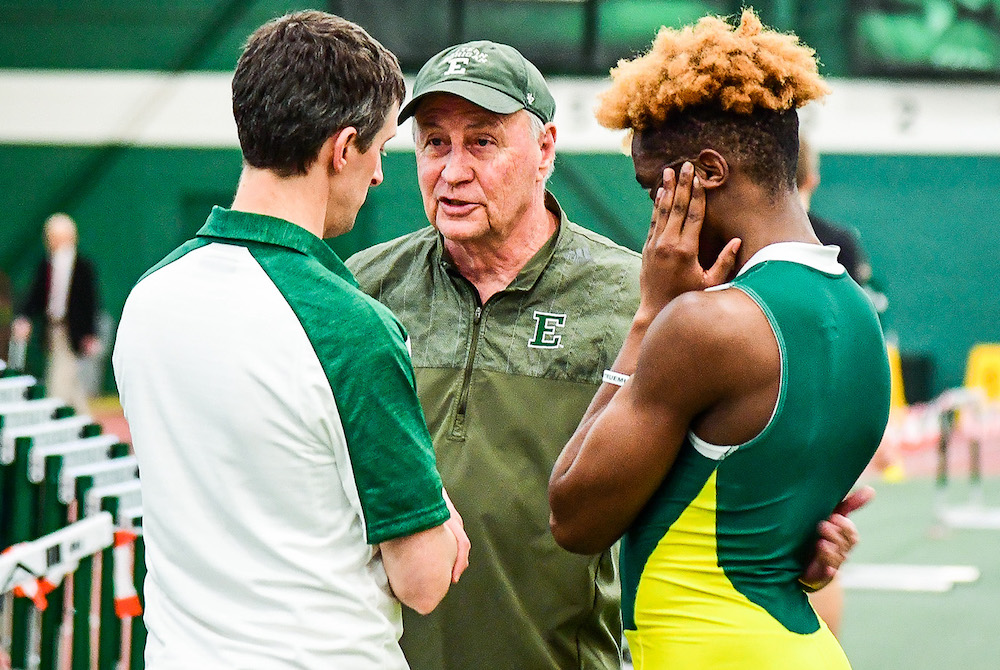
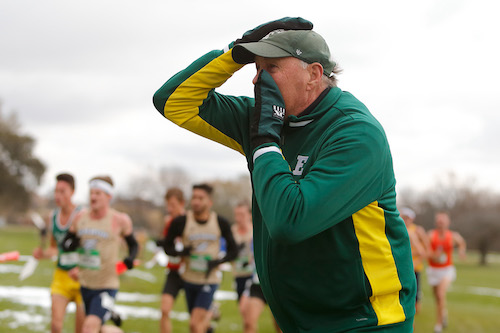
PHOTOS: (Top) John Goodridge, center, retired in the fall from coaching the men’s track & field team at Eastern Michigan University. (Middle) Goodridge also served as coach of the men’s cross country team. (Photos courtesy of the EMU athletic department.)
Kelloggsville Shines in First Title Run
June 1, 2013
By Geoff Mott
Special to Second Half
COMSTOCK PARK – Saturday’s Lower Peninsula Division 3 Boys Track and Field Finals just kept getting better and better for Wyoming Kelloggsville senior T.J. Burnett.
First he won the 400-meter dash title in 48.59 seconds, a mark he thought was well short of the LP Division 3 meet record.
“Coach had told me that 47.9 was the record, and when I got that time, I was pretty disappointed,” Burnett said. “Then I’m getting my medal, and I found out that I set the record.”
Then Burnett went out and helped his team win the 800 relay in 1:31.10 and close the meet with a title in the 1,600 relay (3:24.27).
And then Burnett found out the Rockets had captured their first-ever team title in track and field.
Wyoming Kelloggsville scored 52 points to easily outdistance runner-up Mason County Central (31) and third-place Standish-Sterling (28).
“The individual medals feel great, but nothing is better than winning that team title,” said Burnett, who immediately celebrated with family that numbered more than 10, including his sister from Texas.
Kelloggsville coach Tom DeGennaro has coached for 27 years, including the last three with the Rockets. It’s his first MHSAA title and a gratifying one at that.
“This group is special and full of outstanding kids,” DeGennaro said. “I can think of a lot of kids over the years that have helped build into this. But these kids are just awesome. They are gifted, but they also have great attitudes.”
DeGennaro pointed to athletes like Dionte Williams, who finished fourth in the 800 and ran legs for both relay title teams.
“He’s capable of competing in anything,” DeGennaro said. “He filled in for an injured kid in the 400 relay. He competed in the long jump this year.”
DeGennaro also was pleased to see Burnett come out on top.
“I saw something special in him the moment I took over the team,” DeGennaro said. “This has been a wonderful four-year journey for him. He’s a bulldog on the track and in the classroom, where he’s a 4.0 student.”
After a second-place finish in the 1,600 run last year, Mason County Central junior Chase Barnett wasn’t coming home without hardware this year. He won the race with a 4:15.97 finish, then added another win in the 800 run in 1:57.41.
“All the glory to God because I’m feeling pretty blessed right now,” Barnett said. “I really felt stronger this year. There was weird weather that kind of shortened up the season, but we figured out new ways to train and get the job done.
“I put in a lot of miles in the winter for this.”
Barnett brought home three championship medals, anchoring a Mason County Central title in the 3,200 relay – the team crossed with a 7:57.04 finish, nearly 17 seconds better than its qualifying time of 8:14.
“Now it’s time to go home and relax,” Barnett said.
Warren Michigan Collegiate senior Teo Redding glanced at the qualifying times heading into Saturday’s 110 hurdles and wasn’t sold on the 15.5-second time that had him seeded 19th in the event.
“I took second last year, and I’ve had better times than that,” Redding said. “Seeing that time made me even more hungry. I’ve been waiting all year for this. I was ready to go.”
Redding won his first MHSAA title and claimed the first title in school history, finishing the race in 14.65 to clip Burnett’s 14.77 finish. Redding took second in the long jump, clearing 6-8 on his first attempt, and also took second in the 300 hurdles with a 39.7 finish. Bangor’s Jesse Ring won the event in 39.17.
“I ran a really clean race,” Redding said. “I took off fast and wanted to leave (the field) as far behind as I could. It still came down to a photo finish.”
Redding, 18, will play football and hopes to run track next year at Bowling Green University.
Morley-Stanwood senior Travis McCuaig claimed back-to-back titles in the high jump, clearing 6-9 to edge Redding. McCuaig finished with three medals on the day, finishing fifth in the 300 hurdles (40.39) and eighth in the 110 hurdles (15.95).
“It’s funny because I’ve been down in the high jump and I changed some things this week,” McCuaig said. “I’m a power jumper, not a speed jumper. I’ve found I was running too hard and running into the pole. So I slowed it down today and got 6-7 on my first jump.
“Then Redding hit 6-8 on his first attempt, and I thought I was in trouble. I finally got it on my last attempt and then nailed 6-9 on my first attempt. I peaked at the right time this week.”
The 100 meter dash was decided by one hundredth of a second, and the third-place finisher was just three hundredths of a second from the top spot. In fact, one tenth of a second is all that separated the winner from fifth place.
But prevailing as champion was Southfield Bradford Academy senior Alize Champion. His 11.03 finish edged runner-up Jonathan Fife of Flint Southwestern and Carrollton’s Landon Lyons.
“Once I hit 50 meters, my long strides started to kick in,” said Champion, who placed eighth in the event last year and was seeded 22nd heading into Saturday. “I just had to give it my all because I knew this race was very competitive. There was a little pressure.”
The most interesting title went to Watervliet senior Jake Cowsert, who won the long jump with a 21-foot-1½ inch leap. He edged Pewamo-Westphalia’s Andy Pung by a half inch.
Cowsert didn’t compete in track and field until this season. After setting the long jump school record in middle school, all Cowsert wanted to do this year was set the high school record in the event and continue playing with the baseball team.
While his baseball team competed in Districts, Cowsert found a way to win a Finals championship.
“This is unbelievable,” said Cowsert, who’ll play football at Olivet College. “Our school doesn’t like us to compete in multiple sports in a season, but I really wanted the record.
“I didn’t even know what it took to win a state title or what the marks were. I broke the school record in the fourth meet of the season and just kept going. I graduated last night, and now I’m a state champion. Unbelievable.”
Bath senior Jeff Dempsey improved his pole vault by nearly a foot, winning the event with a 14-foot, 7-inich vault after qualifying with a 13-9 in the event. He finished third in 2012.
“I couldn’t be happier right now,” said Dempsey, who next heads to Pensacola Christian College (Fla.) to major in pastoral studies. The school doesn’t have pole vault. “It’s a great way to end a career. It feels great for the personal accomplishment, but I love for God. He gets the glory.”
Dempsey also credited pole vault coach Jerry Sessions from Maple Valley. Dempsey started training with the coach as a sophomore, improving his vault from 12-6 to 14-7.
“He did a tremendous job and gave me a lot of confidence to compete at this level,” Dempsey said. “He brought me a pole that worked very well.”
Niles Brandywine’s Evan Hartman won the discus with an LP Division 3 Finals record of 187-1, while Standish-Sterling’s Clayton Walderzak won the shot put with a toss of 55-2½.
Saginaw Nouvel Catholic Central’s Tyler Hendricks bounced back from horrible injuries a year ago to win the 200 dash in 22.82, while Lansing Catholic’s Rebera Keenan won the 3,200 title in 9:32.46.
Ann Arbor Gabriel Richard won the 400 relay in 43.99.
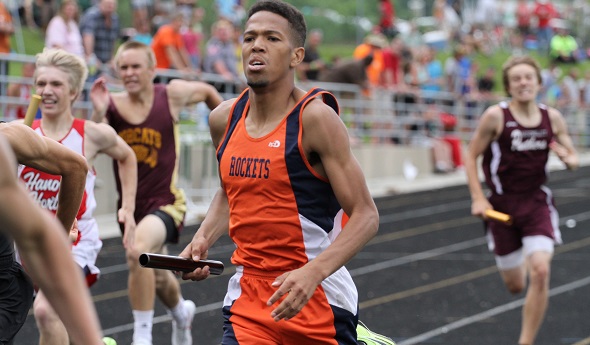
PHOTO: Wyoming Kelloggsville won the 800 and 1,600-meter relays on the way to claiming the overall team championship at Comstock Park. (Photo by Jackie Gomez. Click to see more photo coverage from RunMichigan.com.)