

Brimley Jumper's Leap Soars On as Finals Best
June 6, 2019
By Dennis Grall
Special for Second Half
BRIMLEY – Thirty years ago this spring, John Payment became an unlikely part of Michigan high school track & field history.
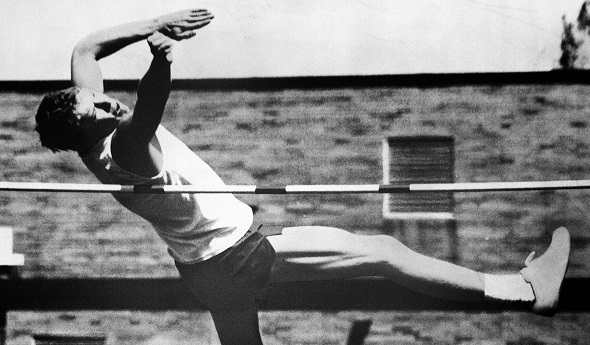
 In some respects, it almost seems like yesterday the Brimley High School senior soared 7-feet, 1 inch, to set an MHSAA Finals high jump record that still stands. In fact, Payment is the only Upper Peninsula athlete in this sport to own an all-Finals record – meaning his performance remains the best all-time from any class or division in either peninsula.
Payment is still approached by strangers about his performance that 1989 day in Marquette, and is stunned people remember what he did.
Think about it: A high school senior with a minimal high jump history from a tiny Upper Peninsula town accomplished a feat that has not been duplicated by hundreds of athletes from big cities like Detroit, Flint and Grand Rapids.
It is mind-boggling it happened, and mind-boggling the record still stands. Talk about doing something very notable well beneath any radar screen.
"It is kind of neat to say no one in the state of Michigan has ever done this," Payment said in a telephone interview on the eve of the 2019 Upper Peninsula Track & Field Finals. "It is actually kind of weird to say it.
"It is very humbling. It is amazing people haven't forgotten. It never gets old."
Payment still finds it hard to believe it happened. He had never been able to break the 6-10 barrier in a meet, even though practice jumps convinced him he could surpass that mark.
At the U.P. Finals, he even passed until the bar got to 6-11. He missed twice at 7-0, then easily cleared it on his final try, by a couple of inches. He then asked officials to put the bar at 7-1, but his next jump was delayed until the height could be measured officially to ratify the record attempt.
By that time, the public address announcer had explained Payment’s opportunity to the huge crowd in attendance at what remains the Upper Peninsula's largest one-day prep athletic contest. The meet basically came to a stand-still as athletes in the infield gathered around the high jump bar.
"(The official) stood on a folding chair and measured the bar at 7-1," said Payment. "He then told me, 'Son, if you do this, it is a state record.'"
After clearing that record-setting height, Payment said, "I was excited. Then I tried 7-2, but my legs got rubbery and I just couldn't do it. They said I cleared 7-1 by 3-4 inches. I just couldn't do it anymore. I had an adrenalin rush, but I just wore out."
Obviously very excited at what had just happened, the request to go at 7-2 came up instantly – and he never really had a chance to collect his thoughts and rejoice.
"I couldn't wait for the other jumpers to jump because they were done. It was like boom, boom, boom. I couldn't just sit down and let it sink in," he recalled.
In the immediate aftermath, Payment said he understood what had just happened. "It was huge; it was like a sigh of relief that I just did 7-feet. I was more in awe than anything. (But) I didn't get a chance to savor it."
The realization of what he did hit home on the way back to Brimley when he learned the Detroit Free Press was trying to contact him for an interview. "It was like, wow, this is something. Now it is a bigger deal. It took a little while to have it soak in about the caliber of the jump," he said.
Payment and teammates Bob Carrick and Kevin Sutton finished 1-2-3 in the high jump in U.P. Class D that day, and Payment said having good teammates and their competition helped him reach record heights. In fact, Carrick helped him adjust his approach by having Payment start a step closer on the blacktop rather than begin on the grass.
"I had three teammates always helping. We would be laughing and joking. It wasn't stressful. That was helpful. It was an individual event, but we made it our individual event," he said.
He also adjusted from a J approach to a straight-on Fosbury Flop to clear the bar.
Blessed with strong legs, Payment said he "messed around in the gym" and then his coach, John Morrison, said he should try the event. "I cleared it pretty good," said Payment.
As a junior, he drove to Mount Pleasant and worked with the Central Michigan University coach, who later came to Brimley for some on-site coaching. "We just jumped. It was fun," he said, indicating he quickly was clearing 6-8 but the mental block struck at 6-10. "I couldn't get past it," he said, even though he was sure he could clear that barrier.
He is still shocked at the response of athletes and fans who focused on his state record effort. "High jump is not a flashy sport, it is not the main (track & field) attraction," he said.
"It was definitely exciting (that day). Once I cleared seven feet, people went crazy. Believe it or not, but I just focused on doing it. I don't think I noticed the crowd until afterward. People shook my hand and asked for autographs. It was really something."
The accomplishment opened a whole new world to the innocent youngster. He competed in all-star track invitationals in Indiana and Chicago against athletes from across the country, quite a leap for someone from the shores of Gitchee Gumee just south of the Canadian border. In fact, he flew to Chicago, which was his first airplane ride.
His part of the world was so small, but suddenly it had enlarged well beyond his imagination.
College track coaches and recruiters were now after the unsung champion, who was somewhat uncomfortable being the talk of the town.
He turned down the chance to attend college and compete at the higher levels of high jump. "The opportunities were there, but for me it just wasn't my thing," he conceded, indicating it became more important to get a job and start earning money.
"It was a real eye-opener. You don't realize what is all out there, and to leave a small town and see what was out there," he said, adding more classroom work was not a priority.
"The schooling I wanted to be done with," he said, noting his parents encouraged him to attend college. "Maybe I was just scared. My grades were not the best. Life goes on, the what-ifs go on."
Payment, who also played football (wide receiver), basketball and baseball at 6-3, 175 pounds, for the Bays simply decided to move on with his life. He got a job with the road commission and still works there, although he now weighs about 275.
"The world is full of what-ifs. I've got some regret I didn't go on and try, but we've got four kids and four grandkids and another one on the way. I'm doing all right," he said.
 Denny Grall retired in 2012 after 39 years at the Escanaba Daily Press and four at the Green Bay Press-Gazette, plus 15 months for WLST radio in Escanaba; he served as the Daily Press sports editor from 1970-80 and again from 1984-2012 and currently is in a second stint as the interim in that position. Grall was inducted into the Upper Peninsula Sports Hall of Fame in 2002 and serves as its executive secretary. E-mail him at [email protected] with story ideas for the Upper Peninsula.
PHOTO: Brimley's John Payment flies over the high jump bar in 1989 to set an all-MHSAA Finals record in the event that still stands. (MHSAA file photo)

Saginaw's Martin Leaps Into All-Time Elite
By
Paul Costanzo
Special for MHSAA.com
May 1, 2019
Sometimes greatness can come from random circumstance.
 One spring day after having their basketball taken away during lunch, then-Saginaw High sophomore Tony Martin and his friends improvised by playing the game without a ball. With one of his track coaches looking on, Martin received a “pass” from a teammate, ran to the free-throw line and took off, touching the rim before returning to the ground.
“You’re long jumping at our next meet,” the coach said, introducing a new event to the sprint specialist, and a star was born.
In the two years since that fake basketball game, Martin has become arguably the best long jumper in Michigan history. He recently leapt 26 feet, 6 inches, which according to michtrack.org smashed the previous record by a Michigan high schooler of 25-2½, set by Lansing Everett’s Marcel Richardson in 1988.
“I felt it when I hit the board, and when I was in the air, because I had more time in the air to move my legs and reach,” said Martin of his record-breaking jump, which he achieved April 25 in a home dual meet against Saginaw Arthur Hill. “I had more of a fold in my legs when I was landing. I felt it in my spine when I was stretching. My reaction was, I looked at it and it said 26-6, and I had to look again because it’s an unbelievable jump. I had to look at it again and again when they marked it.”
Martin, who opened his senior season at Saginaw by breaking the school’s 45-year-old long jump record, came into the year looking to set school and state records. As the calendar turns to May, he’s setting his sights farther.
“Right now, it would have to be me breaking the national record,” Martin said. “It has to be the national one now, because really there’s no other one. The only other thing I could think about is actually hitting the Olympic standard.”
The national high school record as regarded by the National Federation of State High School Associations (NFHS) is 26-4¾, jumped by Tulane Union, California’s James Stallworth in 1989. Others consider the national record to be 26-10, set in 2009 by current San Francisco 49ers wide receiver Marquise Goodwin while a high schooler at a USA Track & Field junior championships meet. The Olympic standard is 8.22 meters, which is a little more than 26-11½.
The MHSAA record book includes only Finals performances, and the MHSAA generally confirms records to the National Federation record committee that have occurred only during Finals, where officials are on hand to certify results and conditions including wind speed. (The MHSAA Finals record of 24-2¾ was set in 2017 at the Lower Peninsula Division 1 meet by Salem’s Mason Phillips.) However, an official will be on hand at Friday’s Bay City Western Invitational to monitor the long jump and certify the national record if Martin breaks it.
Martin’s 26-6 would tie for seventh all-time nationally, with only four people ever jumping farther at the high school level. Among them is United States Track & Field legend Carl Lewis, who had an official high school best of 26-8¼.
“I’ve watched him jump against Mike Powell every day,” Martin said of the epic 1991 showdown between Powell and Lewis at the 1991 World Championships, where Powell broke the world record. “That’s what I study, that video of Mike Powell breaking the record. That’s like my favorite track video ever (along with) videos of Usain Bolt. It’s definitely an honor joining somebody that I’ve watched.”
 Saginaw coach DeEddie Sanders believes Martin can reach those goals.
“He’s got the potential, if he keeps working hard, to make the Olympic team,” Sanders said. “That’s what he wants, and I know he’s going to keep working hard.”
Martin, who has signed to compete for Michigan State University, came into this season plenty accomplished. He is the reigning Division 2 MHSAA Finals champion in the long jump, and a returning state placer in the 100 (fourth) and 200 (third) meters. He was also part of Saginaw’s fifth-place 400 relay team.
Last season’s Finals were a high point for his career, but also something he saw as just the beginning.
“It was pretty exciting,” Martin said. “It was emotional, because I was really tired at the state meet my sophomore year from jumping. I was not ready for the state meet at all (as a sophomore), so I had to win something (as a junior). That’s my goal (this year); I have to win all three for me to be satisfied, really. That is my goal, and I feel like I really have a chance this year.”
Martin has official personal bests of 10.71 seconds in the 100 and 21.71 in the 200, although he’s been hand-timed at 10.25 and 21.5. He said his goal is to get under 10.5 and 21 officially (fully automatic time), which would certainly put him in the running for a sprint double at this year’s Finals.
He should be a heavy favorite in the long jump, of course, and a lot of that can be attributed to taking a longer approach. After lining up about 80 feet from the pit in past years, Martin was urged to move backward to about 100 feet by the coaches he spoke with on his college visits. That allows him to build up more speed before takeoff.
“Ever since I changed my mark from indoor to outdoor, because I got faster, every time I jump is a (personal record), or over my best from last year,” Martin said.
In his first meet of the season, Martin showed that off, jumping 24-¼ to eclipse his previous best of 23-4¾, and the Saginaw High record of 23-7¾ set by Larry Foster in 1974.
“That was something that I cherished for a long time,” said Foster, who went on to play football and basketball at Northern Illinois, and now lives in Atlanta. “I’m glad I was alive to see him break it. I didn’t think it was going to last 45 years. I thought maybe in the 80s or 90s, somebody would break it. But my daughter, she was born in ‘74, and when she turned 45, I realized that was a long time. I’m so proud of that young guy. He did a fantastic job.”
Foster, who said he went to school with Martin’s grandmother, said he was able to speak with Martin and congratulate him after the record was broken.
“In a way, I was hoping it would (last) a little longer,” Foster said. “But 45 years, that’s long enough for me. When he goes to college, I’m going to follow him. I’m very proud of him.”
What Foster will be following is an athlete who believes he can further tap into his potential at MSU – a potential that even amazes Martin himself.
“To me, it’s unbelievable, because I’m only in high school and I’ve only been jumping since my sophomore year,” Martin said. “I’m kind of surprising myself every meet. It’s kind of unreal.”
 Paul Costanzo served as a sportswriter at The Port Huron Times Herald from 2006-15, including three years as lead sportswriter, and prior to that as sports editor at the Hillsdale Daily News from 2005-06. He can be reached at [email protected] with story ideas for Genesee, Lapeer, St. Clair, Sanilac, Huron, Tuscola, Saginaw, Bay, Arenac, Midland and Gladwin counties.
PHOTOS: (Top) Saginaw High sprinter and long jumper Tony Martin prepares to launch. (Middle) Martin is taking aim this spring at MHSAA Finals and national records. (Photos by Scott Keyes.)