


Longtime Coach Lukens Remembered for Building Champions, Changing Lives
By
Tom Spencer
Special for MHSAA.com
September 27, 2024
The results speak for themselves as there were conference, Regional and MHSAA Finals championship and runner-up finishes.
 But those accomplishments are not necessarily why Don Lukens will be remembered by most. It will be for the lives he touched and successes his student-athletes found after graduation.
Lukens impacted two communities separated by 200 miles during multi-decade coaching tenures for multiple high school programs.
Lukens died Sept. 15 at age 90. He was well-known across the state for his coaching as he spent 27 years teaching at Kalamazoo Loy Norrix, where he coached with Ted Duckett, and 33 years coaching at Traverse City Central with John Lober. Duckett, now 78, and Lober, 82, are still coaching today.
Tico Duckett, one of the most accomplished running backs in Michigan State University football history, is one of thousands of kids Lukens recruited into the running world. Duckett, who went on to play in the National Football League, credits Lukens for recruiting first-time track athletes from challenging life situations and turning them into college scholarship recipients.
Lukens knew how to get the best individual performances out his athletes, recalled Duckett, whose high school running career ended with a hamstring injury sustained during Regional preliminary sprints.
“I can tell story after story of kids that he plucked out of class, and they are successful today,” said the first MSU back to rush three times for more than 1,000 yards. “Between him and my dad, they would take kids that had no direction, no future, no hope and bring them in and teach them track and teach kids what you put into it is what you’re going to get out.”
Lukens had graduated from Western Michigan University where he’d participated in football and track. During his 38 years coaching track, Lukens’ teams posted a dual meet record of 220-24, won 20 conference championships, nine MHSAA Regional championships, a Lower Peninsula Class A title and finished runners-up twice.
Lukens’ cross country teams also were impressive with a record of 198-60 during his 34 years of coaching. They won 14 conference championships and 12 MHSAA Regional titles.
Tico Duckett has memories of being recruited to the sport as a child while his father served as an assistant coach at Loy Norrix.
“Coach Lukens would say, ‘I can’t wait ’til you get here,’” the former MSU star fondly recollected. “Coach Lukens loved track – he breathed and ate track.”
Loy Norrix hosts the highly-competitive Don Lukens Relays every May. Duckett attended this year’s meet as he often does. It was Lukens’ ability to recruit and coach track that made the Knights stand out across the state.
 “Loy Norrix track was special,” said Duckett, proudly noting the Knights’ dual-meet dominance. “When we would go places and get off the bus, people would literally say, ‘There’s Loy Norrix,’ and they would literally talk about us, and we would show ’em on the track and we backed it up.”
Inside the halls and walls of Loy Norrix, the Duckett name is engraved on trophies and next to track & field records earned by Tico Duckett and his brother TJ, who also went on to play professional football. Ted Duckett took over the head coaching duties when Lukens retired and moved to Platte Lake in Benzie County.
Word traveled fast that Lukens had arrived in Northern Michigan, and he immediately was asked to help Benzie Central by another legendary coach, Pete Moss, who died in 2019.
Lober ran across Lukens at a meet at Benzie and recruited him to coach distance running at Traverse City Central – which at the time had just five athletes committed to participate in those races.
Central had a prior history of success in sprints and field events, but the Trojans won the 1992 Class A title as their distance runners had become competitive enough to start contributing points at the Finals.
“We started coaching together in 1989, and we had 30-plus glorious years together,” Lober said. “We ended up qualifying right off the bat for the state finals, and we went 16 years in a row.”
Lober too was known for his recruiting to the sport.
“When we talked with kids, I’d be talking in one side of the kid’s ear and Don would be talking in the other,” Lober said with a laugh. “By the time we were done, the kid didn’t have a prayer of not joining the team.”
Lukens continued at Central until 2021, stepping aside as he ended 62 years of coaching.
Cody Inglis, now a senior assistant director for the MHSAA, served as Central’s athletic director while Lukens coached. He was well aware of Lukens’s coaching at Loy Norrix as he grew up a distance runner for nearby Portage Northern.
Inglis noted most of Northern Michigan knew very little of Lukens’ resume prior to his coming north. Inglis was coaching and serving as athletic director at the time for Suttons Bay when Lukens first joined the Trojans.
“People in Traverse City didn’t understand the success he had at Loy Norrix,” Inglis said. “I remember thinking, ‘Oh my gosh, Traverse City Central was good, and they’ll be even better’ and it’s no secret that the reason their cross country program took off was because of Don Lukens.”
Lukens won the inaugural Coaching Legacy Award at the 2019 Traverse City Record-Eagle/John Lober Honor Roll Meet. Going forward, the award will be named after Lukens.
Lukens is survived by his wife Rosinda, daughters Paige Gray of Gladwin, Wendy Pohl of Kalamazoo and Donyelle Hayhoe of Lansing, and five grandchildren: Brynn Rusch, Ian Gray, Westyn Hayhoe, Travis Hayhoe and Lucas Hayhoe.
The Trojans will host a memorial tribute to Lukens the day after next year’s Bayshore Marathon in Traverse City. A graveside service was held for Lukens on Monday at the Benzonia Township Cemetery.
 Tom Spencer is a longtime MHSAA-registered basketball and soccer official, and former softball and baseball official, and he also has coached in the northern Lower Peninsula area. He previously has written for the Saginaw News, Bay County Sports Page and Midland Daily News. He can be reached at [email protected] with story ideas for Manistee, Wexford, Missaukee, Roscommon, Ogemaw, Iosco, Alcona, Oscoda, Crawford, Kalkaska, Grand Traverse, Benzie, Leelanau, Antrim, Otsego, Montmorency, Alpena, Presque Isle, Cheboygan, Charlevoix and Emmet counties.
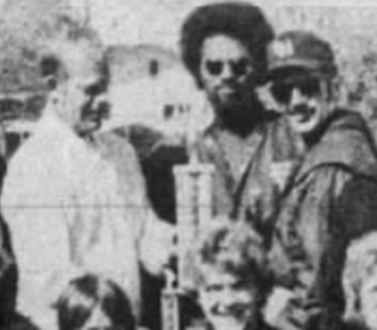
PHOTOS (Top) Longtime coach Don Lukens, far left, is pictured during the 2015 LP Cross Country Finals with past Traverse City Central runner John Steen (center) and Trojans coach John Lober, with Jane and Jack Steen standings in front. Jane and Jack Steen are current Traverse City Central runners. (Middle) The Niles Daily Star published this 1976 photo of Lukens (back row, second from right) and coach Ted Duckett (back row, center) receiving the championship trophy at the Daily Star Relays from publisher Bill Applebee. (Top photo courtesy of John Lober.)

Field Events Push Gladstone Back To No. 1
By
John Vrancic
Special for MHSAA.com
June 2, 2013
KINGSFORD — The grandstand was nearly full at Kingsford's Flivver Field on Saturday. But probably not many people witnessed the work in the field events by the Gladstone boys during the Upper Peninsula Division 1 Track and Field Finals.
Gladstone, which scored 69 points in the field events, finished with 112 for its seventh U.P. championship in 10 years.
The Braves were followed by Menominee 80, Kingsford 73 and three-time defending champ Marquette 61.
"I couldn't be more proud of these kids," said Gladstone athletic director/assistant coach Matt Houle. "They were prepared, confident and ready to go. All the kids stepped up in the field events. We had to dominate those to win the meet. We took control in the field, and the guys in the running events took care of business."
Houle filled in for head coach Gary Whitmer, who suffered a broken sternum in an automobile accident Friday morning.
Senior Jared Vuksan set the U.P. D-1 shot put record at 55 feet, 11¼ inches, topping the previous best (52-1/2) by Braves' now-volunteer assistant coach Kent King three years ago.
 Vuksan, who will play football at Northern Michigan University this fall, also won discus in a school--record toss of 153-2¾, placed fourth in long jump (18-4) and helped the Braves take third in the 400-meter relay.
"My release was a lot better today in disc," Vuksan said. "I evened out my throw, and the disc came out flatter.
"I got the U.P. record in shot on my last throw. I stayed low and my footwork was good. My first throw was 50-5 and I think that set the tone. I really got pumped for the last throw. That was a great way to finish."
Classmate Justin Pederson added firsts in high jump (6-3) and long jump (21-½) and was runner-up in the 100-meter dash in 11.31 seconds.
Kingsford junior Cole Tengesdahl won the 100 (11.26).
"I'm a little disappointed in my 100, although I have to take my hat off to Cole," said Pederson, who plans to run track at Michigan State as a walk-on next year. "In high jump, everyone went out after six feet and I kept going. There was a lot of pressure, but I seem to do better in that situation. After I cleared 6-3, I went up to 6-5 and nicked the bar on my way down.
"My goal in long jump was just to break 21. I just tried to stay consistent."
Junior Chris Sedenquist added a victory in the 400 at 51.39.
Menominee had a triple-winner in senior Bryan Hines, who took the 110 hurdles (15.96) and 300 (41.59) and helped the winning 400 relay.
Sault Ste. Marie freshman Parker Scott, hindered by a foot injury much of this season, won the 800 (2:00.9) and 1,600 (4:31.98). He was the U.P. cross country champion in his division last fall.
PHOTOS: (Top) Gladstone senior Justin Pederson completes a high jump on the way to finishing first with a leap of 6-3. (Middle) The Braves' Jared Vuksan added a fourth place in long jump to his championships in the discus and shot put. (Photos by Eric Thompson; click to see more Gladstone photos at www.ericthompson.smugmug.com.)