

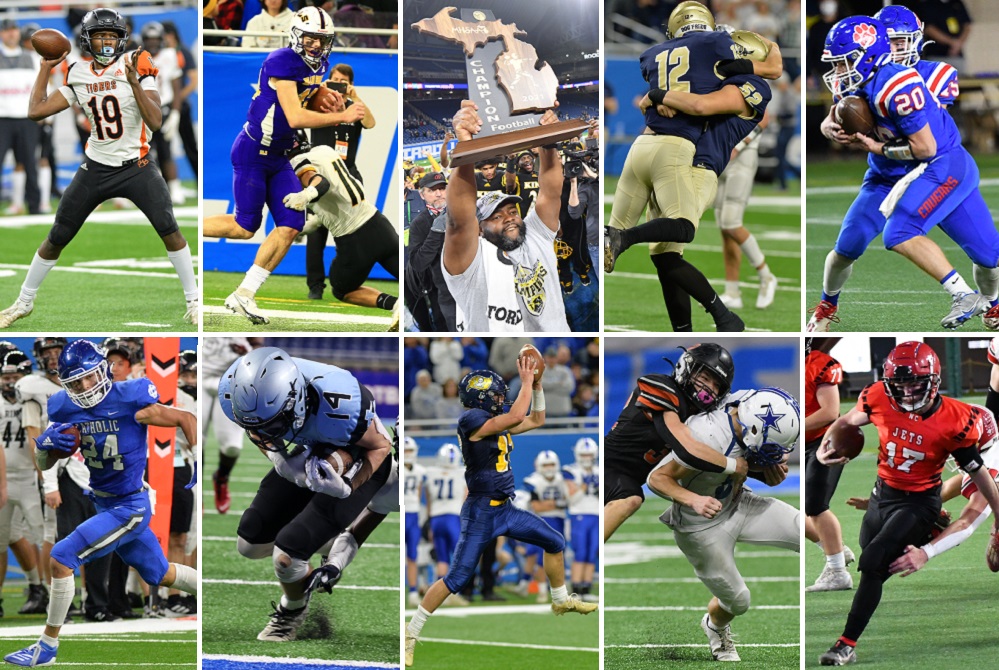
1st & Goal: 2021 Finals Review
By
Geoff Kimmerly
MHSAA.com senior editor
November 30, 2021
Two of the longest MHSAA Finals days at Ford Field – capped by two of the most exciting championship games in recent memory – concluded the 2021 football season this weekend.
 Fans were able to savor every moment until nearly midnight both nights, and more than 38,000 made the trip to Detroit over the two-day 11-player event. That was in addition to those who journeyed from near and far the weekend before for the 8-Player Finals at Northern Michigan University’s Superior Dome, where a pair of repeat champions reigned again.
Second Half covered all 10 championship games, with quick recaps and links (click on the game scores) to those stories below followed by notations of performances entered into the MHSAA Finals record book and a report on some of the biggest and best stories to emerge from the championship weekends.
Finals in Review
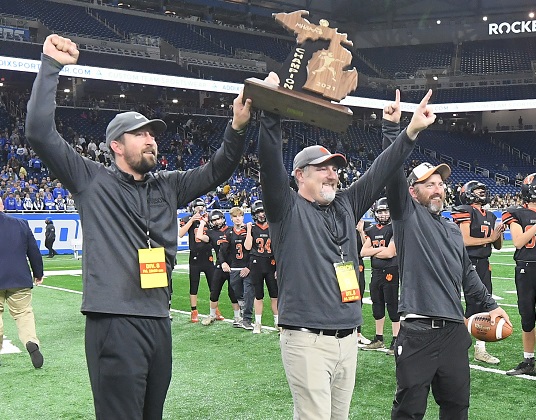
11-Player Division 1: Belleville 55, Rochester Adams 33
After falling a win short of reaching the Final the last three seasons, Belleville advanced this fall and completed its first championship run. Freshman quarterback Bryce Underwood showed on a statewide stage why he’s received lots of attention during his high school debut, and he was surrounded by seniors including receiver Jeremiah Caldwell who helped carry the Tigers to the win.
11-Player Division 2: Warren De La Salle Collegiate 41, Traverse City Central 14
After falling in last season’s championship game, De La Salle took the next step in winning its fourth Finals title – and with expectations we could see the Pilots back at Ford Field again in 2022. Junior quarterback Brady Drogosh has been a big part of both trips, and this time he had a hand in 316 total yards and four touchdowns either running or passing.
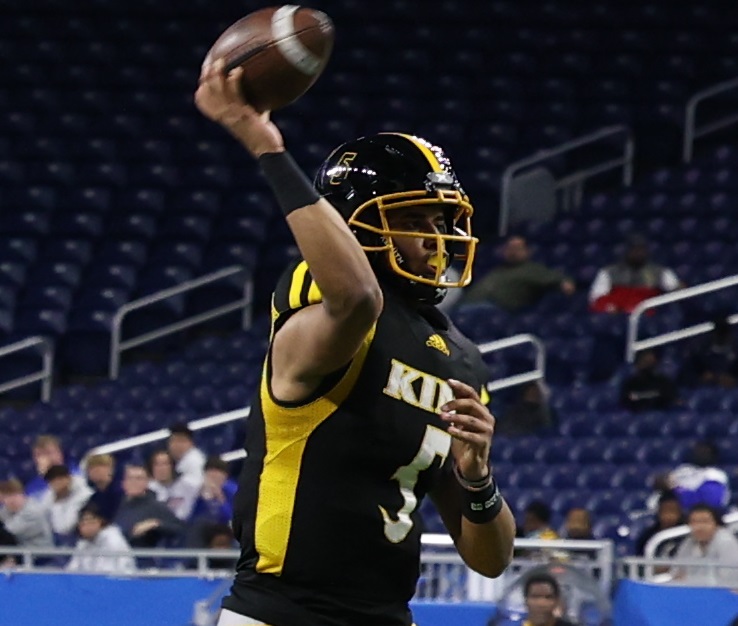
11-Player Division 3: Detroit Martin Luther King 25, DeWitt 21
Two of the state’s premier quarterbacks were on display, junior Dante Moore for King and senior Ty Holtz for reigning champ DeWitt. But the deciding play was a defensive stand – specifically, the Crusaders stopping a 4th-and-goal from their 1-yard line with 2:34 to play. Both teams brought interceptions back for touchdowns, Holtz making the grab and score for DeWitt.
11-Player Division 4: Chelsea 55, Hudsonville Unity Christian 52
This is the game from this weekend many will be referring to years from now. Take your pick why – the 11-Player Finals record 107 combined points, Chelsea’s also-record 28-point comeback over the final 23 minutes, the fact Unity Christian had set the season record for points scored during the game. Maybe the walk-off field goal by Hunter Shaw saved in part by the deft handling of a short snap by quarterback/holder Lucas Dunn.
11-Player Division 5: Grand Rapids Catholic Central 31, Marine City 7
The Cougars won their second-straight championship in Division 5 and fifth over the last six seasons to go with Division 4 titles in 2016, 2017 and 2019. They did so with what has to be one of the finest back-up quarterbacking performances ever – senior John Passinault stepped in for injured past Finals star Joey Silveri and threw for 2,307 yards and 37 touchdowns this fall.
11-Player Division 6: Lansing Catholic 16, Warren Michigan Collegiate 6
The Cougars have been known for their offensive production over the last decade or more, but the defense led the way to their second championship in three seasons – they had won Division 5 in 2019. Lansing Catholic gave up only 40 points – or eight per game – during this playoff run, and in this game took advantage of four interceptions and a fumble recovery.
11-Player Division 7: Pewamo-Westphalia 14, Lawton 10
The Pirates added their fourth championship in six seasons, capping a run which saw them win their league and defeat eight more league champions along the way – one of them Lansing Catholic, the eventual Division 6 title winner. P-W had accomplished most of it with key players out with injuries, but multiple returned to lead the Pirates past Lawton, which was making its first Finals appearance.
11-Player Division 8: Hudson 14, Beal City 7
Defense has reigned in Division 8 the last few seasons, with Hudson following recent champions Centreville and Reading in thriving on that side of the ball. The Tigers ended their undefeated season having given up only 99 points (7.1 per game), and this time stopped a Beal City team averaging 35.5 points per contest entering Ford Field.
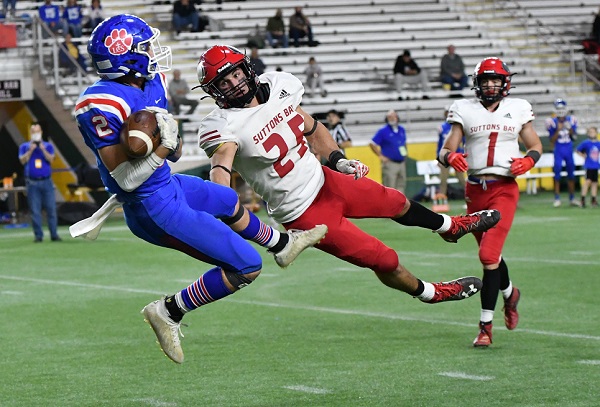
8-Player Division 1: Adrian Lenawee Christian 31, Suttons Bay 20
A rematch of last season’s Division 1 Final was more closely contested, but with the same result as Lenawee Christian finished its second-straight undefeated campaign. Cougars quarterback Ashur Bryja is a name to remember – he opened the scoring 51 seconds in with an interception return touchdown, ran for two more scores and threw for 229 yards.
8-Player Division 2: Powers North Central 63, Colon 0
The Jets won their second-straight Division 2 title and fourth 8-player championship total, and put up a combined 133 points over those last two Finals wins. North Central had 520 yards of total offense this time. Wyatt Raab, Luke Gorzinski and Alex Naser all scored two touchdowns, and Gorzinski also was the team’s leading tackler.
Records Report
11-Player
Chelsea and Hudsonville blew past the previous record of 94 combined points in an 11-Player Finals game with their combined 107. Chelsea’s 55 tied for third-most, with Unity Christian now sitting at sixth on that list after Belleville also scored 55 in Division 1.
As expected from a 55-52 game, Chelsea ended up with the fourth-most total yardage in 11-Player Finals history, with 533, and the teams’ combined total of 1,024 ranks second. Chelsea’s 28 first downs are tied for third-most.
Chelsea’s Lucas Hanifan tied 11-player championship game records with 30 points and five touchdowns, and set the receiving touchdowns record by two with that total. His quarterback Lucas Dunn set the 11-Player Finals record with six touchdown passes while also making the yardage list with 308, pass attempts list with 36 and completions list with 25. Hanifan’s nine receptions also rank among the most in that category.
Belleville freshman quarterback Bryce Underwood may have even exceeded high expectations with his Finals debut, making the total offense list with a combined 346 rushing and passing yards (with 284 passing) and tying for second with four others with five touchdown passes. Senior receiver Jeremiah Caldwell played a big part, tying for second with 204 receiving yards (on only four receptions) and also tying for second with three touchdown catches.
Warren De La Salle Collegiate became the 22nd team to keep an opponent from completing a pass, shutting out Traverse City Central on its nine attempts. Detroit Martin Luther King became the 29th team to not punt in an 11-Player Final.
De La Salle quarterback Brady Drogosh also made the total yardage list with 316 (including 174 rushing). King’s Dante Moore made the completions list with 18 on 24 attempts.
Chelsea’s Hunter Shaw and Belleville’s Brayden Lane tied the 11-Player Finals record held by three others with seven extra points, while in Division 2, De La Salle’s Brady Lowe made the extra point list with five. Shaw and Adams’ Colin Timko became the 11th and 12th, respectively, to make two or more field goals, Timko hitting from 27 and 35 yards in the Division 1 game and Shaw from 26 and 33.
Hudson’s march to victory included 282 rushing yards on 64 carries, which tied for the eighth-most runs by one team in an 11-Player Final.
8-Player
Powers North Central’s big win was accompanied by multiple scoring record book entries, including for 29 points in a quarter (third most), 49 in the first half (first) and 63 for one game (also ranking third). The Jets also made the team rushing yardage list with 328 and the team first downs list with 20. North Central also became the first in the category for fewest rushing yards allowed, holding Colon to -14.
Adrian Lenawee Christian set the team first downs record with 24 against Suttons Bay.
Lenawee Christian quarterback Ashur Bryja earned the sixth-most total yards in 8-Player Finals history, with 372 including 229 passing.
North Central’s Jaden Walters set the standard for 8-player championship game kickers, making all seven of his extra point attempts.
Suttons Bay’s August Schaub set a record that will be tough to match, returning an interception 99 yards for a touchdown against Lenawee Christian.
Teammate Hugh Periard was added with the second-longest rushing play in 8-Player Finals history, 90 yards against Lenawee Christian.
Stories Behind the Scores
Winning streaks grow: A few of this season’s winners not only repeated as champions, but extended overall winning streaks that will be followed closely next season. Grand Rapids Catholic Central has won 36 straight games, tied for the sixth-longest undefeated run. Lenawee Christian has won all 24 8-player games it’s played over the last two seasons, and North Central also is 24-0 over the last two.
What’s new is new: Belleville and Chelsea were first-time champions after some just-misses over the last decade. As noted above, the Tigers made the Semifinals this season for the fourth straight year before reaching Ford Field for the first time, and Chelsea has made the Semifinals five of the last seven seasons and had lost in Finals in 2015 and 2018.
QB Power: Michigan is graduating another fine class of high school quarterbacks – DeWitt’s Ty Holtz, in particular, provided two seasons of memories leading the Panthers on back-to-back trips to Ford Field. But we should expect to see some of the other 2021 championship signal-callers a lot next season. King’s Dante Moore will close one of the most highly-followed careers in some time, and De La Salle’s Brady Drogosh will be watched just as much next fall. Belleville’s Bryce Underwood will generate plenty of statewide interest over the next three seasons. As noted, Lenawee Christian’s Ashur Bryja is one of the next stars among the small schools, and North Central’s Luke Gorzinski has led two championship runs and still is just a junior. Two more to remember: Marine City junior Jeffery Heaslip was a standout run/pass threat in leading his team to the Division 5 Final, and Rochester Adams junior Parker Picot became known at least in-state as much for football leading his team in Division 1 as he’s known as a top-level baseball prospect.
No taking ‘normal’ for granted: Those who experienced the start-stop-start 2020 season will never forget it, nor should any of us who had the opportunity to enjoy a more “normal” 2021. With COVID-19 ever present, Michigan high schools did their parts again to play safely this fall. And proper perspective remains a great teacher of just how much that’s worth.
Second Half’s weekly “1st & Goal” previews and reviews are powered by MI Student Aid, a part of the Office of Postsecondary Financial Planning located within the Michigan Department of Treasury. MI Student Aid encourages students to pursue postsecondary education by providing access to student financial resources and information. MI Student Aid administers the state’s 529 college savings programs (MET/MESP), as well as scholarship and grant programs that help make college Accessible, Affordable and Attainable for you. Connect with MI Student Aid at www.michigan.gov/mistudentaid and find more information on Facebook and Twitter @mistudentaid.

MHSA(Q&)A: NFL official Ronald J. Winter
July 19, 2012
By Brian Spencer
Second Half
 Kalamazoo's Ron Winter has officiated in the National Football League for nearly two decades, and became a referee in 1999. But long before he joined the highest level of the game, he got his start on Michigan's high school fields.
Winter has officiated that sport at all three levels and also high school and college basketball. He's also served as a source of knowledge for officials around the state -- and an example for those hoping to start at the high school level and climb to the pros.
Winter remains registered as an MHSAA official, as he's been for 42 years. An associate professor emeritus of human performance and health education at Western Michigan University, Winter was appointed earlier this month to serve a two-year term on the Governor's Council on Physical Fitness, Health and Sports. The council focuses on increasing physical activity and health improvements.
He served on the WMU faculty first beginning in 1969 and then again from 1992-2008. Winter earned bachelor and master's degrees at Michigan State University.
Did you play any sports in high school or college?
I played football, basketball, baseball, and track in high school. However, once I got to Michigan State University, I started playing lacrosse. A couple guys that lived near me played lacrosse and asked me to come out to throw the ball around. After throwing with them a couple times they asked me to come out for the team. I ended up playing lacrosse for MSU for four years.
How did you decide to choose football as the sport you would officiate?
I started officiating as a student at MSU in their intramural program, officiating touch football and basketball. The next logical step was to then officiate in the high school leagues. From there, I began to proceed to all the different levels.
Are there specific requirements for becoming an NFL official?
The biggest requirement is experience. The progression that I went through went like this:
After officiating high school games, I went to the MIAA (Michigan Intercollegiate Athletic Association). They (MIAA) were looking for people that had 3-5 years of experience at the high school level. From there I went to the Mid-Continent conference. I wasn’t able to go to the Mid-American Conference because I was employed at Western Michigan University.
From there I went to the Big Ten. The Big Ten was looking for people with 5 to 10 years of experience in high school and people that had experience at different positions as an official. I ended up officiating in as a Big Ten football official for 10 years and a Big Ten basketball official for 15 years. I then submitted an application to the National Football League. Coincidentally, the NFL was scouting officials, and had followed me for four years before they finally asked me to be a part of the staff. The NFL decides on who they want to pursue through recommendations and personal interest. They look for personality traits as well as how (officials) carry themselves through different situations.
What has been your favorite level to officiate; High school, college or professional?
I enjoyed officiating all of them, but for different reasons.
I found high school to be the most fascinating because it’s all about the kids; they are playing the game for the love of the game. That is the purest sense of the sport. I loved being involved with kids simply because they love the game.
I found the Big Ten to be most exciting because of the kind of atmosphere that exists on a Big Ten campus on a Saturday afternoon. It’s electric. You don’t get that same sense or the same feel on Sunday afternoon in a pro stadium.
I found the NFL to be most intense. The NFL really has three or four different levels of play during the season. There is preseason play, the first third of the season, the second third of the season, and the last five games of the season. Each level is ramped up another notch as the season progresses. Playoffs are entirely different all together. In terms of the intensity and pure speed of the game, there is nothing like the NFL playoffs.
How important is getting along with your fellow officials on the field?
It’s imperatively important if you want to have a smooth and well-run game. This doesn’t mean that you have to buddy-buddy off the field, but on the field you have to be committed to one goal. We spend two or three hours on meetings Saturday afternoon to go over rules tests, tape, and more to prepare for the next game (and) to get over rough patches that develop on a personal level in a previous week. I need to know that the other six guys are focused and thinking about football like me. Everyone has to have confidence in one another. We spend plenty of time on Saturday to get to the point that we need to on Sunday.
What has been the most exciting game you’ve officiated?
I’ve been in plenty of exciting games from NFL playoff games, to the first Orange Bowl game, to the Rose Bowl, to the Division III Hope vs. Calvin basketball game, to when Indiana played Purdue in basketball. All of them were incredible to be a part of. During the Indiana vs. Purdue game, the arena was electric. The players, coaches, fans were intense. Everybody is totally focused on the game. Each coach had a tremendous respect for one another. Neither one wanted to show up or embarrass their counterpart. This game wasn’t that drastically different at the Division III level, however. The intensity of both was very similar.
Are there games that you get excited to officiate more than others, presently?
Not in terms of specific teams. It really just depends on the circumstances, of course. Pittsburgh vs. Baltimore is an intense game. The Jets vs. Patriots game is great. There are clearly rivalries that are very exciting to be a part of. The level of play and intensity of the athletes in the NFL is unmatched and can provide excitement every week.
What is the most difficult aspect of being a NFL official?
I would say that preparation and being able to maintain intensity on the field on Sunday are key aspects. The preparation is difficult because it’s time-consuming. It is a misconception that we simply show up on Sunday to work the game. By the time Sunday rolls around, I’ve spent over 20 hours during the week trying to prepare for a Sunday game. It isn’t hard in terms of physical labor, but difficult in terms of a time commitment. You have to have an understanding family to be in the occupational field that I am in.
Do you have any advice for aspiring officials who hope to make it to the league?
Practice, practice, practice. Be able to work any game at any level and get as much experience as you can. Be a good partner on the field. It takes time; it isn’t something that just happens. Like anything else, it takes practicing your trade to be able to make it to the top level.