

1st & Goal: 2026 11-Player Semifinals Preview
By
Geoff Kimmerly
MHSAA.com senior editor
November 20, 2026
Seven of last season’s eight MHSAA 11-Player Football Finals champions have reached this year’s Semifinals – but that’s hardly a guarantee they’ll stroll right into playing at Ford Field again next weekend.
 Saturday’s 16 Semifinals are filled with programs that are plenty familiar with playing at this late November date. And those that are not have accomplished more than enough this fall to feel confident they can keep the run rolling all the way to Detroit.
Here's a glance at all 16 games, with all set to kick off at 1 p.m. unless noted. All games can be watched on the NFHS Network at the links provided.
Division 1
Detroit Catholic Central (11-1) vs. East Kentwood (12-0) at Jackson WATCH
This is a rematch of a 2025 Semifinal won by reigning Division 1 champion DCC 46-6. Shamrocks senior quarterback Duke Banta returned from injury last week, and they also can turn to senior running back Ryan Jaafar (1,169 yards/12 touchdowns rushing) in the ground game. East Kentwood has plenty of air power with senior quarterback Colin O’Connor throwing for 2,750 yards and 33 touchdowns, finding senior receiver Steph Jones for 1,206 yards and 18 scores.
Detroit Cass Tech (12-0) vs. Romeo (12-0) at Troy Athens WATCH
Cass Tech is playing to make a third straight Finals trip to Ford Field, and junior quarterback Donald Tabron II has continued to set the pace throwing for 2,133 yards and 30 touchdowns this fall. Romeo is coming off its first Regional title since 2016 and is fueled by a rushing attack averaging 276 yards per game. Senior running back Landen Fetty is averaging 11.1 per carry with 947 total and 15 touchdowns on the ground.
Division 2
Muskegon Mona Shores (11-1) vs. Milford (11-1) at Battle Creek Harper Creek WATCH
Milford is playing in its first Semifinal after avenging a Week 4 31-point loss to South Lyon to claim a Regional title. Senior quarterback Hudson Smith has thrown for 1,791 of the team’s 2,602 passing yards and 14 of the team’s 26 touchdowns through the air. Mona Shores is coming off its first Regional title since 2020 and features a pair of accomplished rushers in senior running back Kevin White (1,174 yards/15 TDs) and junior quarterback Owen Terpstra (1,369/23).
Orchard Lake St. Mary’s (9-3) vs. Grosse Pointe South (11-1) at Novi WATCH
Reigning champion St. Mary’s has enjoyed another massive season from senior quarterback Jabin Gonzales, who has thrown for 2,456 yards and 33 touchdowns and run for seven scores. Grosse Pointe South senior quarterback Sam Rouleau is a serious two-way threat as well, throwing for 2,185 yards and 25 touchdowns and running for 733 yards and 14 scores.
Division 3
Zeeland West (10-2) vs. DeWitt (10-2) at Caledonia WATCH
This is a rematch of a 2024 Semifinal won by West, and after losing that day the Panthers marched to last season’s Division 3 championship. Senior quarterback Griffin Braman has taken the reins of the DeWitt offense throwing for 1,581 yards and 19 scores and running for 1,160 yards and 19 touchdowns. West’s rushing attack is chewing up yards again, totaling 4,236 to this point led by senior running back Brandon Holman (1,378/20 TDs) and junior back Kenny Howe (1,057/10).
Chelsea (12-0) vs. Harper Woods (10-2) at Ypsilanti Lincoln WATCH
These two opened the season together, with Chelsea winning their Week 1 matchup 29-20. The Bulldogs also have topped 4,000 yards rushing with senior running back Gibby Ichesco gaining 1,523 with 21 touchdowns and junior quarterback Jax Ichesco 1,226 and 19, respectively. Senior Dakota Guerrant and junior Deandre Bidden are one of the most talented receiving tandems in the state, with Guerrant leading Harper Woods in both rushing with 772 yards and 18 touchdowns and receiving with 976 yards and 12 scores, and Bidden following with 698 yards and 11 scores rushing and 603 and eight, respectively, receiving.
Division 4
Grand Rapids South Christian (11-1) vs. Grand Rapids Kenowa Hills (11-1) at Rockford WATCH
These past league rivals will face off for the first time since 2023, with Kenowa Hills riding an 11-game winning streak after losing its season opener to DeWitt. There may not be a more balanced offense in the state as the Knights have run for 2,634 yards and thrown for 2,632, led by senior running back Lundon Hampton (1,740 yards/36 TDs rushing) and senior quarterback Grayson Fellows (2,588/25 passing). Senior quarterback Austin Burgess is a dual-threat standout leading South Christian’s multi-faceted attack with 903 yards and 11 touchdowns passing and 11 touchdowns rushing as well.
Detroit Country Day (9-3) vs. Dearborn Divine Child (11-1) at Rochester Adams WATCH
Reigning Division 4 champion Divine Child has won all three meetings with Country Day since they began playing annually in 2024, including 14-7 in Week 3 now that both are part of the Catholic High School League AA. Junior quarterback Drew Sheridan led last year’s Falcons title march and has thrown for 3,315 yards and 34 touchdowns. Country Day is back in the Semifinals for the first time since 2022 and after missing the playoffs the last three seasons. Junior Jacob Patton has run for 1,454 yards and 24 scores.
Division 5
Ogemaw Heights (10-2) vs. Grand Rapids West Catholic (10-2) at Big Rapids WATCH
This is another Semifinal rematch from a year ago, won then by West Catholic 34-24 on the way to claiming the Division 5 title. Senior running back Collin Abram has shouldered the majority of the Falcons’ rushing attack with 1,576 yards and 28 touchdowns. Junior Brenson Keith has done the same for Ogemaw Heights, piling up 2,080 yards on the ground.
Monroe Jefferson (11-1) vs. Frankenmuth (11-1) at Rochester Hills Stoney Creek WATCH
Jefferson is making a return trip to the Semifinals, and senior quarterback Luke Beaudrie has been among constants during the program’s emergence. The Bears are a combined 22-3 over the last two seasons. Frankenmuth is seeking to reach Ford Field for the fourth time over seven seasons, piloted this time by junior quarterback Noah Main, who has thrown for 1,625 yards and 19 touchdowns and run for 794 yards and 18 scores.
Division 6
Kingsley (12-0) vs. Almont (12-0) at Clare WATCH
These two last faced off in the 2023 Division 6 championship game, won by Kingsley, and the rematch might ride on which team’s defense slows down the opposing attack. Senior running back Perry Smith averages nearly 10 yards per carry for the Stags, while senior running back Brody Corneau (1,331 yards/22 TDs) has carried a significant share of the load in getting the Raiders back to the Semifinals for the second straight season and third time in four years.
Detroit Edison (11-1) vs. Jackson Lumen Christi (10-2) at Westland John Glenn WATCH
These two also met in a season opener, with Lumen Christi winning 39-21. The Titans are seeking to extend a four-year Finals title streak, and the win in this Semifinal will tie head coach Herb Brogan with Farmington Hills Harrison’s John Herrington for the state’s all-time lead in football coaching victories at 443. Edison will work to push that achievement to next season, and has given up more than 20 points only once since that Week 1 loss.
Division 7
Ithaca (11-1) vs. Menominee (11-1) a Gaylord (2 p.m.) WATCH
Ithaca has made its reputation over the years for high-scoring offense, but the story this season really has been its defense, which has given up 80 points all season. That said, senior quarterback Gibson Rondy has thrown for 2,510 yards and 32 touchdowns and run for 709 and seven scores. Menominee has won 25 of its last 26 games – including last year’s Final – and senior Jackson Myszak has taken on a starring role running for 1,377 yards and 24 scores for an offense that has reached 38 points nine times.
Ottawa Lake Whiteford (10-2) vs. Ravenna (10-2) at Mattawan WATCH
Ravenna’s first Semifinal trip since 2010 has included avenging a regular-season loss to North Muskegon, while Whiteford has reached this round for the first time since 2023 thanks in part to avenging its season-opening defeat to Monroe St. Mary Catholic Central. Ravenna’s attack runs through junior halfback Brady Kachinski (1,123 yards/15 TDs rushing) and senior halfback Jaxson Wilburn (909/15 rushing), while Whiteford has enjoyed a stat-packing performance from senior Brek Ruddy (2,136 yards/33 TDs rushing, 422 yards/4 TDs receiving).
Division 8
Beal City (12-0) vs. New Lothrop (11-1) at Alma WATCH
This will be Beal City’s fourth Semifinal this decade, and the Aggies have wins over Ravenna and Ithaca in addition to winning all three of their playoff games by at least 29 points. Ten players have run for at least one touchdowns for Beal City, and senior running back Avery Small is averaging 19 yards per carry as the team’s leading rusher. New Lothrop is a two-point Week 3 loss to Montrose from a perfect season as well, and the Hornets are averaging 42 points per game directed by junior quarterback Karson Agnew (1,654 yards/25 TDs passing, 939 yards/16 TDs rushing).
Madison Heights Madison (10-2) vs. Hudson (11-1) at Redford Union WATCH
Last season’s runner-up Hudson is a win away from playing for the title again and coming off scoring a season-high 61 points last week against Springport. Junior running back Beckett Campbell is over 2,000 yards rushing again for the Tigers, this time with 2,132 and 25 touchdowns on the ground. Madison is back in a Semifinal for the first time since 2018 and has outscored its three playoff opponents by a combined 131-29.
MHSAA.com's weekly “1st & Goal” previews and reviews are powered by MI Student Aid, a division within the Department of Lifelong Education, Advancement, and Potential (MiLEAP). MI Student Aid encourages students to pursue postsecondary education by providing access to student financial resources and information. MI Student Aid administers the state’s scholarship and grant programs that help make college Accessible, Affordable and Attainable for you. Click to connect with MI Student Aid and find more information on Facebook and Twitter @mistudentaid.
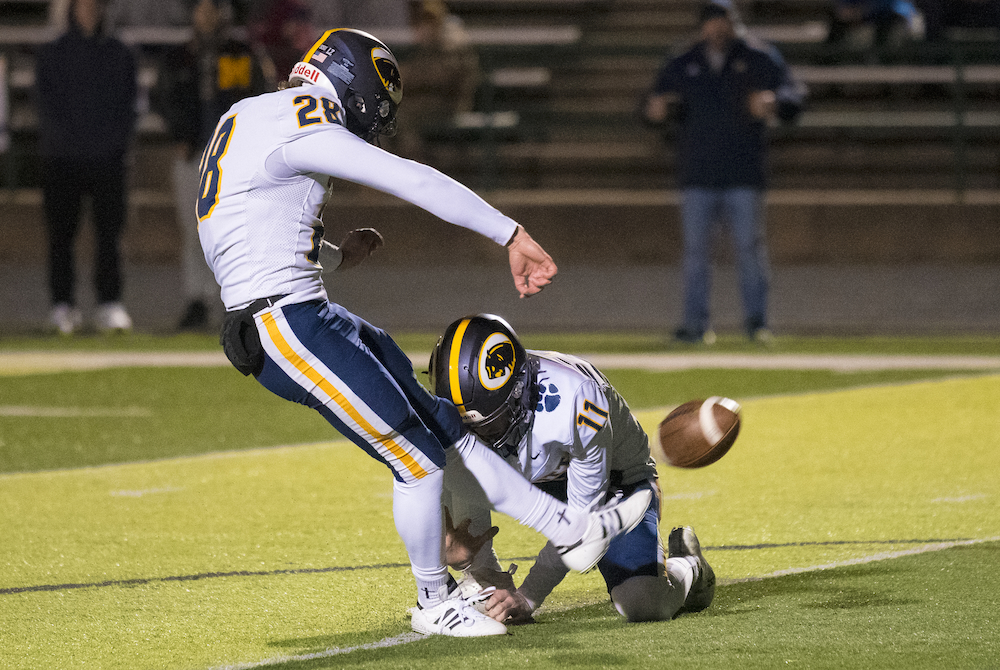
PHOTO DeWitt kicker Vincent Rose (28) steps into an extra-point attempt, held by teammate Isaac Bean. (Photo by TCP Photography.)
Forgotten Series Named 1st Grid Champs
November 29, 2016
By Ron Pesch
Special for Second Half
“In the first decade of this century, there were some very, very unsavory things going on in high school sports," said MHSAA sports historian Dick Kishpaugh back in 1999. "Though teams used school names as if they represented their high schools, schools didn't set policy, players did. … Serious injuries were common, gamblers arranged games, and shady recruiting practices were the norm.”
On March 31, 1899, at the Michigan State Teachers’ Association meeting hosted in Ypsilanti, discussion took place about a proposal that had been put forth by some high schools. The request was to form a statewide “conference with a view to arranging (a) series of base and football games between those schools which adopt the rules.”
Speaking in 1907, Herbert W. “Buck” Read, a coach at Kalamazoo Central High School (and later head basketball coach at modern-day Western Michigan University) recalled the purpose of the plan was “to do away with the chaotic state of affairs then existing in high school football circles” as teams and communities jockeyed for superiority and arranged games that did little more than create an “opportunity to those of betting proclivities.”
The proposal advanced to the Association’s High School Athletic Committee. There, a plan was formed for a playoff system designed to identify a state football champion. The system would be governed by the Committee and run by the Interscholastic Department of the University of Michigan Athletic Association. The playoffs would then culminate with a championship game played at the university on Thanksgiving Day.
By late summer, it was decided to broach the subject with Michigan’s schools.
As Lewis L. Forsythe noted in his book, “Athletics in Michigan High Schools: The First Hundred Years,” the prosperity of the Technological Revolution, combined with the fact athletics were achieving new popularity in colleges and schools, helped propel expansion of athletic activities across the nation.
At the time, there were 165 high schools in incorporated cities and villages with populations of 1,000 or more scattered across Michigan. Only 72 enrolled more than 100 students (including girls).
A League is formed
Letters were sent to state high schools, offering application for membership in this new Michigan Interscholastic Athletic League. While a number of schools opted to remain independent, by deadline, there were 42 teams accepted into the “Interscholastic.”
 The state was divided into six geographical “sections” and “sectional” games were arranged by the league, designed to allow for sectional championship contests to be scheduled for Nov. 9. District championship title games, designed to produce a Western division and an Eastern division champion, were scheduled for Nov. 23. The state title game between east and west was then scheduled for Thanksgiving Day at the University of Michigan’s Regents Field.
Complications quickly surfaced. Transportation at the time was primarily by rail or trolley line, and many teams had to travel a fairly great distance to face scheduled league opponents. Almost immediately, some schools dropped out of league play or forfeited games because of travel expense.
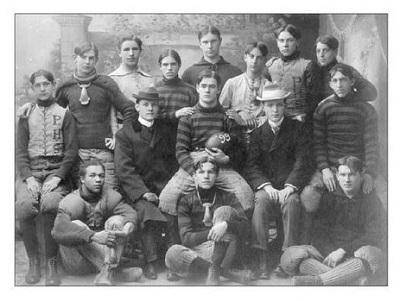
Still, 33 games were played by the high school teams belonging to the “Michigan Interscholastic Football League.” Pontiac, which defeated Bay City in the semifinals, emerged as the state’s first playoff champion with a thrilling 6-5 victory over Western representative Plainwell before a reported crowd of 1,000. Plainwell had downed Escanaba in the semis to reach the final game.
U.P. Power
Because of the complications, talk of disbanding the league erupted in the media. But, with some minor modifications, including more local control over scheduling, the playoffs were again planned for the fall of 1900.
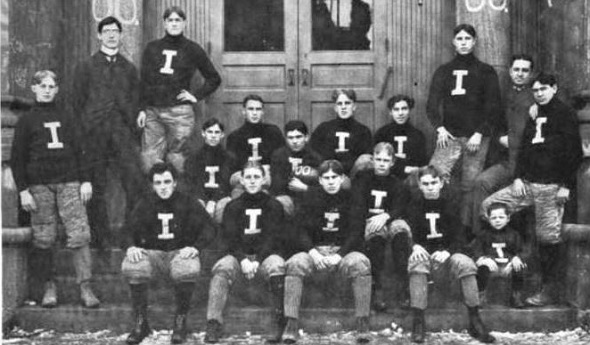
Ishpeming and the Michigan Military Academy of Orchard Lake emerged from a field of 34 teams to square off for the title at Regents Field. In a battle of “speed against weight,” the boys from the Upper Peninsula, averaging 135 pounds, completely outplayed their heavier opponent, and grabbed a 12-5 win. According to The Michigan Alumnus, financially, the event lost money, as a crowd of only around 300 attended the title game. Still, the university saw the “Interscholastic” as a success. According to the university’s annual, Michiganian, during the season, the Athletic Association was forced to apply “some severe measures in its governance of the football contests, thus showing members of the league that they must learn to be square and businesslike.”
On the other hand, the championship contest served as a great opportunity to expose athletes to the campus. Without question, recruitment of future university athletes was an underlying desire. Anderson of Ishpeming was identified as the top player of the day. According to the Alumnus, “Michigan needs a few such as he.”
By mid-November, the 1901 interscholastic series saw the race narrowed to Kalamazoo, Lansing, Orchard Lake, Ann Arbor, Alpena and South Haven in the Lower Peninsula, while Ishpeming, which knocked off Escanaba 11-0, had emerged again as the Upper Peninsula champion. Ultimately, Kalamazoo downed Lansing on Thanksgiving Day to set the stage for the title game on Saturday, Dec. 7.
Although cost concerns related to bringing Ishpeming to Ann Arbor threatened to derail plans for the championship game, the contest was played. In a close battle, the faster Ishpeming squad again prevailed, 27-21. The team returned to the U.P. to a great reception. According to the Detroit Free Press, “a procession was formed at the depot with the footballists occupying seats on a chariot. … Mine whistles and bells of the city sounded for thirty minutes, while thousands of school children and others gave school yells.” It was estimated that 8,000 fans came out, making a procession six blocks long.
In 1902, Escanaba nearly ended Ishpeming’s championship reign, as the teams played to a scoreless tie in early November. However, ties in Interscholastic League action meant the game had to be replayed. Ishpeming downed Escanaba, 11-5, in the rematch and again returned to Ann Arbor for the championship game. There they flexed their speed and skills in a 35-12 victory, this time over Lower Peninsula champion Benton Harbor in a game played at Michigan’s Ferry Field. A total of 34 high schools participated in the Interscholastic League that fall.
Financial challenges and eligibility questions
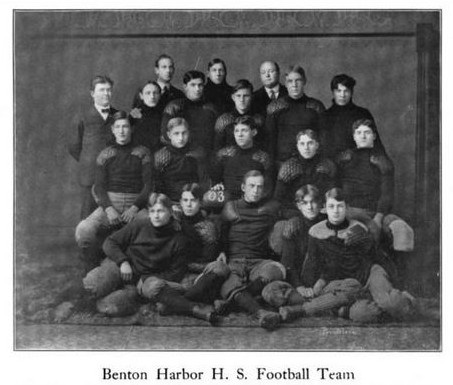
Benton Harbor returned to the championship game in 1903 with a squad averaging 160 pounds, unusually heavy for the time. Up north, Escanaba defeated Ishpeming 34-2 to punch its ticket to Ann Arbor. The state championship contest, played on Thanksgiving Day, was one-sided and decisive as Benton Harbor rolled to a 22-0 victory. According to press reports, at no time was their goal line “in danger.” The championship series, however, was threatened as university officials again declared the title game was simply unprofitable as travel costs outweighed ticket revenue.
Still, another attempt was made in 1904 as 46 schools, 29 from the Lower Peninsula and 17 from the U.P., opted to battle for the Interscholastic football crown. League contests opened Oct. 1 with the Lower Peninsula championship game scheduled for Nov. 19. Many schools, especially in the larger cities, continued to avoid participation, due to the inconvenience of arranging contests around Interscholastic dates, as well as the simple fact that more revenue could be generated by playing local or familiar opponents.
 In a major upset, Mount Pleasant won the 1904 Lower Peninsula championship honor by downing heavily-favored Benton Harbor 11-0 at Fancher Field in Mount Pleasant before a crowd of 1,800. Five passenger coaches, filled with Benton Harbor fans and a band, made the trip north for the early morning game. Fred Norcross, quarterback and incoming captain of the University of Michigan football team, was also in attendance. Quoted in the Michigan Daily, he lent some insight into the way the game was played at the time.
“It was a good clean game, free from slugging and unnecessary roughness, and the way the Mt. Pleasant boys worked to help the man with the ball along was great,” he said. “They would drag a man five yards after he was down.”
Escanaba, a 12-6 winner over Menominee, earned the U.P. crown. The Interscholastic championship game at Ann Arbor on Thanksgiving Day was surrounded with controversy. Just prior to the game, a protest had been raised by Benton Harbor with claims that Mount Pleasant had used an ineligible player in their contest. Bay City, defeated by Mount Pleasant in Interscholastic play the previous week, joined the protest. The complaints, it appears, were dismissed, as Escanaba defeated Mount Pleasant 16-5 for the state title. Following its school’s defeat in the title contest, the Mt. Pleasant Courier “denounced the Escanaba team as having three ineligibles.”
Following the game, newspapers reported that both Detroit Central and Muskegon finished the season undefeated and were considered outstanding teams, but since they did not compete in the Interscholastic series, both were unable to lay claim to the official state title.
Tightening the rules
Perhaps as a result of questions concerning eligibility that surrounded the previous season, the 1905-06 school year brought changes. The management duties of the Interscholastic Athletic League now fell into the hands of a state “Athletic Director,” the duties of which were assumed by Principal C. G. Wade of Flint. A tightening of regulations and rules tied to management of high school athletics in Michigan also were enacted. Very specific requirements for enrollment, age and allowed number of years of eligibility were defined. Players could not be compensated for their athletic skills. Transfer between schools now required certification of eligibility from a superintendent or principal before a student was allowed to compete at a different school. Football players needed to pass a physical examination and have parental consent to compete. Passing marks, as defined by the school, were now a requirement for play.
Participation decreased as some of the state’s larger schools joined the League.
“What is the matter with the high schools of the third inter-scholastic district?” asked a writer in the Benton Harbor News-Palladium at the beginning of the 1905 season when it was announced that only three teams – Benton Harbor, Plainwell and Allegan – would compete in their section of the Interscholastic League. “Where is Kalamazoo? Is South Haven afraid? Does Hastings know anything about football? Why don’t St. Joseph enter the race? What is the matter with Cassopolis and the other places in the district …”
The tournament fell into disarray in the final weeks of November. Ishpeming was identified as the U.P. champion, but as of Nov. 24, it appeared that the state title would not be decided. Frontrunners for the Lower Peninsula crown were Ann Arbor and Grand Rapids Central, but the schools couldn’t come to an agreement on a location for the game. A ruling by director Wade identified Grand Rapids as the proper venue, but Ann Arbor felt the game should be played locally.
Then Kalamazoo High School announced it felt it should be the team playing Ann Arbor for the Lower Peninsula crown as it had beaten Grand Rapids earlier in the year. With an undefeated and unscored upon record, Kalamazoo should be an obvious choice.
Wade noted that while Kalamazoo had impressive record, the school had chosen not to participate in Interscholastic League play. Since the game with Grand Rapids was not considered an Interscholastic contest, the loss didn’t affect Grand Rapids’ pursuit of the League title.
Finally, since Ann Arbor refused to travel, it were forced by the league to forfeit the semifinal game. So, a championship contest between Grand Rapids and Ishpeming was scheduled.
Plans to play the game at Ann Arbor, announced earlier in the season, were scuttled and the contest was scheduled for 10:30 a.m. at Ramona Park in Grand Rapids. The Upper Peninsula again emerged as champion, as Ishpeming exposed a weak Grand Rapids defense and posted a 17-5 victory. The move of the game to the site of one of the participants appeared to be a wise one, as 800 paid admissions were collected.
(In an interesting turn of events, Ann Arbor opted, instead, to play a Thanksgiving Day road game with Kalamazoo High. Kalamazoo downed Ann Arbor 16-0 to finish the year as the state’s first unbeaten, untied and unscored upon team.)
The format unravels
Nationally, the brutality and danger of football was being discussed, and calls were to ban the game. President Teddy Roosevelt heard the cries and convened a panel of football authorities to investigate and suggest changes to save the game he loved. In 1906, sweeping alterations to the rules were unveiled and opened the game to the forward pass.
That fall, Muskegon and Benton Harbor emerged as finalists for the Lower Peninsula title. Muskegon had defeated Benton Harbor earlier in the season; however, in a twist of league rules, since the game had not been scheduled by the League office, the result of the contest had no impact on the championship series. After much debate over location and selection of officials, a record-breaking crowd of 1,500 was expected in Muskegon for the rematch, as the implications from a victory drew interest well beyond the borders of both cities. Extra streetcars were scheduled to move the crowd to the site of the contest, and the newspaper social pages were filled with reports of folks heading to Muskegon for the game.
Outplayed and out punted, the “Red and White of Muskegon” fought to the finish before a crowd of “about 1,600 paid admissions,” but fell 20-0 to the “orange sox” of Benton Harbor. The visitors capitalized twice on Muskegon fumbles, scoring a touchdown early in the game and another off a mishandled punt.
Revenue of over $500 (equaling around $13,000 in 2016) was generated from ticket sales. With expenses of around $175, including the $125 paid to Benton Harbor management, organizers were pleased. The following week Benton Harbor agreed to bear the expense if Escanaba would “defend the championship of the Upper Peninsula” in a Saturday, Nov. 24 game to be played in Benton Harbor, with University of Michigan officials in charge.
The Escanaba team left Wednesday for the event and arrived on Friday. The visitors ran through signals at Benton Harbor’s Fourth Division Armory before retiring for the night.
“Before a madly enthusiastic throng of three thousand spectators, Benton Harbor ran wild, overwhelming their guests from Escanaba, 50-0.
More complications
Still, dissention surfaced. Officials at Muskegon High School announced plans to resume playing an independent schedule in 1907, due to concerns about play of ineligibles appearing in its game with Benton Harbor the previous year, and ringers appearing in a spring baseball championship sponsored by the Interscholastic. A newspaper article in October noted the league was down to three teams: Ann Arbor, Saginaw and Benton Harbor. According to a report in the Muskegon Chronicle, the “arbitrary manner in which the executive committee arranged games” was stated as the primary reason the League was disfavored. Because of this, it was generally expected that the Interscholastic League would wither and die within a year.
Yet by season’s end, Muskegon was involved in the mix for a state title.
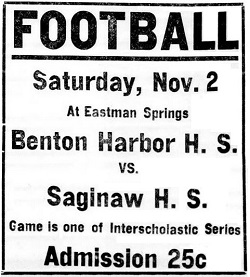 After three contests, it appears “the Red and White” had a change of heart and applied for membership in the Interscholastic League. As of Nov. 7, six teams were still in the state title race: Alpena, Saginaw, Muskegon, Big Rapids, Ann Arbor and Lansing.
In a bizarre twist, Muskegon’s later application and delays in paying a $12 membership fee to the League became the pivot point in the Interscholastic’s next move. According to a Nov. 14 Detroit Free Press article, “the question of Muskegon’s eligibility to compete for the state high school championship had been deferred (until a state board meeting) and that Saginaw would therefore play Ann Arbor. …The winner of this game will play Muskegon, if the latter is admitted, in the final of (the) state series.”
Ann Arbor High School, which had beaten Muskegon earlier in the year and stood unbeaten and unscored upon, was extremely upset by the decision. Ann Arbor now had to face Saginaw, also unbeaten, with the winner still facing the possibility of meeting once-beaten Muskegon.
A bizarre safety assessed against Ann Arbor in the final minutes of its battle with Saginaw made matters worse. Leading 6-5 near the close of the contest, an Ann Arbor player fielded a bounding punt, “lost his head” and “deliberately ran back (of) his own goal line,” where he touched it down “instead of trying to make a gain or calling ‘down’ when he picked up the ball.” The two points awarded to Saginaw were all that were necessary to win.
With that victory, many felt Saginaw had gained rightful ownership of the Lower Peninsula title. The state athletic board of control, at its meeting in Ann Arbor, formalized Muskegon’s acceptance into the Interscholastic, and voted to give Muskegon, as a member, the right to demand a game with Saginaw. Noting the earlier Ann Arbor loss, the board also suggested that, in the interest of true sportsmanship, Muskegon should concede the state crown.
Muskegon High School officials contacted Saginaw and did concede the Lower Peninsula title, but still requested a game.
Casting aside the format of past Interscholastic championships, Saginaw did not play the Upper Peninsula champion, Escanaba, but rather accepted the Muskegon challenge.
Some 400 Muskegon enthusiasts brought to Saginaw by train helped form the largest crowd ever at Recreation Park, estimated at 5,000. In the end, disappointment reigned on both sides as the contest ended in a scoreless tie.
Following the showdown, the Upper Peninsula media weighed in.
“The recent dispute between the high school football teams of Escanaba and Saginaw over conflicting claims to the state championship has caused much discussion, but as there exists no court for the decision on a controversy between an upper and lower peninsula athletic team, the matter will very likely die as it is at present and the state will have two champion football elevens,” stated the Hancock Journal.
According to the Sault Ste. Marie Evening News, Michigan needed a state interscholastic athletic association, and “it is evident that until some such organization is formed, there will be no deciding of a championship in case of contention from any of the teams in the race.”
At the conclusion of the season, “Buck” Read spoke about the failure of the Interscholastic as time went on.
“The interscholastic divided the state into sections, played the winners of the sections against each other, and finally by a process of elimination managed to arrive pretty closely at the real championship,” he said.
“The plan looked good on paper, and as long as the university exercised a direct regulation particularly in that game which was for several seasons played at Ann Arbor, the interscholastic awakened a general, definite interest. But a season prosecuted under such an uncertainly arranged schedule, as was necessarily the case, proved unusually ruinous financially to the schools participating. Often a match had to be played between towns several hundred miles apart, entailing great expense, and often providing a poor drawing card when one of the contestants was a team ordinarily of little reputation. So a number of the bigger schools drew out and arranged schedules on a financial basis. The university authorities too, finally refused to guarantee the concluding game.”
One last gasp, and a new beginning
Somehow, the Michigan Interscholastic League survived for another season, although with few participants.
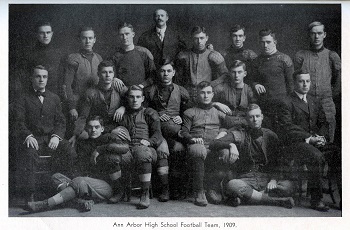
Ann Arbor, led by three touchdowns from future U-M great John Maulbetsch, earned the League title, upsetting Benton Harbor, 16-5, at University of Michigan’s Ferry Field. Pontiac and the Detroit University School, teams with outstanding undefeated marks, then clamored for a chance to play Ann Arbor.
Both had competed outside the M.I.A.L. during the 1908 season. Ann Arbor ignored Detroit University School, likely the stronger of the two teams based on season results, and scheduled a contest with Pontiac for Thanksgiving Day. The game was won by Ann Arbor 24-0.
At the Schoolmasters’ Club meeting on April 2, 1909, the High School Athletic Committee addressed the broadest issue that the Michigan State Teachers’ Association faced. It was recommended “there be formed a State organization to be composed of all high schools of the State that will sign an agreement to abide by the laws passed at the meetings of the Schoolmasters’ Club.”
It is also recommended to the committee, “that (athletically) a full schedule of all the schools in this organization shall not be made but that the different schools make out their own schedule and from such schools in the organization as they most prefer.”
 The upcoming 1909 season saw a further tightening of the athletic rules, as the Michigan Schoolmasters’ Association issued strict code that barred paid coaches, requiring instead that a school’s coach must be part of the faculty of the school. In addition, “sweaters and such awards cannot be made to the athletes, only ribbons and banners being given.”
In mid-August, the Detroit Free Press stated that the new rules would be unacceptable to most: “Most of (the state schools) are not prepared, and it looks like a safe bet that the Michigan Interscholastic contenders are not going to chase out some professor that knows football of a few years back and risk their reputations on his game.
“Then there is the matter of awards. The schoolmasters have tabooed the sweaters and that stuff, and will in the future award a ribbon or something similar,” continued the paper. “Where will the big old numeral of days gone by come in? How many football men will play for the honor of the school, and not have the pleasure of sporting the big letter on their manly breasts?”
The new rules, along with complaints concerning the handling of previous tournaments and various other issues, resulted in the final unraveling of the Interscholastic League.
“… Interest in high school football will not decline because of the death of the interscholastic league,” stated a September 1909 syndicated article that appeared in the Benton Harbor News-Palladium and the Grand Rapids Press. “The leading high school teams of the state have banded together in much the same old way and will play for the championship of the state just as though the league or even something better existed.”
With a number of athletes back, Ann Arbor again ended the year with Lower Peninsula laurels. Its schedule included wins over Muskegon, Detroit Central, Saginaw and Grand Rapids. On Thanksgiving Day, the “Purples” defeated Menominee, a power from the Upper Peninsula, 42-0.
“This victory gives the local high school a clear title to the state championship,” stated the Ann Arbor Daily Times News.
The following year saw a major change that eventually would set wheels in motion to create the system of determining football champions we have today.
On Oct. 28, 1910, at the M.S.T.A. convention held in Bay City, a new organization, the Michigan Interscholastic Association, was formed. It served the state’s schools until December 1924, when it was replaced by today’s Michigan High School Athletic Association.
The first MHSAA Football Playoffs were conducted in 1975. The 42nd version of the tournament concluded this Thanksgiving weekend.
 Ron Pesch has taken an active role in researching the history of MHSAA events since 1985 and began writing for MHSAA Finals programs in 1986, adding additional features and "flashbacks" in 1992. He inherited the title of MHSAA historian from the late Dick Kishpaugh following the 1993-94 school year, and resides in Muskegon. Contact him at [email protected] with ideas for historical articles.
PHOTOS: (Top) Ishpeming's 1900 football team, the second Interscholastic League champion. (Middle top) Pontiac's 1899 team, which won the first League title. (Middle) Benton Harbor's 1903 championship team. (Middle below) An advertisement tells of the 1907 Saginaw/Benton Harbor final. (Below) Ann Arbor's 1909 championship team. (Photos collected by Ron Pesch.)