

Be the Referee: Football Holding
By
Sam Davis
MHSAA Director of Officials
August 27, 2024
Be The Referee is a series of short messages designed to help educate people on the rules of different sports, to help them better understand the art of officiating, and to recruit officials.
Below is this week's segment – Football Holding - Listen
In football, it’s often said that holding happens on every play. But does it?
When an offensive player uses their hands or arms to illegally restrain a defensive player – that’s holding. This typically happens when blockers grab or pull defensive players away from their path – impeding their ability to make a play. The penalty is 10 yards from the previous spot.
Defensive players can be flagged for holding as well. That’s also a 10-yard penalty. An example of defensive holding is when a cornerback grabs a receiver to slow him down before the ball is thrown. If that same contact happens while the pass is in the air – then it’s pass interference. Defensive pass interference is a 15-yard penalty.
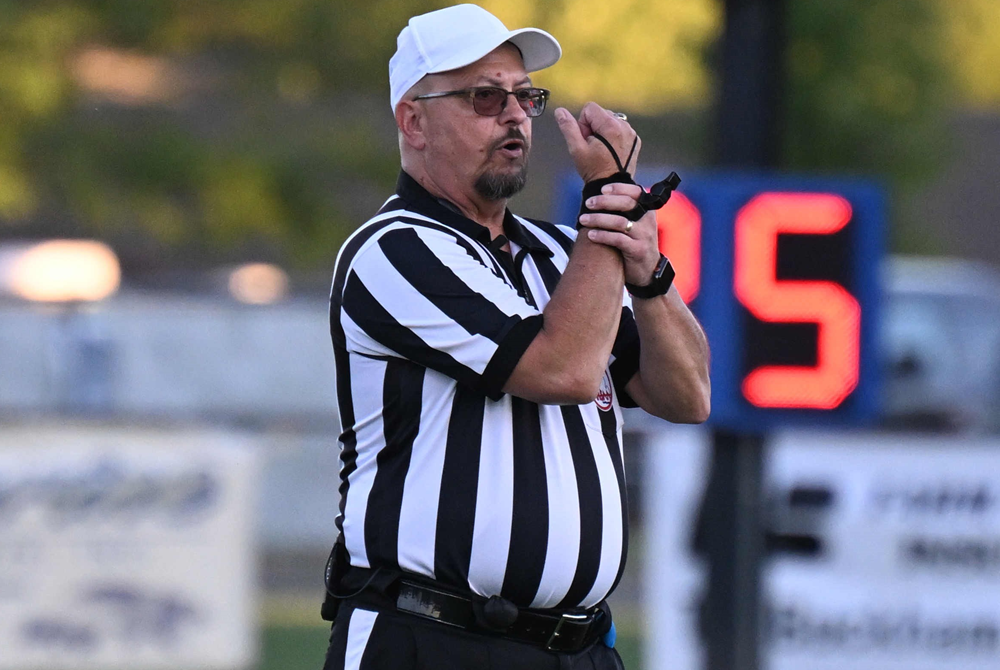
PHOTO A football official signals holding during a 2023 game. (Photo by Gary Shook.)
Title IX at 50: Girls Lacrosse Finals Officials Set Empowering Example
By
Geoff Kimmerly
MHSAA.com senior editor
June 14, 2022
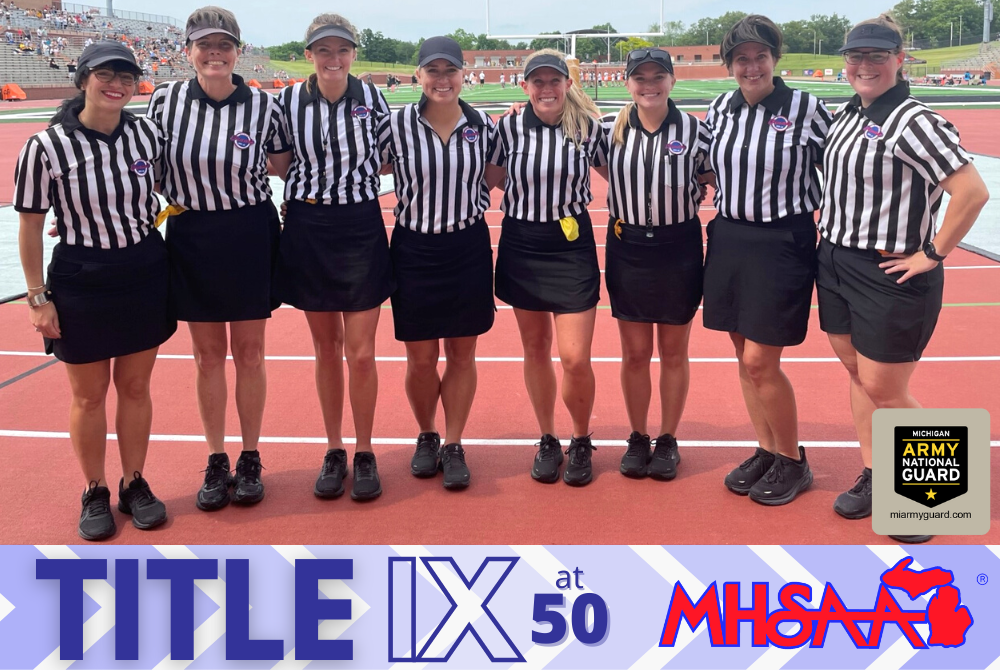
Saturday's MHSAA Girls Lacrosse Finals – and notably the two crews who officiated those two championship games – perfectly exemplified what we’ve commemorated in recalling the legislation and opportunities Title IX has provided for girls and women in athletics over the last half-century.
Eight women – four for each game – officiated this season’s girls lacrosse championship contests: Anne Acluche, from West Bloomfield; Sierra Bain, Ferndale; Laura Berger, Lake Orion; Ellery Blasch, Alto; Sydney Jaenicke, Rockford; Virginia Merlo, Ferndale; Marci Schaeffer, Eaton Rapids; and Paige Winne, from Lansing. Berger (15 years) and Acluche (14) both have officiated girls lacrosse nearly since its beginning as an MHSAA-sponsored sport in 2005.
MHSAA assistant director Kathy Vruggink Westdorp explained the significance of these all-woman officiating crews in her letter to each announcing their selection for the Finals:
“You are an important part of the past as well as the future of girls and women’s sports.
“While watching girls lacrosse throughout the last eighteen years, it has been amazing to see the evolution of the game. The athleticism that we see today by some of Michigan’s most skilled female athletes would never have been possible without the passage of Title IX and the offerings of sports for girls and women through our nation’s schools. … You have all been an important part of this journey as role models for these young women.
“Thank you for providing opportunities, action and validation for young girls and women. We will continue to be charged with educating and empowering the next generation in this quest. It is so exciting that youth today can see female athletes, officials and administrators lead the way to a future with unlimited options.”
Both championship games ended with 12-11 scores – Brighton edging Grand Rapids Forest Hills Northern/Eastern in overtime in Division 1, and East Grand Rapids narrowly defeating Detroit Country Day by sudden victory in Division 2.
Second Half's weekly Title IX Celebration posts are sponsored by Michigan Army National Guard.
Previous Title IX at 50 Spotlights
June 7: From Gymnastics to Wrestling, Girls Opportunities Continue to Grow - Read
May 31: Mumford Sprinter's Magnificent 2006 Final Remains Unmatched - Read
May 24: Scane, Whiteside Alone on 400-Goal, 500-Point Girls Lacrosse Lists - Read
May 17: Over 8 Days in 1988, Pair of Champs Set No. 1 Singles Standard - Read
May 10: Portage Central's Tarpley Scores as State's Superstar, U.S. Soccer Hero - Read
May 3: Prychitko 'Legend In Her Own Time,' Legend for All Time - Read
April 26: Braddock vs. Verdun Still Striding Among All-Time Sprint Matchups - Read
April 19: Holmes' Strikeout Record Rarely Approached, May Be Unbreakable - Read
April 12: Anticipation High as 45,000 Girls Return to Spring Sports - Read
April 5: Regina's Laffey Retiring as Definition of Legendary - Read
March 29: Edison's Whitehorn named 2022 Miss Basketball - Read
March 22: Carney-Nadeau Sets Girls Hoops Standard with 78-Win Streak - Read
March 15: Binder Among Voices Telling Our Story on MHSAA Network - Read
March 8: 28 Years, Thousands of Cheers - Read
March 1: Kearsley Rolls On Among Girls Bowling's Early Successes - Read
Feb. 22: Marquette Ties Record for Swim & Dive Finals Success - Read
Feb. 15: Jaeger's 2004 Winter Run Created Lasting Connection - Read
Feb. 8: Marian's Cicerone to Finish Among All-Time Elite - Read
Feb. 1: WISL Award Honors Builders of State's Girls Sports Tradition - Read
Jan. 25: Decades Later, Edwards' Legend Continues to Grow - Read
Jan. 18: Iron Mountain Completes Championship Climb - Read
Jan. 11: Harrold's Achievement Heralds Growth of Girls Wrestling - Read
Dec. 20: Competitive Cheer Gives Michigan Plenty to Cheer About - Read
Dec. 14: Evelyn's Game Had Plenty of Magic - Read
Dec. 7: Council Term Ends, But Leinaar Leaves Lasting Impact - Read
Nov. 30: Basketball Season Ready to Add to Rich Tradition - Read
Nov. 23: Marysville Builds Winning Streak Yet to be Challenged - Read
Nov. 16: Wroubel Has Championed Girls School Sports from Their Start - Read
Nov. 9: Pioneer's Joyce Legendary in Michigan, National Swim History - Read
Nov. 2: Royal Oak's Finch Leading Way on Football Field - Read
Oct. 26: Coach Clegg Sets Championship Standard at Grand Blanc - Read
Oct. 19: Rockford Girls Set Pace, Hundreds After Have Continued to Chase - Read
Oct. 12: Bedford Volleyball Pioneer Continues Blazing Record-Setting Trail - Read
Oct. 5: Warner Paved Way to Legend Status with Record Rounds - Read
Sept. 28: Taylor Kennedy Gymnasts Earn Fame as 1st Champions - Read
Sept. 21: Portage Northern Star Byington Becomes Play-by-Play Pioneer - Read
Sept. 14: Guerra/Groat Legacy Continues to Serve St. Philip Well - Read
Sept. 7: Best-Ever Conversation Must Include Leland's Glass - Read
Aug. 31: We Will Celebrate Many Who Paved the Way - Read
PHOTO From left: Virginia Merlo, Laura Berger, Paige Winne, Ellery Blasch, Sydney Jaenicke, Sierra Bain, Anne Acluche and Marci Schaeffer. (MHSAA file photo)