

Be the Referee: No Tackle Box
October 3, 2019
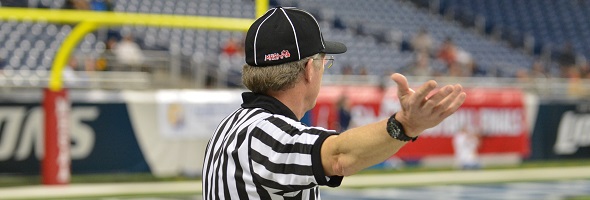
This week, MHSAA officials coordinator Sam Davis explains the difference between high school and college/pro rules in regards to the football tackle box and intentional grounding.
Be The Referee is a series of short messages designed to help educate people on the rules of different sports, to help them better understand the art of officiating, and to recruit officials.
Below is this week's segment - No Tackle Box - Listen
Today we are going to talk about the rules that govern the quarterback, specifically when the quarterback is being rushed and is looking to throw the ball away and avoid the sack.
Under both pro and college rules, they have what’s called the tackle box. When the quarterback gets outside of the original position of the offensive tackles and throws the ball and it reaches the line of scrimmage, there is never a foul for intentional grounding.
However, under high school rules there is no such thing as a tackle box. If the quarterback is either in pocket or scrambles outside of the pocket and now is trying to throw that ball away to avoid the sack, there always must be a receiver in the vicinity of the pass to avoid an intentional grounding foul.
Past editions
Sept. 26: You Make the Overtime Call - Listen
Sept. 19: Swimming Finishing Touch - Listen
Sept. 12: Curbing Gamesmanship By Substitution - Listen
Sept. 5: Football Safety Rules Changes - Listen
Aug. 29: 40-Second Play Clock - Listen
Drive for Detroit: Playoff Week 1 Preview
October 26, 2017
By Geoff Kimmerly
Second Half editor
Michigan’s high school football championship quest is set to begin this weekend in historic fashion, with a record 288 teams taking part in this 43rd MHSAA Playoffs.
 So let’s get right to it. Our “Drive for Detroit” previews powered by MI Student Aid will follow a similar format as during the regular season, except that instead of organizing the must-watch games by region we’ll pick out some of the most intriguing from every division – including the two 8-player divisions in something of a “March to Marquette.”
There are a variety of options to watch 13 playoff games live tonight – click Prep Zone for four free broadcasts from FOX Sports Detroit and check out the MHSAA.tv schedule – and be sure to keep up with all of the scores and new pairings as they’re created on the MHSAA playoff scoreboard page. The MHSAA Playoffs are sponsored by the Michigan Army National Guard.
11-Player Division 1
Saline (7-1) at Canton (8-1), Friday
This is a rematch of last season’s District Final, a 37-31 Saline win. The Hornets are coming back from a week off after winning the Southeastern Conference Red. They’ve won seven straight since falling to Rockford on opening night, and few teams have had as much playoff success of late – Saline has played in three straight Regional Finals and four over the last five seasons. Like Saline, Canton also fell on opening night – to Muskegon Mona Shores – but has won eight straight on the way to the overall Kensington Lakes Activities Association title. The Chiefs also are quietly are as familiar with the playoffs as any program; Canton will be making its 16th appearance in 17 seasons.
Others that caught my eye: FRIDAY Grandville (6-3) at Holland West Ottawa (8-1), Bloomfield Hills (6-3) at West Bloomfield (7-2), Romeo (7-2) at Rochester Adams (8-1), Rockford (6-3) at Grand Ledge (8-1).
11-Player Division 2
Birmingham Brother Rice (6-3) at Birmingham Groves (7-2), Friday
These two have met in District games in 2016, 2014 and 2013, with Groves winning last season’s 24-0 to claim a District Final after falling badly in their first two recent meetings. The Falcons are Oakland Activities Association White co-champions but coming off a 49-26 loss to OAA Red co-champ West Bloomfield. Brother Rice has rattled off four straight wins including two over playoff teams and could be hitting stride offensively. The Warriors’ combined 97 points over the last two weeks were 43 percent of their total this season.
Others that caught my eye: FRIDAY Portage Central (7-2) at Muskegon Mona Shores (8-1), Lowell (6-3) at Flushing (7-2), Livonia Churchill (7-2) at Pinckney (8-1), Warren DeLaSalle (7-2) at Ferndale (8-1).
11-Player Division 3
Grand Rapids Christian (7-2) at DeWitt (8-1), Friday
This is a rematch from opening night, when Grand Rapids Christian got up big and held off DeWitt’s fourth-quarter comeback attempt to win 38-30. The Panthers rebounded immediately to defeat Grand Ledge the next week for the unofficial title of Greater Lansing’s best team, and they haven’t given up more than 14 points in a game since falling to the Eagles. Christian mostly navigated the competitive Ottawa-Kent Conference Gold schedule, falling only to East Grand Rapids until last week’s unexpected 24-20 loss to two-win Middleville Thornapple Kellogg. Many eyes will be watching to see if the Eagles bounce back this time as the winner has the possibility of seeing EGR in the District Final.
Others that caught my eye: FRIDAY Zeeland West (6-3) at Zeeland East (9-0), Coldwater (6-3) at Battle Creek Harper Creek (9-0), St. Joseph (7-2) at Stevensville Lakeshore (8-1), Redford Thurston (6-3) at Romulus (6-3).
11-Player Division 4
Wyoming Godwin Heights (7-2) at Wyoming Kelloggsville (9-0), Friday
Few rivalries have enjoyed the level of back-and-forth this one has rolled out over the last four seasons, and this will be the first playoff rematch. Kelloggsville won this season’s first meeting in Week 6 by a point, last season’s by two points and the 2014 game by four. In the middle, Godwin Heights claimed a two-point win in 2015. In part because of that 21-20 victory four weeks ago, Kelloggsville went on to finish as champ of an O-K Silver that sent four teams to the playoffs.
Others that caught my eye: FRIDAY Williamston (5-4) at Lake Fenton (8-1), Coopersville (6-3) at Comstock Park (6-3), Benton Harbor (5-4) at Edwardsburg (8-1), Vicksburg (7-2) at Three Rivers (7-2).
11-Player Division 5
Gladstone (7-2) at Kingsford (7-1), Friday
Gladstone has enjoyed its best season since 2008, winning the Mid-Peninsula Conference after moving into that league this season from the Great Northern Conference. Despite taking its two losses over the last three weeks, the Braves tuned up for the offseason against former GNC foe Escanaba and Calumet, two more of the best in the Upper Peninsula. They’ll hope that extra prep work pays off against arguably the number one team north of Mackinac Bridge, GNC champion Kingsford, which has beaten Gladstone in 18 straight.
Others that caught my eye: FRIDAY Grant (6-3) at Newaygo (7-2), Carrollton (6-3) at Freeland (6-3), Lansing Catholic (7-2) at Olivet (8-1), Richmond (7-2) at Marine City (7-2).
11-Player Division 6
Detroit Henry Ford (6-3) at Warren Michigan Collegiate (9-0), Friday
This District provides an interesting gauge for a pair of Detroit leagues that don’t frequently cross paths. Henry Ford and Central in the other Pre-District opener are from the Detroit Public School League – Ford finished fourth in the Green behind Division 1 Cass Tech, Division 3 Cody and Division 4 Mumford. Michigan Collegiate, from the Charter School Conference, built the highest playoff point average in Division 6 by winning that league ahead of Division 4 Harper Woods Chandler Park while also earning significant nonleague wins over Division 4 Pontiac Notre Dame Prep and Division 1 Walled Lake Central.
Others that caught my eye: FRIDAY Maple City Glen Lake (6-2) at Boyne City (9-0), Morley Stanwood (7-2) at Kent City (9-0), Schoolcraft (5-4) at Watervliet (9-0), Detroit Central (7-2) at Clinton Township Clintondale (7-2).
11-Player Division 7
Riverview Gabriel Richard (8-1) at Rochester Hills Lutheran Northwest (9-0), Friday
This is another opportunity for two programs already enjoying historic success this fall. Gabriel Richard is 8-1 for the first time since 1980 after finishing second in the Detroit Catholic League Intersectional I and has won a playoff game only once before – two seasons ago. Lutheran Northwest won the Michigan Independent Athletic Conference title with its second 9-0 season since starting the program in 1987 – and a win tonight also would be its second playoff win ever, adding to the first that came after starting 10-0 in 2008.
Others that caught my eye: FRIDAY Grand Rapids NorthPointe Christian (6-3) at Pewamo-Westphalia (8-1), Flint Hamady (7-2) at Elkton-Pigeon-Bay Port Laker (8-1), Clinton (6-3) at Hudson (8-1). SATURDAY Ishpeming Westwood (8-1) at Elk Rapids (7-2).
11-Player Division 8
Ubly (7-2) at Harbor Beach (8-1), Friday
Only two weeks ago, Harbor Beach downed Ubly 26-14 to win the outright Greater Thumb Conference East championship. How much has changed in 14 days? Perhaps not much, but the rematch could be even closer especially considering Ubly won the previous two meetings before falling Oct. 13. The rivals are plenty familiar with each other, but Ubly more so with the playoffs – the Bearcats made the Semifinals a year ago, while Harbor Beach’s last playoff berth turned into the Semifinal run of 2014.
Others that caught my eye: FRIDAY Newberry (6-2) at Frankfort (6-2), Johannesburg-Lewiston (6-3) at Lincoln Alcona (7-2), Petersburg-Summerfield (6-3) at Morenci (6-3), Waterford Our Lady (6-2) at Clarkston Everest Collegiate (7-2).
8-Player Division 1
Rudyard (7-2) at Cedarville (7-2), Friday
These two tied for second place (with Engadine) in the Bridge Alliance and also had the same playoff point average; Cedarville broke the tie to host this Pre-Regional with its 46-28 opening night win over the Bulldogs. A year ago, the Trojans lost their last three regular-season games and were out of the playoffs the first week; this season they lost two straight in Weeks 7 and 8 but rebounded last week to beat a Brimley team by 50 that may have made the playoffs with a win. Rudyard, on the other hand, fell to league champion Pickford 53-14 last week and has to bounce back quickly to continue its best season since 2011 in 11-player.
Others that caught my eye: FRIDAY Mayville (5-4) at Deckerville (8-1), Kingston (7-2) at Morrice (8-1), Lawrence (4-5) at Camden-Frontier (9-0), SATURDAY Wyoming Tri-unity Christian (6-3) at Suttons Bay (6-3).
8-Player Division 2
Powers North Central (6-2) at Crystal Falls Forest Park (6-2), Friday
These two (with Stephenson) also tied for second place in their league, the Western Eight Conference, behind Rapid River. North Central, the reigning 8-player champion, handed the Rockets a first of two straight losses two weeks ago – and the winner of this game could face Rapid River again in the Regional Final. Forest Park won the first meeting with North Central, 66-58 in Week 2, as both were breaking in new playmakers who now have plenty of experience and lots of opportunity in a division that appears wide open.
Others that caught my eye: FRIDAY Engadine (7-2) at Rapid River (7-2), Bay City All Saints (6-3) at Marion (7-2), Bellaire (5-4) at Onekama (8-1), SATURDAY Battle Creek St. Philip at Flint International Academy (7-2).
Second Half’s weekly “Drive for Detroit” previews and reviews are powered by MI Student Aid, a part of the Student Financial Services Bureau located within the Michigan Department of Treasury. MI Student Aid encourages students to pursue postsecondary education by providing access to student financial resources and information, including various student financial assistance programs to help make college more affordable for Michigan students. MI Student Aid administers the state’s 529 savings programs (MET/MESP) and eight additional aid programs within its Student Scholarships and Grants division. Click for more information and connect with MI Student Aid on Facebook and Twitter @mistudentaid.
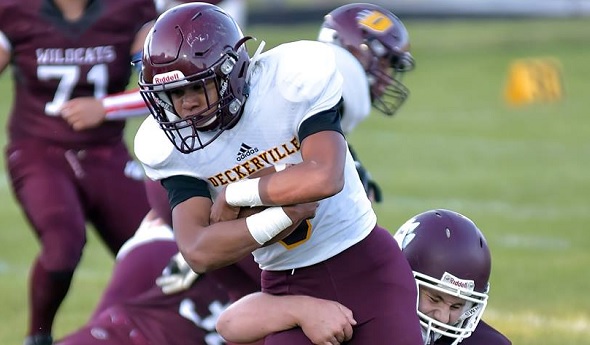
PHOTO: Deckerville downed league rival Mayville 42-8 on Sept. 8; they will meet again this weekend in an 8-player Division 2 opener. (Click for more from Varsity Monthly.)