


Best Practices
April 10, 2012
For decades, football has had the greatest participation among high school sports. In recent years it’s become the greatest spectator sport as well. Today, MHSAA Football Playoff revenue exceeds that of Boys and Girls Basketball Tournaments combined. And if I ever want to generate comments to a blog, all I have to do is mention football.
I can write either the most inspired or inane words about most topics, and not generate a comment. But mention “football,” and opinions come fast and usually furious.
So it was with my eyes wide open that I challenged some “sacred cows” in my posting of March 20, questioned some of the standard operating procedures of high school football practice, and predicted that we will soon be making some changes in the sport I played through four years of college and coached in high school and to which I owe more of my character development than any other sport. I knew some readers would call me out of date and out of touch, knowing nothing of my past or my passion.
I knew some readers would challenge any comparison made with college and professional players, asserting that older players need fewer practices with less contact because they already have the skills and techniques of blocking and tackling. However, they miss the fact that it is the younger and still growing body that needs more care and caution, not less. Less hitting, not more. More heat and humidity acclimatization, not less.
I knew some readers would complain about diminishing time to develop young players, overlooking the proliferation of camps, clinics, combines, 7-on-7 leagues and the like which have improved skills and conditioning for many athletes prior to the official start of practice. If that were not true or if we would dial down the out-of-season demands, then I might not join the amassing advocates for reduced in-season practice demands. But sadly, it is true; coaches already have these kids year-round.
On the same day that I posted predictions of changes for football practice policies in Michigan, including more days before pads and fewer days with double sessions, the Georgia High School Association adopted policies that did just that, requiring five days of practice before the first with full pads and prohibiting two-a-day practices on consecutive days.
Such changes reflect the growing body of evidence regarding “best practices” for high school football, including the recommendations of the American Academy of Pediatrics, the Centers for Disease Control and Prevention, and the National Federation of State High School Associations. This train has left the station; and Michigan should be an early stop, an early adopter of practice policies modifications. We put our players, coaches and selves in peril if we ignore the evidence.
I’m embarrassed to say that for too long I avoided this topic because I knew it would bring ridicule. Then recently, a young but experienced head football coach told me that these are the kinds of changes that football needs. Needs to keep the game attractive to kids; and needs to keep the game safe for kids.
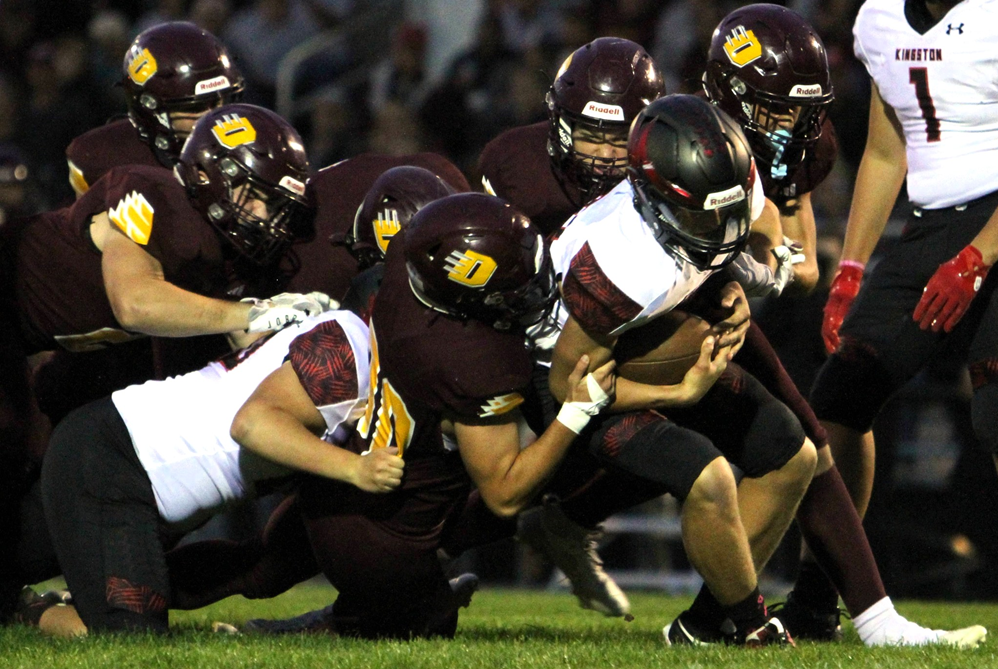
With Seasoned Seniors in Lead, Deckerville Set to Begin Another Title Pursuit
By
Paul Costanzo
Special for MHSAA.com
October 30, 2024
Preston Holman was an eighth grader when his family moved to Deckerville from the west side of the state, but it didn’t take long for him to realize how much football meant to the community.
 “Instantly, it was all clear to me that Deckerville was a powerhouse program around here, and if you’re going to play for them and Coach (Bill) Brown, you needed to be the best version of yourself,” said Holman, now a senior and all-state two-way lineman for the Eagles. “It was really cool. I remember my eighth-grade year, Deckerville lost to Mayville on Homecoming. I remember how upset the players were. I could tell in the atmosphere that Deckerville does not like to lose. But it was really cool to see how the community supported the program.”
Holman and the Eagles have set themselves up to have that support through the 8-Player Division 1 Semifinals, should they keep winning, as the highest-rated team by playoff points in the bracket.
Deckerville, which finished a 9-0 regular season with a win over previous No. 1 Alcona in Week 9, will open the postseason at home Friday night against Bay City All Saints.
“It’s been great,” senior quarterback Hunter Garza said. “We’ve been taking it one game at a time and preparing all season for this, and I think the hard work is showing and paying off. This started three years ago, when we were all sophomores and freshmen, and the hard work is all paying off.”
When Garza and Holman were sophomores, they were part of a core group in that class who were playing key roles on the varsity. That group went 7-4 and won a playoff game in 2022, and Brown was starting to see the potential for something special in the future.
 A run to an 8-Player Division 2 Semifinal the next year proved him right.
“We have six kids that started when they were sophomores that are now seniors, and last year, our defense was one freshman, three sophomores and four juniors, so our whole defense is back,” Brown said. “So we knew we had a lot of potential there. We knew we had something going on, even back then. We knew when they were sophomores, even though they were pretty young. The next year, we got halfway through the season, and they were juniors that were starting to play like seniors.”
Knowing what he had coming back, and what a Deckerville crowd could bring during a playoff run, Brown set out to build a schedule that could guarantee the Eagles homefield advantage through the first three weeks of the postseason. That meant scheduling All Saints in Week 1 and Alcona in Week 9. Even had the Eagles lost those games, the benefit of playing a tougher schedule would have been a net positive. Of course, they won them, getting the best of both worlds.
“We play some tough competition in our conference,” Brown said. “But to get to 9-0, that’s pretty special.”
The Eagles outscored opponents, on average, 49-14 on their way to the program’s first unbeaten season since 2019, and fifth in Brown’s 32 years as head coach.
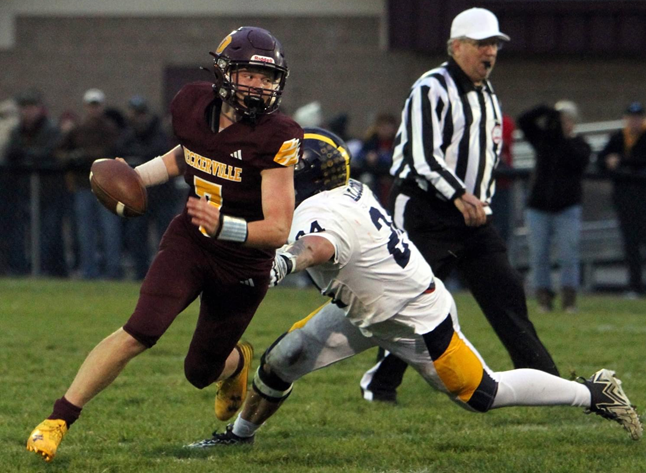
“I think we’ve played very good defense,” Brown said. “Last week (a 50-42 win against Alcona) was tough, but we were playing one of the best teams in the state. Sometimes you have to outscore someone. I think, defensively, we match up and are able to defend a lot of people. Then, being able to turn around and Hunter Garza is having a great year at quarterback – he can run, and he can throw – so I think we’re a little more diverse offensively.”
Garza has rushed for 1,134 yards and 21 touchdowns on 104 carries this season, leading an Eagles’ offense that is averaging 304.9 yards per game on the ground. Senior Parker Merriman had added 859 yards and 11 TDs.
 Garza also has thrown for 747 yards and nine touchdowns on just 76 pass attempts.
Defensively, the Eagles specialize in getting teams out of sync, as they have recorded 42 tackles for loss as a team, led by Holman’s 17. He also has nine sacks, while sophomore Brandon Halowitz leads the team with 83 tackles, including 13 for loss and five sacks.
Being a defensive stalwart is nothing new for the Eagles. When they joined the 8-player ranks in 2012, they brought a smashmouth style to what had been a wide-open division, and won a Finals title. The score of that championship game against Bellaire: 14-12.
They’ve made the postseason in each of the 12 years since, advancing to Finals in 2016 and 2017.
“Our goal each year is to win the state championship,” Brown said. “Maybe those seem like lofty goals for many, but I think you have to do that. And, as it goes, right now we’re peaking at it. Last year, nobody would have thought we were going to make a run and get to the Semifinal. I would say the expectations are high for us, and I think that gives our team the drive to always be better than the team that did it before.”
Managing to chase those goals while remaining grounded in the day-to-day work necessary to reach them can be tough. But with senior leaders like Garza and Holman, Brown is confident his team will stay on the right path.
“Deckerville has such a good winning tradition, that it does put a lot of pressure on us, but Coach always says, ‘Just because you’re Deckerville, you’re not guaranteed to make the playoffs,’” Garza said. “Just because you wear the D, doesn’t mean you’re going to make a run in the playoffs. You gotta go out and work for it. You have to go out and win it.”
 Paul Costanzo served as a sportswriter at The Port Huron Times Herald from 2006-15, including three years as lead sportswriter, and prior to that as sports editor at the Hillsdale Daily News from 2005-06. He can be reached at [email protected] with story ideas for Genesee, Lapeer, St. Clair, Sanilac, Huron, Tuscola, Saginaw, Bay, Arenac, Midland and Gladwin counties.
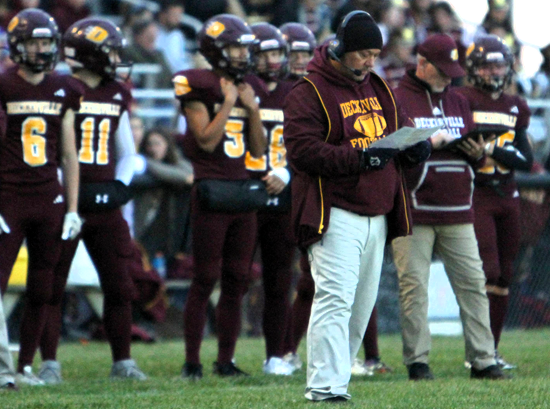
PHOTOS (Top) The Deckerville defense converges on a Kingston ball carrier during this season’s 44-0 victory. (Middle) Hunter Garza eludes an Alcona defender last week. (Below) Eagles coach Bill Brown, in headset, checks his chart on the sideline. (Photos by Mike Gallagher/Saranac County News.)