

Brighton Memories Close to Henson's Heart
By
Steve Vedder
Special for MHSAA.com
November 7, 2017
Drew Henson admits he'll still sneak an occasional peak at the record book.
After 20 years and professional careers in two sports, a quick glance isn't about vanity for Henson. The former Brighton football and baseball star said he's simply curious whether his myriad records are withstanding the test of time.
"Sometimes somebody will send me (a link), and I'll look to see if anybody is getting close," Henson said. "I've got to see who is coming up."
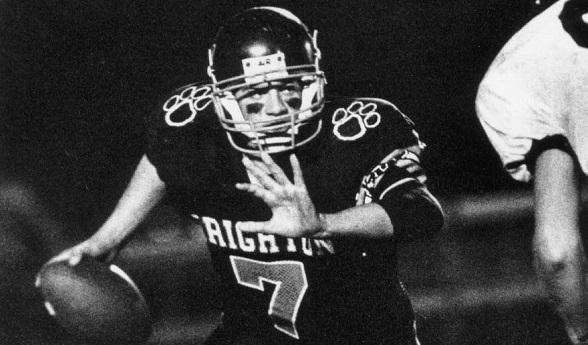
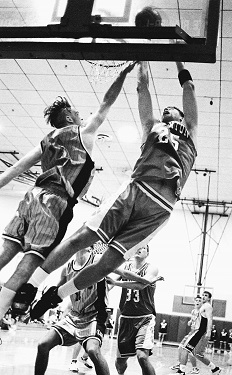
Henson, 37, graduated from Brighton in 1998 having set 11 major hitting records, eight of which he still holds 20 years later. He's also noted among the state football record setters after throwing for 5,662 yards and 52 touchdowns during his Bulldogs career. Twice he threw for more than 2,000 yards in a season during an era right before spread offenses made doing so a much more regular occurrence. In addition, he was a standout basketball player as well at Brighton and his class’ valedictorian.
In baseball, Henson is still the all-time career leader in hits (257), doubles (68), home runs (70), grand slams (10) and RBI (290). The 70 homers is 23 more than those hit by any other Michigan high school player, including eventual major leaguers such as Nate McLouth (Whitehall), Ryan LaMarre (Jackson Lumen Christi) and Zach Putnam (Ann Arbor Pioneer). Henson drove in at least 78 runs every season sophomore through senior years. He's the state's all-time leader in RBI by 87. He also continues to hold national high school records for career RBI and grand slams.
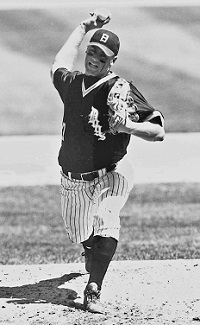
Henson's senior baseball season is unquestionably the best ever amassed by a Michigan prep player. He set single-season records with 22 homers and 83 RBI, batted .605 and went 14-2 as a pitcher, including appearing in an MHSAA tournament game in which he struck out 20 of 21 batters, allowing batters to make contact with a pitch only twice.
 Now living in Tampa, Fla., Henson he still views the records the same way he did before he departed to play quarterback at University of Michigan and then eventually sign $3.5 and $17 million contracts with the Dallas Cowboys and New York Yankees, respectively. Henson, who once fielded ground balls beside Derek Jeter and battled Tom Brady for a starting job, played on four Brighton baseball teams that averaged about 30 wins per year.
"A lot of factors created those opportunities for me. You don't set records like that without playing on a good team with good teammates," he said.
"We were a good hitting team from one through nine in the order. Our goal was to try and win state every year. I wouldn't have hit the homers or driven in the runs every year without my teammates. I have a lot of vivid memories of high school that are near and dear to my heart."
Former Brighton coach Mark Carrow said it's no surprise to him that Henson still owns the record book two decades after graduating. Carrow said Henson was the perfect blend of work ethic and natural talent.
"I coached for 34 years, and he was without question the best player I ever saw," Carrow said. "From the time he came to us as a freshman, it took one look at him throwing or one look hitting to know he was special.
"If there was a checklist for what you wanted in a baseball or football player, he checked the top of the box every time. He could throw 97, 98 (mph) and he could hit. He could dominate a game."
Carrow said the records are even more remarkable when you consider Henson every season would draw more than 40 walks, many intentional.
"Scouts used to come to the games, and I mean teams' top scouts," Carrow said. "And they'd say Drew was as good as they had ever seen."
Henson’s parents both were Division I college athletes, and his father Dan coached football at four Division I programs. Still, Drew’s dual sport professional career nearly took a different path as a youngster. While Henson started playing T-ball as a 5-year-old, his first love during his preteen years was basketball. Henson didn't play his first competitive football game until the eighth grade.
Considering he had interests in virtually every sport and at least in part because his father was a football coach, Henson thought of himself as a "gym rat" growing up. He would tag along to his father's practices, devour box scores in the paper and prop himself in front of the television on fall afternoons.
Much of high school athletics today is focused on specialization, but Henson said he never considered narrowing his sports to one. In fact, he encourages his young daughter to play as many sports as she can fit in.
"It never got dull for me," he said. "For a lot of kids today, it's too much for too long. You don't get a mental break. You can start to lose you."
 While Henson's high school career was one for the record books, and he helped the Wolverines to a 9-3 record and Cotton Bowl win in 2000, his professional career never took off. He was a third-round draft pick by the Yankees (97th overall) in 1998 and sixth-round pick of the NFL's Houston Texans in 2003.
He stalled at Triple-A in the Yankees system, but did make the major leagues in 2003, singling off the Orioles' Eric DeBose for his only big league hit. He wound up retiring from baseball following the season after hitting .248 with 67 homers and 274 RBI in 501 minor league games. He was 23 years old.
In the NFL, Henson wound up making one start for the Cowboys in 2004 and in 2008 joined the Lions for a season. Henson threw one touchdown pass as a Cowboy, to Jeff Robinson in 2004.
Henson, who in July of 2015 still rated a profile in Sports Illustrated a decade after throwing his final pass in the NFL, has been asked many times about his lack of success in professional sports. Past speculation states he was rushed through the Yankees' chain, while participation in professional baseball may have stunted his football development.
Two decades after leaving Brighton, Henson said he still answers the question of which sport was actually his favorite the same way: with diplomacy.
"I've always said nothing was more fun than to play baseball, but there is also nothing like being in the huddle on the football field," he said. "It's hard to say which I liked more. You can play baseball every day, but you can only play football once a week."
The one regret Henson may harbor has to do with patience. If he had to do it all over again, Henson said he'd force himself to slow down and enjoy the process. Henson said he often felt he had to play catch-up in both sports.
"I would tell my younger self to have more patience. There were so many opportunities after my junior year (of college) that would have still been there as a senior," he said. "Because of that I wish I would've had more patience and let the process play out."
Henson said his message to youngsters who face the same challenge is simple.
"Society is so go, go, go," he said. "You just have to learn to hit the pause button. If you're always on to the next thing, you're not embracing the moment. I wish I had done more of that.
"If you like to work and put in the time, you can be successful. All that goes into it. If you have the heart and desire and pay attention to detail, you will be successful."
PHOTOS: (Top) Drew Henson starred during the fall at Brighton’s quarterback. (Middle) Henson struck out 20 of 21 batters he faced in a 1997 game against Walled Lake Western. (Below) Henson also was a basketball standout, averaging 22 points per game according to a Sports Illustrated profile published in 1998. (Football and basketball photos courtesy of Brighton High School).
Bedford Follows Mifsud's Hall-of-Fame Formula to 7-0 Start, SEC Red Title Game
By
Doug Donnelly
Special for MHSAA.com
October 15, 2026
The rumors of Dave Mifsud living across the street from Temperance Bedford High School or being able to see the school from his kitchen window are greatly exaggerated.

Mifsud, in his first year coaching the Kicking Mules, actually lives about five minutes from the stadium. And, no, he can’t see the glow from the Friday night stadium lights from his house.
All joking aside, Mifsud may have found the perfect spot to continue his hall of fame career. After stops at Dearborn, Parma Western, Monroe and Brownstown Woodhaven, Mifsud took over the Bedford program in January and has the Mules off to a remarkable 7-0 start heading into Friday night’s Southeastern Conference showdown with powerhouse Saline.
“I feel like I'm at home right now,” Mifsud said this week. “I feel working and coaching at Bedford, being around this community, I feel like I'm at home.”
The funny part is, he wasn’t looking for one.
Mifsud said he moved to Temperance about five years ago to be closer to his son and three grandchildren in Toledo. He became the head coach at Brownstown Woodhaven and thought he had found his last coaching stop.
“When I took the Woodhaven job, I said, ‘This is it – I’m not going to change jobs again.’ But I put a disclaimer on there – and that was unless the Bedford job opened up.”
This past offseason, it did.
Mifsud said the distance driving to and from Woodhaven was the difference.
“I was driving 39 miles each way to work and spending an awful lot of time in the car,” he said. “I didn’t get to enjoy as many community events as I wanted to be involved in, even just going to basketball games or baseball games and things like that. It was just too far from home. So, this job was definitely a big attraction to me.”
He was hired.
By no means was he taking over a bad program. Quite the opposite. Bedford has been a perennial playoff team – they’ve qualified 14 times since 2009 – and contended among the top half of the SEC Red most of those years.
When Mifsud arrived, however, he had a blank slate. He had to bring in an almost entirely new football staff, overhaul the offense, and create a new-look defense.
“I spent hours and hours and lots of late, late nights interviewing coaching candidates,” he said. “I didn’t really know any of them ahead of time. There was one coach, Sean Stephens, that I had met and talked to a couple of times, but really, I didn’t know any of them.
“The foundation was, the thing that I started off explaining to each and every one of them, was my philosophy and what my goals were and where I was coming from. I wanted them to know how we were going to treat the kids and treat the program.”
Football, he said, teaches great life skills and life lessons.
“Our No. 1 goal is for the kids to have the best memories and the most positive memories from their high school days as being part of the football program,” he said.
He hired coaches from Toledo and the Downriver area, a former Bedford player and one coach who was on a previous Bedford staff. He named a football operations coordinator to handle things like media requests and statistics.
The offense, he said, is a combination of all of the offenses he’s run over the years while building a solid resume at Dearborn and Parma Western.
“We adapted and evolved a little,” he said. “I think we’ve cleaned up some of the things we were doing at Woodhaven.
His defense was constructed with the help of Mike Parker, who had coached at Toledo Whitmer, one of the largest schools in northwest Ohio.
The formula has worked wonders. The 7-0 start is something even Mifsud didn’t see coming.
“Going into it, of course you have high hopes,” he said. “I feel like there was the hope or possibility of being 7-0, but there was also this reality that we could be 3-4 or 4-3. You just don’t know how games are going to play out and how kids are going to respond.”
The biggest win was probably the first, a 20-13 victory over Sterling Heights Stevenson.
“The kids played their hearts out that game, and a really great win,” he said.
What’s followed have been six more in much the same fashion.
“We’ve continued on with the thinking that we just need to go 1-0 each week,” he said. “We’ve had to battle and compete in each game.”
Not only did Mifsud have to create a new coaching staff, but few of last season’s ball carriers were back this fall. One who might have been expected to be a starting running back, for example, transferred to an Ohio school. Other players moved positions and into new roles.
Masyn Moran has emerged as the top ball carrier with 636 yards and 12 touchdowns over seven games. Luke Whetstone has thrown for 841 yards while completing 64 percent of his passes. He’s also rushed for more than 500 yards. Jaxson Lestock has 20 catches for more than 300 yards. The Mules offense has been balanced with 263 rushes and 100 passes.
Bedford’s 7-0 start is the first for the program since 2013 and just the third in school history. Mifsud said the same formula that got Bedford to this point is what he plans on using this week against the also-undefeated Hornets. The winner will own the SEC Red title outright.
“There are some really good kids at Bedford, and they have bought into and committed to the new coach and system,” he said. “The school community has been awesome.”
 Doug Donnelly has served as a news and sports reporter at the Adrian Daily Telegram and the Monroe News for 30 years, including 10 years as city editor in Monroe. He's written a book on high school basketball in Monroe County and compiles record books for various schools in southeast Michigan. He is now publisher and editor of The Blissfield Advance, a weekly newspaper. E-mail him at [email protected] with story ideas for Jackson, Washtenaw, Hillsdale, Lenawee and Monroe counties.
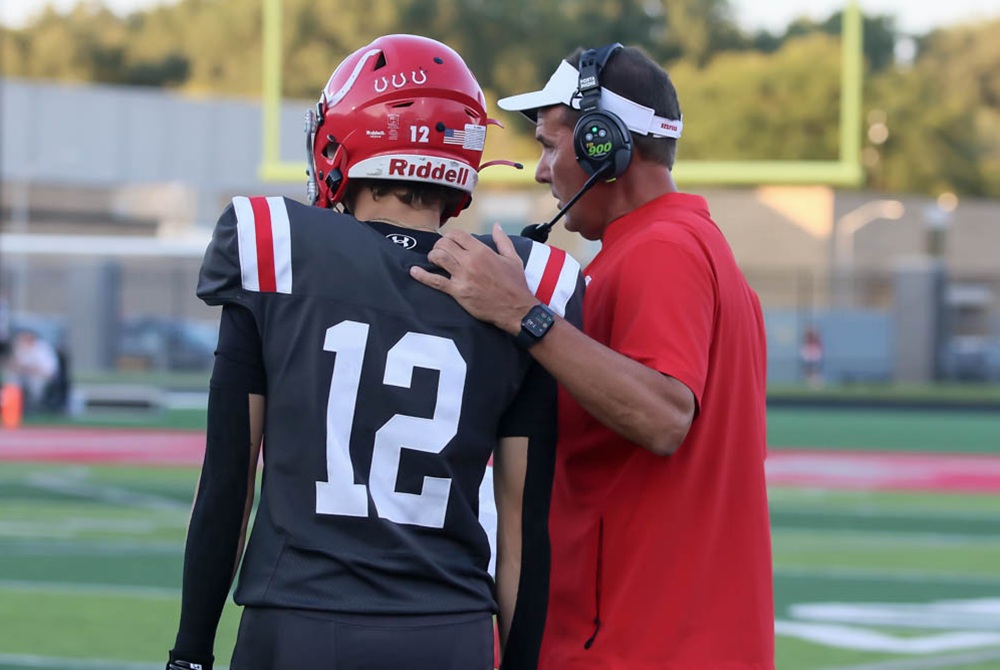
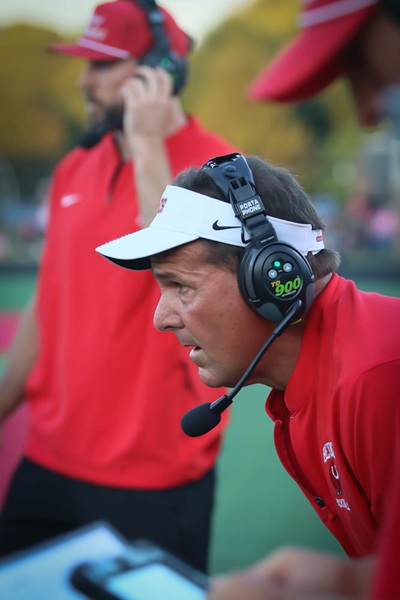
PHOTOS (Top) Temperance Bedford football coach Dave Mifsud instructs player Brady Boisselle during a game this season. (Middle) Mifsud monitors the action from the sideline. (Photos by Jaymee Beard/Temperance Bedford athletics.)