

Brighton Memories Close to Henson's Heart
By
Steve Vedder
Special for MHSAA.com
November 7, 2017
Drew Henson admits he'll still sneak an occasional peak at the record book.
After 20 years and professional careers in two sports, a quick glance isn't about vanity for Henson. The former Brighton football and baseball star said he's simply curious whether his myriad records are withstanding the test of time.
"Sometimes somebody will send me (a link), and I'll look to see if anybody is getting close," Henson said. "I've got to see who is coming up."
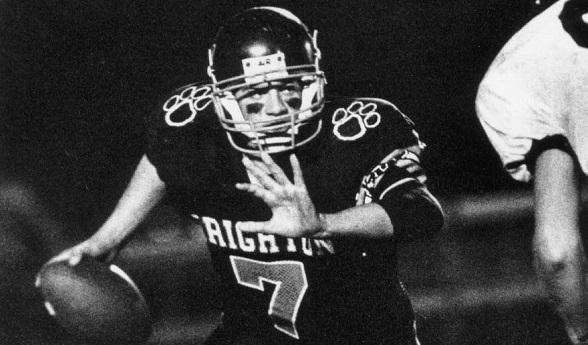
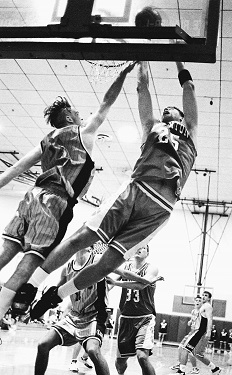
Henson, 37, graduated from Brighton in 1998 having set 11 major hitting records, eight of which he still holds 20 years later. He's also noted among the state football record setters after throwing for 5,662 yards and 52 touchdowns during his Bulldogs career. Twice he threw for more than 2,000 yards in a season during an era right before spread offenses made doing so a much more regular occurrence. In addition, he was a standout basketball player as well at Brighton and his class’ valedictorian.
In baseball, Henson is still the all-time career leader in hits (257), doubles (68), home runs (70), grand slams (10) and RBI (290). The 70 homers is 23 more than those hit by any other Michigan high school player, including eventual major leaguers such as Nate McLouth (Whitehall), Ryan LaMarre (Jackson Lumen Christi) and Zach Putnam (Ann Arbor Pioneer). Henson drove in at least 78 runs every season sophomore through senior years. He's the state's all-time leader in RBI by 87. He also continues to hold national high school records for career RBI and grand slams.
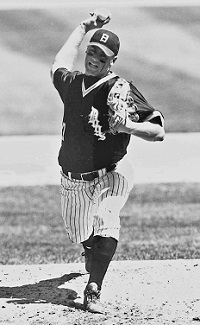
Henson's senior baseball season is unquestionably the best ever amassed by a Michigan prep player. He set single-season records with 22 homers and 83 RBI, batted .605 and went 14-2 as a pitcher, including appearing in an MHSAA tournament game in which he struck out 20 of 21 batters, allowing batters to make contact with a pitch only twice.
 Now living in Tampa, Fla., Henson he still views the records the same way he did before he departed to play quarterback at University of Michigan and then eventually sign $3.5 and $17 million contracts with the Dallas Cowboys and New York Yankees, respectively. Henson, who once fielded ground balls beside Derek Jeter and battled Tom Brady for a starting job, played on four Brighton baseball teams that averaged about 30 wins per year.
"A lot of factors created those opportunities for me. You don't set records like that without playing on a good team with good teammates," he said.
"We were a good hitting team from one through nine in the order. Our goal was to try and win state every year. I wouldn't have hit the homers or driven in the runs every year without my teammates. I have a lot of vivid memories of high school that are near and dear to my heart."
Former Brighton coach Mark Carrow said it's no surprise to him that Henson still owns the record book two decades after graduating. Carrow said Henson was the perfect blend of work ethic and natural talent.
"I coached for 34 years, and he was without question the best player I ever saw," Carrow said. "From the time he came to us as a freshman, it took one look at him throwing or one look hitting to know he was special.
"If there was a checklist for what you wanted in a baseball or football player, he checked the top of the box every time. He could throw 97, 98 (mph) and he could hit. He could dominate a game."
Carrow said the records are even more remarkable when you consider Henson every season would draw more than 40 walks, many intentional.
"Scouts used to come to the games, and I mean teams' top scouts," Carrow said. "And they'd say Drew was as good as they had ever seen."
Henson’s parents both were Division I college athletes, and his father Dan coached football at four Division I programs. Still, Drew’s dual sport professional career nearly took a different path as a youngster. While Henson started playing T-ball as a 5-year-old, his first love during his preteen years was basketball. Henson didn't play his first competitive football game until the eighth grade.
Considering he had interests in virtually every sport and at least in part because his father was a football coach, Henson thought of himself as a "gym rat" growing up. He would tag along to his father's practices, devour box scores in the paper and prop himself in front of the television on fall afternoons.
Much of high school athletics today is focused on specialization, but Henson said he never considered narrowing his sports to one. In fact, he encourages his young daughter to play as many sports as she can fit in.
"It never got dull for me," he said. "For a lot of kids today, it's too much for too long. You don't get a mental break. You can start to lose you."
 While Henson's high school career was one for the record books, and he helped the Wolverines to a 9-3 record and Cotton Bowl win in 2000, his professional career never took off. He was a third-round draft pick by the Yankees (97th overall) in 1998 and sixth-round pick of the NFL's Houston Texans in 2003.
He stalled at Triple-A in the Yankees system, but did make the major leagues in 2003, singling off the Orioles' Eric DeBose for his only big league hit. He wound up retiring from baseball following the season after hitting .248 with 67 homers and 274 RBI in 501 minor league games. He was 23 years old.
In the NFL, Henson wound up making one start for the Cowboys in 2004 and in 2008 joined the Lions for a season. Henson threw one touchdown pass as a Cowboy, to Jeff Robinson in 2004.
Henson, who in July of 2015 still rated a profile in Sports Illustrated a decade after throwing his final pass in the NFL, has been asked many times about his lack of success in professional sports. Past speculation states he was rushed through the Yankees' chain, while participation in professional baseball may have stunted his football development.
Two decades after leaving Brighton, Henson said he still answers the question of which sport was actually his favorite the same way: with diplomacy.
"I've always said nothing was more fun than to play baseball, but there is also nothing like being in the huddle on the football field," he said. "It's hard to say which I liked more. You can play baseball every day, but you can only play football once a week."
The one regret Henson may harbor has to do with patience. If he had to do it all over again, Henson said he'd force himself to slow down and enjoy the process. Henson said he often felt he had to play catch-up in both sports.
"I would tell my younger self to have more patience. There were so many opportunities after my junior year (of college) that would have still been there as a senior," he said. "Because of that I wish I would've had more patience and let the process play out."
Henson said his message to youngsters who face the same challenge is simple.
"Society is so go, go, go," he said. "You just have to learn to hit the pause button. If you're always on to the next thing, you're not embracing the moment. I wish I had done more of that.
"If you like to work and put in the time, you can be successful. All that goes into it. If you have the heart and desire and pay attention to detail, you will be successful."
PHOTOS: (Top) Drew Henson starred during the fall at Brighton’s quarterback. (Middle) Henson struck out 20 of 21 batters he faced in a 1997 game against Walled Lake Western. (Below) Henson also was a basketball standout, averaging 22 points per game according to a Sports Illustrated profile published in 1998. (Football and basketball photos courtesy of Brighton High School).
Airport Graduate Villarreal Hoping to Receive Call on WPBL Draft Day
By
Steve Vedder
Special for MHSAA.com
November 19, 2025
It hasn't always been the smoothest of paths for Bella Villarreal – but considering the trail-breaking nature of her quest, she refuses to second guess her choices.
Which is how it goes for someone trying to make the leap from a high school of fewer than 800 students to becoming the first Michigan native to play in the new Women's Professional Baseball League.
A graduate of Carleton Airport High School and presently a freshman at Eastern Michigan, Villarreal's journey includes overcoming her own doubts, ignoring skeptics, poking a hole in a sport universally reserved for males and traveling hundreds of miles to find suitable competition. It's a long and continuing fight she's hoping will culminate in her being among the players taken in the inaugural WPBL draft Thursday.
While Villarreal describes herself as a football fan and someone who could never get into softball, dabbled in basketball and pushed thoughts of playing volleyball to the back of her mind, her first love has always been baseball. It's been that way since before she stepped into her kindergarten classroom and peaked after shining in a WPBL tryout in Washington, D.C., in August.
"I've been drawn to baseball since I was a 4-year-old playing T-ball," Villarreal said. "I've always wanted to play baseball. It's inspirational to me and was always a goal for me to play. I never wanted to stop something that made me feel so good."
While she harbors a deep love of baseball, the sport, however, hasn't always returned that affection. After playing in local boys leagues growing up, Villarreal – a pitcher and second baseman – made the Detroit Bees boys travel team as a 9-year-old. From there she graduated to the Indians Baseball Club as an 11-year-old and then finally more travel ball with the Cubs club as a 15-year-old. She's played in three Baseball For All events, the largest girls baseball tournament in the country.
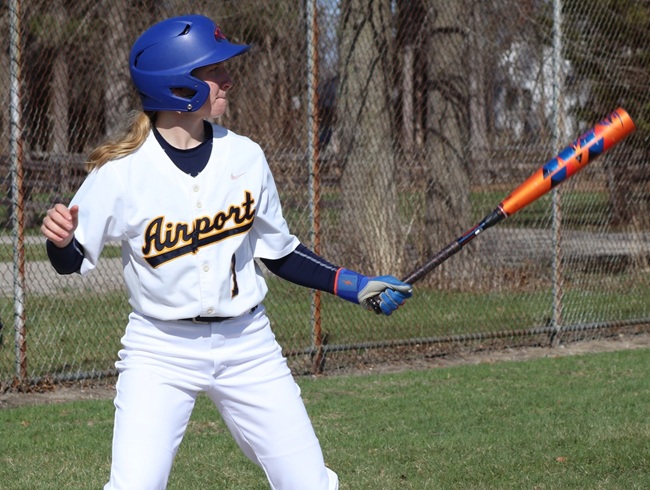 Along the way Villarreal has encountered support, but also a prevalent attitude that girls who favor a sport with a bat and ball should be playing softball, not baseball. By the time she was 16, Villarreal, by then long committed to a future on the baseball diamond, was having to travel all over the Midwest to find baseball tournaments.
What she found was scattered acceptance among some male teammates, but also a frustration with traveling around a half-dozen states to play the sport she loved.
One of the turning points of Villarreal's fledging baseball career came at Airport High School. After her extensive inclusion in travel leagues, Villarreal made the school's junior varsity baseball team as a freshman and sophomore. While there were bumps along the way, the foremost lesson Villarreal took from that school's baseball program was that she could indeed succeed playing against the boys. She also honed fundamentals and learned the value of everyone pulling in the same direction.
According to the National Federation of State High Schools Association (NFHS), there are no states with girls baseball as a sanctioned sport – but the organization counted 1,372 girls who played baseball on high school boys teams this spring. While Major League Baseball estimates 46 percent of all baseball fans are women, only nine women played on NCAA men's baseball teams in 2024.
None of which has deterred Villarreal's love of the game.
"I worked hard and wanted to be part of the team. I learned that there is no "I" in team," Villarreal said of her time at Airport. "And I think it also confirmed my ability. I knew if I did well in high school, I could do it any place."
Armed with the confidence that she could carve a space in the sport, Villarreal, now 19, has tried to improve her game with twice-a-week hitting workouts and four days of work designed to improve her strength and speed.
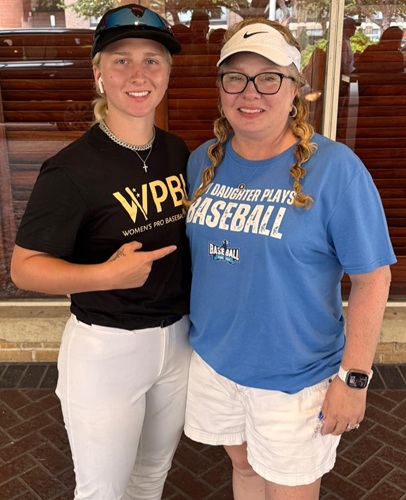 The work has paid off. She came away from the first WPBL tryout in Washington, D.C., with hopes of being taken in the draft. The tryout included players from 10 countries, including a dozen from Japan, which has the top-ranked women's team in the world by the World Baseball and Softball Federation. In all, the first day of tryouts included 600 players from across the country and as far away as Australia, Mexico, South Korea, the United Kingdom and France. Cuts were made after each of the four days, with Villarreal surviving all of them. That's a hopeful sign she will be taken in the draft by one of the league's four franchises.
Villarreal admits the tryouts, which concluded with inter-squad games, were high stress.
"Of course I was nervous," she said. "But I made some friends there who helped me stay motivated that I could get through it. It was serious, but everyone had fun, which was a big thing. There were jitters the first day, but then I was good at becoming myself. To make the second and third days, you knew you must be doing something right. I started becoming confident with the things I knew I could do."
Originally slated to include six teams, the league will start play in May with teams in New York, Boston, Los Angeles and San Francisco. Teams will have 15-player rosters which will play a seven-week regular season. It's not the first attempt at forming a professional women's baseball league. There have been four previous attempts beginning with the All-American Girls Professional Baseball League during World War II and the most recent with Ladies League Baseball in 1997-98.
Villarreal believes given time and enough resources, women's professional baseball can thrive. She would love to look back on her time as being among the trailblazers in that progress.
"Absolutely, there is interest," she said. "I know there have been attempts before, and some really haven't stuck. But I think we can build it up to a place where girls have more of an opportunity."
For those girls who would someday wish to join that quest, Villarreal has advice.
"You should know where you're supposed to be," she said. "Do what you love as a challenge, and just be who you are. It doesn't matter what sport you play – know that you are capable."
Editor's note: Villarreal was drafted in the fifth round of the WPBL Draft by Los Angeles, the 82nd pick overall of 120. She was selected as a second baseman, and was one of two Michigan players drafted. Jordan Eyster of Royal Oak, a 21-year-old outfielder, was selected in the fourth round by San Francisco.
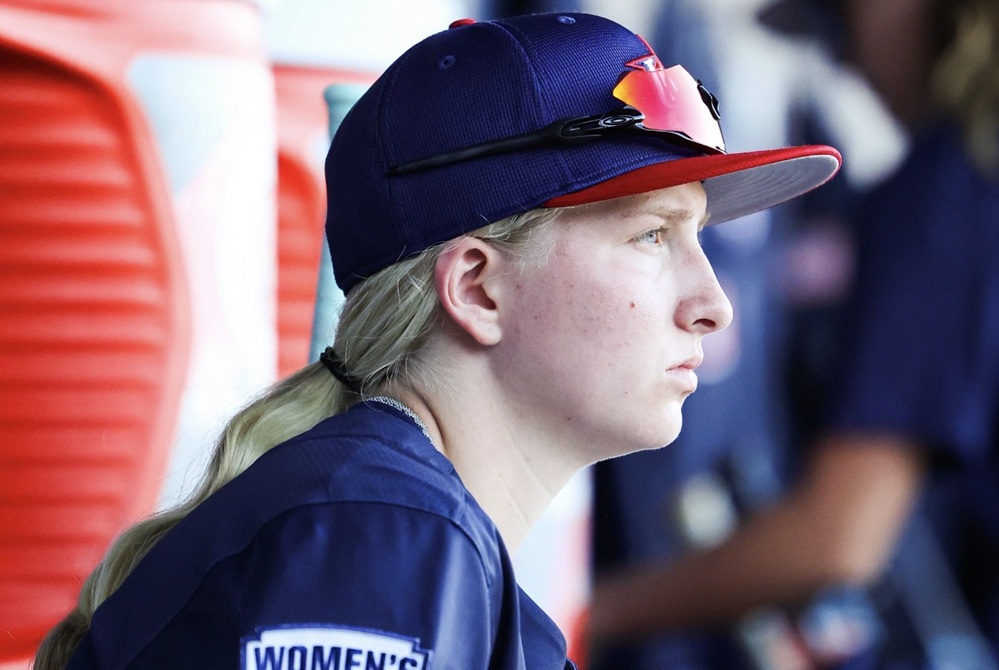
PHOTOS (Top) Airport grad Bella Villarreal watches from the dugout during a USA Baseball Development Program event. (Middle) Villarreal steps to the plate as a member of Carleton Airport’s junior varsity baseball team. (Below) Villarreal takes a photo while pointing toward her mother Tonya. (Photos provided by the Villarreal family.)