

Catch These New Rules as Fall Kicks Off
August 7, 2014
By Geoff Kimmerly
Second Half editor
The first practices of 2014-15 begin next week for approximately 110,000 student-athletes taking part in eight sports in which the Michigan High School Athletic Association sponsors postseason tournaments, with nearly 41,000 football players practicing under a new policy in that sport aimed at continuing to improve player safety.
The new practice policy was proposed by a Football Task Force made up of coaches, administrators and MHSAA staff which met during 2012 and 2013, and approved by the MHSAA’s Representative Council at its Winter Meeting on March 21.
The modifications are meant to promote heat acclimatization and limit helmet-to-helmet contact during practices. They include:
- During the first week of practice, only helmets are allowed the first two days, only shoulder pads may be added on the third and fourth days, and full pads may not be worn until the fifth day of team practice.
- Before the first regular-season game, schools may not schedule more than one “collision” practice in a day. A collision practice is defined as one in which there is live, game-speed, player-versus-player contact in pads involving any number of players.
- After the first regular-season game, teams may conduct no more than two collision practice days in any week, Monday through Sunday.
- No single football practice may exceed three hours, and the total practice time for days with multiple practice sessions may not exceed five hours. Neither strength/weight training activities nor video/classroom sessions are considered practice for the purposes of the three or five-hour limits.
Previously, schools were required to conduct at least three days of practice without pads before beginning contact. The change to four days for gradual addition of pads was added to assist athletes in acclimating to being physically active in hot weather. Guidelines reducing the amount of collision practice go hand in hand with rules changes that have been made to reduce helmet-to-helmet contact in game situations. The policies in detail can be found on the Football page of the MHSAA Website.
“We think these new policies, with respect to the number of collision practices there can be before the first game, and after the first game, really are where 85 to 90 percent of our coaches already were,” said John E. “Jack” Roberts, executive director of the MHSAA. “This new policy sends a signal to that 10 to 15 percent to get on board with the rest of us to make football just as safe as it can possibly be.”
Practice in football must begin on August 11 for all schools wishing to begin regular-season games the weekend of August 28-30. Schools must have 12 days of preseason practice at all levels before their first game, and those 12 days of practice may not occur before 16 calendar days.
Practice sessions for all other sports begin on Wednesday (August 13). In golf and tennis, competition may commence no earlier than after three separate days of team practice, and not before seven calendar days. The first day competition may take place in golf and tennis is August 20. In all other fall sports, contests can take place after seven days of practice for the team and not before nine calendar days. The first day competition may take place in cross country, tennis, soccer, swimming and diving, and volleyball is August 22.
Only one football date precedes Labor Day, and most varsity games will take place on Thursday, August 28, that week. Subvarsity competition may begin on Wednesday, August 27. In Week 1, 255 games will be played on Thursday, 53 contests will be played on Friday, and five games will be played on Saturday.
Continuing the focus on player safety, a number of rules changes were made in football for 2014:
- Rules were added restricting targeting of opponent and illegal helmet contact with defenseless players, with both resulting in 15-yard penalties. Targeting is defined as taking aim at an opponent with the helmet, forearm, hand, fist, elbow or shoulder to initiate contact above the shoulders and with an intent beyond making a legal tackle or block, or playing the ball. A defenseless player can be considered one no longer involved in a play, a runner whose progress has been stopped, a player focused on receiving a kick or a receiver who has given up on an errant pass, or a player already on the ground.
- Illegal contact to a quarterback now will be considered roughing the passer, and the offense will receive an automatic first down in addition to the previous 15 yards from the penalty.
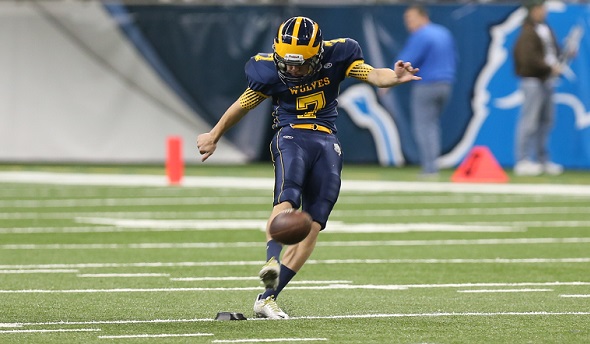
- On kickoffs, the kicking team must have at least four players on either side of the kicker, and no kicking team players except for the kicker may line up more than five yards behind the free-kick line. These changes were made to improve safety by balancing the kicking formation and shortening the potential run-up by kicking team players heading down the field to tackle the ball carrier.
A number of significant rules changes will go into effect for other fall sports:
- In cross country, the ban on wearing jewelry has been lifted (and also for track and field in the spring). The National Federation of State High School Associations deemed the ban unnecessary in these two sports because there is little risk of injury with minimal contact between competitors. Elimination of the rule will allow officials to further focus on the competition.
- In soccer, Michigan has adopted the National Federation rule stating home teams must wear solid white jerseys and socks, with visiting teams in dark jerseys and socks (dark defined as any color contrasting white). Also, officials may now wear green and blue shirts in addition to red and black as alternates to the primary yellow shirt with black pinstripes.
- Also for soccer, both field players and goalkeepers must now leave the field when injured and the referee has stopped the clock. Previously, an injured goalkeeper was not required to leave the game when the referee stopped the clock; going forward, the keeper must be replaced.
- In swimming and diving, one change affects the beginning of races and another impacts a specific event. The use of starter’s pistols is now prohibited; starters must use an alternative sounding device to start races. Additionally, in the backstroke, a swimmer may not submerge his or her entire body after the start except for during turns. The swimmer must remain on or above the water surface on the finish, eliminating the abuse of submerging well before touching the wall. This change also applies to the finish of the backstroke leg of the individual medley.
The 2014 Fall campaign culminates with postseason tournaments beginning with the Upper Peninsula Girls Tennis Finals the week of Sept. 29, and wraps up with the 11-Player Football Playoff Finals on Nov. 28-29. Here is a complete list of fall tournament dates:
Cross Country:
U.P. Finals – Oct. 18
L.P. Regionals – Oct. 24 or 25
L.P. Finals – Nov. 1
11-Player Football:
Selection Sunday – Oct. 26
Pre-Districts – Oct. 31 or Nov. 1
District Finals – Nov. 7 or 8
Regional Finals – Nov. 14 or 15
Semifinals – Nov. 22
Finals – Nov. 28-29
8-Player Football:
Selection Sunday – Oct. 26
Regional Semifinals – Oct. 31 or Nov. 1
Regional Finals – Nov. 7 or 8
Semifinals – Nov. 15
Finals – Nov. 21
L.P. Girls Golf:
Regionals – Oct. 8 or 9 or 10 or 11
Finals – Oct. 17-18
Soccer:
Boys L.P. Districts – Oct. 13-18
Boys L.P. Regionals – Oct. 21-25
Boys L.P. Semifinals – Oct. 29
Boys L.P. Finals – Nov. 1
L.P. Girls Swimming & Diving
Diving Regionals – Nov. 13
Swimming/Diving Finals – Nov. 21-22
Tennis:
U.P. Girls Finals – Oct. 1 or 2 or 3 or 4
L.P. Boys Regionals – Oct. 9 or 10 or 11
L.P. Finals – Oct. 17-18
Girls Volleyball:
Districts – Nov. 3-8
Regionals – Nov. 11 & 13
Quarterfinals – Nov. 18
Semifinals – Nov. 20-21
Finals – Nov. 22
The MHSAA is a private, not-for-profit corporation of voluntary membership by more than 1,500 public and private senior high schools and junior high/middle schools which exists to develop common rules for athletic eligibility and competition. No government funds or tax dollars support the MHSAA, which was the first such association nationally to not accept membership dues or tournament entry fees from schools. Member schools which enforce these rules are permitted to participate in MHSAA tournaments, which attract more than 1.4 million spectators each year.
Drive for Detroit: Week 1 in Review
August 29, 2016
By Geoff Kimmerly
Second Half editor
Upsets and comebacks, broken win streaks and broken hearts mending were among the storylines most prevalent from another highlight-filled first weekend of Michigan high school football.
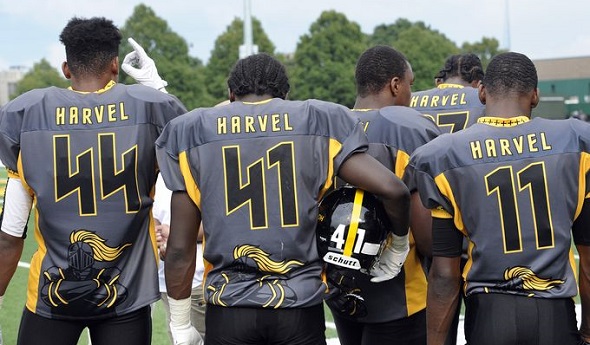
Two reigning MHSAA champions – Romeo and Ishpeming – fell in their first games after ending last season at Ford Field. Another 2015 champ, Detroit Martin Luther King, returned to the field this fall victorious but without coach Dale Harvel, who died unexpectedly in July. He was with his players however, his name across all of their backs.
Each week during the regular season and playoffs, we’ll look back at the games from every region of our state and 8-player and discuss which results could have the biggest impacts as we move ahead. Games are organized regionally by hometown of the winning team.
And now, our season debut.
Bay & Thumb
Algonac 7, Marine City 2
Odd score, but it was a pretty impressive defensive display by an Algonac unit that had five shutouts a year ago. Last season’s 19-18 opening-night win over powerhouse Marine City seemed to spur the Muskrats to their best finish ever, and they’ll be hoping for the same momentum after scoring the game’s lone touchdown midway through the third quarter. Click for more from the Port Huron Times Herald.
Also noted:
Byron 29, Montrose 27 – The Eagles ended last season with a 55-18 Pre-District playoff loss to the Rams, but came back for what’s believed to be the school’s first win over Montrose.
Bay City Central 13, Swartz Creek 12 – The Wolves became the 12th team in Michigan high school football history to win 500 games, running their record since 1922 to 500-321-31.
Midland Dow 41, Mount Pleasant 14 – The Chargers ran off 10 straight wins after opening last season with a 14-point loss to the Oilers, and appear ready to keep that run going.
Almont 35, Saginaw Michigan Lutheran Seminary 26 – The Raiders couldn’t have prepped better for next week’s matchup with Algonac than by beating a Seminary team that’s gone a combined 21-4 over the last two seasons.
Greater Detroit
Macomb Dakota 35, Orchard Lake St. Mary’s 28
Dakota earned new coach Greg Baur arguably the most impressive win of opening weekend as it downed the two-time reigning Division 3 champion Eaglets. Dakota quarterback Brett Droski connected with receiver Jaylen Hall on two long scores as the Cougars came back from an early deficit. A year ago, Dakota opened by downing then-reigning Division 1 champ Clarkston. Click for more from the Macomb Daily.
Also noted:
Oxford 27, Romeo 26 – Especially after going 3-6 a year ago, knocking off the reigning Division 1 champion was Oxford’s best win in a few seasons (and its second over Romeo in three.)
Dearborn Fordson 40, Canton 35 – The Tractors avenged an opening-night loss to the Chiefs last season by rallying from 21 points down at Wayne State.
Clarkston 28, Lapeer 7 – JT King ran for two of Clarkston’s four rushing touchdowns as it handed Lapeer the first regular-season loss of the Lightning’s now three-season history.
Utica Eisenhower 28, Plymouth 7 – Eisenhower earned some momentum to take into this week's Macomb Area Conference Red tilt against league favorite Dakota by downing a playoff team from last season.
Mid-Michigan
Ithaca 31, Clare 28
Ithaca hasn’t had a scare during the regular season in a long time – and the Yellowjackets kept their regular-season winning streak alive at 56 straight. Ithaca had beaten Clare by four touchdowns just a year ago, but this time the reigning Division 6 champion had to survive a comeback attempt by the Pioneers. Click to read more from the Mount Pleasant Morning Sun.
Also noted:
East Lansing 42, St. Johns 7 – The Trojans broke a two-year opening-night losing streak to the Redwings as reigning Lower Peninsula Division 1 110 hurdles champion Kentre Patterson showed why he might be the Lansing area’s most exciting player this fall.
Brighton 14, Detroit East English 8 – The Bulldogs took a two-score lead into the fourth quarter and held on in a Michigan Stadium matchup of teams that both won nine games a year ago.
DeWitt 42, Linden 14 – The Panthers ran their opening-night winning streak against the Eagles to three after also beating Linden during the 2012 and 2013 playoffs.
Pewamo-Westphalia 30, Monroe St. Mary Catholic Central 20 – Add another couple of hundred yards to Jared Smith’s pursuit of the all-time career rushing record as he leads the reigning Division 7 runner-up Pirates.
Northern Lower Peninsula
Traverse City West 42, Midland 14
The Titans got a start on reversing last season’s sub-.500 finish by nearly reversing the score of last season’s opening-night 42-11 loss to the Chemics. West stacked up 391 total yards including 271 rushing on 45 carries and jumped out to a 21-0 lead and 35-7 advantage by halftime. The Titans were 4-5 in 2015, while Midland finished 7-3. Click for more from the Traverse City Record-Eagle.
Also noted:
Cadillac 40, Big Rapids 6 – Cadillac’s first sub-.500 season since 2008 last fall started with a three-point loss to Big Rapids, but the Vikings put up points more like their one-loss teams of 2014 and 2013 in this victory.
Gaylord 41, Boyne City 32 – With Gaylord showing a few more new faces in key places, this result might have been a bit of a surprise – and was an impressive win for the Blue Devils against a Ramblers team that won 10 games a year ago.
Onekama 18, Hillman 0 – The Portagers are coming off two straight playoff appearances, but it’s still strong that they handed Hillman the latter’s first shutout since 2012.
Tawas 35, Lincoln Alcona 30 – Alcona bounced back from an down season in 2014 to return to the playoffs a year ago, and Tawas looks like a possibility to copy with a big win coming off last year’s 2-7 finish.
Southeast & Border
Grass Lake 32, Stockbridge 18
Grass Lake is seeking its 12th straight playoff appearance this fall, so it’s not like the Warriors haven’t won their share of big games over the years. But they still made quite a defensive stand, holding down a Stockbridge offense that has scored more than 400 points each of the last two seasons and is returning its quarterback and a top receiver this fall. Click for more from the Jackson Citizen-Patriot.
Also noted:
Clinton 48, Manchester 12 – The 115th meeting between these two was not nearly as close as the 114th, which also was won by Clinton, but by only a point.
Morenci 34, Pittsford 7 – If one game is an indication, the Bulldogs are coming in on a roll again with a second straight opening-night win over a Pittsford team coming off the playoffs.
Adrian Lenawee Christian 35, Britton Deerfield 34 – Returning after the best finish in 2015 of its eight-year history, Lenawee Christian hung on to get off to another good start.
Tecumseh 15, Harper Woods Chandler Park 14 – The Indians got a much-needed opening win heading into one of the most loaded schedules from this corner of the state.
Southwest Corridor
Benton Harbor 28, Marshall 7
The good times continue to roll for Benton Harbor. Last season was history-making as the Tigers secured their first playoff berth, but this win over Marshall actually made Benton Harbor 1-0 for the first time since 2011 – and came against a playoff team from a year ago. Click for more from the St. Joseph Herald-Palladium.
Also noted:
Gobles 14, Delton Kellogg 13 (OT) – The Tigers made it two straight one-point opening-night wins in a row over Delton, this one secured with a two-point conversion in overtime.
Coldwater 33, Jackson 22 – These two both have come back from one-win seasons to make the playoffs over the last few years, but the Cardinals are still a little ahead of the Vikings as both surge forward.
Vicksburg 17, Dowagiac 7 – In a Wolverine Conference where teams play nine league games, this one right out of the gate could be a decider or at least influence the final championship result.
Stevensville Lakeshore 30, Battle Creek Central 13 – This win could prove especially important as Lakeshore goes for its 19th straight playoff appearance but faces what will likely be one of the strongest league schedules in Michigan, again.
Upper Peninsula
Iron Mountain 35, Ishpeming 24
After absorbing two losses – opening night and playoffs – to Ishpeming a year ago, Iron Mountain started the climb back against its longtime Week 1 foe by breaking the Hematites’ 27-game regular-season winning streak that dated back to 2012. The Mountaineers hadn’t beaten Ishpeming since opening night 2011, and Ishpeming – the reigning Division 7 champion – didn't lose at all in 13 tries in 2015. Click for more from the Iron Mountain Daily News.
Also noted:
Menominee 31, Marinette, Wis. 14 – The 110th meeting in the longest interstate rivalry involving a Michigan team moved the Maroons’ all-time edge to 53-50-7 in the series.
Sault Ste. Marie 13, Cheboygan 7 (OT) – Sault Ste. Marie is 1-0 after opening night for the first time since 2007 with its third win over the last four tries against Cheboygan.
Gwinn 36, Gladstone 16 – The Modeltowners won on opening night for only the third time over the last decade and with their most points in a game since Week 7 of 2014.
Lake Linden-Hubbell 28, Hancock 26 – The Lakes didn’t come close to having a regular-season scare going 9-0 in 2015, but stopped a two-point conversion late to survive this one.
West Michigan
Grand Rapids Catholic Central 27, East Grand Rapids 6
GRCC debuted Cougar stadium by breaking a three-year losing streak to opening-night rival East Grand Rapids. The Cougars scored twice on defense and a third time after an interception to put away the Pioneers, who like GRCC also won nine games last season. Click for more from the Grand Rapids Press.
Also noted:
Muskegon 51, Ann Arbor Pioneer 14 – Muskegon quarterback Kalil Pimpleton might be the player most people statewide want to see; he ran for two scores, threw two touchdown passes and caught one at Michigan Stadium.
Caledonia 55, Fenton 52 – The Scots gained the lead for good midway through the fourth quarter after the teams were tied at halftime at Grand Valley State University.
Hudsonville 21, Grand Ledge 14 – Holding off a Comets team that went 12-1 a year ago was a great way for the Eagles to start off a new season.
East Kentwood 31, Farmington Hills Harrison 24 – The Falcons added a second-straight seven-point opening-night win over Harrison, this time at Michigan Stadium.
8-player
Crystal Falls Forest Park 64, Rapid River 22
No team that’s made the switch from 11 to 8-player has brought as much championship success as three-time MHSAA title winner Forest Park did in making the move this fall. Its debut against annual power Rapid River could be a scary sign for opponents of what’s to come. Click for more from the Iron Mountain Daily News.
Also noted:
Pickford 56, Bellaire 6 – The Panthers did make the playoffs last season in their first of 8-player, but with a 37-26 loss to Bellaire, a regular contender in the Bridge Alliance race.
Camden-Frontier 86, Elyria Open Door Christian, Ohio 8 – The Redskins won for the first time since Week 8 of 2013, giving them immediate satisfaction in their first game of 8-player football.
PHOTO: Detroit Martin Luther King players wear jerseys showing the last name of late coach Dale Harvel during their Week 1 win over Southfield Arts & Technology. (Photo courtesy of Detroit Public School League.)