


Committees Fail Critical Issues
June 7, 2013
Typically, each sport committee meets once each year for three to five hours, during which time it considers proposals that come from schools, leagues and the state’s coaches association for the sport; and the proposals most often deal with allowing more regular-season events and more qualifiers to the MHSAA postseason tournament.
Occasionally there is a proposal that might improve sportsmanship. But much more often the proposals would increase conflicts between academics and athletics and/or strain overstressed local budgets. And almost never is there a proposal that would address the health and safety of participants (the Wrestling Committee has been an occasional exception and the Competitive Cheer Committee is a routine exception).
While coaches associations must shoulder some of the blame because they’ve brought MHSAA committees “trivial” topics, at least in comparison to the tougher health and safety topics, much of the cause of MHSAA committee ineffectiveness is that the committees don’t meet long enough or often enough to research serious problems and develop well-thought-out solutions. That is forgivable because it is difficult to get commitments from busy people all across Michigan to be absent from their regular jobs and travel dozens or even hundreds of miles, and to do so multiple times each year – which is what it takes to more fully understand complex problems and more carefully construct solutions. Meetings have to be few and they have to be efficient.
However, facing the worst publicity football has seen since the mid-1970s, we knew we had to supplement the football committee process. We did so by appointing a special Football Task Force of optimum size and experienced, representative makeup to meet on however many occasions are necessary during 2013 to accomplish three purposes:
- Review practice policies to improve acclimatization of players and reduce head trauma.
- Review competition rules to reduce head trauma and the frequency of the sport’s most injurious game situations.
- Develop promotions that extol the value of football to students, schools and communities and the safety record of school-based football.
The promotional efforts have begun to be rolled out; game rule modifications are being investigated; and four proposals for changing football practice policies have been prepared. They will be the topic of our next posting.
For Their Teams, For Each Other, St. Mary Seniors Team Up 2 More Times
By
Tom Spencer
Special for MHSAA.com
March 17, 2023
Shawn Bramer and Dylan Barnowski, as middle schoolers, attended the MHSAA Boys Basketball Finals every year.
 Last year, they nearly played in the Division 3 title game – falling in a Semifinal but almost making a dream come true for the then-juniors and their Lake Leelanau St. Mary coach, Matt Barnowski, also Dylan’s father.
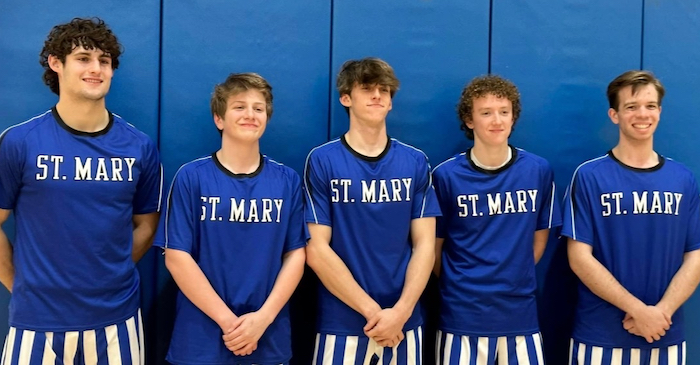
That dream began for some when the boys were coached by Matt as third graders, and they made serious strides last season. Before last winter, the last time the Eagles had won a Regional championship was 1950 – and no St. Mary boys basketball team had reached the Semifinals. Bramer and Dylan Barnowski – along with current seniors Jack Glynn, Drew Thompson and Nick Linguar – had high hopes of making more history this winter.
The dream ended Wednesday night with a Regional Final loss to Frankfort, which St. Mary had defeated 54-41 during the regular season. This time, the Eagles were faced with a large number of K-12 students succumbing to illness – with all five of its starters at least somewhat sick – as nearly a third of the school’s tiny enrollment was out of school the day after the loss to the Panthers.
But you won’t hear any of the players or coaches making excuses. They give all the credit to Frankfort, and they’re ready to move on. And many in the LSM family know reaching the Regional Finals this season and Breslin Center in 2022 had absolutely no probability had Bramer and Barnowski not made an iron-clad agreement last summer.
 The two friends vowed to help each other despite their personal, opposing challenges.
Barnowski and Bramer, through LSM’s cooperative agreement with Suttons Bay, went 3-for-3 playing in 8-Player Division 1 Football Finals during their first three years of high school. But through last summer Barnowski, who quarterbacked the Norseman, had no interest in football.
Bramer, meanwhile, had been nursing a quad tendon injury since his sophomore football season and battling two bad knees but was thinking he could suffer though football and sit out the basketball season to recover. The all-state running back experienced training difficulties and even had his strength training severely hampered.
Football was king for Bramer, and he also loved basketball too. Basketball is number one to Barnowski. The longtime friends decided cut a deal to help each other — and their teammates — out.
“I was kind of on the edge,” said Bramer, who plays with braces on both knees. “After talking to each other, we both ended up just playing.
“I really shouldn’t be playing sports, but I couldn’t miss out playing with my friends,” he continued. “We just figured it was our last season so we might as well just do it.”
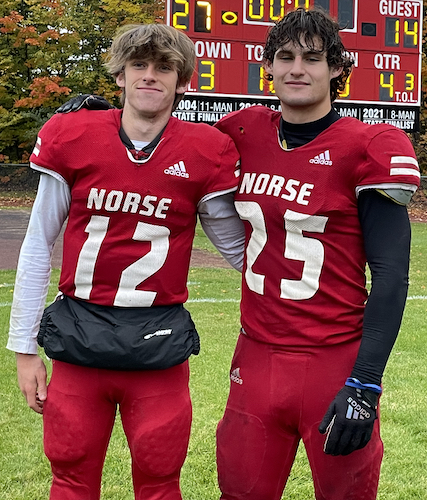 Barnowski had been considering ending his football days immediately after the Norse fell short in their third-straight trip to the Finals, at Superior Dome in Marquette in Fall 2021. That loss was at the hands of Adrian Lenawee Christian 31-20.
The Norseman graduated most of their offensive and defense lines last spring and expected to be small in numbers. Until this fall, they had lost only one regular-season game on their way to three straight title game appearances. This year they finished 3-5.
The big linemen losses — Barnowski’s protection — was forcing him to weigh his injury risk against having a senior basketball season.
“We did it for each other,” Barnowski said. “I talked with Shawn, and we knew we had a big community behind us and it would be hard for them if we just quit.
“I knew we weren’t going to have the same powerhouse team we had,” he continued. “We weren’t very good this year, but we still had a blast.”
This week’s loss put an end to the possible Breslin championship finish, but it left the friends happy with the decision to play both sports. The Eagles finished 20-4.
Barnowski led St. Mary in scoring. He averaged better than 20 points a game with more than seven rebounds and five assists. Bramer averaged just under 15 points per game, and almost 10 rebounds.
The two big men each scored 11 in the season-ending loss. Thompson scored 14. This year’s senior-dominated team likely will be remembered for its basketball success for some time. Barnowski, Bramer and Glynn experienced only one loss in District play over their four seasons.
“It’s a really special groups of kids,” Coach Barnowski said. “These kids kind of transformed St. Mary’s basketball.
 “They’ve really built the program,” he continued. “It’s been a roller coaster ride.”
Bramer and Dylan Barnowski also played baseball in the past for the Eagles, but that likely won’t happen this spring. Barnowski plans to golf, and Bramer expects to sit the spring season out and heal.
“We’ll never forget these last four years of varsity we played,” Barnowski said. “I‘ve decided to go a more relaxing route, and I’m going for some golf.”
With their Breslin dream over, the friends are ready to enjoy the St. Mary’s community support and move on. They’re bummed so many were sick in the end but won’t use it as an excuse.
“Hats off to Frankfort,” Barnowski said. “They did an incredible job of shutting us down.”
Bramer agreed.
“They just played their game better than we did,” he said. “They took the lead at the end of the third quarter, and it was a battle from there.”
 Tom Spencer is a longtime MHSAA-registered basketball and soccer official, and former softball and baseball official, and he also has coached in the northern Lower Peninsula area. He previously has written for the Saginaw News, Bay County Sports Page and Midland Daily News. He can be reached at [email protected] with story ideas for Manistee, Wexford, Missaukee, Roscommon, Ogemaw, Iosco, Alcona, Oscoda, Crawford, Kalkaska, Grand Traverse, Benzie, Leelanau, Antrim, Otsego, Montmorency, Alpena, Presque Isle, Cheboygan, Charlevoix and Emmet counties.
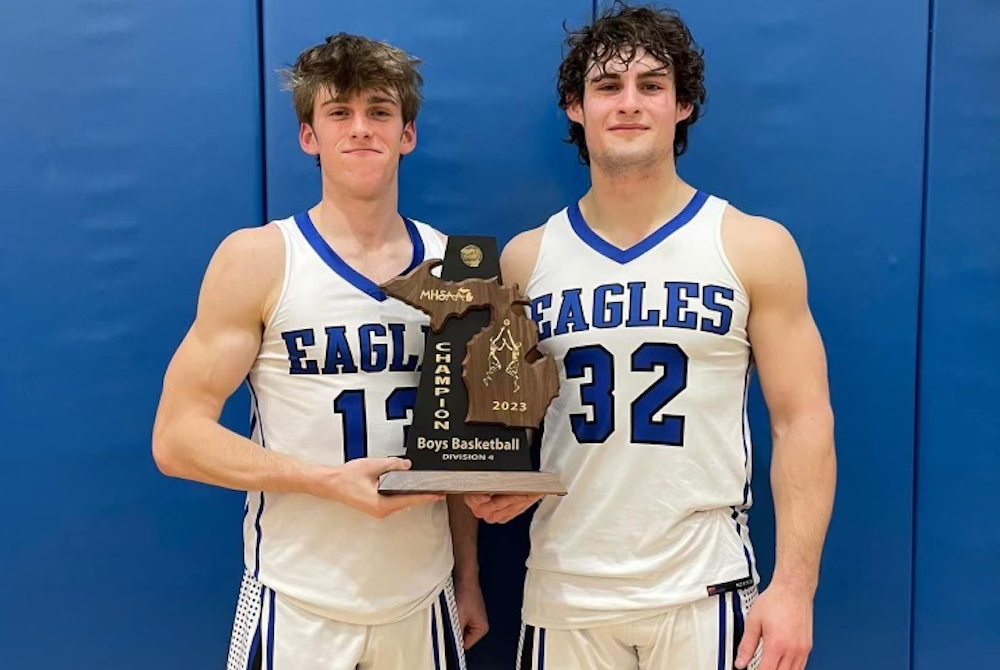
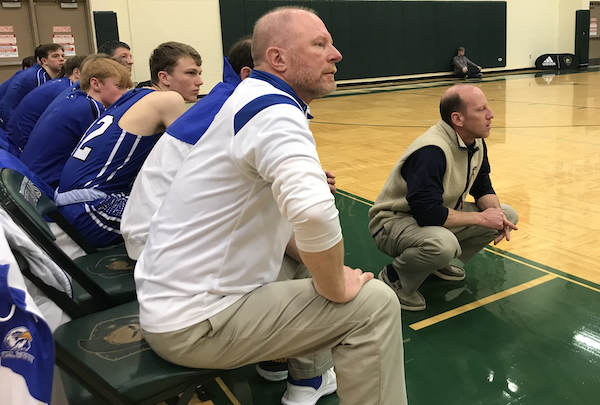
PHOTOS (Top) St. Mary’s seniors Dylan Barnowski, left, and Shawn Bramer hold up the team’s District championship trophy last week. (2) Eagles coach Matt Barnowski, center, and assistant Sander Scott coach up their team during last week’s Regional Semifinal win over Mesick. (3) Dylan Barnowski and Bramer also teamed up during successful football careers. (4) St. Mary’s seniors, from left: Shawn Bramer, Jack Glynn, Dylan Barnowski, Drew Thompson and Nick Linguar. (Sideline photo by Tom Spencer; player photos by Emmerson Lamb Photography.)