

'Crew of the Month' Recognized for Excellence On Field, Impacts as Mentors & Recruiters
By
Geoff Kimmerly
MHSAA.com senior editor
November 11, 2026
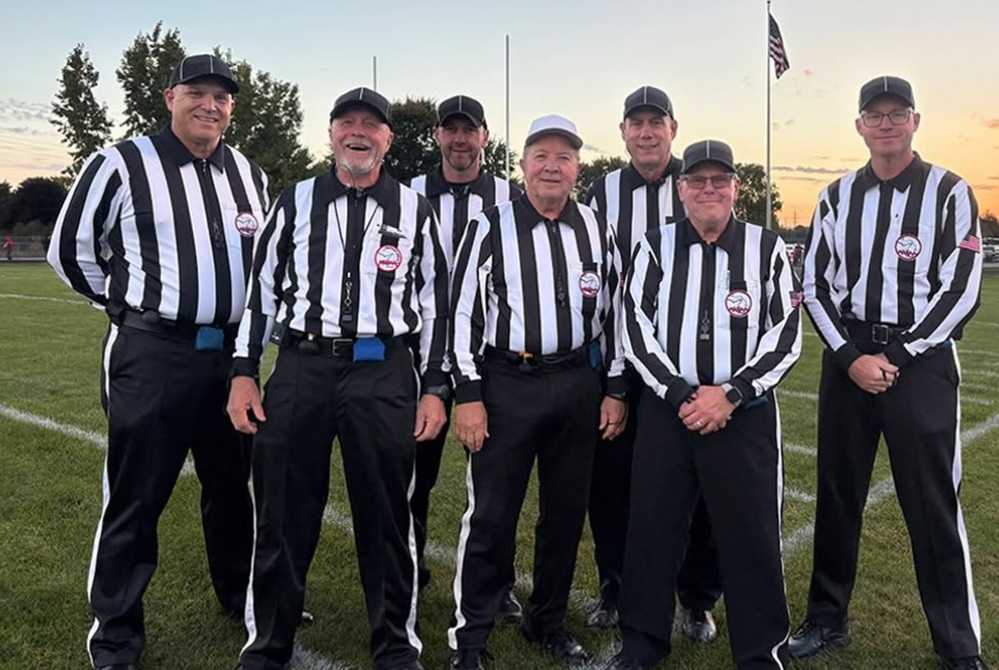
Valued for their work on the field and off, the Eastern Michigan Officials Association football crew led by referee Joel Venia has been named the Michigan “High School Officiating Crew of the Month” for October by the Detroit Lions.
Venia, from Marysville, is joined by umpire John Schwelhofer (Marysville), head linesman Mike Roosen (Macomb), line judge Tom Mailoux (Capac), back judge Ken Marzka (Lakeport), side judge Paul Guttowsky (Allentown) and field judge David Wood (Jeddo). The crew was one of the first in the EMOA to expand to seven officials and is often requested by schools for their biggest games.
They are noted for the wisdom and leadership they individually supply during local association meetings, with multiple serving as board members. They also are recognized for their mentorship of developing officials – and this crew has recruited a total of 12 new football officials over the last few years.
The Lions, in partnership with the MHSAA and National Federation of State High School Associations (NFHS), are recognizing an officiating crew monthly this season.
Heads and Heat
August 16, 2012
We are engaged in very serious discussions. They’re not only complicated, with unintended negative consequences possible from what are thought to be positive actions; they’re also a matter of life and death.
The topic is football – the high school sport under most scrutiny today and suffering from the most criticism it’s seen since the 1970s when catastrophic neck injuries spiked, liability awards soared, many insurers balked, and most helmet manufacturers abandoned the business altogether.
During recent years we have learned about the devastating long-term effects of repeated blows to the head; and we’re trying to reduce such hits. We’ve learned that 70 percent of concussions in football result from helmet-to-helmet contact, and we’re trying to have coaches teach blocking and tackling differently and have officials penalize “high hits” consistently and rigorously.
During the past several years we’ve learned that serious heat illness and heat-related deaths are 100 percent preventable, yet nationwide there were 35 heat-related deaths in high school football alone from 1995 to 2010; and we’re promoting practices that acclimatize athletes more gradually than “old school” traditionalists might advocate.
As we simultaneously address issues of heads and heat in football, some coaches may think we’re being overbearing, while many in medical fields say we’re out of date, citing higher standards of the American Academy of Pediatrics, National Athletic Trainers Association and National Federation of State High School Associations, as well as many of our counterpart organizations across the country.
As we consider in-season changes to improve athlete acclimatization and reduce blows to the head, we should be open to making out-of-season changes that work toward rather than in opposition to those objectives. There can be no sacred cows. The topic is too serious.
Ultimately, if we err in the outcome of this year’s discussions about heads and heat in football, it must be on the side of safety, on minimizing risks for student participants. They deserve it and, once again, the sport of football needs it.