

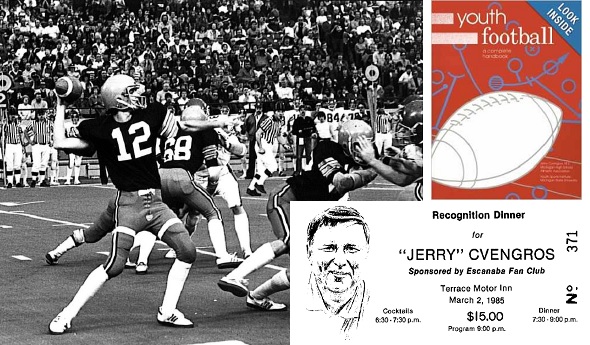
Cvengros Leaves Lasting Impact
By
Geoff Kimmerly
MHSAA.com senior editor
April 1, 2014
Retired Associate Director Jerry Cvengros, who served at the Michigan High School Athletic Association for more than 13 years after three decades at Escanaba High School, died Monday evening in Lansing. He was 80.
As lead assistant to Executive Director John E. “Jack” Roberts from August 1988 until retiring in January 2002, Cvengros served as director of football and briefly hockey in addition to coordinating the Program of Athletic Coaches Education (PACE), presenting annual in-service training for administrators and serving as MHSAA liaison to statewide principals, athletic directors and coaches associations.
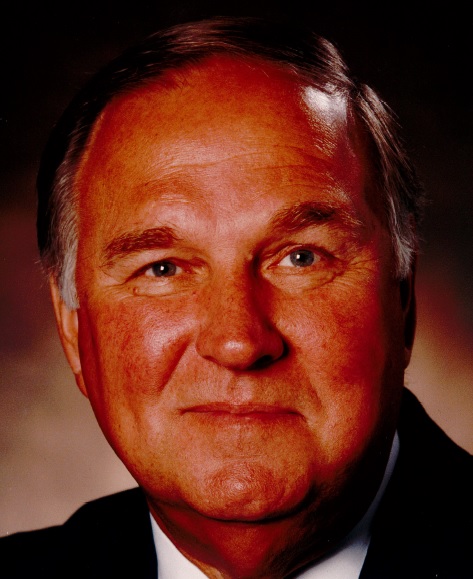 He came to the MHSAA after 30 years at Escanaba, where he taught, coached, served as athletic director and later principal during a tenure stretching from August 1958 through July 1988. While at Escanaba, Cvengros also represented Upper Peninsula Class A and B schools on the MHSAA Representative Council from 1983-88 and served as the Council’s president from 1986-88.
Cvengros received the MHSAA’s Charles E. Forsythe Award in 2000 in recognition of his many and significant contributions to interscholastic athletics.
“During his lifetime, Jerry Cvengros impacted every area of interscholastic athletics as a coach, athletic director, principal and then associate director of the MHSAA," Roberts said. “He was the perfect combination of fairness, toughness and diplomacy, able to draw on a vast knowledge of MHSAA rules and an understanding of educational athletics fostered by his various experiences.
“Jerry was known and respected statewide for his dedication, and his contributions have had a lasting impact.”
Cvengros built an elite football program at Escanaba as varsity head coach from 1962-84, leading the Eskymos to a 161-42-3 record, a Class A runner-up finish in 1979 and the MHSAA championship in 1981. That team remains the only Class A/Division 1 team from the Upper Peninsula to win an MHSAA football title. Cvengros was inducted into the Michigan High School Football Coaches Association Hall of Fame and served on its original Board of Directors.
His 1979 team fell to Detroit Catholic Central 32-7, but he brought the Eskymos back to the Finals for a 16-6 win over Fraser two seasons later. Cvengros' championship lineup included quarterback Kevin Tapani, who would go on to pitch for the Minnesota Twins among five major league clubs, and tailback Dean Altobelli, who later played at Michigan State University. The title run included a 15-14 Semifinal win over Dearborn Fordson that included a savvy two-point conversion call by Cvengros, who wanted to avoid overtime after a late score drew Escanaba to within a point of tying the score.
As the MHSAA’s director of football, Cvengros was instrumental in creating the current playoff format that expanded the field from 128 to 256 teams beginning with the 1999 season. He also co-authored “Youth Football: A Complete Handbook,” a guide to coaching at that level.
Among many additional honors, Cvengros was inducted into the Upper Peninsula Sports Hall of Fame and Michigan High School Coaches Association Hall of Fame and received the Distinguished Service Award from the Michigan Interscholastic Athletic Administrators Association. The National Federation of State High School Associations twice awarded Cvengros with a Citation – the NFHS’ highest honor – for his service as a coach and then as a member of the MHSAA staff.
Since his retirement, Cvengros and his wife Shelley have continued to reside in Okemos. A visitation will take place beginning at 10 a.m. Monday, April 7, at St. Martha Parish in Okemos, with a funeral Mass to follow at 11 a.m.
Cvengros was a 1951 graduate of Ironwood High School and went on to study and play football at the University of Wisconsin in Madison. He earned his bachelor’s degree in secondary education and teaching from the University of Wisconsin-Superior and a master’s from Northern Michigan University.
He taught English, history and physical education at Escanaba High School and also coached basketball and track and field. He became the school’s athletic director in 1970, added the duties of activities director in 1975 and became principal in 1983.
Cvengros is survived by his wife and children Michael, Steven and David, and seven grandchildren. He was preceded in death by his daughter Lee Ann (Cvengros) Swasey in May 2013.
PHOTOS: (Clockwise from left) Escanaba quarterback Mike Beveridge fires a pass during the 1979 Class A Final; Cvengros co-authored a book on coaching youth football; Cvengros was celebrated once more in Escanaba following his final season as football coach.
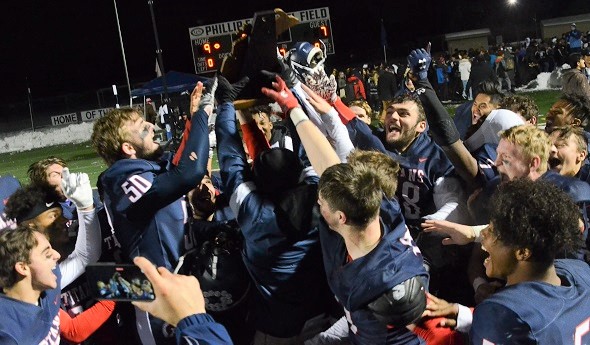
Leader Re-Energizes Past Power Stevenson
By
Tom Markowski
Special for Second Half
November 22, 2019
Regardless of how one looks at it, Justin Newcomb is the right person for the right job at the right time.
 Newcomb, 33, is one of the youngest head football coaches in the Detroit area, and he’s causing a stir. He’s in his second season at Sterling Heights Stevenson and the person most responsible for the Titans playing in an MHSAA Division 1 Semifinal on Saturday for the first time in a decade.
Stevenson (8-4), as an additional playoff qualifier, has played the underdog role to a T throughout the playoffs. There’s an advantage to that role, and Stevenson will take it up again when it takes on Davison (10-2) at Troy Athens at 1 p.m.
Once a football power, Stevenson fell back to the middle of the pack in the highly competitive Macomb Area Conference Red from 2010-18. Four times previously the program had reached an MHSAA Final, the last in 2009 when the Titans lost to Detroit Catholic Central, 31-21, in the Division 1 title game.
That was Hall of Fame coach Rick Bye’s 35th and final season at Stevenson. Since then, the Titans qualified for the playoffs three times and didn’t win a playoff game. That is, until this season.
“You’ve got goals,” Newcomb said. “You set goals at the start (of the season), and you just want to get the most out of (your) team.”
When Newcomb took over, the program had won just three games over the previous two seasons. The Titans were 4-5 overall in 2018, and just 1-4 in the MAC Red, which was won by eventual Division 1 champion Clinton Township Chippewa Valley. The average margin of defeat in those four league losses was 25.5 points.
“We took our lumps (in the MAC Red),” Newcomb said. “The challenge was getting kids to come out. When we first came in there was some interest lost. We had to beg some to come out. Now that we’re winning, kids are saying they want to come out.”
Despite his young age, Newcomb has coached high school football for 14 seasons. He started as an assistant under Mike Powell at Warren Cousino in 2006 when Newcomb was a student at Wayne State University. For 10 seasons he was the head varsity baseball coach at Cousino, but he gave that up when he took over for Powell as Cousino’s head football coach in 2017.
Though Newcomb finds himself in the right position at Stevenson, don’t view Stevenson’s sudden success as luck. Newcomb possesses an insatiable appetite for knowledge. If there’s a clinic to attend, you’ll likely find Newcomb there. And his ego doesn’t prevent him from talking to more experienced coaches to pry loose valuable information. Most often you’ll find Bye on the Stevenson sideline, not as an assistant but someone there whom Newcomb can confide in.
“Justin is positive and energetic,” Bye said. “He’s definitely not a guy who thinks he knows it all. He’s bought into everything, the Stevenson history, everything. He’s up on technology, much more so than I ever was. And he doesn’t let little things bother him. His practices have a tempo, and there’s little time wasted.”
 Not lost in Newcomb’s system is his military background. After graduating from Wayne State with a teaching degree, he joined the U.S. Army Reserve in 2011. He continues to serve today in the Individual Ready Reserve (IRR).
“It has a lot to do with the way we coach,” Newcomb said of his military experience. “(Coaching) is a lot more than just what goes on on the field. There’s (teaching) leadership roles and being responsible. In our culture, it’s all about winning. It’s all about playing time. The kids get caught up in that.
“Their attitudes have changed. We had to address the group as a whole. We had guys that first year that said that they play linebacker, and that’s it. Others came in saying they just play one way. That’s not how we do it. You’re here to help the team. Now the kids are doing whatever we need them to.”
A prime example is junior Giovanni El-Hadi. A college prospect (committed to University of Michigan), El-Hadi had been told, by some outside of the program, that he was an offensive lineman and wouldn’t play defense. This season El-Hadi is starting on defense for the first time and said earlier this fall that his time spent on the defensive side has helped improve his speed.
Another two-way starter on the line is senior Sal Madonna. Madonna is a two-year starter, and he and his brother, sophomore Biagio Madonna, are the sons of assistant coach Carmine Madonna – who played for Bye during the late 1990s.
“For me, I’ve been a part of Stevenson football for a long time,” Sal Madonna said. “Last year’s team wasn’t as connected as much. This year we bonded together. We trusted Coach Newcomb’s style. Even last year as juniors (we knew) to be successful, we had to buy in. We didn’t have the same mindset last year. We’re playing with a lot more confidence now.
“This means a lot to me. I remember being in the stands (at Troy Athens) when Jason Fracassa threw a touchdown pass in the (2009) Semifinals. Just like this team, that team never gave up.”
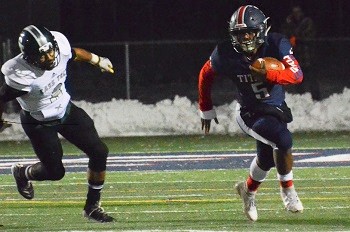
This team rebounded from a 2-3 start with a 13-7 comeback victory over Utica in Week 6. That game, more than others, was the turning point of the Titans’ season. Newcomb made a switch at quarterback, moving Biagio Madonna from linebacker and switching fellow sophomore Jordan Ramsey from quarterback to slot receiver and running back. With Ramsey, Newcomb was running a zone read offense. With Madonna, Stevenson is running an option attack.
In the victory over Utica, Stevenson used a trick play to score the winning touchdown. Last week in the 9-7 Regional Final victory over Detroit Cass Tech, the Titans had a goal-line stand in the first half and scored the winning touchdown on a double pass. Madonna threw to Dylan Kleinedler, who threw to Ramsey for a touchdown early in the second half. A Ramsey interception ended the game with 14 seconds left.
The previous week against Macomb Dakota, Newcomb decided not to go for the tying field goal from 40 yards out, and instead called on Madonna to throw the winning touchdown pass to Ramsey with a minute to play. Stevenson won 38-35 against a team it had lost to, 40-14, during the regular season and before Newcomb had made the quarterback switch.
“We’ve been fortunate the last few weeks with trick plays,” Newcomb said. “(But) getting here is a testament on just how hard these kids have worked.”
 Tom Markowski is a correspondent for the State Champs! Sports Network and previously directed its web coverage. He also covered primarily high school sports for the The Detroit News from 1984-2014, focusing on the Detroit area and contributing to statewide coverage of football and basketball. Contact him at [email protected] with story ideas for Oakland, Macomb and Wayne counties.
PHOTOS: (Top) Sterling Heights Stevenson players hoist their Division 1 Regional championship trophy after defeating Detroit Cass Tech last week. (Middle) Jordan Ramsey (5) breaks into the open against the Technicians. (Photos courtesy of the Stevenson football program.)