

Drive for Detroit: Week 3 in Review
September 10, 2012
By Geoff Kimmerly
Second Half editor
Mid-September is not the logical time to announce a league championship has been decided.
But this season, games played during Week 3 eventually may determine at least nine league championships.
A number of results could've been considered the most intriguing – and we've tried to hit all of the possibilities in this week's Drive for Detroit report.
West Michigan
Muskegon 21, Rockford 9
The Big Reds are rivaling Detroit Cass Tech as the most impressive team in the state so far after motoring past Rockford on the legs of a 400-21 rushing yards advantage. Muskegon (3-0) now owns wins over Rockford, Orchard Lake St. Mary and Ohio power Sylvania Southview. The Rams face a 1-2 start for the first time since 1999. But rest assured, Ram Nation: the last time Rockford opened 1-2, it still made the Division 1 Semifinals. Click to read more from the Muskegon Chronicle.
Also noted:
Holland West Ottawa 24, East Grand Rapids 17 – These teams met for the first time since 1983; West Ottawa beat the Pioneers for the first time since 1980.
Muskegon Oakridge 35, Montague 7 – After two straight one-point games between these two, Oakridge won big to take the upper hand in the West Michigan Conference.
Zeeland East 15, Hudsonville 14 – East is off to a 3-0 start again, but the Eagles are 1-2 with those losses by a combined four points.
Grand Rapids South Christian 42, Grand Rapids West Catholic 7 – Beating this 2011 Division 5 Semifinalist, plus losing to Grand Rapids Christian by only 10 in Week 1, makes the Sailors look lined up to challenge Grand Rapids Catholic Central in the O-K Gold.
Mid-Michigan
Pinckney 36, Brighton 14
The Pirates had lost 18 straight to Brighton. In fact, they hadn’t beaten the Bulldogs since 1977 before scoring 29 unanswered points Friday in the Kensington Lakes Activities Association West opener. Pinckney is 2-1, just a win off last season’s total and halfway to their best season since 2001. Brighton fell to 1-2. Click to read more from the Livingston Daily.
Also noted:
Alma 14, Freeland 6 – The Panthers opened the Tri-Valley Conference Central season by avenging a loss that kept them from winning a share of the title in 2011.
Grand Ledge 35, Lansing Sexton 8 – The Comets scored more than 30 points for the third straight week and look good to cruise into an Oct. 5 showdown with Lansing Everett that could decide the Capital Area Activities Conference Blue title.
Portland St. Patrick 58, Burr Oak 14 – The Shamrocks appear to have struck gold with the 8-player format, averaging nearly 61 points per game during a 3-0 start.
Owosso 25, Haslett 22 – This was arguably Owosso’s most impressive win since 2006 and will help as the Trojans go for a first playoff berth since 2001.
Greater Detroit
Oxford 34, Farmington Hills Harrison 31 (2 OT)
The Wildcats had lost by an average of 31 points to the Hawks over the last two seasons, their first together in the Oakland Activities Association White. But Oxford (2-1) broke Harrison’s 21-game regular-season winning streak in what has to be considered an upset although both teams made the playoffs in 2011. The Wildcats also beat a 2011 playoff team, North Farmington, in Week 2. Click to read more from NorthOaklandSports.com.
Also noted:
Livonia Churchill 35, Plymouth 31 – Churchill had lost its first four matchups with Plymouth since the start of the KLAA, including 41-0 in 2011.
Warren DeLaSalle 40, Dearborn Fordson 19 – After a loss to one of the best in Ohio, Cleveland St. Ignatius, the Pilots bounced back for a solid win heading into the Catholic League season.
Clinton Township Chippewa Valley 21, Utica Eisenhower 7 – The Big Reds avenged a 45-0 shutout from last season to get to 2-1 and only a win shy of last season’s victory total.
Oak Park 34, Rochester Adams 22 – The Knights are 3-0 and equaled last season’s win total; combine this with an opening-weekend win over Detroit East English, and Oak Park is looking good to make some noise in the OAA White.
Thumb and Bay
Frankenmuth 12, Millington 8
The Eagles (3-0) had lost four straight to their rival, and appeared in trouble of making it five after giving up a safety in the fourth quarter. But Frankenmuth recovered an onside kick and scored, and with the win earned an an early upper hand in the Tri-Valley Conference East. Millington fell to 2-1. Click to read more from the Saginaw News.
Also noted:
Capac 12, Almont 7 – The Chiefs avenged a 28-0 loss from 2011 and gained what could be a significant step toward its playoff hopes.
Peck 44, Carsonville-Port Sanilac 13 – The Pirates downed the reigning MHSAA 8-player champion to move to 3-0.
Midland Dow 27, Saginaw 16 – Dow avenged last season’s 18-13 loss and moved to 2-0 in the tough Saginaw Valley Association North.
Saginaw Michigan Lutheran Seminary 28, Merrill 14 – The Cardinals needed this one to keep pace in a league that sent five of eight teams, including both of these squads, to the playoffs last season.
Southwest and Border
Schoolcraft 21, Olivet 20
Schoolcraft knocked out two Kalamazoo Valley Association favorites over the last two weeks and at 3-0 is now the team to beat. Olivet led by 10 points during the fourth quarter, but couldn’t hold on despite some significant statistical advantages and fell to 2-1. Click to read more from the Kalamazoo Gazette.
Also noted:
Battle Creek Harper Creek 35, Sturgis 3 – This was looking like a must-win for the 1-2 Beavers, and turned into an impressive win as well.
Stevensville Lakeshore 21, Portage Northern 14 (2 OT) – This was the best of the Southwestern Michigan Athletic Conference openers, and could have title implications later on.
Blissfield 32, Hudson 13 – The Royals got their first win by avenging a 39-point loss from 2011.
Dowagiac 30, Plainwell 13 – Dowagiac extended its winning streak over Plainwell to seven straight and looks set for another run in the Wolverine B South.
Lower Up North
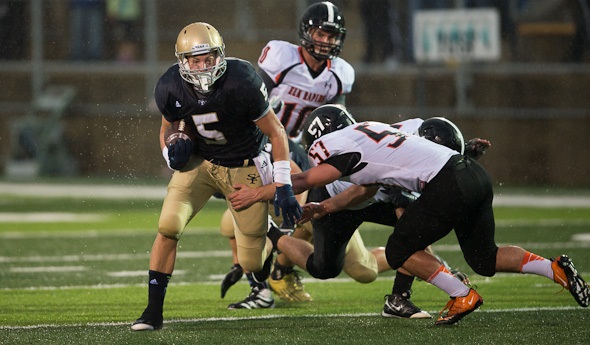
Traverse City St. Francis 12, Elk Rapids 7
The Gladiators have bounced back well since an opening-night loss to Kingsley, moving to 2-1 against an Elk Rapids team that is likely better than its 1-2 record. The Elks also fell on opening night, to Mancelona, which won 10 games in 2011. With St. Francis not playing in the Lake Michigan Conference this season after winning it a year ago, Elk Rapids could be the team that pushes Grayling for the league title. Click to read more from the Traverse City Record-Eagle.
Also noted:
Pellston 7, Rogers City 6 – The Hornets made a first-quarter touchdown stand to move to 3-0 for the first time since 1995 and equal their highest win total of the last decade.
Benzie Central 8, Frankfort 6 – This was looking like a bit of a must-win for Benzie Central after an 0-2 start, and is a big first step toward defending the Northwest Conference title.
McBain 19, Manton 14 – The Ramblers stopped a Manton offense that had scored at least 40 points in each of its first two games this season.
Cadillac 44, Petoskey 14 – One of these two has won the Big North Conference every season dating to 2008; Cadillac is the favorite now.
Upper Peninsula
Negaunee 36, Gladstone 34
The Miners (3-0) pushed their winning streak over Gladstone to three straight with this second consecutive win over the Braves by a field goal or less. Negaunee entered the fourth quarter trailing by 14 points, but scored twice during the final six minutes to stay perfect this fall. Gladstone fell to 2-1, but has plenty to be pleased about after finishing winless in 2011. Click to read more from the Marquette Mining Journal.
Also noted:
Crystal Falls Forest Park 13, Hurley 12 – The Trojans avenged last season’s lone regular-season loss and became favorites in the Great Western Conference.
L’Anse 45, Ontonagon 6 – The Purple Hornets eclipsed last season’s win total and moved to 3-0 by beating a team with three straight playoff appearances.
Norway 14, Stephenson 8 – The Knights equaled last season’s win total by moving to 2-1, also by beating a team that is coming off three straight playoff berths.
Eben Junction Superior Central 61, Posen 40 – The 8-player game has proven high-scoring, but this is the first matchup this season to result in more than 100 combined points with the losing team scoring at least 40.
Trophy Games
Each week, the MHSAA highlights trophy games around the state. Here's one from Week 3.
- The Wooden Oar Trophy: Fruitport and Spring Lake launched this award last week, dubbing their matchup the Bayou Battle. Final: Fruitport 15, Spring Lake 6.
PHOTO: Traverse City St. Francis' Byron Bullough (5) works to break a tackle by Elk Rapids' Ryan Simpson (57) during Friday's 12-7 Gladiators win. (Click to see more at Terry McNamara Photography.)
Fugate Carries CC On 1 More Trophy Run
By
Paul Costanzo
Special for MHSAA.com
November 24, 2017
DETROIT – As classmates and fans screamed his name from the Ford Field stands Friday night, Nolan Fugate put the focus on his teammates.
 “I cannot thank my offensive line and my outside receivers enough,” the Grand Rapids Catholic Central senior running back said. “Without them none of this would be possible, and I just can’t thank them enough. They’re the best offensive line in the state.”
That line paved the way for Fugate, who gained 306 yards on the ground and tied an MHSAA Finals record with five total touchdowns as the Cougars defeated Edwardsburg 42-31 in the Division 4 championship game.
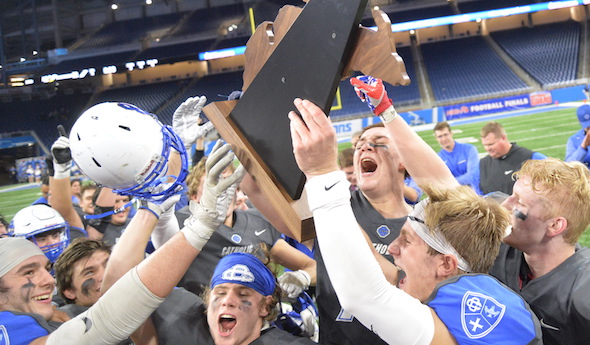
It was the second straight title for Catholic Central (14-0), and the program’s fourth overall. Coach Todd Kolster has led the Cougars to three of them (2010, 2016 and 2017).
“It has nothing to do with me,” Kolster said. “I’m the beneficiary of being the head coach for three of these, but it’s the kids that do all the work. They’re outstanding. This senior class, I love them so much. I’ve been so critical of them, and I say that all the time, because I came back here to Catholic Central with that class when they were freshmen and now they’re seniors. It’s really special to see these guys enjoy this, because they’ve earned every bit of it.”
This year’s title game was in stark contrast to last season’s when the Cougars eked out a 10-7 victory in a defensive struggle against Detroit Country Day. Big plays from both offenses highlighted Friday night’s game as Catholic Central had to battle to hold off a relentless Edwardsburg team down the stretch.
“They all mean the same,” Kolster said. “They all come in the right column, so we’ll take it.”
Seven of the game’s scoring plays were 20 yards or longer, including an MHSAA Finals record-tying 99-yard kick return touchdown by Edwardsburg’s Caden Goggins, and a MHSAA Finals record-tying 90-yard touchdown run by his teammate Nick Bradley.
On the night, the Eddies (12-2) averaged 9.7 yards per play and 10.8 yards per carry, while Catholic Central averaged 7.7 yards per play in managing to outgain Edwardsburg 448-369.
“Our defense, they played well -- we gave up a couple big plays, and Edwardsburg is a heck of a football team,” Kolster said. “We gave up three (big) kickoff returns and three big plays, but we handled them pretty well. That’s what they do, and that’s why they’re so good. That’s why they’re here, because they just keep at it, they keep at it and they’ll pop one, and they have confidence in that. But we have confidence in our guys.”
The Cougars’ defense did stiffen when it absolutely had to, as sophomore Ethan Lott came up with a tackle for loss on a 4th-and-1 play late in the fourth quarter to all but seal the game.
“Our guys did a great job on that 4th-and-1; it’s just a matter of reading their keys,” Kolster said. “I’m really proud of them.”
 The game was absolutely put away when Fugate went 58 yards on a 3rd-and-10 in the final minute, barely getting tripped up at the Edwardsburg 10. It was another in a long line of huge plays for Fugate, who had touchdown runs of one, five, 54 and 32 yards, as well as a 20-yard touchdown reception from Jack Bowen.
Fugate also had 86 yards receiving and came down with a 38-yard catch along the sideline on a crucial 3rd-and-28 play midway through the fourth quarter with his team clinging to a 35-31 lead.
“The long third down, I saw (Bowen) leave the pocket and I was running my route and knew I had to get open,” Fugate said. “I just kind of boxed my guy out and said throw the ball, and I just did my best to make a play on the ball, and I was able to come down with it.”
The game put Fugate over 2,900 yards rushing for the season, and capped off a brilliant career that saw him set the school’s all-time career rushing record.
“Fugate is obviously a terrific runner,” Edwardsburg coach Kevin Bartz said. “I thought he ran as hard as I’ve ever seen him. We watched a good portion of film on him, and we knew he was fast, but I guess what I was more impressed with today is how hard he ran. He picked up lots of extra yards after contact. He’s an impressive athlete.”
Bartz was equally impressed with his team, which was playing in the title game for the first time and kept finding ways to hang around despite trailing by 16 midway through the third quarter.
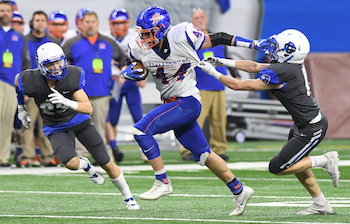
On top of the record-tying touchdowns, the Eddies had scoring runs of 55 and 78 yards from Kyle Shrider, and 64 yards from Chase Sager. Shrider finished with 162 yards rushing, while Bradley had 96 and Sager had 73.
“Just to make it to this point, this was a team that was not expected to be here,” Bartz said. “With the number of kids we lost last year, we were kind of expected, I think, by most to be average at best. For them to come out here and perform against a top-level team like Grand Rapids CC, I’m extremely proud of these kids. They’ve now set the bar pretty high for everybody else at Edwardsburg.”
Bowen finished with 128 yards passing for the Cougars, while Erik Grabow had a 14-yard touchdown run.
The MHSAA Playoffs are sponsored by the Michigan Army National Guard.
PHOTOS: (Top) Grand Rapids Catholic Central players raise the winner's trophy after Friday night’s Division 4 championship game. (Middle) Edwardsburg’s Kyle Shrider pulls away from a Cougars defender.