

E-TC's Witt Bulldozing Path from Small Town to Football's Biggest Stage
By
Jason Juno
Special for MHSAA.com
June 28, 2024
Ewen-Trout Creek graduate Jake Witt is playing for a spot on the Indianapolis Colts’ 53-man roster. The memories of high school sports, and the impact they’ve had on his journey to the NFL, have stuck with him through his college days and even now as a professional.
 The 300-plus receiving yards he went for in a game against the eventual 8-player state champion back in 2017.
The regular-season basketball game where 3,276 fans turned out to watch his Panthers play just a few months later.
The teamwork prep sports taught him. The family atmosphere he got to be a part of on the high school football team.
“Football was definitely the sport I felt the most family-type feeling with it,” Witt said earlier this week after fishing on Erickson Lake while back in the Upper Peninsula before training camp begins next month. “That’s what drew me back to wanting to play football in college, was my opportunity in high school to play and getting that feeling with the guys and that family-oriented feel.”
Witt played two years of high school football. He lined up exclusively at wide receiver for Ewen-Trout Creek as a junior and then was more of a blocking tight end when E-TC and Ontonagon joined forces as a co-op program when he was a senior.
He ultimately decided to play basketball first in college, at Michigan Tech. But two of his three finalists were football opportunities.
“Obviously playing basketball from second grade on, people would probably assume that I would want to play basketball in college,” Witt said. “I think that just goes to show that football in those two years had a big impact and obviously it led me to where I am when I played at Northern and where I am today.”
Witt played only one year of basketball at Tech. He transferred to Northern Michigan University to attend as a student only before being talked into playing football.
He was initially a tight end there before moving to tackle because of injuries during a game against Ferris State. He dominated, not allowing a sack or even a quarterback pressure against what was considered the best Division II defensive line in the country.
He stayed at tackle for what was left of that season and then all of his final year at Northern. Despite his limited time at the position, he had the attention of NFL scouts and entered the draft. The attention reached a fever pitch during his pro day at Central Michigan when he wowed with his athleticism. His 9.92 Relative Athletic Score, a way to measure players’ athletic testing while accounting for their size, was one of the best for an offensive tackle prospect since it began being used in 1987.
 He was drafted with the 236th pick, in the seventh round, by the Colts in 2023.
His first training camp was cut short due to a hip injury, and he was then placed on season-ending injured reserve. But he’s back healthy and ready to go. He practiced at second-string left tackle during the offseason camp this spring and now hopes to earn a spot on the 53-man roster with training camp set to begin in a month.
“I want to go into training camp, play well and then play well enough to where they can’t release me off the 53,” Witt said. “The next goal is to play in a game. And I think that will start with special teams, that will start with field goal. And then from there, obviously, everybody is one week of great practice away from playing with the offense, one injury away from playing in a game with the offense.”
Those who watched him during his high school days in the U.P. likely wouldn’t be at all surprised to see that happen.
Witt is still the only receiver to go for 300 or more receiving yards in 8-player football in state history, according to the MHSAA record book. And he did it twice, a 325-yard game against Eben Junction Superior Central as a junior and the 305-yard performance against Crystal Falls Forest Park as a senior.
The Ontonagon co-op team had mostly stuck to running the ball that season, but looked for Witt through the air against the eventual state champion Trojans.
“I think it was 345 (yards), I think they sent in the wrong number,” Witt said. “That was one game where we switched things up with our offensive attack and threw the ball a lot more, and it ended up paying off for us very well. We were down big at halftime, and we pushed back and we were in a battle with them in the second half. It was a great game. We didn’t end up winning, but it was a lot of fun.”
He enjoyed both years of high school football – even while mostly blocking on the line as a senior despite having shown previously to be a more-than-capable receiver.
 “A lot of the offense wasn’t focused on me anymore, which was great,” Witt said. “It made me a much more well-rounded football player. It made me a much better athlete, it gave me a better perception on things as a football player versus just being a receiver. I think both years were great for different reasons.”
Witt said every sport he played in high school was beneficial to him going forward. Basketball, for example, taught him teamwork and coordination.
“And just relationship building is huge; for me, it helped me move on to the professional football level,” he said.
No high school game was quite as memorable for him as that regular-season basketball game at Michigan Tech on a chilly Wednesday night in Houghton.
Ewen-Trout Creek and Dollar Bay were tied atop the U.P. small-school poll. With that type of matchup, and the chance for fans in the Copper Country to see the 6-7 Witt and his above-the-rim play that’s pretty unique in the U.P., the game was moved from Dollar Bay’s tiny gym to Michigan Tech. (He wasn’t quite 300 pounds like he is now, but he was close – and he came into that game averaging 27 points and 16 rebounds per game with no one able to match his size and strength.)
They expected a crowd; they got 3,276. The latest arriving fans had to sit on the floor on the baseline.
“You don’t see that very much in Division 4 basketball even in the playoffs,” Witt said. “Just having that atmosphere, and especially having it between two of the best U.P. teams at the time, and having the storyline that was behind the game was great – and one of the most memorable events to this day still for me.”
Witt is looking forward to the challenge of training camp and achieving his goals in Indianapolis. But he’s not rushing away a U.P. summer.
He helped out at last week’s U.P. Football All-Star game. He was happy to provide insight for any players headed off to play college ball, and they helped the Marquette County Habitat for Humanity with the finishing touches on one of their houses.
Over the next month, he’ll still be training, going over the playbook and doing position skill work. As happy as he was to help out last week, he’s happy to be on the lake again, too, fishing like a normal Yooper.
“That’s what I’ve been trying to do, that and train,” Witt said. “Just trying to destress before I get back into it.”
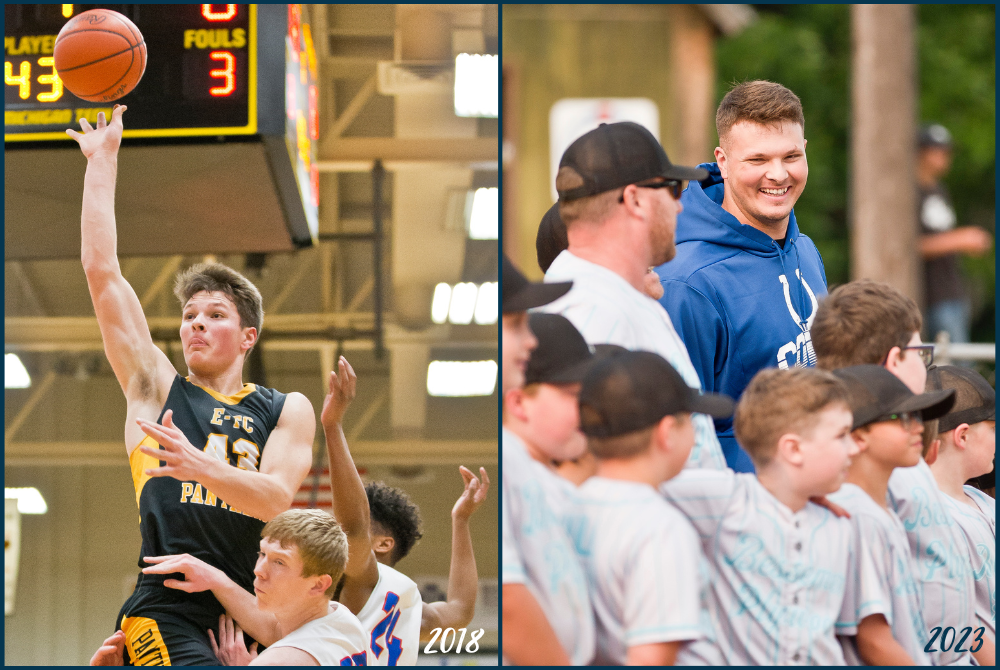
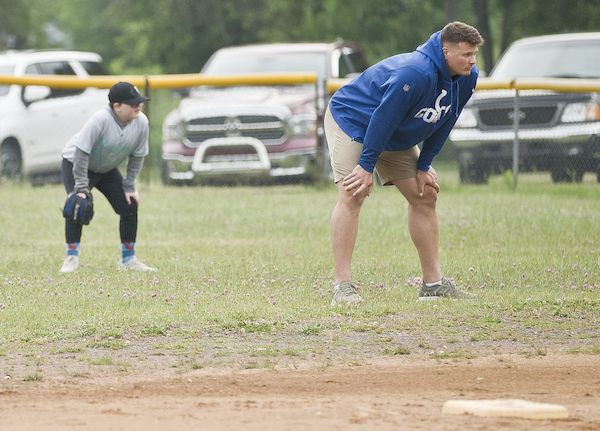
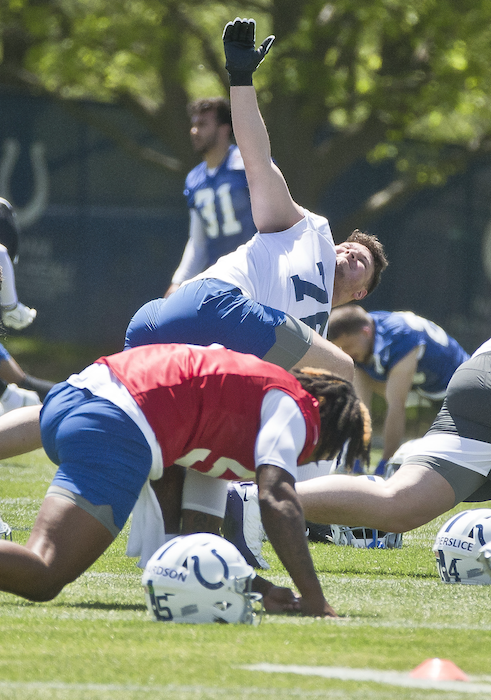
PHOTOS (Top) At left, Jake Witt played for Ewen-Trout Creek during a 2018 basketball game at Michigan Tech, and at right Witt takes a photo with area youth baseball players last summer. (Middle) Witt, right, umpires a baseball game last summer. (Below) Witt warms up during the Indianapolis Colts’ rookie camp in May 2023. (Photos by Jason Juno.)
Be the Referee: Basketball Over the Back
By
Sam Davis
MHSAA Director of Officials
January 13, 2026
Be The Referee is a series of short messages designed to help educate people on the rules of different sports, to help them better understand the art of officiating, and to recruit officials.
Below is this week's segment – Basketball Over the Back - Listen
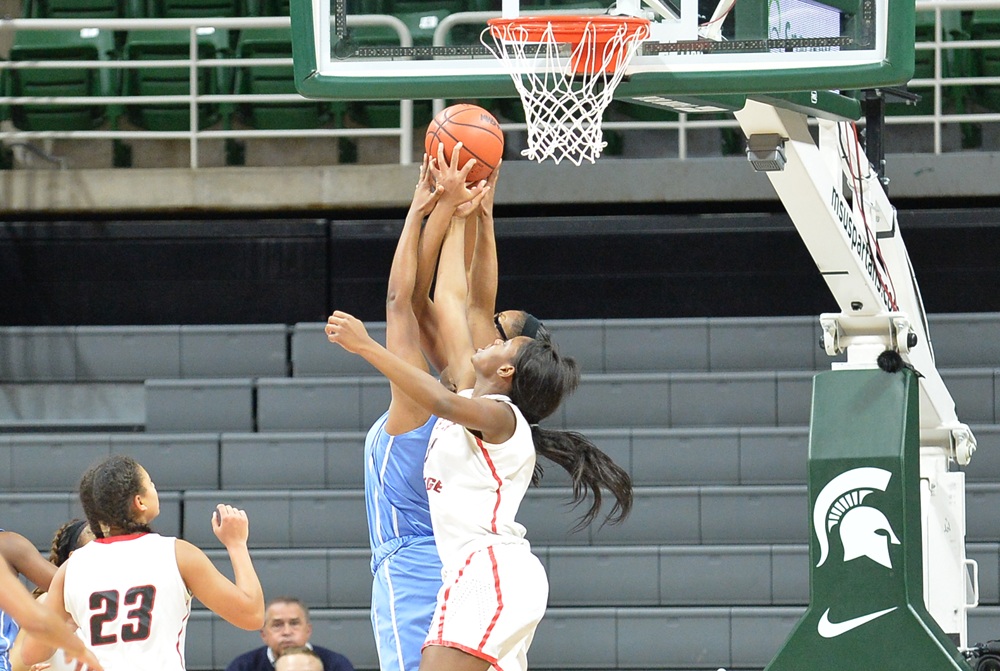
Did you know there is no such thing as “over the back” in basketball? If two players are going for a rebound and the player behind another player is able to grab it over the top of the player in front – that’s not necessarily a foul. He or she did not go over the back.
The player behind another player may have committed a foul such as bumping the player in front, or pushing that player – gaining an advantage to grab the rebound – but that would be whistled for a push or grab. Not over the back.
A taller player or player who can jump higher grabbing a rebound is not a foul. It’s only a foul if they create an advantage by pushing, bumping, or any other kind of illegal contact while in the process of going for a rebound. Fans yell over the back all the time, but an official will never call a foul for going over the back.
Previous 2025-26 editions
Jan. 6: Bowling Ball Bounces Out of Gutter - Listen
Dec. 9: Puck on Goal Netting - Listen
Dec. 2: Goaltending vs. Basket Interference - Listen
Nov. 25: Football Finals Instant Replay - Listen
Nov. 18: Volleyball Libero Uniforms - Listen
Nov. 11: Illegal Substitution/Participation - Listen
Nov. 4: Losing a Shoe - Listen
Oct. 28: Unusual Soccer Goals - Listen
Oct. 21: Field Hockey Penalty Stroke - Listen
Oct. 14: Tennis Double Hit - Listen
Oct. 7: Safety in Football - Listen
Sept. 30: Field Hockey Substitution - Listen
Sept 23: Multiple Contacts in Volleyball - Listen
Sept. 16: Soccer Penalty Kick - Listen
Sept. 9: Forward Fumble - Listen
Sept. 2: Field Hockey Basics - Listen
Aug. 26: Golf Ball Bounces Out - Listen