

Eagles Stone-wall Bellaire in 8 Final
November 16, 2012
By Dean Holzwarth
Special to Second Half
GREENVILLE – Deckerville sophomore Ryan Stone had serious doubts about playing on the varsity team this year.
Stone thought he was better suited for the junior varsity. But following Friday night's MHSAA 8-player football championship game, everyone in the city of Deckerville is glad he opted for the jump to the next level.
The scrawny 5-foot-8, 140-pound Stone made perhaps the biggest play of the game as the Eagles survived a late rally from Bellaire to pull out a 14-12 victory at Greenville High School's Legacy Field.
Stone stopped Bellaire's two-point conversion run try short of the goal line with 49 seconds remaining to prevent a tie score and possible overtime.
“I was lined up and saw him coming around the corner,” Stone said. “I was hustling to him, hoping I could get him before he crossed the line. I just got to him.”
And doing so gave Deckerville its first MHSAA championship in its first Final appearance, to cap its first season in 8-player football. Bellaire made the switch to 8-player three seasons ago, and also made its first MHSAA Final appearance. The first 8-Player Final was last season.
On Friday’s game-saving play, Stone popped out his right shoulder and laid on the turf for several minutes while athletic trainers tended to him.
He eventually stood up and walked gingerly to the sidelines.
“I thought that was amazing,” said Deckerville senior fullback Chris Wolfe, who rushed for 108 yards on 20 carries and scored a touchdown.
“To put his body at risk to stop a two-point conversion for us not to go into overtime – I thought that was amazing to help our team like that.”
Deckerville coach Bill Brown wasn't surprised to see Stone put himself in harm's way for the benefit of his team.
“He has made big plays for us all year, and it takes a lot of heart and guts to make that happen,” he said. “This whole team is just like him, and what a heck of a play. He's one of those kids who thought he might not want to come up as a sophomore, but he came up, and what a great addition to our team.”
 Stone also came up with a key interception in the third quarter, and scampered 23 yards for a touchdown on the Eagles' ensuing possession that put them ahead 14-6.
“It's my sophomore year, and to already win a state championship is pretty amazing,” Stone said. “I wanted to stay on the junior varsity this year because I didn't think I could make it on the varsity very well, but I think I did pretty good.”
Stone's effort was almost for naught, as Bellaire recovered an onside kick and threatened in the final seconds.
A 31-yard pass from quarterback Zach Smith to Wes Villafane put Bellaire at the Deckerville 4-yard line.
But Deckerville's defense smothered the run on the game's final play to preserve the win.
“We didn't spike it down there because I live by the philosophy of, let's catch them so the defense can't get set,” Bellaire coach Ron Bindi said. “We hit a big play earlier with that running play, and it just didn't work out.
“The kids have played like this all year. With only 13 of them, they are always outnumbered, but there is no quit in them. We just didn't get it done at the end this time.”
Trailing 14-6 late, Smith tossed a long bomb to Villafane, who hauled in the 52-yard score and trimmed the deficit to14-12.
Bellaire (9-4) failed multiple times to capitalize on scoring opportunities.
The Eagles were inside Deckerville's 30-yard line five times, but only scored once on a 1-yard quarterback keeper by Smith in the final minute of the second quarter.
“We came out ready to play, but our offense did things that we haven't done all year,” Bindi said. “We made mistake, after mistake, after mistake, and you can't win football games like that.”
Deckerville closed with a 12-1 record en route to the title. Its lone loss came in Week 2 against Cedarville.
“Ever since Week 1, it has been a great ride,” Wolfe said. “We learned a lot of things. We learned responsibility, dedication and how to become a team.”
Said Brown: “It means a lot to the program, our community and all the alumni who have played before us and busted their tails. We just happened to have a great year with a great group.”
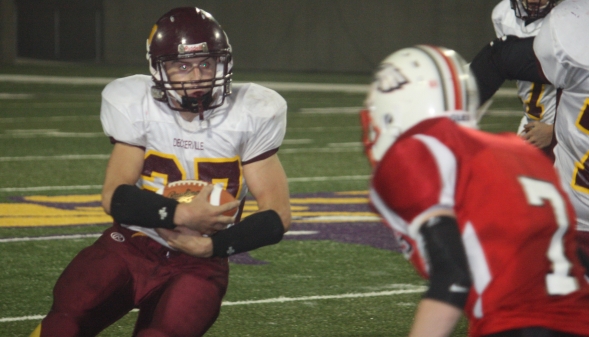
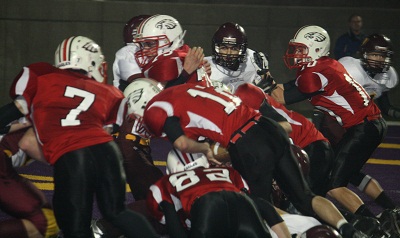
PHOTOS: (Top) Deckerville running back Christopher Wolfe prepares for an oncoming tackler during Friday's 8-Player Final. (Middle) Bellaire's Zach Smith (12) dives for his team's first touchdown. (Click to see more from the Regional Final at HighSchoolSportsScene.com.)
Drive for Detroit: Regionals in Review
November 12, 2012
By Geoff Kimmerly
Second Half editor
Four of last season's MHSAA football champions still have opportunities to repeat when the games return to Ford Field in two weeks.
But Friday and Saturday's Regional Finals laid waste to some of the seemingly safest title predictions from only a few weeks ago.
Few weekends in recent playoff history have done as much damage to the top of The Associated Press' polls. Four top-ranked teams fell in Regional Finals – leaving Rockford, Muskegon, Portland and Muskegon Catholic among those instead celebrating trips to this Saturday's MHSAA Semis. Ithaca in Division 6 is the only No. 1 team from the final polls still alive.
And then there were the 8-player Semifinals – two classics that set up what looks like another this Friday at Greenville High School.
Read on for a few lines on all 34 games played in Michigan over the weekend. And click to see this weekend's schedule of 11-player Semifinals.
Division 1
Rockford 25, Clarkston 14
The Rams (10-2) advanced to their third Division 1 Semifinal in four seasons by handing Clarkston its first and only loss of the fall. Rockford has won at least 10 games in eight of the last nine seasons, and got this milestone victory after jumping out to a 13-0 lead. Clarkston finished its 10th-straight playoff season at 11-1. Click to read more from the Grand Rapids Press.
Also noted:
Detroit Catholic Central 28, Plymouth 7 – The Shamrocks (8-4) advanced to their fourth Semifinal in the last six seasons and have given up only 39 points during the playoffs. Plymouth finished 9-3.
Detroit Cass Tech 21, Saline 14 – The reigning champion Technicians (10-2) advanced to their third straight Semifinals, while ending Saline’s best season at 10-2.
Lake Orion 51, Macomb Dakota 35 – The Dragons (11-1) had three of their last night seasons end with playoff losses to Dakota (10-2), most recently in 2007.
Division 2
Muskegon 49, Midland 21
It’s fair to argue that no team has faced a tougher playoff road than the Big Reds (11-1), whose postseason opponents were a combined 24-6. Midland (11-1) was undefeated and considered a slight favorite to win Division 2. Click to read more from the Muskegon Chronicle.
Also noted:
Caledonia 42, Mattawan 28 – The Fighting Scots (9-3) have bounced back in a big way after two straight 4-5 finishes. Mattawan (10-2) finished with its single-season record for wins.
Birmingham Brother Rice 42, Walled Lake Western 12 – The reigning champion Warriors (10-2) are one win from another trip to Ford Field and have won all three playoff games by at least 21 points. Walled Lake Western finished 9-3.
Wyandotte Roosevelt 10, Oak Park 6 – Roosevelt (11-1) finally got back home, and enjoyed celebrating its first Semifinal berth since 2001. But Oak Park (9-3) also can celebrate its best finish.
Division 3
Grand Rapids Christian 31, Stevensville Lakeshore 7
The Eagles (11-1) moved into their first MHSAA Semifinal by handing Lakeshore (11-1) its first and only loss this season. Grand Rapids Christian gained 410 yards, with quarterback Alex VandeVusse throwing for only 254 and two touchdowns this week (he threw for four and ran for four the week before). Click to read more from the Grand Rapids Press.
Also noted:
DeWitt 29, St. Johns 27 – This was another memorable chapter to an intense Capital Area Activities Conference Red rivalry, with DeWitt (10-2) getting the sweep this fall but only after the Redwings (8-4) hung close until the very end.
Battle Creek Harper Creek 26, Tecumseh 24 – After starting this season 0-2, Harper Creek (10-2) has surged into its second straight Semifinal – although not without a good scare from Tecumseh (9-3).
Orchard Lake St. Mary 42, Detroit East English 24 – Reigning champion St. Mary (10-2) is one win from its fourth straight trip to Ford Field. East English, in its first season, finished 9-3.
Division 4
Saginaw Swan Valley 35, Croswell-Lexington 13
The Vikings (10-2) will be making their third Semifinals appearance in seven seasons. But this has been the most impressive run of the three. The Vikings opened by beating first-time playoffs qualifier Saginaw Valley Lutheran, followed by beating a solid Goodrich team by 30, and then this week handed Croswell-Lexington its first and only loss. The Pioneers (11-1) did finish this fall with their most wins for one season. Click to read more from the Saginaw News.
Also noted:
Comstock Park 62, West Branch Ogemaw Heights 27 – The Panthers (11-1) didn't see a letdown after beating Grand Rapids Catholic Central in the District Final; their 62 points against Ogemaw Heights (8-4) was a season high by more than two touchdowns.
Grand Rapids South Christian 38, Three Rivers 14 – South Christian (9-3) is back in the Semifinals for the first time since 2004 after winning five or fewer games each of the last three seasons. Three Rivers can celebrate an 8-4 finish after going just 1-8 in 2011.
Detroit Country Day 47, Grosse Ile 14 – Country Day (10-2) advanced to its ninth Semifinal by containing a Grosse Ile offense that had scored 70 points the week before. The Red Devils finished 10-2 to move to 20-5 over the last two seasons.
Division 5
Portland 45, Flint Powers Catholic 28
This might have been the upset of the 2012 playoffs so far – not because Portland hasn't had success, but because reigning champion Powers has dominated so thoroughly this fall. No team had gotten within 25 points of the Chargers (11-1) since September, but Portland (11-1) took an early lead and ran. The Raiders last made the Semifinals in 1975 – the first season of MHSAA playoffs – and had never won more than nine games in a season before this fall. Click for more from the Flint Journal.
Also noted:
Menominee 28, Clare 21 – New Menominee coach Joe Noha played for and served as an assistant to recently-retired Ken Hofer, and has taken their program back to the Semifinals for the ninth time. The Maroons moved to 11-1, while Clare finished a seventh-straight playoff season 9-3.
Grand Rapids West Catholic 21, Newaygo 7 – West Catholic (9-3) has returned to the Semifinals for the third straight season despite starting 1-3. Newaygo also can celebrate a comeback story, finishing 9-3 after going 4-23 over the last three seasons.
Ann Arbor Gabriel Richard 16, River Rouge 6 – In its fourth Regional appearance, Gabriel Richard (11-1) set a school record for wins while ending the best season ever for River Rouge (11-1).
Division 6
Constantine 49, Hillsdale 35
The Falcons (10-2) have to love the preparation they get playing in the Kalamazoo Valley Association. They've made the Semifinals four straight seasons after joining the league five years ago, and now are playing for their second-straight Finals berth. Hillsdale was off to its best run since 2006 and finished 11-1. Click for more from the Jackson Citizen Patriot.
Also noted:
Shelby 26, Negaunee 22 – Shelby has watched a number of its league mates make long playoff runs in the past, but the Tigers (10-2) are in their first Semifinal after ending the best run by the Miners (10-2) since 2004.
Ithaca 31, Montrose 0 – Make that 40 straight wins and counting for the Yellowjackets (12-0), who are known for offense but tallied their seventh shutout in stopping the Rams (10-2).
Monroe St. Mary Catholic Central 28, Grass Lake 21 – A great turnaround by the Falcons (10-2) continued as the 2010 and 2009 MHSAA runners-up continued to rebound from last season’s 4-5 finish. Grass Lake finished 10-2 to up its two-year record to 21-3.
Division 7
Flint Beecher 19, Saginaw Nouvel 15
This followed right behind Portland over Powers in games that made the state take special notice this weekend, but this time the Flint team came out on top. The Buccaneers, under former Michigan State and NFL receiver Courtney Hawkins, advanced to their first MHSAA Semifinal by upending reigning champion Nouvel (9-3). Beecher (8-4) has made the playoffs six straight seasons, but had played in a Regional Final only once – in 1980. Click for more from the Saginaw News.
Also noted:
Ishpeming 28, Lake City 12 – The Hematites (11-1) made their fifth Semifinal and second in three seasons, and have allowed only 24 points in three playoff games. Lake City finished its best season at 10-2.
Pewamo-Westphalia 26, Decatur 21 – This group of Pirates (9-3) is much different than the one that made it to last season’s Final at Ford Field, but the results are coming up the same. Decatur finished 9-3, its best since 2008.
Detroit Loyola 32, Britton Deerfield 0 – The last two seasons have been the best two in the short history of Loyola (12-0), which will make its first Semifinal appearance after finishing 11-1 but falling in the Regional last season. Britton Deerfield finished 8-4.
Division 8
Muskegon Catholic Central 28, Mendon 6
Although the Crusaders (9-3) are considered a statewide power, this was their first Regional title since 2009. But they’re certainly the favorites now for their first MHSAA title since 2008. Mendon (11-1) had won 25 straight games including last season’s Final and had scored fewer than 27 points only one other time this fall – in a 15-12 win over reigning Division 7 runner-up P-W. Click for more from the Muskegon Chronicle.
Also noted:
St. Ignace 26, Felch North Dickinson 20 – The Saints (12-0) are in the Semifinals for the sixth time and second straight, but had to outlast another previously-unbeaten team; North Dickinson finished 10-1.
Beal City 49, Johannesburg-Lewiston 16 – Beal City (12-0) is back in the Semifinals for the first time since its last championship season in 2009. Johannesburg-Lewiston’s last two seasons have been ended by the Aggies; this time the Cardinals finished 9-3.
Harbor Beach 17, Waterford Our Lady 10 – The Pirates are 11-1 for the second straight season, but this time are back in the Semifinals for the first time since 2007. Our Lady rebounded from last season’s 4-5 to finish 9-3.
8-Player (Semifinals)
Bellaire 20, Rapid River 16
Bellaire (9-3) finished only fourth in the Bridge Alliance Conference this fall, but took out league and 2011 MHSAA runner-up Rapid River to reach the second 8-player Final in MHSAA history. Bellaire opened this season 0-2 but also beat the Rockets (9-3) on Oct. 19. Click to read more from the Traverse City Record-Eagle.
Deckerville 36, Portland St. Patrick 30 (2 OT)
The Eagles (11-1) withstood a 22-point comeback by St. Patrick that pushed this game to overtime, but got the game-winning stop in the second extra period. Both of these programs played 8-player this fall for the first time, and Deckerville earned its first MHSAA Final berth after also playing in a Semifinal in 2000. Portland St. Patrick, which did win an 11-player championship in 1992, finished this fall 11-1. Click to read more from the Port Huron Times Herald.
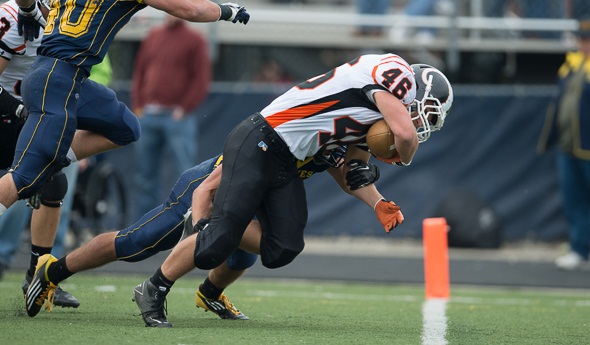
PHOTO: Rockford senior running back Sam Reinke (46) stretches for the goalline during the Rams' Division 1 Semifinal victory Saturday at Clarkston. (Click to see more, plus photos from Birmingham Brother Rice/Walled Lake Western at Terry McNamara Photography.)