


Eagles Stone-wall Bellaire in 8 Final
November 16, 2012
By Dean Holzwarth
Special to Second Half
GREENVILLE – Deckerville sophomore Ryan Stone had serious doubts about playing on the varsity team this year.
Stone thought he was better suited for the junior varsity. But following Friday night's MHSAA 8-player football championship game, everyone in the city of Deckerville is glad he opted for the jump to the next level.
The scrawny 5-foot-8, 140-pound Stone made perhaps the biggest play of the game as the Eagles survived a late rally from Bellaire to pull out a 14-12 victory at Greenville High School's Legacy Field.
Stone stopped Bellaire's two-point conversion run try short of the goal line with 49 seconds remaining to prevent a tie score and possible overtime.
“I was lined up and saw him coming around the corner,” Stone said. “I was hustling to him, hoping I could get him before he crossed the line. I just got to him.”
And doing so gave Deckerville its first MHSAA championship in its first Final appearance, to cap its first season in 8-player football. Bellaire made the switch to 8-player three seasons ago, and also made its first MHSAA Final appearance. The first 8-Player Final was last season.
On Friday’s game-saving play, Stone popped out his right shoulder and laid on the turf for several minutes while athletic trainers tended to him.
He eventually stood up and walked gingerly to the sidelines.
“I thought that was amazing,” said Deckerville senior fullback Chris Wolfe, who rushed for 108 yards on 20 carries and scored a touchdown.
“To put his body at risk to stop a two-point conversion for us not to go into overtime – I thought that was amazing to help our team like that.”
Deckerville coach Bill Brown wasn't surprised to see Stone put himself in harm's way for the benefit of his team.
“He has made big plays for us all year, and it takes a lot of heart and guts to make that happen,” he said. “This whole team is just like him, and what a heck of a play. He's one of those kids who thought he might not want to come up as a sophomore, but he came up, and what a great addition to our team.”
 Stone also came up with a key interception in the third quarter, and scampered 23 yards for a touchdown on the Eagles' ensuing possession that put them ahead 14-6.
“It's my sophomore year, and to already win a state championship is pretty amazing,” Stone said. “I wanted to stay on the junior varsity this year because I didn't think I could make it on the varsity very well, but I think I did pretty good.”
Stone's effort was almost for naught, as Bellaire recovered an onside kick and threatened in the final seconds.
A 31-yard pass from quarterback Zach Smith to Wes Villafane put Bellaire at the Deckerville 4-yard line.
But Deckerville's defense smothered the run on the game's final play to preserve the win.
“We didn't spike it down there because I live by the philosophy of, let's catch them so the defense can't get set,” Bellaire coach Ron Bindi said. “We hit a big play earlier with that running play, and it just didn't work out.
“The kids have played like this all year. With only 13 of them, they are always outnumbered, but there is no quit in them. We just didn't get it done at the end this time.”
Trailing 14-6 late, Smith tossed a long bomb to Villafane, who hauled in the 52-yard score and trimmed the deficit to14-12.
Bellaire (9-4) failed multiple times to capitalize on scoring opportunities.
The Eagles were inside Deckerville's 30-yard line five times, but only scored once on a 1-yard quarterback keeper by Smith in the final minute of the second quarter.
“We came out ready to play, but our offense did things that we haven't done all year,” Bindi said. “We made mistake, after mistake, after mistake, and you can't win football games like that.”
Deckerville closed with a 12-1 record en route to the title. Its lone loss came in Week 2 against Cedarville.
“Ever since Week 1, it has been a great ride,” Wolfe said. “We learned a lot of things. We learned responsibility, dedication and how to become a team.”
Said Brown: “It means a lot to the program, our community and all the alumni who have played before us and busted their tails. We just happened to have a great year with a great group.”
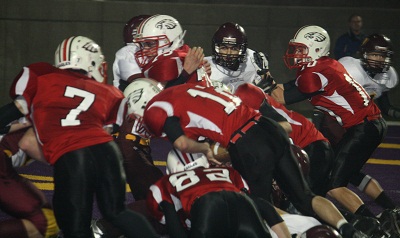
PHOTOS: (Top) Deckerville running back Christopher Wolfe prepares for an oncoming tackler during Friday's 8-Player Final. (Middle) Bellaire's Zach Smith (12) dives for his team's first touchdown. (Click to see more from the Regional Final at HighSchoolSportsScene.com.)

Harrison Comes Back to Win Classic
August 23, 2016
By John Johnson
MHSAA Communications Director
As a new season of events launches this week on MHSAA.tv, this summer’s 80s Finals Flashback series concludes with one of the classic Football Finals of all time.
Our ninth and final game in the Flashback series is the 1989 Class B Final at the Pontiac Silverdome between Farmington Hills Harrison and DeWitt. Here’s a look at this week’s game, and click the score below to watch:
Week of August 22 – Farmington Hills Harrison 28, DeWitt 27 – 1989 Class B Football Final - In Class B, Farmington Hills Harrison scored a 28-27 victory over DeWitt in what many consider the greatest game of Michigan's 25-year playoff history. The defending Class B champions and top-ranked Hawks had their hands full with the Panthers. Tied 7-7 after one quarter, DeWitt grabbed a two-touchdown lead in the second on 32-yard run by John Tellford and a 35-yard pass play from Tellford to John Cowan. Harrison responded with a Matt Conley 1-yard run to cut the margin to 21-14 at the half. Hawks quarterback Mill Coleman knotted the score at 21 with a dazzling 16-yard run early in the fourth quarter, but DeWitt stormed back again, driving 75 yards on 13 plays. The series was highlighted by tight end Dave Riker's 24-yard, one-handed catch to the Hawks’ 3-yard line. Two plays later, quarterback Chris Berkimer slipped over from the 1, and DeWitt again took the lead, 27-21. With 2:12 remaining on the clock and the ball at the Harrison 33, Coleman went to work. Three quick completions moved the ball to the DeWitt 16, then Coleman let his legs do the rest of the work. Following a Hawks timeout, Coleman dashed right for seven more yards to the Panthers’ 9. Facing a 2nd-and-three, Coleman dropped back to pass, escaped the rush at the DeWitt 17, then scampered up the middle and dove into the end zone for the tying points. Steve Hill added his fourth PAT of the game with 1:34 remaining for the final margin, then secured the victory with an interception on the next series. (Watch Coleman’s game-winning touchdown by Clicking Here.)
DVDs may be purchased directly from the MHSAA.tv Website – just click the “Get DVD” button below the player. See the bottom of this screen for the rest of this summer’s “Flashbacks.”
The new season of games produced by members of the School Broadcast Program begins this week with live video of two football games scheduled as of noon Monday. Coming up on Thursday, the SBP at Montrose High School follows its Rams on the road for a game at Byron beginning at 6:40 p.m. At 7 p.m., Marquette High School will cover its home contest against Traverse City St. Francis. Check this release on the MHSAA Website for updates throughout the week as additional games are scheduled.
The NFHS Network has announced new pricing for 2016-17, eliminating the Day Pass and lowering the cost of a Month Pass to $9.95. Subscribers will have access to all live video and streaming statistics across the country. All content becomes available for free, on demand viewing 72 hours after being shown live. Some schools also will be selling Annual Passes at a discounted rate. A portion of every subscription sold by a school goes to benefit its program.
Now in its eighth year, the School Broadcast Program gives members an opportunity to showcase excellence in their schools by creating video programming of athletic and non-athletic events with students gaining skills in announcing, camera operation, directing/producing and graphics. The program also gives schools the opportunity to raise money through advertising and viewing subscriptions.
Schools interested in becoming a part of the School Broadcast Program should contact John Johnson at the MHSAA Office.
Previous Flashbacks
August 15: St. Joseph Lake Michigan Catholic 41, Ontonagon 39 – 1988 Class C Girls Basketball Final - Watch
August 8: Grand Rapids South Christian 69, Redford Bishop Borgess 66 – 1988 Class B Boys Basketball Final - Watch
August 1: Dearborn Divine Child 50, Okemos 45 (OT) – 1986 Class B Girls Basketball Final - Watch
July 25: Muskegon 16, Detroit Martin Luther King 13 – 1988 Class A Football Final - Watch
July 19: Northport 80, Beal City 78 – 1988 Class D Boys Basketball Final - Watch
July 12: Detroit Cass Tech 52, Saginaw 51 – 1987 Class A Girls Basketball Final - Watch
July 5: Traverse City 24, Detroit Catholic Central 14 – 1988 Class A Football Final - Watch
June 28: Saginaw Buena Vista 33, Flint Beecher 32 – 1986 Class B Boys Basketball Final - Watch