

Farewell Silverdome; Our Memories Live On
By
Ron Pesch
MHSAA historian
November 28, 2017
Farewell Pontiac Silverdome.
In early December, more than 15 years after the Detroit Lions played their last game beneath its air-supported Teflon-paneled roof, the “Dome” will take a last breath and then depart.
Finally.
The last few years have been cruel to the stadium that was once a gem and the home of dreams.
The Lions arrived at the newly opened “Pontiac Metropolitan Stadium” (or “Ponmet” as it was called by enthusiasts of the new structure) in August 1975. It was renamed “Pontiac Stadium” later in the year by the city council, and in October of 1976 the Pontiac council again re-christened the building as the “Pontiac Silverdome.”
“We feel the new name better conveys the image of our facility,” said Charles McSwigan, Jr., stadium executive director, at the time. “It certainly lets everyone around the country know we have a modern year-round domed stadium.”
The move was primarily marketing motivated. “The other three giants, Super, Astro and King, get all the publicity,” added McSwigan, further explaining the change. “Promoters call them, but they don’t even come near us.”
Launched in 1975, the MHSAA football championship games were played outdoors at college stadiums that first year on the Saturday before Thanksgiving. While deemed a success, the games were played at two different sites. That had presented challenges.
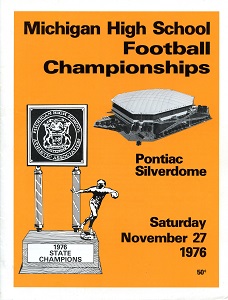 Following that first year, consideration was given to the new structure in Pontiac.
“There are some problems,” remarked Al Bush, MHSAA executive director, explaining the logistics of a possible move to the NFL stadium. “For instance, it would be difficult to play four games on the same day. We would have to start early in the morning, and the last game would have to start late at night.”
Competition for attendance with various events, including deer hunting season, and college football – especially the televised University of Michigan-Ohio State game – were factors to be considered. The high school football playoffs were still a new product without a tradition. Finances also were an area of worry. It was estimated that a crowd of between 20,000 and 25,000 would be needed to make the jump economically feasible.
So, it was with great caution and trepidation that the move was made indoors to Pontiac. Initially, the contract was for a single year. The games would be played on the Saturday following Thanksgiving. By all measures, to the delight of all involved, the 1976 championships were a huge success.
“The four state championship games, which were played in the Silverdome in two sessions on Saturday, drew a paid attendance of 29,423 fans,” said Associated Press writer Harry Atkins in a follow-up piece following the games, “bringing smiles of relief and joy to MHSAA Executive Director Al Bush and his assistant, Vern Norris. The attendance figure was almost double the number of fans who turned out last year in ice box-like weather at two sites – Western Michigan University and Central Michigan University.”
With that, a new contract was signed, and for 29 years the city of Pontiac served as home to the MHSAA 11-player football championships. “Goin’ to the Dome” soon became the goal of every high school in Michigan that offered the sport.
Following a 15-10 victory over the Dallas Cowboys in early January 2002, the Lions departed the Silverdome for Ford Field, located in downtown Detroit. The high school Finals stayed put for three more years before moving to Ford Field.
Twelve seasons after following the Lions from Pontiac to Detroit, countless memories and several MHSAA championship game records still stand from those years under the Dome.
Four championship games were played at the Silverdome to close each season from 1976-90. In 1991, the playoffs were expanded to eight classifications and the Finals expanded to eight games over a two-day showcase.
For many across Michigan, those 176 high school state title games were their first live exposure to the building many had only seen on television. For football fans, the MHSAA Finals provided an affordable and unique chance to visit the stadium and watch the game between the 20-yard-lines at ground level. An NFL game, concert, or in later years a Pistons basketball game at the Silverdome was far from an intimate experience for most. Seating 80,311, it was the largest stadium in the NFL until 1997.
For thousands of athletes and coaches, the playing surface was their first exposure to artificial turf. It was an honor to set foot on the field. After all, who didn’t want to run on the same canvas on which Lions legend Barry Sanders painted?
 Who can forget the Mill Colemen-led comeback drive to title glory in the final minutes as Farmington Hills Harrison downed DeWitt for the Class B title in 1989, or “The Catch” by Muskegon Reeths-Puffer’s Stacy Starr that broke the hearts of Walled Lake Western players and fans in the final seconds in Class A in 1992? Who remembers the wild 91 points (and 883 yards in total offense) posted in Belding’s 50-41 victory over Detroit Country Day in Class B in 1994, when Belding trailed by 19 points at the half? The combined final score remains the record for most points tallied in a title game by two teams.
Farmington Hills Harrison and coach John Herrington won five consecutive finals in Pontiac (1997, 1998, 1999, 2000, 2001), and 12 of their 13 MHSAA Finals titles at the Silverdome. A total of 12 of Detroit Catholic Central’s 17 trips to the Finals meant a bus ride to Pontiac.
One record performance set in the opening game of the 1976 championships still stands in the MHSAA championship record book. With the evolution of the game, it may never fall.
Despite the climate-controlled environment afforded by moving indoors, Crystal Falls Forest Park threw only three passes against Flint Holy Rosary in the Class D title game, completing one for a net -3 yards. By default, that total established a record for pass defense in a title game. It remains the zenith.
Forest Park had little need for the pass that day. The Trojans rolled up 234 rushing yards on 48 carries, including a 74-yard touchdown run off left tackle by all-state running back Marty Ball with 4:36 to play in the first quarter. Less than two minutes later, a fumble recovery by Forest Park’s Charlie Davis was returned 25 yards for a score, and the Trojans led, 14-0. Holy Rosary passed for 204 yards including an 18-yard pass from Ron Fray to Dan Lehoux in the second quarter, but couldn’t overcome that first quarter deficit, falling 14-6. A crowd of 14,879 attended the day’s first session, comprised of the Class D and Class A games.
Other long-standing record performances at the Dome still can be spotted in the record book.
Josh Wuerfel’s 46-yard field goal in the second quarter gave Traverse City a 10-0 halftime lead and aided the second-ranked Trojans’ 24-14 defeat of top-ranked Detroit Catholic Central in the 1988 Class A contest. The kick stood for 28 years as the title game record before finally being exceeded (twice!) at the 2016 championships played at Ford Field. Liam Putz of Grand Rapids West Catholic shattered the mark with a 47-yarder against Menominee in the Division 5 title game, before Ben Fee of Orchard Lake St. Mary’s topped the kick in the eighth game of the weekend. Fee’s 49-yard field goal late in the fourth quarter helped St. Mary’s down Muskegon 29-28 in the Division 3 thriller. The boot was his third field goal of the game. Combined with two extra points, he finished as the Eaglets’ top scorer.
Paul Gross of Jackson Lumen Christi established a new mark for extra points against Livonia Clarenceville in the 2001 Division 5 game, connecting accurately on all seven of his attempts. The record has been matched twice since the move to downtown Detroit.
Nick Williams’ 90-yard touchdown dash on Farmington Hills Harrison’s first play from scrimmage in the 1994 Class A game, a 17-13 victory over Grand Rapids Forest Hills Central, still tops the record book category for longest run play in a title game. An 89-yard TD run by Constantine’s Jim Schragg sits directly behind the Williams’ mark. Schragg rolled up 307 yards in a 34-13 win over Suttons Bay in the 2004 Division 6 game, during the final year at the Silverdome. His total established the pinnacle for rushing yards in a game.
Ravenna’s Benny Clark carried the ball 49 times (including 29 rushes in the second half) for 212 yards as the Bulldogs topped Morenci 30-14 in the 1996 Class C contest. The total, which exceeded the previous mark of 40 set by Dan Lato of Crystal Falls Forest Park in 1977, has yet to be matched or exceeded.
The fastest championship game passing touchdown came 15 seconds into the 2003 Division 5 Final, when Jackson Lumen Christi‘s Tyler Aldridge found wide-open Matt Russell on a reverse pass on the second play from scrimmage. The Titans defeated Muskegon Oakridge 23-0 for the title.
 Quarterback Tony Koshar tossed a short pass to Jim Steinman, “who shed a tackler and managed to stay in bounds as he took off for the end zone on a 96-yard scoring play,” as Gobles grabbed a 31-22 upset victory over top-ranked Crystal Falls Forest Park in the 1984 Class D title game. The reception for the longest pass play lasted 24 years before it was finally topped in 2008.
Kirk Williams’ 15 pass receptions for DeWitt against East Grand Rapids in the 2002 Division 3 contest still stand the test of time, as does Brad Johnson’s 87-yard punt return for a touchdown for Schoolcraft against Frankfort in the 1988 Class D championship game.
The 1991 title games saw two defensive marks set, both on the same day. On Saturday, November 30, Rick Marcotte of Lake Linden-Hubbell scooped up a fumble and dashed 79 yards for a touchdown and a new Finals record versus Mendon in Class DD. Less than 16 hours earlier Nate Cierlak of Muskegon Catholic Central had set the mark with a 56-yard return for a TD against Harbor Beach. In that year’s Class CC Final against Negaunee, Jason Livengood of Battle Creek Pennfield set the one mark that statistically can never be topped when he returned a pick-six for 100 yards.
Eight punts by Muskegon’s Jason Crago in the Big Reds’ 16-13 victory over Detroit Martin Luther King in the 1989 Class A title game was unmatched until 2007, when Aaron Hudson of Blissfield equaled the total. On Saturday, Clarkston’s Jermaine Roemer also tied the record in the Division 1 Final.
Between 1976 and 2004, more than 1.5 million fans attended the games in Pontiac, with a peak of attendance of 71,156 in 1995.
Soon the site will be cleared, with plans for redevelopment. Not far down the road, The Palace of Auburn Hills, once home to the MHSAA Basketball Finals and longtime home to the MHSAA Individual Wrestling Finals, will be scrubbed from the earth. Along with them, the structural evidence of the home of countless accomplishments will disappear.
Change is constant, and time moves on. Still those achievements, and several others, live on in the pages of the MHSAA record book, in the memories of those who competed and the recollections of those who played witness.
 Ron Pesch has taken an active role in researching the history of MHSAA events since 1985 and began writing for MHSAA Finals programs in 1986, adding additional features and "flashbacks" in 1992. He inherited the title of MHSAA historian from the late Dick Kishpaugh following the 1993-94 school year, and resides in Muskegon. Contact him at [email protected] with ideas for historical articles.
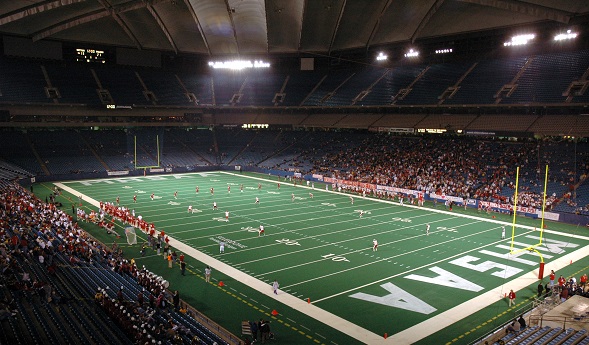
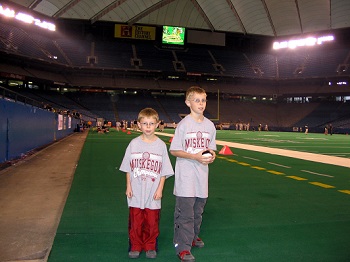
PHOTOS: (Top) Constantine and Suttons Bay played in the Division 6 Final at the Silverdome as part of the last weekend of MHSAA games in the building in 2004. (Top middle) The 1976 program welcomed Finals fans to the Dome for the first time. (Bottom middle) The author's children during a trip to the Silverdome before the Finals moved to Ford Field. (Below) The 1986 Finals ticket got fans into two games at the Silverdome for $4. (Photos courtesy of Ron Pesch and MHSAA files.)
1st & Goal: 2026 Week 5 Preview
By
Geoff Kimmerly
MHSAA.com senior editor
September 24, 2026
It’s halftime, but no one is taking a break. In fact, the pace is picking up even more as we start looking toward the final month of the football regular season.

We’ve reached the midpoint, with four games down, another set to be played over the next 48 hours, and four to go after that. Every week several more eyes are turning toward our Playoff Point Summary page, which lists how every team ranks in its respective playoff division as scores are entered on MHSAA.com.
Teams are moving into and out of the potential fields of 32 for 11-player 16 for 8-player every week – and surely several of the games mentioned below will affect how those rankings stack up moving forward.
Games below are Friday unless noted. Tune in to the NFHS Network to watch the majority and follow the MHSAA Scores page for results as they’re submitted.
Bay & Thumb
Millington (4-0) at Cass City (4-0)
This Big Thumb Conference White showdown pits two of the three teams that shared the championship a year ago, when Cass City defeated Millington 17-14 in overtime. The Cardinals opened league play last week with a 43-16 win over Elkton-Pigeon-Bay Port Laker, the third returning co-champion from a year ago. The Redhawks have put themselves among the undefeated in part with a pair of three-point nonleague wins in Weeks 2 and 3.
Keep an eye on these FRIDAY Marine City (4-0) at St. Clair (4-0), Holly (3-1) at Fenton (3-1), Almont (4-0) at Imlay City (4-0), Bloomfield Hills Cranbrook Kingswood (4-0) at Sanford Meridian (4-0).
Greater Detroit
Detroit Martin Luther King (4-0) at Detroit Cass Tech (4-0)
Cass Tech has won the last three of what’s almost sure to be a twice-annual series again, as these two also have met in a city championship game the last six seasons. The Technicians’ wins last year came by five and then 16 points, and they enter this matchup with three shutouts over four games and averaging 52 points per contest. King has played the toughest opponent of the two, impressively emerging with a 44-42 victory over Orchard Lake St. Mary’s in Week 2.
Keep an eye on these FRIDAY Grosse Pointe South (4-0) at Romeo (4-0), Orchard Lake St. Mary’s (3-1) at Bloomfield Hills Brother Rice (4-0), Oxford (4-0) at Clarkston (4-0). SATURDAY Ecorse (4-0) at Romulus Summit Academy (3-1).
Mid-Michigan
Portland (4-0) at Lake Odessa Lakewood (4-0)
Lakewood is 4-0 for the first time since 2017 and after winning four games total a year ago, already having avenged a 2025 loss to Charlotte as it points to a potential first playoff berth this decade and title contention in the Capital Area Activities Conference White. The Raiders have owned the division, winning 30 straight league games going back to 2021 with that run including three shutouts of the Vikings since they rejoined the CAAC in 2023.
Keep an eye on these FRIDAY Lansing Sexton (2-2) at Charlotte (3-1), Kent City (2-2) at Lakeview (3-1), Fowler (4-0) at Saranac (4-0), Mason (4-0) at St. Johns (3-1).
Northern Lower Peninsula
Kingsley (4-0) at Elk Rapids (3-1)
Coming off a notable Week 3 victory over 2025 playoff team Mancelona, and after having last week off thanks to a forfeit win from Cheboygan, Elk Rapids is staring down a big-time opportunity to impress as it continues to pursue a first playoff berth since 2022. A low-scoring loss to Traverse City St. Francis in Week 1 also was notable as the Elks take on the Stags, who opened this season with a pair of shutouts and have already conquered one major obstacle in the Northern Shores Conference race with a 39-13 win over Charlevoix.
Keep an eye on these FRIDAY Petoskey (3-1) at Cadillac (2-2), McBain (2-2) at Charlevoix (3-1), Boyne City (2-2) at Grayling (2-2), Midland Dow (2-2) at Traverse City Central (2-2).
Southeast & Border
Ida (4-0) at Adrian Madison (4-0)
Madison earned the spotlight last week with its first win over Hudson, and it’s time to give Ida deserved attention as well as the Bluestreaks join the Trojans and Clinton at 3-0 atop the Lenawee County Athletic Association standings. Ida entered this season coming off a District championship run last fall and has reached 42 points in all of its games during this first half, which should lead to an intriguing matchup as Madison allowed the high-scoring Tigers only 12.
Keep an eye on these FRIDAY Dearborn Divine Child (4-0) at Ann Arbor Father Gabriel Richard (3-1), Dexter (2-2) at Chelsea (3-1), Toledo Central Catholic (4-0) at Jackson Lumen Christi (4-0), Jackson (2-2) at Tecumseh (3-1).
Southwest Corridor
Portage Central (3-1) at Kalamazoo Loy Norrix (3-1)
Loy Norrix is off to its best start since 1998 and facing Portage Central for the first time since 2019, adding a few layers of interest as the neighbors prepare for this get-together. After reaching the Division 2 Semifinals last year, Portage Central opened this fall with a 10-point loss to Toledo Central Catholic before stacking a few wins including over rival Portage Northern two weeks ago.
Keep an eye on these FRIDAY Hartford (2-2) at Cassopolis (3-1), Edwardsburg (4-0) at Otsego (2-2), Three Rivers (2-2) at Vicksburg (4-0), Plainwell (2-2) at Paw Paw (3-1).
Upper Peninsula
Bark River-Harris (4-0) vs. Pewamo-Westphalia (4-0) at Petoskey
While this won’t be played in the Upper Peninsula, it does feature one of the best from north of the Bridge facing a contender from downstate. For the second-straight season these two will meet on a neutral field after losing their previously-scheduled opponents. Pewamo-Westphalia won last year’s matchup 49-0 on the way to ending the fall in the Division 7 Semifinals, while Bark River-Harris finished its season in the Division 8 Semifinals.
Keep an eye on these FRIDAY Kingsford (4-0) at Calumet (3-1), Iron Mountain (2-2) at Manistique (2-2), Escanaba (1-3) at Marquette (2-2), Hancock (3-1) at Negaunee (2-2).
West Michigan
Coopersville (4-0) at Lowell (3-1)
Coopersville made some nice noise last season coming back from an 0-3 start to reach a District title game, and that’s carried over and then some as the Broncos have opened this fall by defeating four 2025 playoff teams that are a combined 10-6. Coopersville avenged last season’s loss to Cedar Springs last week and now has the opportunity to do the same against another River Cities Alliance foe in Lowell, which won last year’s matchup 33-20. The Red Arrows have been similarly impressive this season coming off last year’s run to the Division 3 Semifinals.
Keep an eye on these FRIDAY Wyoming Godwin Heights (3-1) at Hopkins (4-0), Hudsonville (3-1) at Caledonia (3-1), Grand Rapids Catholic Central (3-1) at East Grand Rapids (3-1), Zeeland West (4-0) at Grand Rapids South Christian (3-1).
8-Player
Mendon (4-0) at Colon (4-0)
Mendon has won this matchup the last three years big, but that shouldn’t have any bearing this time as Colon already avenged a 41-point loss to Climax-Scotts from a year ago with a 24-point victory last week. Mendon, meanwhile, handed Mio its first loss with a third-straight 50-point performance and rolls into this Southern Central Athletic Association Red opener as the reigning champion.
Keep an eye on these FRIDAY Mio (3-1) at Bay City All Saints (4-0), Blanchard Montabella (3-1) at Dansville (4-0), Deckerville (4-0) at Dryden (4-0), St. Helen Charlton Heston Academy (2-0) at Rogers City (3-1).
MHSAA.com's weekly “1st & Goal” previews and reviews are powered by MI Student Aid, a division within the Department of Lifelong Education, Advancement, and Potential (MiLEAP). MI Student Aid encourages students to pursue postsecondary education by providing access to student financial resources and information. MI Student Aid administers the state’s scholarship and grant programs that help make college Accessible, Affordable and Attainable for you. Click to connect with MI Student Aid and find more information on Facebook and Twitter @mistudentaid.
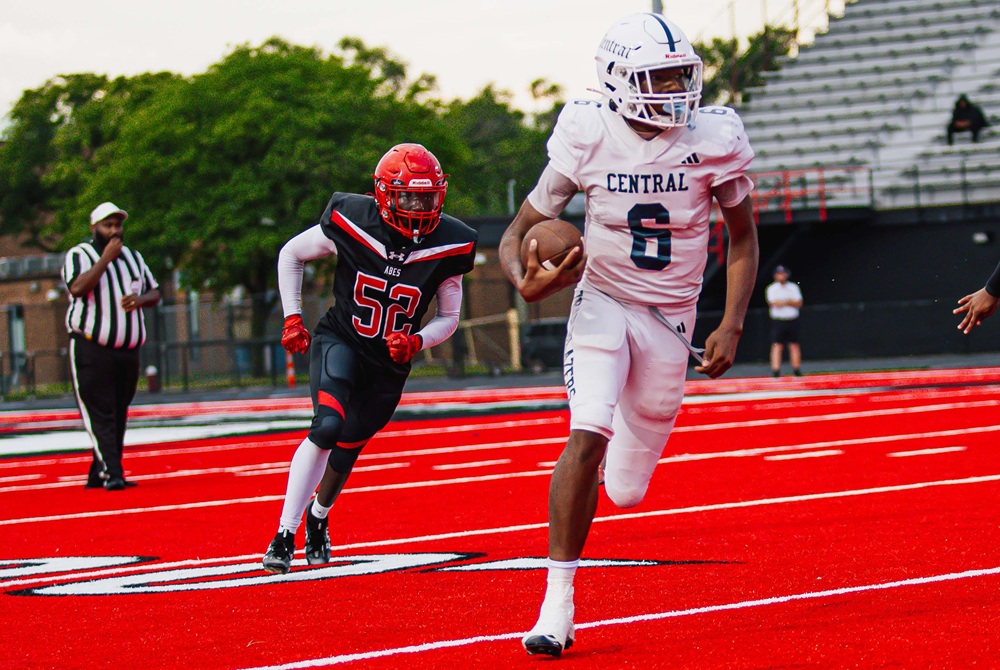
PHOTO A Detroit Central receiver breaks toward the end zone during the team's 38-0 Week 2 win over Warren Lincoln. (Photo by Olivia B. Photography.)