


Ford Field Parking, Protocols Announced
November 24, 2014
By Geoff Kimmerly
Second Half editor
To provide for the convenience and safety of spectators attending the Michigan High School Athletic Association 11-Player Football Finals at Ford Field in Detroit, Nov. 28 and 29, attendees are being advised of a variety of items related to transportation and security – including policies regulating types of bags allowed into the stadium.
Parking will be available in Ford Field facilities and lots to the east and north of the stadium and cost $6. A map identifying the designated Ford Field lot (4) and parking deck can be found on the Football page of the MHSAA Website. (There also are a number of privately-operated parking facilities close to Ford Field, but their pricing may differ.)
Fans also are advised that tailgating, including the setting up and use of grilling equipment, and the consumption of alcohol, is prohibited in Ford Field parking facilities and lots.
Gates A, B and G will be available for public entrance during the event. Ticket sales will begin near Gates A and G at 8 a.m. each day, and the building will open its doors to spectators at 9 a.m.
Tickets are priced at $10 and allow a fan to see all four games in a single day. Spectators leaving the stadium will be required to purchase another ticket for re-entry. Children under the age of 2 will be admitted without charge for this event. There will not be a public Will Call window.
Upon arrival in the building, fans will find their designated seating areas on the South side of the field if their team is the designated home team for their contest and on the North side for the designated visiting team. Home teams this weekend are Clarkston, Muskegon Mona Shores, Muskegon, Grand Rapids South Christian, Grand Rapids West Catholic, Ithaca, Ishpeming and Munising. Brightly lit video boards above the seating areas will display the names of the participating teams each day, and fans should sit on the side of the stadium where they see their school’s name. For general fans, the entire lower bowl of Ford Field will be open for the event.
Security measures also will be in place to help assure spectator safety. Fans will be subject to a visual search, and Ford Field personnel reserve the right to request patrons open their coats, bags and other item-carrying vessels for visual inspection and deny entrance to individuals who do not cooperate. Items which fans will be prohibited from bringing into the building include, but are not limited to, the following:
- Purses larger than a clutch bag, coolers, briefcases, backpacks, cinch bags, grocery & paper bags, duffle bags, luggage of any kind, computer and camera bags and large camera cases.
- Aerosol cans (hairspray, mace, pepper spray, etc.)
- Animals (except service animals to aid guests with disabilities)
- Balloons (air or helium)
- Balls (beach balls, footballs, etc.)
- Banners or large flags
- Cameras with lenses longer than five inches
- Decals, stickers, confetti or glitter
- Electronic equipment including laptop computers, video recorders and video cameras, and tripods (hand-held video cameras are allowed)
- Fireworks
- Food, beverages or liquids (cans, bottles, boxes, flasks, etc.)
- Illegal substances
- Knives, pocket knives, box cutters, scissors, etc.
- Laser pointers
- Markers (permanent) and/or paint
- Noisemaking devices (bells, horns, kazoos, whistles, etc.)
- Objects that can be used as missiles or projectiles (sticks, bats, clubs, Frisbees, etc.)
- Seat cushions
- Strollers and infant car seats or carriers
- Umbrellas
Weapons
The following items will be permitted after inspection:
- Small bags, purses and fanny packs that do not exceed 8½ inches by 14 inches by 10 inches. An exception will be made for medically necessary items after proper inspection at a gate designated for this purpose.
- Diaper bags (only if accompanied by a child)
- Binoculars and binoculars cases
- Cameras and small camera cases (lenses may not measure longer than five inches)
- Small radios (no larger than the size of a football and used with an earpiece)
- Small hand-held video cameras (but no tripods or extension cords)
- Small, compact umbrellas (must be placed securely under seat)
- Posters and signs without poles or sticks, or larger than what one person can hold.
The complete list of prohibited items can be found on the Ford Field Web site under Policies & Info. Prohibited items that are discovered during security inspections at stadium entrances must either be returned to the owner's vehicle or discarded. Items will not be held for later pickup.
Fans are reminded that all image taking (still and video) may be only for personal, non-commercial use.
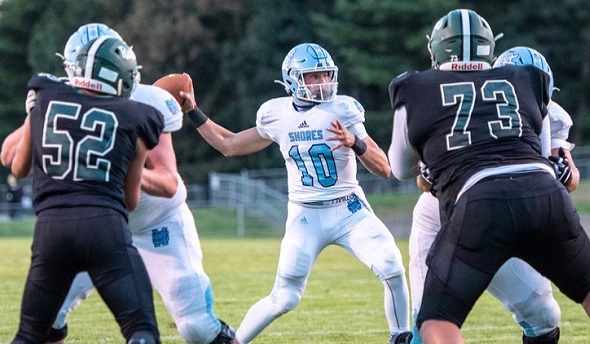
Familiar Name Home Again for Mona Shores
September 23, 2020
By Tom Kendra
Special for Second Half
One of the biggest names in Muskegon Mona Shores football history is back at quarterback – after a 40-year hiatus.
 Mark Konecny, who went on to Alma College and then became the first Michigan Intercollegiate Athletic Association player to make it to the NFL, moved back home from Colorado in 2017. Now it’s his son (same name) who is connecting with receivers for the reigning Division 2 champion Sailors.
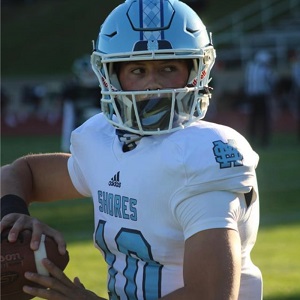
“It’s kind of cool to be here playing on the same field and practicing on the same field as him,” said Konecny, a 6-foot, 190-pound junior who wears No. 10, while his dad wore No. 11 at Shores. “I came here for a veer camp in the summer before my 8th-grade year and I liked Coach Koziak and the kids and thought it would be a good fit for me, and it has been.”
Konecny is the backup to senior Brady Rose (5-7, 172), a state Player of the Year candidate who powered the Sailors to a 35-26 upset of Detroit Martin Luther King in last year’s MHSAA Division 2 Final. But that doesn’t mean Konecny won’t play a key role in Friday’s showdown at crosstown rival Muskegon High.
Konecny threw a pair of first-half touchdown passes Friday as Shores picked up right where it left off with a 55-0 pounding of Muskegon Reeths-Puffer in an Ottawa-Kent Conference Green game.
While the explosive Rose is a magician running the veer offense, Koziak said having a backup like Konecny with a rocket arm adds another dimension to the attack.
“We want to get our best players on the field, but there can only be one quarterback, so it’s kind of a problem,” said Koziak, who led Mona Shores to its first-ever playoff berth in 2013 and then to the Finals three times in the past six years. “Brady is an amazing leader and high school football player, while Mark is more of a prototypical QB who can really spin it. So we’ll try to find unique ways to get them on the field at the same time.”
One of those unique ways came in the first quarter Friday, when Konecny lined up as a slot receiver and received a backwards toss from Rose. Konecny then fired his first-ever varsity pass, which a wide-open Elijah Farnum took 59 yards for a touchdown.
On the next possession, Konecny took over at quarterback and Rose moved to the slot, the position he played last year before stepping in for injured starting quarterback Caden Broersma early in the Semifinal against Walled Lake Western. With the Puffer defense focused on Rose, Konecny gunned a four-yard scoring pass to a sliding Keondre Pierce on a seam route.
 The two-quarterback attack might be required Friday at Muskegon, as Shores managed just 15 rushing yards and three first downs in last year’s humbling 53-0 loss to the Big Reds.
Muskegon holds a 32-7 all-time edge over Mona Shores, and had won 14 in a row before the Sailors broke through with back-to-back regular-season wins in 2014 and 2015. The Big Reds have since won five straight in the series, including a playoff victory in 2015.
Friday’s game will be the first on the new synthetic field turf at renovated Hackley Stadium, where the Big Reds have been playing since 1927.
Muskegon coach Shane Fairfield hinted before Monday’s practice that the Big Reds could also use multiple quarterbacks in Friday’s game. Projected starter Amari Crowley did not play in Muskegon’s 59-14 opening win at Holland, but is expected to be back Friday. Junior Myles Walton stepped in last week and rushed for 133 yards and completed 4-of-5 passes for 52 yards.
Konecny’s dad remembers classic battles against Muskegon back during his era, and leading the Sailors to a 20-7 win over Muskegon his senior year in 1980 before suffering a season-ending broken collarbone the following week at Traverse City.
He was converted to running back at Alma College, where he became the first in school history to rush for more than 1,000 yards in a season with 1,059 in 1984 in earning all-MIAA honors. He played two years in the Canadian Football League, before realizing his dream of playing in the NFL in 1987 with the Miami Dolphins.
Konecny’s best NFL season came with the Philadelphia Eagles in 1988, when he returned 17 kickoffs for 276 yards and 32 punts for 226 yards.
After football, he worked as a fireman in Littleton, Colo., for 25 years, but fate led him back home to Mona Shores when Koziak invited him to speak at a team fundraiser in 2017. Later that year, the younger Konecny took part in the school’s veer camp and the family decided to come home for good.
Things have fallen into place ever since. Konecny got a job with the Norton Shores Fire Department; his wife, Lauri, landed a kindergarten teaching job at Campbell Elementary in the Mona Shores district; and their only child, Mark, quarterbacked the Sailors freshmen to a 7-1-1 record two years ago and the junior varsity to an 8-1 record last fall.
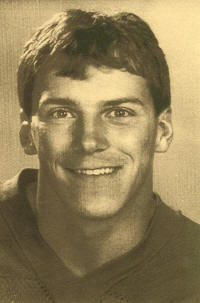 The elder Konecny coached the Shores special teams the past two years, but stepped aside during the offseason to give his son some space and just be another dad in the stands.
“I want these next two years to be all about him and the work that he has put in,” said Konecny, who was inducted into the Muskegon Area Sports Hall of Fame in 2007. “I just want to be an advocate for him and do whatever I can, lend whatever knowledge or experience I can, to help him achieve his goals.”
The younger Konecny is always trying to learn – soaking in lessons from Koziak and offensive coordinator Aaron James about the nuances of the veer offense and working with his father and former MSU quarterback Ryan Van Dyke on the mechanics of quarterback play. But perhaps the best lessons of all come from Rose.
“We compete with each other, but we also encourage each other,” explained Konecny, who has played hockey in the past but plans to powerlift and play baseball this school year. “What Brady does on the field just logistically doesn’t make sense for someone his size. But you see him in the weight room and around our teammates, and he’s such a leader. He’s a great influence on me.”
Koziak said he has no doubt Konecny will be a college quarterback in a couple of years.
“One of the things I really like about Mark is that he has a very inquisitive football mind,” said Koziak. “He wants to know why we do certain things we do in terms of motion or blocking on a particular play – not just what he has to do, but why.”
Konecny also has an incredible work ethic, never missing a chance to throw with his teammates or to hit the weight room. He recently became a rare junior skill athlete to join the Mona Shores 1,000-pound club – meaning his combined best lift in the bench, squat and dead lift tops that weight.
And when he’s not doing one of those things, he can often be spotted at his dad’s old favorite workout spot: the giant Lake Michigan sand dunes at Lake Harbor Park.
“Every so often, we’ll be sitting around the house and he’ll be restless and go run the dunes,” the elder Konecny said with a smile. “Those are the same dunes that I used to run when I played at Shores, so that’s kind of neat. Like father, like son, I guess.”
 Tom Kendra worked 23 years at The Muskegon Chronicle, including five as assistant sports editor and the final six as sports editor through 2011. E-mail him at [email protected] with story ideas for Muskegon, Oceana, Mason, Lake, Oceola, Mecosta and Newaygo counties.
PHOTOS: (Top) Mona Shores junior quarterback Mark Konecny drops back to pass during Friday's game at Muskegon Reeths-Puffer. (Middle) Konecny warms up Friday. (Below) The elder Mark Konecny. (Mona Shores photos by Eric Sturr and Mike Meekhof, respectively. Head shot courtesy of the Muskegon Area Sports Hall of Fame.)