


Heads and Heat
August 16, 2012
We are engaged in very serious discussions. They’re not only complicated, with unintended negative consequences possible from what are thought to be positive actions; they’re also a matter of life and death.
The topic is football – the high school sport under most scrutiny today and suffering from the most criticism it’s seen since the 1970s when catastrophic neck injuries spiked, liability awards soared, many insurers balked, and most helmet manufacturers abandoned the business altogether.
During recent years we have learned about the devastating long-term effects of repeated blows to the head; and we’re trying to reduce such hits. We’ve learned that 70 percent of concussions in football result from helmet-to-helmet contact, and we’re trying to have coaches teach blocking and tackling differently and have officials penalize “high hits” consistently and rigorously.
During the past several years we’ve learned that serious heat illness and heat-related deaths are 100 percent preventable, yet nationwide there were 35 heat-related deaths in high school football alone from 1995 to 2010; and we’re promoting practices that acclimatize athletes more gradually than “old school” traditionalists might advocate.
As we simultaneously address issues of heads and heat in football, some coaches may think we’re being overbearing, while many in medical fields say we’re out of date, citing higher standards of the American Academy of Pediatrics, National Athletic Trainers Association and National Federation of State High School Associations, as well as many of our counterpart organizations across the country.
As we consider in-season changes to improve athlete acclimatization and reduce blows to the head, we should be open to making out-of-season changes that work toward rather than in opposition to those objectives. There can be no sacred cows. The topic is too serious.
Ultimately, if we err in the outcome of this year’s discussions about heads and heat in football, it must be on the side of safety, on minimizing risks for student participants. They deserve it and, once again, the sport of football needs it.
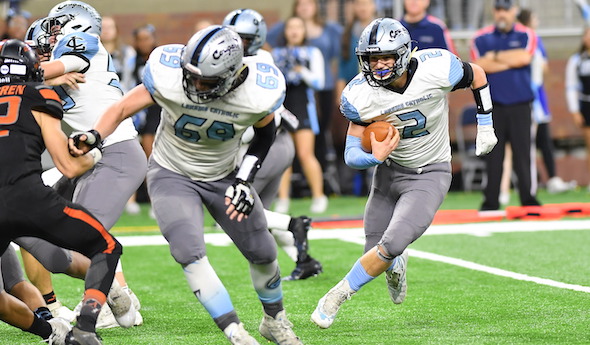
Lansing Catholic Comes Back to Claim D5
November 30, 2019
By Geoff Kimmerly
Second Half editor
DETROIT – Zach Gillespie was just part of what was out of rhythm for Lansing Catholic during the first half of Saturday’s Division 5 Final against Almont.
The senior quarterback headed into the break 2-of-6 passing for 16 yards with an interception, and had eight carries for nine yards – not at all characteristic for a standout who had thrown for nearly 2,500 yards and run for more than 550 through his first 13 games this season.
But somehow, the Cougars and Raiders were tied. And that meant Lansing Catholic was in position to win.
Gillespie stormed back with a big second half, the offense meeting halfway a defense that had kept the Cougars in the game, and the lessons of comebacks earlier this season made the difference in Lansing Catholic finishing a 31-17 win over Almont to earn its first Finals championship since 1985.
“I probably shouldn’t say that with these guys here, but I don’t think this team is the most talented team from top to bottom that we’ve ever had,” said Cougars coach Jim Ahern, who also brought Lansing Catholic to Ford Field in 2011 and 2014. “But I’ll tell ya, I don’t think I’ve had a team that has more chemistry and more heart than this group of kids did. We’ve been behind in a lot of games this year and they never quit, and I think that’s why.”
They call it a “21-7 mentality” and it was born from a loss this season, the sixth-straight over four seasons to rival Portland.
The Cougars (13-1) trailed in that Week 5 matchup 21-7 at halftime, and lightning forced the second half to be played the next day. Lansing Catholic came back to make the final score 21-20 – but even in defeat, the message hit home that the team can change the course of a game over the final two quarters. (And Lansing Catholic went on to defeat Portland 21-0 in the District Final.)
“We write it on the board at halftime – 21-7 mentality in the second half – and I think that was a big turning point coming out firing that game,” Cougars senior linebacker Sam Edwards said. “We’ve just carried that with us since, and it’s made us better.”
This time, as in many before, Gillespie led the way. He found his footing and touch after the break, completing 9-of-17 passes for 171 yards and two touchdowns over the final two quarters and running for two scores as well.
Almont carried a 17-7 lead into the final two minutes of the third quarter. But Lansing Catholic scored 24 unanswered points to finish the game, with Gillespie shutting the door with a four-yard scoring run with 1:39 to play.
That followed touchdown passes of seven yards to senior Vince Salquist and 23 to senior Mitch Raphael, a soccer player last year who showed some delicate footwork getting one down before exiting the side of the end zone. Raphael’s score put the Cougars ahead 24-17 with 3:41 to play.
“We just knew. We knew we could come out and score with anyone,” Gillespie said. “We knew we had a couple three-and-outs, and it wasn’t going our way. We kinda just had all gas, no brakes, and weren’t just satisfied with going up seven there. We wanted to score again.
 “I don’t think I could’ve had a worse first half. Especially in the state championship game, I went in at halftime and I was pretty down on myself. I (restored) the confidence in myself that I can make the throws, and I’ve got great playmakers that are going to catch it. Our line blocked pretty good in the second half … and everyone just got open for me and I was able to deliver.”
Almont (13-1) was making its first trip to the Finals for football, concluding an impressive run that saw it win on the road three of the first four weeks of the playoffs.
But the first half Saturday was frustrating, as the Raiders ended two drives throwing interceptions and a third giving up a fumble. The only first-half possession that didn’t end in a turnover finished with a touchdown.
Almont then scored on a field goal and touchdown on the first two possessions of the second half. But the Raiders threw another interception and fumbled the ball away again on the next two, allowing Lansing Catholic opportunities to catch up.
Senior Jack Paupert and junior Michael Lulgjuraj scored those Almont touchdowns, and Paupert ran 18 times for a team-high 78 yards. Senior Colby Schapman caught five passes for 80 yards. Senior Ryan Miller booted a 31-yard field goal to round out the team’s scoring.
Senior linebacker Jacob Hausmann with seven tackles led a defense that again this season measured up with the state’s best. The Raiders gave up just 11.6 points per game, holding teams below 15 per game for the sixth time in seven seasons. Lansing Catholic’s 31 points were the most surrendered by the Raiders since the 2017 playoffs.
“The backbone of our team is our defense. Coach (Ritchie) Feys does an excellent job preparing these guys, and these guys execut(e) the game plan,” Almont coach James Leusby said. “When we came out (after halftime) we were 0-0 ballgame, and we were going after it.”
Sophomore Alex Watters caught five passes for 107 yards for Lansing Catholic as Gillespie finished with 187 total through the air. Edwards had 19 tackles, recovered both fumbles and snagged an interception, and senior Daniel Magaway had 10 tackles as the Cougars locked down an offense that averaged 39.5 points this fall. Ahern directed the credit to assistants Kelly Carrier, Mike Doran and Pat Barner, who handle all of the defensive play-calling and made adjustments at halftime to slow down Almont’s outside running attack.
Ahern, meanwhile, claimed his first championship five decades after he began his head coaching career at Gobles in 1969. He spent more than three decades at Ithaca and came back from Florida in 2009 to take over at Lansing Catholic – going over 300 career wins this season and moving up to 11th on the in-state career list with a 301-152-6 record while coaching at those three Michigan high schools.
“When you get here and you don’t win, you don’t realize until I think months after that you had a great season. This is definitely a different feeling,” Ahern said.
“The message all week was let’s get him to 301,” Edwards said. “It means the world to me to be able to put on the jersey and play for this guy. It’s kinda bittersweet that I won’t get to do it again, but to end it on a high – there’s no one that deserves this more than this guy right here.”
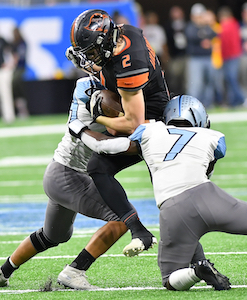
PHOTOS: (Top) Lansing Catholic quarterback Zach Gillespie follows his blockers during Saturday’s Division 5 Final. (Middle) Mitch Raphael (7) helps bring down Almont’s Michael Lulgjuraj.