


Heads and Heat
August 16, 2012
We are engaged in very serious discussions. They’re not only complicated, with unintended negative consequences possible from what are thought to be positive actions; they’re also a matter of life and death.
The topic is football – the high school sport under most scrutiny today and suffering from the most criticism it’s seen since the 1970s when catastrophic neck injuries spiked, liability awards soared, many insurers balked, and most helmet manufacturers abandoned the business altogether.
During recent years we have learned about the devastating long-term effects of repeated blows to the head; and we’re trying to reduce such hits. We’ve learned that 70 percent of concussions in football result from helmet-to-helmet contact, and we’re trying to have coaches teach blocking and tackling differently and have officials penalize “high hits” consistently and rigorously.
During the past several years we’ve learned that serious heat illness and heat-related deaths are 100 percent preventable, yet nationwide there were 35 heat-related deaths in high school football alone from 1995 to 2010; and we’re promoting practices that acclimatize athletes more gradually than “old school” traditionalists might advocate.
As we simultaneously address issues of heads and heat in football, some coaches may think we’re being overbearing, while many in medical fields say we’re out of date, citing higher standards of the American Academy of Pediatrics, National Athletic Trainers Association and National Federation of State High School Associations, as well as many of our counterpart organizations across the country.
As we consider in-season changes to improve athlete acclimatization and reduce blows to the head, we should be open to making out-of-season changes that work toward rather than in opposition to those objectives. There can be no sacred cows. The topic is too serious.
Ultimately, if we err in the outcome of this year’s discussions about heads and heat in football, it must be on the side of safety, on minimizing risks for student participants. They deserve it and, once again, the sport of football needs it.
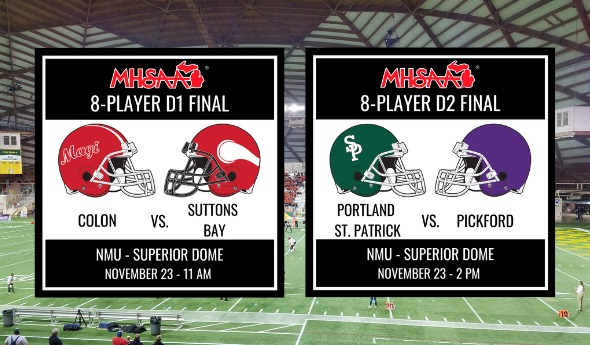
March to Marquette: 8-Player Preview
November 22, 2019
By Geoff Kimmerly
Second Half editor
For the second straight season, the majority of teams making the trip to the 8-Player Finals at Northern Michigan University’s Superior Dome will come seeking their first MHSAA football championship.
Colon, Suttons Bay and Pickford will be first-time title hopefuls Saturday. Portland St. Patrick is seeking its first football title since 1992, long before any of these current players was born.
Kickoff for the Division 1 game is 11 a.m., with the Division 2 game following at 2 p.m. Tickets cost $10 and one is good for admittance to both games. Both games also will be broadcast live on FOXSportsDetroit.com and the FOX Sports app, and replayed on FOX Sports Detroit’s primary channel on Nov. 26 – Division 1 at 8 p.m. and Division 2 at 11 p.m. Audio of both games will be streamed live on MHSAANetwork.com.
Below is a look at all four finalists. Team “rankings” are based on their playoff-point averages heading into the postseason.
 Division 1
COLON
Record/rank: 12-0, No. 2
Coach: Robbie Hattan, fourth season (28-13)
League finish: First in Southern Central Athletic Association A
Championship history: Has never played in an MHSAA Final.
Best wins: 27-8 over No. 6 Morrice in Semifinal, 56-12 over No. 3 Martin in Regional Final, 60-12 (Pre-Regional) and 55-0 over No. 13 Camden-Frontier, 43-8 over No. 11 Bellevue, 42-0 over Division 2 No. 5 Climax-Scotts.
Players to watch: RB/DL Brandon Crawford, 6-2/240, jr. (1,491 yards/22 TDs rushing); SL/DB/P Jonathan West, 6-2/160, sr. (653 yards/7 TDs rushing, 498 yards/12 TDs receiving); QB/DB Phillip Alva, 5-9/140, sr. (954 yards/19 TDs passing, 903 yards/17 TDs rushing).
Outlook: Colon moved to 8-player before the 2018 season after a nice recent run in 11-player that had included eight playoff appearances over the previous 14 seasons. But the Magi have succeeded at a higher level since making the switch, putting up double-digit wins last season for the first time and again this fall. Last season’s champion Morrice was the first opponent to hold Colon to under 34 points and also the first to come within 34 of catching the Magi this fall. Crawford and West both earned all-state honorable mentions in 2018, and 6-4 junior Brayden Ireland gives Alva another big target in the passing game. West also has scored off interceptions and punt and kickoff returns this season.
SUTTONS BAY
Record/rank: 12-0, No. 4
Coach: Garrick Opie, second season (21-2)
League finish: First in Midwest Central Michigan Conference West
Championship history: Division 6 runner-up 2004 (11-player).
Best wins: 45-14 over No. 8 Kingston in Semifinal, 36-30 over No. 14 Gaylord St. Mary in Regional Final, 36-14 over No. 16 Brimley in Pre-Regional, 20-14 and 29-18 over Division 2 No. 9 Onekama.
Players to watch: RB/DB Lucas Mikesell, 5-11/175, sr. (1,259 yards/29 TDs rushing, 501 yards/9 TDs receiving), QB/DB Bryce Opie, 6-4/194, sr. (1,167 yards/15 TDs passing, 692 yards/13 TDs rushing); OG/DT Gavyn Shananaquet, 6-0/230, sr.
Outlook: Suttons Bay has run its record over three seasons of 8-player to a combined 28-6 after being forced to end its final 11-player season early in 2016. The Norsemen had only three games decided by single digits this fall. The first was a six-point win over Onekama, and Suttons Bay won the rematch by 11, and the other two were against Gaylord St. Mary – a one-point loss on the field that became a forfeit win and a six-point win in the Regional Final. The defense has been especially impressive, giving up 16.7 points per game on the season but more than 18 only twice (both times to St. Mary). Bryce Opie also has five interceptions, and the team had a 23-14 turnover advantage heading into last week’s Semifinal.
 Division 2
PORTLAND ST. PATRICK
Record/rank: 12-0, No. 3
Coach: Patrick Russman, 13th season (88-48)
League finish: Does not play in a league.
Championship history: Division 2 runner-up 2017 (8-player), Class D champion 1992, runner-up 1991 and 1997 (11-player).
Best wins: 49-6 over No. 5 Climax-Scotts in Semifinal, 51-16 over No. 11 Kinde North Huron in Regional Final, 45-0 over No. 16 Bay City All-Saints in Pre-Regional, 42-24 over No. 9 Onekama.
Players to watch: RB/DL Ned Smith, 5-10/195, sr. (1,510 yards/24 TDs rushing); QB/DB Connor Cross, 6-2/175, jr. (1,688 yards/36 TDs passing); WR/DB Zach Spitzley, 6-2/180, sr. (1,133 yards/19 TDs receiving).
Outlook: The Shamrocks have made at least the Semifinals the last three seasons and four times since switching to 8-player in 2012, and this has been their most successful run of all four. St. Patrick has won all of its games by at least 18 points (not counting a 2-0 forfeit in Week 3) and by an average score of 52-10. Senior linebacker Alex Kissane, sophomore linebacker Derec Fedewa, senior defensive back Riley Kissane and senior lineman Jeff Davlin are among leaders of a defense that has given up more than 16 points only twice and a combined 22 points over three playoff games.
PICKFORD
Record/rank: 11-1, T-No. 1
Coach: Josh Rader, 16th season (110-55)
League finish: First in Great Lakes Eight Conference East
Championship history: Division 1 runner-up 2018 (8-player).
Best wins: 22-14 over T-No. 1 Powers North Central in Regional Finals, 40-8 over No. 4 Hillman in Semifinal, 57-12 (Pre-Regional) and 58-15 over No. 6 Engadine, 48-16 over No. 7 Crystal Falls Forest Park, 64-20 over No. 12 Cedarville, 46-23 over Division 1 No. 14 Gaylord St. Mary.
Players to watch: QB/LB Jimmy Storey, 6-0/185, sr. (1,400 yards/19 TDs passing, 1,809 yards/24 TDs rushing); TE/DE Nick Edington, 6-7/220, sr. (307 yards/3 TDs receiving); RB/DB Stephen Lamothe, 5-10/175, sr. (752 yards/11 TDs rushing, 813 yards/11 TDs receiving).
Outlook: After reaching last season’s Division 1 championship game with a junior-heavy roster, Pickford is back playing for its first Finals championship with many of the same standouts. Edington, Storey and senior lineman Isaiah May all made the all-state team last season, and Storey was the statewide Player of the Year for 8-player by The Associated Press. The team’s only loss this fall came in Week 3, by six points, to Powers North Central – and the Panthers avenged the defeat in the Regional Final. The Jets also were the only team able to hold Pickford under 40 points this fall. Senior running back Isaac Brown provides another valuable option on offense with 613 yards and 12 touchdowns rushing.