


Heads and Heat
August 16, 2012
We are engaged in very serious discussions. They’re not only complicated, with unintended negative consequences possible from what are thought to be positive actions; they’re also a matter of life and death.
The topic is football – the high school sport under most scrutiny today and suffering from the most criticism it’s seen since the 1970s when catastrophic neck injuries spiked, liability awards soared, many insurers balked, and most helmet manufacturers abandoned the business altogether.
During recent years we have learned about the devastating long-term effects of repeated blows to the head; and we’re trying to reduce such hits. We’ve learned that 70 percent of concussions in football result from helmet-to-helmet contact, and we’re trying to have coaches teach blocking and tackling differently and have officials penalize “high hits” consistently and rigorously.
During the past several years we’ve learned that serious heat illness and heat-related deaths are 100 percent preventable, yet nationwide there were 35 heat-related deaths in high school football alone from 1995 to 2010; and we’re promoting practices that acclimatize athletes more gradually than “old school” traditionalists might advocate.
As we simultaneously address issues of heads and heat in football, some coaches may think we’re being overbearing, while many in medical fields say we’re out of date, citing higher standards of the American Academy of Pediatrics, National Athletic Trainers Association and National Federation of State High School Associations, as well as many of our counterpart organizations across the country.
As we consider in-season changes to improve athlete acclimatization and reduce blows to the head, we should be open to making out-of-season changes that work toward rather than in opposition to those objectives. There can be no sacred cows. The topic is too serious.
Ultimately, if we err in the outcome of this year’s discussions about heads and heat in football, it must be on the side of safety, on minimizing risks for student participants. They deserve it and, once again, the sport of football needs it.

Sand Creek's Muck Making His Move
August 16, 2018
By Doug Donnelly
Special for Second Half
SAND CREEK – Alec Muck doesn’t take for granted that he’s one of the fastest athletes in the state.
 It just makes him want to become faster.
“I’ve always had speed,” said the Sand Creek senior. “I guess you could say I was blessed with speed. But I train hard, too. I do a lot of stuff on my own, I work with a personal trainer and I lift. It motivates me.”
Muck is a five-time MHSAA Finals track champion and has rushed for more than 2,600 career yards for the Aggies’ varsity football team. As he prepares for his senior season on the football field, he said he’s healthy and ready to go out a winner.
“I just want to go out and play hard and give it my all,” he said. “I’m going to do whatever it takes for my team. High school football is so different than anything else. I want to leave it all out there.”
Muck has a future as a college athlete. He’s just not sure in which sport. This summer, he went on a multi-state, multi-campus recruiting tour during which he blazed to a 4.3-second 40-yard time in Columbus, Ohio.
“That definitely caught the attention of a few coaches,” he said. “I kept my time around that 4.3 all summer.”
Other stops on the tour included Louisville, Cincinnati, Findlay and Western Michigan University. The 5-foot-10, 175-pound speedster doesn’t have any formal offers to play college football, but he expects that to change this season.
“I have a passion for both track and football,” he said. “But, I love the grind of football and everything about the game. If I could choose, I’d probably say football. I’ve always wanted to play at the Division I level.”
Muck was part of the Sand Creek varsity football team as a freshman. He blossomed into a weapon as a sophomore. In the third game that season, against Whitmore Lake, he carried the ball 11 times for 277 yards and five touchdowns. It remains his most productive game of his career. In all seven Tri-County Conference games that year, he rushed for at least 100 yards. He went on to rush for 1,505 yards as a sophomore, racking up nearly 2,000 all-purpose yards and 26 touchdowns.
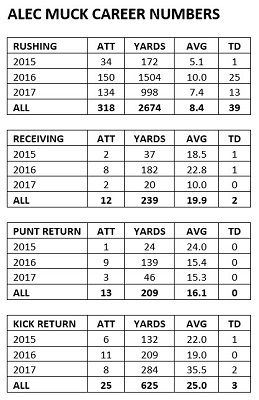 His junior season saw a slight dip in his carries, but he still averaged more than seven yards per rush and came up two yards short of 1,000. He started the season spending some time at quarterback. That experiment ended early in the season, however, and he expects to line up at several different spots on the field this year – but not quarterback.
“I like running back,” he said. “That’s where I’ve played since my Pop Warner days. I like to run and see the whole field. Running with the football is way different than running the track. You have to know when to go only 50 percent, so you know where to make your cut, then explode. You have to have more lateral movement.”
Sand Creek coach Scott Gallagher said the Aggies need to find more and creative ways to get Muck the football.
“He’s explosive,” said Gallagher, in his second season leading the program. “We have to put him in different positions and get him the football in a lot of different ways. He’s had the best camp he’s had since I’ve coached him.”
Muck causes headaches for opposing coaches. He is a threat to score every time he touches the ball.
“Obviously Alec has tremendous speed; however, his ability to take over and change a game is underrated,” said Ottawa Lake Whiteford coach Jason Mensing. “His imprint on the TCC will be lasting.”
Gallagher said Muck sets high expectations for himself.
“He’s hard on himself,” Gallagher said. “He is very driven to be successful, and he wants to that success to rub off on his teammates.”
Muck’s training has involved a lot of speed drills – often on his own. His weightlifting is for strength and maintaining speed, not bulking up.
“My normal warm-ups are low sprints, not long-distance running,” he said. “When I run the short sprints, I set a goal for each sprint and try and beat that time. I run for time.”
Prior to the Regional track meet this spring, Muck injured his hamstring. He took a week off running before the Lower Peninsula Division 4 Finals, but the break didn’t slow him as he won both the 100 and 200 dashes. He won the same events as a sophomore and won the 200 as a freshman. His championship winning times this spring were 10.98 seconds in the 100 and 22.02 in the 200.
“I was really careful warming up at the state meet and, in the preliminaries, I ran easy, just so I could get to the final,” he said. “Once I got there, I knew I could do it.”
Throughout a summer of football camps and 7-on-7s, Muck also attended physical therapy for the hamstring. He said he’s now at 100 percent and ready to start football – and go out with a bang.
“This is the most dedicated the team has been since I’ve been playing,” he said. “The offseason training, the commitment to the weight room, it’s all there. I’m just ready to go out there and lead by example. It’s time to play football.”
 Doug Donnelly has served as a sports and news reporter and city editor over 25 years, writing for the Daily Chief-Union in Upper Sandusky, Ohio from 1992-1995, the Monroe Evening News from 1995-2012 and the Adrian Daily Telegram since 2013. He's also written a book on high school basketball in Monroe County and compiles record books for various schools in southeast Michigan. E-mail him at [email protected] with story ideas for Lenawee and Monroe counties.
PHOTO: Sand Creek running back Alec Muck is a five-time MHSAA Finals track champion with more than 2,600 career rushing yards. He's healthy and ready for a breakout senior year of football. (Photo by Mike Dickie.)