


Heads and Heat
August 16, 2012
We are engaged in very serious discussions. They’re not only complicated, with unintended negative consequences possible from what are thought to be positive actions; they’re also a matter of life and death.
The topic is football – the high school sport under most scrutiny today and suffering from the most criticism it’s seen since the 1970s when catastrophic neck injuries spiked, liability awards soared, many insurers balked, and most helmet manufacturers abandoned the business altogether.
During recent years we have learned about the devastating long-term effects of repeated blows to the head; and we’re trying to reduce such hits. We’ve learned that 70 percent of concussions in football result from helmet-to-helmet contact, and we’re trying to have coaches teach blocking and tackling differently and have officials penalize “high hits” consistently and rigorously.
During the past several years we’ve learned that serious heat illness and heat-related deaths are 100 percent preventable, yet nationwide there were 35 heat-related deaths in high school football alone from 1995 to 2010; and we’re promoting practices that acclimatize athletes more gradually than “old school” traditionalists might advocate.
As we simultaneously address issues of heads and heat in football, some coaches may think we’re being overbearing, while many in medical fields say we’re out of date, citing higher standards of the American Academy of Pediatrics, National Athletic Trainers Association and National Federation of State High School Associations, as well as many of our counterpart organizations across the country.
As we consider in-season changes to improve athlete acclimatization and reduce blows to the head, we should be open to making out-of-season changes that work toward rather than in opposition to those objectives. There can be no sacred cows. The topic is too serious.
Ultimately, if we err in the outcome of this year’s discussions about heads and heat in football, it must be on the side of safety, on minimizing risks for student participants. They deserve it and, once again, the sport of football needs it.
Fast Start Sends DeLaSalle Soaring
By
Paul Costanzo
Special for MHSAA.com
November 24, 2017
DETROIT – Brendan Madigan kept his promise.
 He was on the field as a freshman in 2014 when Warren DeLaSalle won its first MHSAA Division 2 football championship. And he enjoyed it so much, he told himself he would come back and do it again.
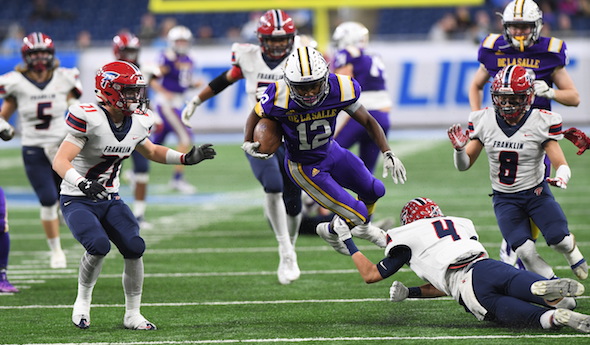
On Friday, the senior captain led the Pilots to title No. 2, as they rolled to a 41-6 victory against Livonia Franklin again in Division 2 at Ford Field.
“I got to see those guys (in 2014), see what it was like and get the feeling of what it is,” Madigan said. “Ever since then, I made a promise to myself to get all of my guys back here and win it again, so it feels great.”
It was a brilliant finish to a season that started with immediate adversity following a 36-6 loss against Lowell during opening weekend. But the Pilots (12-2) responded positively and proved their worth week in and week out, winning the Detroit Catholic League Central title and knocking off two-time reigning Division 2 champion Detroit Martin Luther King on their way to Ford Field.
“Nobody thought we could do it after we lost to Lowell – and we lost by a lot,” said DeLaSalle junior Evan Vaillancourt, who had 160 yards receiving and a touchdown Friday. “But we came back and had the best practice we had, and played really good (in Week 2) against Grandville, then we played good from there on.”
There was no adversity to deal with in the title game, as DeLaSalle found itself ahead 7-0 just 16 seconds in, and without having put its offense on the field.
Madigan recovered a snap that had sailed over the Franklin backfield and ran 13 yards for the touchdown on the first play from scrimmage. It was the first time since 2005 that the first play from scrimmage had resulted in a touchdown in an MHSAA Final.
“I saw the ball go over (the quarterback’s) head, and immediately I knew I had to scoop it up,” Madigan said. “It bounced good, I got to pick it up and run it in. (DeLaSalle junior) Jacob Dobbs even helped me get in, carrying me a little bit. It felt great to start the game out with points even when they started with the ball.”
DeLaSalle scored 21 points off three first-half Franklin turnovers.
 “We knew going in that we couldn’t get them extra opportunities, and that’s kind of what we did there in the first half,” Franklin coach Chris Kelbert said. “Just momentum never got on our side, and that’s one of the things we had to do to win, to beat a team that good, and it just didn’t work out for us.”
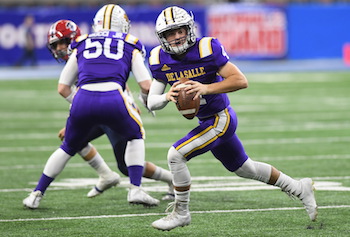
DeLaSalle proved it didn’t need good field position to score points, averaging 8.0 yards per play and racking up 313 yards of offense. Senior quarterback Luke Pfromm accounted for 207 of those yards through the air, as he was 10 of 12 passing with a pair of touchdowns.
“I thought (Pfromm’s performance) was decent,” DeLaSalle coach Mike Giannone said with a laugh. “I would say he was on. Some of the things we do, play-action passing, some of the deep balls and other things that he can see – he’s developed into a real fine quarterback, and I think someone out there is going to really get a steal.”
Franklin (11-3), which was playing in its first Final since winning the first MHSAA Class A title in 1975, appeared unfazed by the unfortunate start, driving all the way to the DeLaSalle 5-yard line on the next possession. But that was as close as the Patriots would get, turning the ball over on downs before seeing the Pilots put together a 93-yard drive of their own and go up 14-0 on 60-yard pass from Pfromm to Vaillancourt.
Turnovers on Franklin’s next two possessions allowed the Pilots to essentially put the game away in the second quarter. A Josh DeBerry interception set up a 2-yard Pfromm touchdown run, and a fumble recovery set up 4-yard touchdown pass from Pfromm to Sergio Gasperoni.
“We’ve made some plays defensively (this season); we put pressure on people,” Giannone said. “One of our coaches says, with pressure, the pipes burst.”
A 2-yard touchdown run from Cordell Tannyhill and a 23-yard field goal by Riley Garrison gave DeLaSalle a 38-0 lead heading into halftime. Garrison added a 30-yard field goal early in the fourth quarter.
Franklin’s lone score came on a 5-yard run by Isaac Moore, which he set up with a 72-yard run on the previous play. Moore led the Franklin offense with 160 yards on the ground.
The MHSAA Playoffs are sponsored by the Michigan Army National Guard.
PHOTOS: (Top) Warren DeLaSalle’s Semaj Shelton (12) leaps past a defender's outstretched arm during Friday’s Division 2 Final. (Middle) Pilots quarterback Luke Pfromm rolls out looking for an open receiver.