

Howell Names Field for Longtime Leader
August 30, 2018
By Tim Robinson
Special for Second Half
If you got the impression that John Dukes has been around Howell football forever, you wouldn’t be far off.
 His association with the program began before high school.
“When I was a kid, I used to live near Page Field (Howell’s former athletic complex), and I would go out and watch football practice,” Dukes said. “I was at practice all the time, and the coach said, ‘If you’re going to be here all the time, you may as well get some water for the boys while they’re practicing.’”
That was in 1963, when the Highlanders went 9-0.
A little more than 55 years later, Dukes will be honored tonight when the field at Howell’s Memorial Stadium will be named John Dukes Field.
Howell football coach Aaron Metz began the drive to name the field after Dukes when it was determined the old turf, installed in 2004, needed to be replaced.
“We have a commitment award named for John,” he said. “If you play football for four years, you get the John Dukes Commitment Award. We put a committee together with people who have been around Howell for a long time, and when you ask anybody, they say there’s not a person more deserving than John Dukes.
“So I ran it up the ladder to the athletic director and superintendent, and, to be honest, it was a pretty easy process because no one could find anything bad about John,” Metz added. “We’re excited to have the opportunity to do it.”
Dukes was a three-year varsity player at Howell and then played at Alma College, where his teams won three league championships.
With the exception of six years at Hartland coaching under his son, Marcus, John Dukes has been affiliated with Howell football for 46 years, including 25 as the head coach.
After graduating from Alma in 1972, Dukes got a teaching job at Howell and was an assistant freshman coach for a season and a varsity assistant for two before taking over as head coach at age 25.
“My philosophy at the time was I wanted to help the kids enjoy playing football and help them to be successful at it,” he recalled. “The previous three years our record wasn’t very good. That was one of my objectives, was to make it fun.”
He then talked about his first season with a little self-deprecation, a common thread in most conversations with Dukes.
“I remember my first game,” he said. “Because I played defense in college (Dukes was a linebacker), I thought we were going to be a really good defensive team. We played Fenton in my first game, and we lost 32-19, so my defensive prowess wasn’t good at the time.”
The Highlanders lost six of their first seven games that season, but won the last two and went 8-1 three seasons later.
In all, Howell had winning records in 15 of his 25 seasons, but one group of players stood out for an entirely different reason.
“We had a period of time (1989 and 1990) where we weren’t very good, and we lost 17 games in a row,” he said. “But those kids were wonderful kids to coach. They came to practice with energy all the time, and from a coaching standpoint, it was wonderful to coach them during the week. Now, Fridays were a different story, because we didn’t play very well on Fridays, ever.
 “But the real thing that stands out with that group was the very last game of their senior year we beat (Waterford Kettering), and you’d have thought we’d won the Super Bowl,” Dukes continued. “Those kids who were seniors, that was their first football victory in high school. It was an amazing time. We had several teams with good players, and I really enjoyed coaching them, too, and I don’t want to leave them out. But that really stood out in my mind, in that they came out to work every day.
“Over a period of time of losing that many games, sometimes, it’s not fun and it’s not fun for them or the coaches. But we had a very enjoyable time over that two-year period, regardless of the fact we didn’t win any games.”
His perspective is consistent with the principles by which he ran his program.
“These weren’t original to me,” he says, “but the three things I always told our kids was your faith should be your number one priority, your family should be your number two priority. Football, when school hadn’t started, should be number three. And when school started, school became three and football became number four. We tried to base everything we did on these priorities in our lives. Sometimes those things cross over and mix and match. When they do, then you have to step back and say what is really important here?”
Dukes resigned after the 1999 season.
“There were a lot of things and I don’t know if anything in particular,” he said of his decision. “I had been doing it for 25 years, and we had a string of years where we were 6-3. So we were OK, but I felt it was time to be done with it.”
His self-imposed exile lasted one season. He had a couple of stints as an assistant coach when he finally decided to retire for good in 2006.
“No sooner had I done that, my son (Marcus) called me up and said he just got the Hartland job,” Dukes recalled. “He said, ‘Dad, you have to come here and help.’ So I went there for six years. Then he resigned, and I thought I was going to be done again.”
After another stint as a Howell assistant, John Dukes took the last two years off before agreeing to rejoin the program as a junior varsity assistant this season, as the offensive coordinator.
As it turns out, one grandson, Jackson Dukes, plays on the Howell JV, and John Dukes also is helping coach another grandson, Colin Lassey, on his junior football team.
“When Jackson gets home, I ask him, ‘Did you get yelled at by Grandpa today?” Josh Dukes says. “And when he says yes, I say, ‘Good. You should be getting yelled at.’ So nothing has changed in the 30 years since high school.”
Josh Dukes, the oldest of John Dukes’ three children, joined Marcus in playing football for their father.
“There was never an expectation that we had to be this or that,” Josh Dukes said of himself, his brother and sister, Carrie. “Now maybe he was a little harder on me, but that’s something we were thankful for. I’d rather him be harder on me than any kid on the field, because then the other kids left me alone. They knew it was the same for everyone across the board. He wasn’t going to take it easy on me, my brother or my sister.”
John Dukes coached his daughter, Carrie, when she played middle school basketball.
“The first time he coached me, he came home to my mom and said, ‘I don’t know how people do this,’” she recalled. “‘They’re all crying, half of them don’t think I like them. I don’t know how to do this with girls. It’s a totally different ballgame.’ But he was a great coach. I know some people don’t like their parents coaching them, but I loved having him coach.”
Like her brothers, Carrie Lassey stayed involved with sports. She is now the athletic director at St. Joseph Catholic School in Howell.
“He coached my freshman team a couple of years ago,” she said. “It was third and fourth-grade girls. It’s amazing. He can coach pretty much anybody.”
Indeed, Dukes also coached baseball and wrestling at the varsity level at Howell, and, for a couple of weeks, filled in as a competitive cheer coach when the Highlanders had a temporary vacancy.
“I was more a supervisor,” he said, but serving that role illustrated his commitment to the athletic program as a whole. He was needed, and he stepped in.
 Having stopped and started his career so many times, Dukes, now 68, laughs when asked about what he will do when he retires in the distant future.
“I’m sure he’ll be coaching when he’s in his 90s. Maybe triple digits,” jokes Bill Murray, the former Brighton coach who matched up with Dukes’ teams during the second half of Dukes’ Howell tenure. “The guy loves the game, he’s out there and he has a lot to offer. His teams were always well-prepared, they played great defense, were fundamentally sound and when you went nose-to-nose, they were consistent as to what they were going to do. It was a matter of whether you could stop them or not.”
Dukes still keeps up with the Howell varsity, still offers advice when asked, and still enjoys the competition.
“For me, as a head coach, it’s great having a coach (on staff) who has been there and done it to talk to and mentor, even me,” Metz said. “What makes a successful coach, I don’t think, changes, whether it’s been 50 or 100 years ago to the current day. He steered the ship to have an outstanding record (130-95) and also have a huge impact on kids in our community.”
“When people talk to me about my dad, they say he was a dad to them, or like a second dad,” Josh Dukes added. “Or, ‘I wanted to be a teacher because of him.’ These are the things that for us,” referring to his siblings, “is the most impressive part. The kids of players he’s coached, or the grandkids.”
Dukes has the unusual distinction of having coached more congressmen (Mike Rogers and Mark Schauer, who started on the offensive line for Dukes in the late 1970s) than pro football players (Jon Mack, who played for the Michigan Panthers of the USFL in 1984).
John Dukes will give a short speech before tonight’s ceremony, which will take place before Howell’s home opener against Plymouth.
“They’ve given me five minutes, but it will probably be shorter because they want to get the game started on time,” he joked.
“It’s an incredible honor,” Josh Dukes said. “Everyone in our family feels the same way. I don’t think he ever went into this with any intentions of being singled out. It’s a great lesson for our community and our athletes, to see what hard work and effort and care for your community can do, you know?”
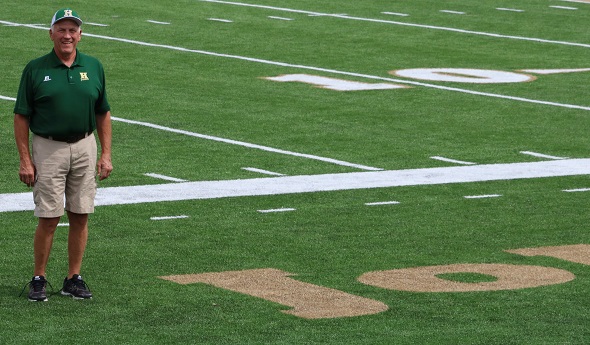
During the ceremony, the letters “John Dukes Field,” which were sewn into the artificial turf in Howell’s Vegas Gold, will be unveiled.
“Aaron showed it to me last week when they were putting it in,” John Dukes said, then joked, “I thought (the lettering) was going to be a little trademark sign (sized), and my goodness, it’s bigger than the numbers. It’s a little bit ostentatious for me, I think; wow, that’s quite a tribute. I’m very humbled by it and honored by it and very appreciative of what people have done to make this happen.”
A few days later, Dukes posed for a picture next to his name on the field and chatted with a reporter as they left the stadium.
Then, he turned a corner to the JV football office and kept walking.
Before he became a living legend, John Dukes was a football coach, and there’s a game coming up and his team to prepare.
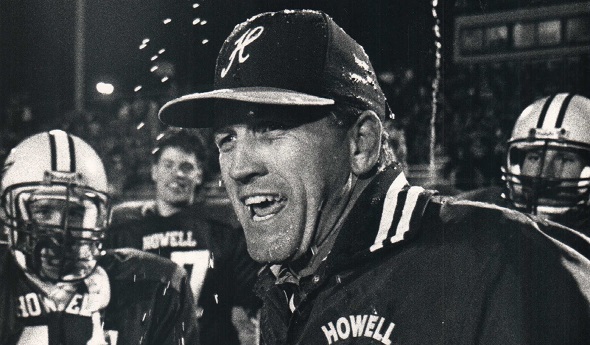
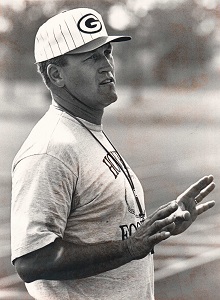
PHOTOS: (Top) Howell coach John Dukes celebrates his team’s 38-0 playoff victory over Wayne Memorial in 1992. (Middle) Dukes, during the 1991 season. (Below) Dukes stands next to the lettering that will be unveiled Thursday when the school’s field is named in his honor. (Photos taken or collected by Tim Robinson.)
New Coach Takes Next Step at Escanaba
September 1, 2015
By Dennis Grall
Special for Second Half
ESCANABA – When school ended in early June, Dave Howes took a vacation trip to Florida and began thinking about his upcoming fourth season as junior varsity football coach at Escanaba High School.
Within a month he had become the school's varsity head coach, a position he had never thought about taking on.
 "To tell you the truth, I never wanted to be a head football coach," Howes said in the Eskymos’ lockerroom before the start of a recent practice. "It just kind of fell in my lap."
Escanaba had a 10-17 record over the last three seasons under previous coach Jim Hansen, who was dismissed in June, but opened this fall with a 21-7 win over Alpena on Thursday. The Eskymos travel to Petoskey on Friday.
When Howes was contacted about moving up from the jayvees, he said, "I had to make up my mind. Do I want it? It happened real fast. I wasn't expecting it. It just happened."
He was encouraged to apply by several people, including an Escanaba High School administrator, and was given the blessing of his wife, Holly, to pursue the position. He is the second coach in four years to direct the Eskymos, who during the previous 50 years had just two head coaches, Upper Peninsula Sports Hall of Fame inductees Jerry Cvengros and Dan Flynn.
When Howes first joined the Eskymos’ coaching staff in 2005, he said Flynn asked if he ever wanted to become the school's head coach. "I said, I don't know," said Howes. "I didn't envision it. Now I'm more than happy."
Howes said he has received excellent support from family, friends, players, coaches and the community during the short time he has been in charge.
"I want our fans to know that our kids are going to be competitive, and they are going to work hard. They will see there will be an edge about them," he said.
About 100 students came out for the three football levels, with 48 on varsity. Howes didn't have any preseason contact until after July 4, about a month behind the normal period. A big plus in the transition was all the previous assistant coaches stuck with the program, and they have all moved up a level in the process.
"They have all the kids they had in previous years, and we're running the same system," Howes said. "It has been an easy transition. Knowing the kids and knowing the coaches was easy. We had the same kids, the same coaches, the same philosophies. It's made practice easier."
 Athletic director Nick Nolde brought the coaches and players together and provided the introductions, which weren't really necessary because of the carry over. "It's been smooth sailing ever since," said Howes of the best-case scenario coming together.
Nolde said given the way "everything went down, it has been a seamless transition. He is familiar with the kids, and he is familiar with the program."
Howes is a native of neighboring Gladstone, graduating in 1993 and playing against Escanaba teams in football, basketball and baseball. "It's weird. As a kid, I hated Escanaba with a passion. Now, here I am," said Howes, whose older brother Dave is an assistant varsity coach with former Escanaba player Don Koish and former Gladstone athlete Jason Micheau.
"It is so funny how things happen," said Howes, who also coached subvarsity football in Gladstone and Beal City following his 1998 graduation from Northern Michigan University and before coming to Escanaba in 2005.
He does not feel any pressure taking over the tradition-laden, highly-respected program spotlighted by the MHSAA Class A championship in 1981 and 1979 runner-up finish.
"To me, it is just a game and we're going to be competitive and try our hardest," Howes said. "We are moving forward. Every day we come in here and see the (old) pictures. It is a great tradition with great pride. But the focus is now. Everything is about the present."
He already has noticed the difference of being in charge of the whole program, from dealing with the news media to handling financial situations and MHSAA rules and regulations. "There is a lot more on my plate. Instead of being in charge of 30 kids, you are the boss of the whole program grades 7-12," he said.
He has also installed his own touch, starting with practice sessions. "The last couple of years we have had super-paced practices. This year we're doing more teaching in our practices," he said. "We are keeping it as simple as possible and putting kids in position to succeed. We're getting more done in a shorter amount of time."
He is not worried about matching X's and O's against such legendary Upper Peninsula coaches as Chris Hofer at Kingsford or Joe Noha from Menominee, nor is he concerned about the imprint made by Cvengros and Flynn, or even his high school coach, the highly-regarded John Mileski.
"I can't follow in their footsteps," he said. "They are irreplaceable. We've just got to move on."
 Denny Grall retired in 2012 after 39 years at the Escanaba Daily Press and four at the Green Bay Press-Gazette, plus 15 months for WLST radio in Escanaba; he served as the Daily Press sports editor from 1970-80 and again from 1984-2012. Grall was inducted into the Upper Peninsula Sports Hall of Fame in 2002 and serves as its executive secretary. E-mail him at [email protected] with story ideas for the Upper Peninsula.
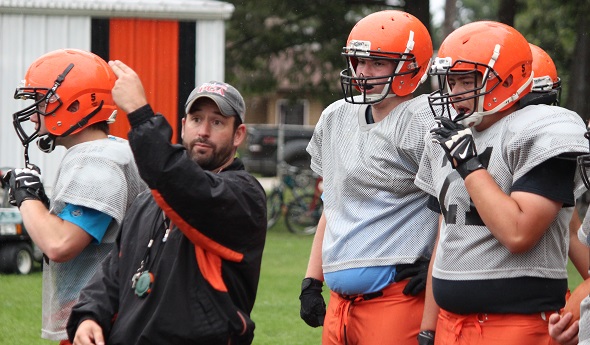
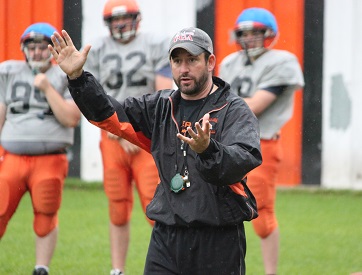
PHOTOS: (Top) Escanaba High School football coach Dave Howes makes a point to members of the Eskymos recently at Escanaba Athletic Field. Howes took over the tradition-laden program in July and is the second head coach in the past four years, after the late Jerry Cvengros and Dan Flynn served as the only head coaches during the previous 50 years. (Middle) Howes encourages his football team during a practice session.