

Howell Names Field for Longtime Leader
August 30, 2018
By Tim Robinson
Special for Second Half
If you got the impression that John Dukes has been around Howell football forever, you wouldn’t be far off.
 His association with the program began before high school.
“When I was a kid, I used to live near Page Field (Howell’s former athletic complex), and I would go out and watch football practice,” Dukes said. “I was at practice all the time, and the coach said, ‘If you’re going to be here all the time, you may as well get some water for the boys while they’re practicing.’”
That was in 1963, when the Highlanders went 9-0.
A little more than 55 years later, Dukes will be honored tonight when the field at Howell’s Memorial Stadium will be named John Dukes Field.
Howell football coach Aaron Metz began the drive to name the field after Dukes when it was determined the old turf, installed in 2004, needed to be replaced.
“We have a commitment award named for John,” he said. “If you play football for four years, you get the John Dukes Commitment Award. We put a committee together with people who have been around Howell for a long time, and when you ask anybody, they say there’s not a person more deserving than John Dukes.
“So I ran it up the ladder to the athletic director and superintendent, and, to be honest, it was a pretty easy process because no one could find anything bad about John,” Metz added. “We’re excited to have the opportunity to do it.”
Dukes was a three-year varsity player at Howell and then played at Alma College, where his teams won three league championships.
With the exception of six years at Hartland coaching under his son, Marcus, John Dukes has been affiliated with Howell football for 46 years, including 25 as the head coach.
After graduating from Alma in 1972, Dukes got a teaching job at Howell and was an assistant freshman coach for a season and a varsity assistant for two before taking over as head coach at age 25.
“My philosophy at the time was I wanted to help the kids enjoy playing football and help them to be successful at it,” he recalled. “The previous three years our record wasn’t very good. That was one of my objectives, was to make it fun.”
He then talked about his first season with a little self-deprecation, a common thread in most conversations with Dukes.
“I remember my first game,” he said. “Because I played defense in college (Dukes was a linebacker), I thought we were going to be a really good defensive team. We played Fenton in my first game, and we lost 32-19, so my defensive prowess wasn’t good at the time.”
The Highlanders lost six of their first seven games that season, but won the last two and went 8-1 three seasons later.
In all, Howell had winning records in 15 of his 25 seasons, but one group of players stood out for an entirely different reason.
“We had a period of time (1989 and 1990) where we weren’t very good, and we lost 17 games in a row,” he said. “But those kids were wonderful kids to coach. They came to practice with energy all the time, and from a coaching standpoint, it was wonderful to coach them during the week. Now, Fridays were a different story, because we didn’t play very well on Fridays, ever.
 “But the real thing that stands out with that group was the very last game of their senior year we beat (Waterford Kettering), and you’d have thought we’d won the Super Bowl,” Dukes continued. “Those kids who were seniors, that was their first football victory in high school. It was an amazing time. We had several teams with good players, and I really enjoyed coaching them, too, and I don’t want to leave them out. But that really stood out in my mind, in that they came out to work every day.
“Over a period of time of losing that many games, sometimes, it’s not fun and it’s not fun for them or the coaches. But we had a very enjoyable time over that two-year period, regardless of the fact we didn’t win any games.”
His perspective is consistent with the principles by which he ran his program.
“These weren’t original to me,” he says, “but the three things I always told our kids was your faith should be your number one priority, your family should be your number two priority. Football, when school hadn’t started, should be number three. And when school started, school became three and football became number four. We tried to base everything we did on these priorities in our lives. Sometimes those things cross over and mix and match. When they do, then you have to step back and say what is really important here?”
Dukes resigned after the 1999 season.
“There were a lot of things and I don’t know if anything in particular,” he said of his decision. “I had been doing it for 25 years, and we had a string of years where we were 6-3. So we were OK, but I felt it was time to be done with it.”
His self-imposed exile lasted one season. He had a couple of stints as an assistant coach when he finally decided to retire for good in 2006.
“No sooner had I done that, my son (Marcus) called me up and said he just got the Hartland job,” Dukes recalled. “He said, ‘Dad, you have to come here and help.’ So I went there for six years. Then he resigned, and I thought I was going to be done again.”
After another stint as a Howell assistant, John Dukes took the last two years off before agreeing to rejoin the program as a junior varsity assistant this season, as the offensive coordinator.
As it turns out, one grandson, Jackson Dukes, plays on the Howell JV, and John Dukes also is helping coach another grandson, Colin Lassey, on his junior football team.
“When Jackson gets home, I ask him, ‘Did you get yelled at by Grandpa today?” Josh Dukes says. “And when he says yes, I say, ‘Good. You should be getting yelled at.’ So nothing has changed in the 30 years since high school.”
Josh Dukes, the oldest of John Dukes’ three children, joined Marcus in playing football for their father.
“There was never an expectation that we had to be this or that,” Josh Dukes said of himself, his brother and sister, Carrie. “Now maybe he was a little harder on me, but that’s something we were thankful for. I’d rather him be harder on me than any kid on the field, because then the other kids left me alone. They knew it was the same for everyone across the board. He wasn’t going to take it easy on me, my brother or my sister.”
John Dukes coached his daughter, Carrie, when she played middle school basketball.
“The first time he coached me, he came home to my mom and said, ‘I don’t know how people do this,’” she recalled. “‘They’re all crying, half of them don’t think I like them. I don’t know how to do this with girls. It’s a totally different ballgame.’ But he was a great coach. I know some people don’t like their parents coaching them, but I loved having him coach.”
Like her brothers, Carrie Lassey stayed involved with sports. She is now the athletic director at St. Joseph Catholic School in Howell.
“He coached my freshman team a couple of years ago,” she said. “It was third and fourth-grade girls. It’s amazing. He can coach pretty much anybody.”
Indeed, Dukes also coached baseball and wrestling at the varsity level at Howell, and, for a couple of weeks, filled in as a competitive cheer coach when the Highlanders had a temporary vacancy.
“I was more a supervisor,” he said, but serving that role illustrated his commitment to the athletic program as a whole. He was needed, and he stepped in.
 Having stopped and started his career so many times, Dukes, now 68, laughs when asked about what he will do when he retires in the distant future.
“I’m sure he’ll be coaching when he’s in his 90s. Maybe triple digits,” jokes Bill Murray, the former Brighton coach who matched up with Dukes’ teams during the second half of Dukes’ Howell tenure. “The guy loves the game, he’s out there and he has a lot to offer. His teams were always well-prepared, they played great defense, were fundamentally sound and when you went nose-to-nose, they were consistent as to what they were going to do. It was a matter of whether you could stop them or not.”
Dukes still keeps up with the Howell varsity, still offers advice when asked, and still enjoys the competition.
“For me, as a head coach, it’s great having a coach (on staff) who has been there and done it to talk to and mentor, even me,” Metz said. “What makes a successful coach, I don’t think, changes, whether it’s been 50 or 100 years ago to the current day. He steered the ship to have an outstanding record (130-95) and also have a huge impact on kids in our community.”
“When people talk to me about my dad, they say he was a dad to them, or like a second dad,” Josh Dukes added. “Or, ‘I wanted to be a teacher because of him.’ These are the things that for us,” referring to his siblings, “is the most impressive part. The kids of players he’s coached, or the grandkids.”
Dukes has the unusual distinction of having coached more congressmen (Mike Rogers and Mark Schauer, who started on the offensive line for Dukes in the late 1970s) than pro football players (Jon Mack, who played for the Michigan Panthers of the USFL in 1984).
John Dukes will give a short speech before tonight’s ceremony, which will take place before Howell’s home opener against Plymouth.
“They’ve given me five minutes, but it will probably be shorter because they want to get the game started on time,” he joked.
“It’s an incredible honor,” Josh Dukes said. “Everyone in our family feels the same way. I don’t think he ever went into this with any intentions of being singled out. It’s a great lesson for our community and our athletes, to see what hard work and effort and care for your community can do, you know?”
During the ceremony, the letters “John Dukes Field,” which were sewn into the artificial turf in Howell’s Vegas Gold, will be unveiled.
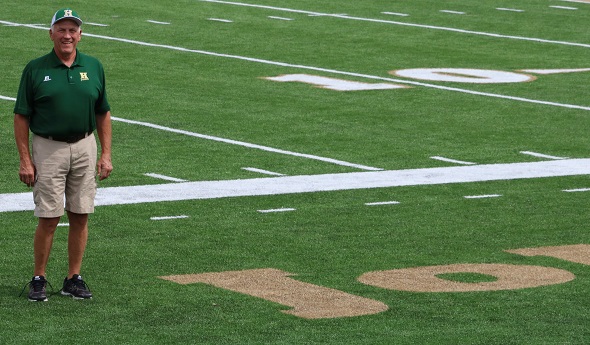
“Aaron showed it to me last week when they were putting it in,” John Dukes said, then joked, “I thought (the lettering) was going to be a little trademark sign (sized), and my goodness, it’s bigger than the numbers. It’s a little bit ostentatious for me, I think; wow, that’s quite a tribute. I’m very humbled by it and honored by it and very appreciative of what people have done to make this happen.”
A few days later, Dukes posed for a picture next to his name on the field and chatted with a reporter as they left the stadium.
Then, he turned a corner to the JV football office and kept walking.
Before he became a living legend, John Dukes was a football coach, and there’s a game coming up and his team to prepare.
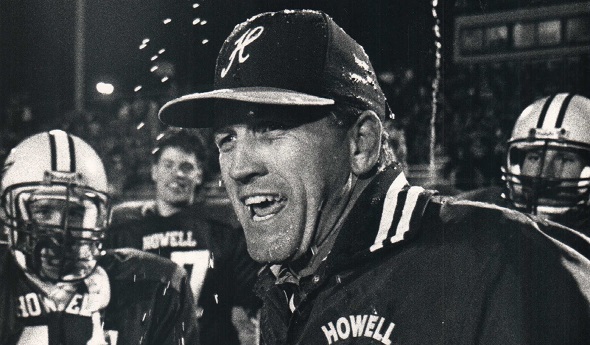
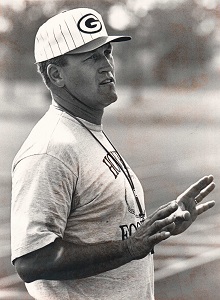
PHOTOS: (Top) Howell coach John Dukes celebrates his team’s 38-0 playoff victory over Wayne Memorial in 1992. (Middle) Dukes, during the 1991 season. (Below) Dukes stands next to the lettering that will be unveiled Thursday when the school’s field is named in his honor. (Photos taken or collected by Tim Robinson.)

2015 Week 6 Football Playoff Listing
September 29, 2015
By Geoff Kimmerly
Second Half editor
Here is a list of Michigan High School Athletic Association football playing schools, displaying their win-loss records and playoff averages through the fifth week of the season.
Schools on this list are in enrollment order for 11-player teams, with 8-player teams ordered by playoff average. An asterisk (*) beside a record indicates a team has eight or fewer games scheduled. A caret (^) beside a school’s name indicates a team is one win away from playoff qualification.
Those schools with 11-player teams with six or more wins playing nine-game schedules, or five or more wins playing eight games or fewer, will qualify for the MHSAA Football Playoffs beginning Oct. 30. Schools with 5-4, 4-3 or 4-4 records may qualify if the number of potential qualifiers by win total does not reach the 256 mark. Schools with six or more wins playing nine-game schedules or five or more wins playing eight games or fewer may be subtracted from the field based on playoff average if the number of potential qualifiers exceeds the 256 mark.
Once the 256 qualifying schools are determined, they will be divided by enrollment groups into eight equal divisions of 32 schools, and then drawn into regions of eight teams each and districts of four teams each. Those schools with 8-player teams will be ranked by playoff average at season’s end, and the top 16 programs will be drawn into regions of eight teams each for the playoff in that division, which also begins Oct. 30.
To review a list of all football playoff schools, individual school playoff point details and to report errors, visit the Football page of the MHSAA Website.
The announcement of the qualifiers and first-round pairings for both the 11 and 8-player playoffs will take place at 7 p.m. Oct. 25 on the Selection Sunday Show on FOX Sports Detroit. The playoff qualifiers and pairings will be posted to the MHSAA Website following the Selection Sunday Show.
11-Player Playoff Listing
1. Macomb Dakota, 2921, 4-1, 82.200
2. Grand Blanc, 2727, 4-1, 76.000
3. Clarkston, 2707, 3-2, 55.800
4. Utica Eisenhower, 2669, 3-2, 62.000
5. Sterling Heights Stevenson, 2634, 4-1, 72.600
6. Clinton Township Chippewa Valley, 2611, 4-1, 85.400
7. East Kentwood, 2581, 4-1, 78.800
8. Howell, 2567, 4-1, 74.200
9. Rockford, 2561, 3-2, 60.800
10. Detroit Cass Tech, 2285, 4-1, 76.000
11. Northville ^, 2281, 5-0, 89.600
12. Brighton ^, 2211, 5-0, 94.400
13. Troy Athens, 2153, 3-2, 55.400
14. Detroit Catholic Central, 2138, 4-1, 64.800
15. Utica Ford, 2080, 4-1, 82.400
16. Canton ^, 2076, 5-0, 91.200
17. Monroe, 2066, 3-2, 55.800
18. Lapeer ^, 2059, 5-0, 86.400
19. Plymouth, 2057, 4-1, 72.400
20. Ann Arbor Pioneer ^, 2025, 5-0, 92.800
21. Hartland, 2017, 3-2, 52.600
22. New Baltimore Anchor Bay, 1946, 3-2, 55.000
23. West Bloomfield ^, 1932, 5-0, 96.000
24. Saline ^, 1879, 5-0, 86.400
25. Livonia Stevenson ^, 1831, 5-0, 96.000
26. Warren Mott, 1810, 4-1, 80.600
27. Utica, 1788, 3-2, 59.000
28. Holt, 1788, 3-2, 55.400
29. Davison, 1765, 3-2, 53.600
30. Hudsonville, 1763, 4-1, 78.800
31. Belleville, 1735, 4-1, 72.200
32. Romeo ^, 1673, 5-0, 99.200
33. Grand Ledge ^, 1663, 5-0, 88.000
34. Grosse Pointe South, 1629, 3-2, 57.200
35. Livonia Churchill, 1620, 3-2, 49.400
36. Walled Lake Northern, 1611, 4-1, 76.000
37. Warren DeLaSalle, 1572, 4-1, 77.600
38. Sterling Heights, 1561, 4-1, 67.800
39. Detroit Martin Luther King ^, 1537, 5-0, 100.800
40. Flint Carman-Ainsworth, 1533, 3-2, 50.600
41. Warren Cousino, 1514, 3-2, 52.200
42. Waterford Kettering, 1512, 3-2, 54.200
43. Detroit U-D Jesuit, 1486, 4-1, 65.000
44. Traverse City Central ^, 1474, 5-0, 94.400
45. Walled Lake Western ^, 1462, 5-0, 99.200
46. Midland ^, 1419, 5-0, 88.000
47. Jenison, 1418, 3-2, 60.000
48. Portage Northern, 1375, 3-2, 53.800
49. Lincoln Park, 1363, 4-1, 72.800
50. Portage Central ^, 1351, 5-0, 94.400
51. Wyandotte Roosevelt, 1346, 4-1, 77.400
52. Battle Creek Lakeview, 1344, 3-2, 58.600
53. Detroit East English, 1338, 4-1, 69.600
54. Southfield-Lathrup, 1320, 3-2, 49.200
55. Grand Rapids Ottawa Hills, 1280, 3-2, 49.000
56. Southfield, 1269, 3-2, 62.000
57. North Farmington, 1267, 3-2, 53.400
58. Port Huron Northern, 1260, 3-2, 50.000
59. Midland Dow, 1256, 4-1, 67.600
60. Birmingham Groves ^, 1248, 5-0, 83.200
61. Berkley, 1248, 4-1, 62.800
62. Royal Oak, 1248, 3-2, 50.200
63. Jackson, 1244, 3-2, 50.600
64. Flushing, 1242, 3-2, 55.400
65. Muskegon Mona Shores ^, 1239, 5-0, 97.600
66. Muskegon Reeths-Puffer, 1222, 3-2, 48.800
67. Farmington Hills Harrison, 1218, 4-1, 75.800
68. Farmington, 1176, 3-2, 75.817
69. Lowell, 1168, 4-1, 82.400
70. Gibraltar Carlson, 1140, 3-2, 52.400
71. Grand Rapids Forest Hills Northern ^, 1124, 5-0, 92.800
72. Muskegon, 1113, 4-1, 82.200
73. Fenton, 1108, 4-1, 75.600
74. Byron Center, 1070, 4-1, 71.200
75. Holly, 1068, 3-2, 60.400
76. Redford Thurston, 1064, 3-2, 58.800
77. Mt. Pleasant, 1061, 3-2, 60.800
78. Ortonville-Brandon, 1060, 3-2, 53.600
79. Allen Park, 1058, 4-1, 74.200
80. St. Johns, 1053, 4-1, 80.600
81. Zeeland East, 1040, 3-2, 64.400
82. Mason, 1033, 3-2, 54.200
83. Orchard Lake St. Mary's *^, 1032, 4-1, 79.267
84. Hamtramck, 984, 3-2, 44.800
85. St. Joseph, 980, 4-1, 77.200
86. East Grand Rapids, 975, 4-1, 79.000
87. Petoskey, 970, 4-1, 64.600
88. DeWitt ^, 960, 5-0, 96.000
89. Romulus, 956, 4-1, 72.800
90. Trenton ^, 953, 5-0, 89.600
91. Linden, 947, 4-1, 77.600
92. Cedar Springs, 943, 3-2, 47.600
93. Gaylord, 940, 4-1, 63.600
94. Sturgis, 926, 4-1, 64.200
95. Riverview, 912, 3-2, 41.400
96. Grand Rapids Christian, 905, 3-2, 52.400
97. Parma Western, 876, 3-2, 47.800
98. Haslett, 875, 3-2, 57.000
99. Stevensville Lakeshore, 874, 3-2, 60.400
100. Fruitport, 865, 3-2, 44.200
101. Coldwater ^, 863, 5-0, 86.400
102. Marshall, 863, 4-1, 74.400
103. Vicksburg, 858, 3-2, 49.400
104. Edwardsburg ^, 851, 5-0, 80.000
105. Sault Ste. Marie, 850, 3-2, 61.600
106. Bay City John Glenn, 847, 3-2, 47.600
107. Chelsea ^, 845, 5-0, 81.600
108. Zeeland West ^, 840, 5-0, 84.800
109. Detroit Mumford, 837, 3-2, 53.800
110. Ada Forest Hills Eastern ^, 828, 5-0, 80.000
111. Milan, 820, 4-1, 67.800
112. Battle Creek Harper Creek, 816, 3-2, 47.200
113. Plainwell, 807, 3-2, 44.000
114. Bloomfield Hills Cranbrook Kingswood ^, 794, 5-0, 67.200
115. Marysville, 783, 3-2, 53.800
116. Holland Christian, 759, 3-2, 47.800
117. North Branch, 758, 3-2, 45.400
118. Goodrich, 754, 3-2, 50.600
119. Pontiac Notre Dame Prep, 728, 4-1, 71.000
120. Detroit Douglass, 718, 3-2, 43.800
121. Harper Woods Chandler Park Academy, 692, 3-2, 49.200
122. Detroit Country Day, 685, 4-1, 64.600
123. Comstock Park, 682, 4-1, 74.400
124. Detroit Cesar Chavez Academy, 681, 4-1, 47.200
125. St. Clair Shores South Lake ^, 668, 5-0, 88.000
126. Croswell-Lexington, 668, 4-1, 53.400
127. Hudsonville Unity Christian, 665, 3-2, 39.400
128. Grand Rapids Catholic Central, 658, 4-1, 77.400
129. Williamston, 657, 4-1, 67.800
130. Corunna, 656, 4-1, 62.800
131. Whitehall, 656, 3-2, 48.000
132. Paw Paw, 653, 3-2, 49.400
133. Alma, 642, 3-2, 47.600
134. Wyoming Kelloggsville, 640, 3-2, 39.600
135. Detroit Collegiate Prep ^, 632, 5-0, 78.400
136. Benton Harbor, 631, 3-2, 57.000
137. Lake Fenton, 625, 4-1, 60.000
138. Lake Odessa Lakewood ^, 624, 5-0, 68.800
139. Saginaw Swan Valley, 613, 3-2, 48.800
140. Dowagiac, 611, 3-2, 44.400
141. Flint Powers Catholic, 610, 3-2, 57.000
142. Big Rapids, 609, 4-1, 56.400
143. Richmond, 605, 4-1, 68.000
144. Wyoming Godwin Heights, 602, 3-2, 36.200
145. Remus Chippewa Hills, 600, 4-1, 59.600
146. River Rouge ^, 593, 5-0, 81.600
147. Clawson, 592, 4-1, 53.000
148. Dearborn Heights Robichaud, 573, 4-1, 64.600
149. Gladwin, 571, 3-2, 42.400
150. Portland ^, 563, 5-0, 84.800
151. Freeland ^, 563, 5-0, 83.200
152. Essexville Garber, 557, 3-2, 47.600
153. Ann Arbor Gabriel Richard, 556, 4-1, 60.200
154. Ida ^, 548, 5-0, 81.600
155. Kingsford, 547, 3-2, 50.000
156. Marine City, 540, 3-2, 44.800
157. Muskegon Oakridge, 538, 4-1, 49.800
158. Algonac ^, 532, 5-0, 70.400
159. Frankenmuth ^, 529, 5-0, 72.000
160. Olivet, 524, 3-2, 41.000
161. Chesaning, 523, 3-2, 46.000
162. Detroit Henry Ford, 523, 3-2, 37.800
163. Lansing Catholic, 517, 4-1, 66.400
164. Almont ^, 513, 5-0, 70.400
165. Onsted, 509, 4-1, 48.800
166. Detroit Central Collegiate, 508, 3-2, 40.800
167. Berrien Springs ^, 495, 5-0, 71.200
168. Stockbridge, 493, 4-1, 61.600
169. Parchment, 493, 4-1, 48.000
170. Reed City ^, 491, 5-0, 61.600
171. Ovid-Elsie, 491, 3-2, 48.000
172. Grayling, 489, 4-1, 59.800
173. Standish-Sterling Central, 489, 3-2, 39.000
174. Dundee, 489, 3-2, 32.600
175. Clinton Township Clintondale, 486, 3-2, 50.600
176. Menominee ^, 480, 5-0, 82.133
177. Harper Woods, 476, 4-1, 47.000
178. Manistee ^, 469, 5-0, 66.000
179. Brooklyn Columbia Central, 463, 4-1, 60.000
180. Buchanan ^, 459, 5-0, 72.000
181. Grand Rapids West Catholic, 442, 3-2, 52.600
182. Kalkaska, 437, 3-2, 37.800
183. Harrison, 430, 4-1, 54.600
184. Hillsdale, 430, 3-2, 43.000
185. Jackson Lumen Christi, 426, 4-1, 67.800
186. Warren Michigan Collegiate, 421, 3-2, 47.800
187. Calumet, 419, 3-2, 44.267
188. Lakeview, 417, 3-2, 39.000
189. Sanford Meridian Early College ^, 408, 5-0, 67.200
190. Michigan Center, 406, 3-2, 34.200
191. Detroit Pershing, 405, 3-2, 37.600
192. Ithaca ^, 402, 5-0, 67.200
193. Byron, 399, 3-2, 39.800
194. Millington, 398, 4-1, 64.800
195. Delton Kellogg, 398, 4-1, 56.400
196. Montague ^, 396, 5-0, 68.800
197. Burton Bendle, 393, 4-1, 50.400
198. Oscoda, 391, 4-1, 40.200
199. Detroit Edison Public School Academy, 390, 3-2, 28.000
200. Monroe St. Mary Catholic Central ^, 389, 5-0, 84.800
201. Morley Stanwood, 386, 3-2, 42.600
202. Negaunee ^, 385, 5-0, 65.600
203. Constantine, 385, 3-2, 43.000
204. Maple City Glen Lake, 384, 4-1, 48.600
205. Boyne City, 383, 4-1, 52.000
206. Niles Brandywine, 380, 3-2, 37.800
207. Adrian Madison, 379, 3-2, 36.600
208. Vassar, 377, 4-1, 47.000
209. Mason County Central, 376, 3-2, 39.600
210. St. Louis, 374, 3-2, 37.800
211. Laingsburg, 373, 4-1, 45.400
212. Watervliet, 372, 4-1, 56.800
213. Madison Heights Madison, 367, 4-1, 68.000
214. Manchester, 365, 4-1, 45.600
215. Schoolcraft ^, 357, 5-0, 65.600
216. Charlevoix, 350, 3-2, 31.600
217. Leroy Pine River, 349, 3-2, 42.800
218. Quincy, 346, 3-2, 34.000
219. Grand Rapids NorthPointe Christian ^, 345, 5-0, 67.200
220. Lawton ^, 342, 5-0, 60.800
221. Vandercook Lake ^, 341, 5-0, 59.200
222. Clinton ^, 335, 5-0, 64.000
223. Traverse City St. Francis ^, 320, 5-0, 75.200
224. Hesperia ^, 310, 5-0, 62.400
225. Sandusky ^, 310, 5-0, 62.400
226. Iron Mountain, 309, 3-2, 36.800
227. McBain, 307, 4-1, 56.800
228. Cass City, 304, 4-1, 46.800
229. Bridgman, 303, 4-1, 52.000
230. Gobles, 301, 3-2, 41.000
231. Union City, 298, 3-2, 34.600
232. Marlette, 298, 3-2, 34.200
233. Elkton-Pigeon-Bay Port Laker, 296, 3-2, 39.400
234. Homer, 294, 4-1, 48.400
235. Pewamo-Westphalia ^, 292, 5-0, 60.800
236. Rochester Hills Lutheran Northwest, 292, 3-2, 36.000
237. Flint Hamady ^, 291, 5-0, 59.200
238. Dansville, 289, 4-1, 47.200
239. Springport, 287, 3-2, 33.200
240. Saginaw Nouvel, 285, 4-1, 58.000
241. Riverview Gabriel Richard ^, 284, 5-0, 64.000
242. Grosse Pointe Woods University Liggett, 282, 3-2, 42.200
243. Harbor Springs, 281, 3-2, 24.800
244. Ishpeming *, 278, 5-0, 64.000
245. Flint Beecher, 278, 4-1, 59.800
246. New Lothrop ^, 276, 5-0, 72.000
247. Detroit Loyola, 276, 4-1, 71.000
248. Saugatuck ^, 271, 5-0, 62.400
249. Ubly, 271, 3-2, 39.800
250. Cassopolis, 270, 3-2, 38.400
251. Concord, 267, 4-1, 51.800
252. Decatur, 266, 3-2, 36.400
253. Lincoln Alcona, 265, 4-1, 33.800
254. Unionville-Sebewaing, 262, 4-1, 48.800
255. Ottawa Lake Whiteford, 255, 4-1, 40.600
256. Indian River Inland Lakes, 251, 4-1, 42.400
257. Onekama, 250, 4-1, 40.600
258. Petersburg-Summerfield, 240, 4-1, 47.000
259. Beal City, 228, 4-1, 53.000
260. Johannesburg-Lewiston, 226, 4-1, 44.000
261. St. Ignace ^, 225, 5-0, 59.200
262. Saginaw Michigan Lutheran Seminary ^, 223, 5-0, 65.600
263. Mayville, 217, 4-1, 40.800
264. L'Anse, 215, 3-2, 42.600
265. Pittsford, 211, 4-1, 40.600
266. Newberry, 211, 3-2, 36.400
267. Marcellus, 209, 3-2, 29.800
268. Vestaburg, 205, 4-1, 39.000
269. Bark River-Harris ^, 194, 5-0, 52.800
270. Morenci, 191, 4-1, 55.200
271. Munising, 191, 4-1, 44.667
272. Central Lake, 189, 3-2, 25.400
273. Fowler, 183, 4-1, 43.800
274. Sterling Heights Parkway Christian, 178, 3-2, 38.200
275. Muskegon Catholic Central *, 177, 3-1, 55.000
276. Adrian Lenawee Christian, 170, 4-1, 34.800
277. Climax-Scotts ^, 163, 5-0, 46.400
278. Crystal Falls Forest Park *, 163, 3-2, 33.467
279. Frankfort, 160, 4-1, 53.400
280. Waterford Our Lady ^, 157, 5-0, 67.200
281. Lake Linden-Hubbell ^, 155, 5-0, 56.800
282. Colon, 153, 3-2, 33.800
283. Hillman, 146, 4-1, 35.400
284. Bay City All Saints, 118, 3-2, 28.200
8-Player Playoff Listing
1. Owendale-Gagetown, 49, 5-0, 50.400
2. Powers North Central, 198, 5-0, 49.600
3. Posen, 84, 5-0, 48.000
4. Waldron, 88, 5-0, 46.400
5. Deckerville, 178, 5-0, 44.800
6. Battle Creek St. Philip, 144, 5-0, 43.200
7. Rapid River, 111, 4-1, 40.400
8. Cedarville, 144, 4-1, 37.400
9. Lawrence, 189, 5-0, 36.800
10. Morrice, 169, 4-1, 36.000
11. New Haven Merritt Academy, 148, 4-1, 33.600
12. Peck, 152, 4-1, 32.600
13. Portland St. Patrick, 87, 4-1, 31.200
14. Webberville, 184, 4-1, 29.600
15. Stephenson, 186, 3-2, 28.400
16. Engadine, 85, 3-2, 28.400
17. Pickford, 164, 3-2, 27.000
18. Onaway, 196, 3-2, 26.800
19. Akron-Fairgrove, 99, 3-2, 25.050
20. Bellaire, 134, 3-2, 24.000
21. Baraga, 164, 3-2, 23.600
22. Marion, 145, 2-3, 20.600
23. Kingston, 187, 2-3, 18.200
24. Kinde-North Huron, 147, 2-3, 17.600
25. Tekonsha, 148, 2-3, 16.400
26. Caseville, 91, 2-3, 15.800
27. Big Rapids Crossroads Academy, 190, 1-4, 12.250
28. Ewen-Trout Creek, 126, 1-4, 10.400
29. Burr Oak, 75, 1-4, 8.800
30. St. Helen Charlton Heston Academy, 108, 1-4, 8.400
31. Eben Junction Superior Central, 123, 1-4, 8.200
32. Ontonagon, 129, 1-4, 8.000
33. Hale, 132, 1-4, 7.850
34. St Joseph Michigan Lutheran, 103, 0-5, 3.600
35. Carsonville-Port Sanilac, 120, 0-5, 2.400
36. Litchfield, 92, 0-5, 2.400
37. Pellston, 170, 0-5, 1.800
38. Flint Michigan School For The Deaf, 47, 0-4, 1.800
39. Covert, 91, 0-3, 1.650
40. Brimley, 142, 0-5, 1.600