

Inside Selection Sunday: Mapnalysis '14
October 26, 2014
By Geoff Kimmerly
Second Half editor
The pictures we drew Sunday morning at the MHSAA office won’t be found hanging on anyone’s walls.
But we worked toward something suitable for framing, designing this season’s football playoff brackets while considering the months and years of work put in by our schools and their teams, parents and fans to earn an opportunity to continue their seasons this weekend.
The work completed today to draw up the 2014 MHSAA Football Playoffs began long before opening night in August. Our football tournament is like none other sponsored by the MHSAA – it’s the only team tournament in which every team doesn’t qualify – and we began talking about this tournament not long after last season’s champions were decided.
Then came April and May and tracking down schedules for 613 MHSAA varsity football teams, plus 45 out-of-state opponents our Michigan schools were set to play including 14 from Ontario and one from Minnesota.
The fun part was monitoring the scores and standings for all of these teams over the nine weeks of the regular season, each Friday night a stream of chatter from kickoff into our weekly highlights show on Fox Sports Detroit.
And then came Sunday – and navigating the most difficult maps to draw in my four seasons assisting in the process.
We often have versions “a” and “b” and on occasion “c” when considering which best accomplishes our goal – to create the correct geographical picture for each of eight 11-player divisions and our 8-player bracket.
Sunday morning, we saw a version “e” for the first time I can remember and some shapes that didn’t make much sense without explanation.
Some of those explanations are below – the stories behind how we made some of the toughest decisions. I start with a quick history lesson you can skip if you’re familiar with this annual report or our playoff selection process in general, then move into some of the specifics many will be discussing this week as they begin focusing on their Pre-District opponents. (Click for the full schedule.)
The process
Our past: The MHSAA playoff structure – with 256 teams in eight divisions, and six wins equaling an automatic berth (or five wins for teams playing eight or fewer games) – debuted in 1999. An 8-player tournament was added in 2011, resulting in nine champions total each season.
The first playoffs were conducted in 1975 with four champions. Four more football classes were added in 1990 for a total of eight champions each fall. Through 1998, only 128 teams made the postseason, based on their playoff point averages within regions (four for each class) that were drawn before the beginning of the season. The drawing of Districts and Regions after the end of the regular season did not begin until the most recent playoff expansion.
In early years of the current process, lines were drawn by hand. Dots representing qualifying schools were pasted on maps, one map for each division, and those maps were then covered by plastic sheets. Districts and Regionals literally were drawn with dry-erase markers.
Our present: After a late Saturday night tracking scores, we file in as the sun rises Sunday morning for a final round of gathering results we may still need (which can include making a few early a.m. calls to athletic directors). Re-checking and triple-checking of enrollments, what schools played in co-ops and opted to play as a higher class start a week in advance, and more numbers are crunched Sunday morning as the fields are set.
This season, there were 229 automatic qualifiers by win total – with the final 27 at-large then selected, by playoff-point average, one from each class in order (A, B, C, D) until the field is filled.
Those 256 11-player teams are then split into eight equal divisions based on enrollment, and their locations are marked on digital maps that are projected on wall-size screens and then discussed by nearly half of the MHSAA staff plus a representative from the Michigan High School Football Coaches Association. Only the locations themselves are marked (by yellow dots) – not records, playoff point averages or names of the schools or towns. In fact, mentions of those are strictly prohibited. Records and playoff points are not part of the criteria. Matchups, rivalries, previous playoff pairings, etc. also DO NOT come into play.
The same process is followed for organizing the 8-player bracket, with the difference that the 16 teams are selected purely on playoff-point average.
Geography rules: This long has been rule number one for drawing MHSAA brackets in any sport, and is a repeat as well for those who have read this report the last three Octobers. Travel distance and ease DO come into play. Jumping on a major highway clearly is easier than driving across county-wide back roads, and that’s taken into consideration. Also, remember there’s only one Mackinac Bridge and hence only one way to cross between peninsulas – and boats are not considered a possible form of transportation. When opponents from both peninsulas will be in the same District, distance to the bridge is far more important than as the bird flies.
Tradition doesn’t reign: Every group of 32 dots is a new group – these 32 teams have not been placed in a bracket together before. That said, how maps have been drawn in the past isn’t considered – it’s hard to say a division has been drawn in a certain way traditionally when this set of 32 teams is making up a division for the first time.
Observations and answers: 2014
Class A ripple: A total of 80 Class A teams qualified for the playoffs in 2013 after three seasons of 79 each. But 89 Class A teams are part of the 2014 field, and that increase in turn shifted a number of smaller schools into different divisions – including some annual favorites. Muskegon, Division 2 runner-up the last two seasons, is in Division 3. Marine City, last season’s Division 4 champion, will play in Division 5. Five-time Division 5 champ Jackson Lumen Christi moved into Division 6, where it could be the toughest obstacle as Ithaca attempts to win that division for the fifth straight season.
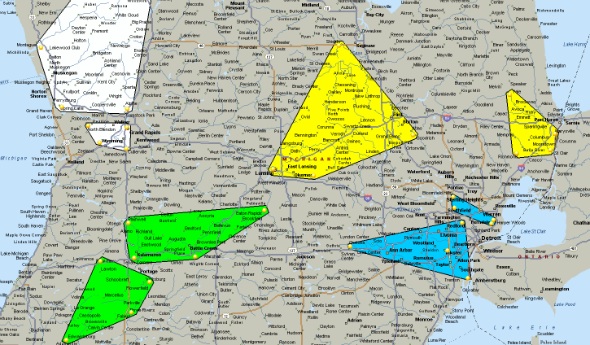
Stranger on paper: Yes, Division 1’s District 2 stretches from Grandville to Hartland. This isn’t a desirable outcome, but was necessary with this field. Six districts are filled with teams all east of U.S. 23, and a seventh is completely north and west of Grand Rapids. That left the four teams in the middle – Grandville, East Kentwood, Grand Ledge and Hartland.
Something similar came down in the 8-player bracket – why would we break up four teams in the Thumb to include three with Big Rapids Crossroads Academy all the way west of U.S. 127? It had to do with creating the appropriate semifinal matchup for whichever team emerges from the Rapid River/Cedarville/Engadine/Bellaire regional; keeping the Thumb teams together might’ve meant Lawrence or Waldron from near the Indiana border going all the way to Rapid River instead of Thumb teams that are still far away but closer to the convenient highways.
Line falls through Warren: Division 2 presented a few challenges. There are five districts made up of schools predominantly in the Greater Detroit and Port Huron areas, so one was going to end up potentially matching up farther from home. At first we drew a region across the bottom of the Lower Peninsula that connected teams from the Kalamazoo/Battle Creek area with a district from Ypsilanti and south of Detroit. But rearranging districts to draw a line between Warren DeLaSalle and Warren Counsino, although they’re nearly neighbors, helped make the rest of the map much cleaner – and eliminated that I-94 Regional we didn’t prefer.
Deconstructing D3: This was another toughie given the locations of teams involved. Three districts are all east of U.S. 23 and south of Pontiac, and four more are all west and/or north of Greater Lansing. Usually the Lansing area has a large share of Division 3 qualifiers – but not this season. So that left five schools somewhat without a sure home – St. Johns, DeWitt, Mason, Tecumseh and Linden. DeWitt is much closer to Mason and even Tecumseh, with the differences between St. Johns and DeWitt to Linden and St. Johns and DeWitt to Grand Rapids small enough to cancel out in the big picture.
Stretching Division 6: In the end, this map looks good – but there was a lot of conversation. The tough part was finding the fairest possible situation for whichever district champ might end up playing Negaunee – Bad Axe in the Thumb, Madison Heights Madison or Warren Michigan Collegiate as possibilities coming out of northern Detroit, or even Fennville near Lake Michigan south of Holland. Proximity to I-75 helped make this decision.
Crisscrossing Division 8: Figuring out this bracket started out easy enough with eight teams in the Upper Peninsula or just south of Mackinac Bridge and with the southwest and southeast Lower Peninsula set. But a group of 10 across the top of the Lower Peninsula – including neighbors Mount Pleasant Sacred Heart, Beal City and Coleman – made this interesting. A rule of thumb is we don’t want a team passing through a different district or regional to reach its opponent – and with three teams so closely bunched, that was a challenge in drawing this one out.
At the end of the day ...
What you see is what our committee decided upon after multiple discussions among multiple groups that broke down every sensible possibility we could muster. There are certainly points open to argument – and we likely made those arguments as well.
In the end, we present a group of dots on a map – as stated above, we don’t identify the schools until after the groupings are drawn. Part of the fun is then finding out what first-round matchups we’ve created: Muskegon Mona Shores vs. Caledonia and Detroit Martin Luther King vs. Southfield should be incredible, as well as the Ishpeming/Westwood and Iron Mountain/West Iron County rivalry games in the Upper Peninsula.
And no doubt, those who play for and support Burton Atherton, Ypsilanti Community, first-year Lapeer High School, Big Rapids Crossroads and New Haven Merritt Academy are ready to enjoy the playoff ride for the first time.
We’re excited to watch them all – and see which end up in Detroit with us to finish the fall over Thanksgiving weekend. We hope to see you there as well.
PHOTO: The Division 4 map for 11-player football has each region shaded; champion of the white plays green in a semifinal with yellow facing blue in the other.
Drive for Detroit: Week 4 Preview
September 13, 2018
By Geoff Kimmerly
Second Half editor
There are some magnificent comeback seasons unfolding across Michigan this football season.
 Holton is 3-0 for the first time since 1999. Leroy Pine River won one game a year ago and is 3-0 for the first time since 2004. We highlight two more 3-0 teams below in Battle Creek Central and Kingsley with similar stories to celebrate – and also big tests this week as we edge closer to the midpoint of the regular season.
Games below are tonight unless noted. Check out the MHSAA Score Center for the full schedule and results as games are completed. MHSAA.tv will broadcast 14 games tonight, including four noted below. Our “Drive for Detroit” previews are powered by MI Student Aid.
Bay & Thumb
Elkton-Pigeon-Bay Port Laker (3-0) at Cass City (2-1)
Laker’s only single-digit regular-season win in 2017 came against Cass City, a 20-14 victory in Week 5 that eventually earned the Lakers the Greater Thumb Conference West championship. They went on to also defeat Cass City 18-14 in a Division 7 District Final – so the Red Hawks no doubt will be amped even more, if possible, as they look to break a nine-game losing streak against their neighbor from the north.
Others that caught my eye: FRIDAY Flint Powers Catholic (2-1) at Davison (3-0), Grand Blanc (3-0) at Flint Carman-Ainsworth (2-1), Croswell-Lexington (3-0) at Richmond (2-1), Carson City-Crystal (3-0) at Merrill (2-1).
Greater Detroit
Marine City (3-0) at Madison Heights Madison (3-0)
Paced by standout quarterback Austin Brown, Madison has outscored its first three opponents by a combined 116-27 in adding to a 15-game regular-season winning streak. The Eagles edged Marine City 28-24 a year ago on the way to winning the Macomb Area Conference Silver title, but the Mariners have been similarly dominant this fall outscoring opponents by a combined 122-37 – including 34-20 over an improved St. Clair Shores South Lake.
Others that caught my eye: FRIDAY Eastpointe (2-1) at Warren Woods-Tower (3-0), Walled Lake Western (2-1) at Waterford Mott (3-0), Dearborn Fordson (3-0) at Livonia Churchill (2-1), Birmingham Brother Rice (3-0) at Warren DeLaSalle (2-1).
Mid-Michigan
Lake Odessa Lakewood (2-1) at Perry (2-1)
The Perry playoff watch has been on again the last few seasons as the Ramblers have finished 5-4 in 2016 and 4-5 last fall while in pursuit of their first postseason berth. Both Perry wins this season came against programs that had winning records a year ago – but the Ramblers are 0-4 against Lakewood since the formation of the Greater Lansing Activities Conference in 2014. The Vikings have never finished lower than second in the league and won it twice.
Others that caught my eye: FRIDAY Holt (1-2) at DeWitt (2-1), Fowlerville (2-1) at Haslett (3-0), Reed City (3-0) at Howard City Tri-County (2-1), Hemlock (2-1) at St. Louis (3-0).
Northern Lower Peninsula
Kingsley (3-0) at Traverse City St. Francis (3-0), Saturday
Kingsley has rebounded from 1-8 by beating two 2017 playoff teams in three games under former-now-new coach Tim Wooer, who returned this fall after a decade at Traverse City West. But this weekend will provide a different level of barometer for the Stags’ rejuvenation. St. Francis has yet to be tested, winning its three games by an average of 38 points per.
Others that caught my eye: FRIDAY Benzie Central (2-1) at Elk Rapids (3-0), Manton (3-0) at Lake City (3-0), Clare (3-0) at Roscommon (2-1), Traverse City West (1-2) vs. Traverse City Central (3-0) at Thirlby Field.
Southeast & Border
Riverview (2-1) at Milan (3-0)
Milan’s work over the last six seasons and beginning of this one is impressive: a 50-17 record with five playoff berths and three Huron League championships. But Riverview took the spotlight last season with the Huron title, 11 wins and a trip to the Division 3 Semifinals. Will Milan take it back this weekend? Senior running back Hunter Aeschbacker ran for 197 yards in a 26-21 Week 2 victory over Monroe St. Mary Catholic Central and has 342 rushing yards total to go with more than 1,200 a year ago. Riverview was tripped up last week by the Falcons, 20-6.
Others that caught my eye: FRIDAY Brooklyn Columbia Central (3-0) at Blissfield (2-1), Dundee (3-0) at Ida (2-1), Whitmore Lake (2-1) at Ottawa Lake Whiteford (3-0), Chelsea (3-0) at Ypsilanti Lincoln (2-1).
Southwest Corridor
Portage Central (2-1) at Battle Creek Central (3-0)
Battle Creek Central’s best start since 2003 has drawn statewide attention, but Portage Central might be the biggest test yet. The Mustangs are coming off a one-point win on the road over rival Portage Northern and own a sizable victory over Richland Gull Lake, which the Bearcats beat by just a point. Regardless of what happens tonight, both teams could end up as league champions in the Southwestern Michigan Athletic Conference – Battle Creek Central plays in the East and Portage Central in the West.
Others that caught my eye: FRIDAY Edwardsburg (3-0) at Dowagiac (2-1), East Lansing (3-0) at Portage Northern (2-1), Saugatuck (3-0) at Schoolcraft (2-1), St. Joseph (2-1) at Stevensville Lakeshore (1-2).
Upper Peninsula
Calumet (3-0) at Iron River West Iron County (3-0)
Calumet earned some valuable close-game experience with last week’s 14-12 win over Ishpeming Westwood, and now will get a look at the Wykons – who just missed making the Division 8 championship game a year ago. Having opened against three opponents with a combined 1-8 record, West Iron will be facing its toughest challenge since that three-point Semifinal loss to Saginaw Nouvel last fall – but did down Calumet 53-20 a year ago.
Others that caught my eye: FRIDAY Gwinn (3-0) at Hancock (2-1), Ishpeming (3-0) at Ishpeming Westwood (2-1), Johannesburg-Lewiston (2-1) at St. Ignace (2-1), Iron Mountain (2-1) at Norway (2-1).
West Michigan
Whitehall (3-0) at Muskegon Oakridge (3-0)
Whitehall’s 28-14 win over Oakridge a year ago was a headline grabber – the Vikings hadn’t come out on top in this matchup since 1999. They fell short in their West Michigan Conference title pursuit thanks to a two-point loss to Montague the next week – but this is lining up as a similar opportunity except this time Whitehall is undefeated heading in. After scoring 50 or more points three times last season, Oakridge has done so in every game so far – but numbers are relative as tonight’s game will be the toughest challenge for both teams to date.
Others that caught my eye: FRIDAY Grand Rapids Forest Hills Northern (2-1) at Grand Rapids Forest Hills Central (1-2), Grand Rapids Christian (2-1) at Grand Rapids West Catholic (1-2), East Kentwood (2-1) at Holland West Ottawa (3-0), Muskegon Mona Shores (3-0) at Rockford (1-2).
8-Player
AuGres-Sims (3-0) at Hillman (3-0)
The longtime North Star League foes made the jump together this fall into 8-player football. So far, so good – but Hillman surely hopes the move also includes the end of a two-game losing skid against the Wolverines, who are carrying an 11-game regular-season winning streak. They also haven’t given up a point since opening night – or faced an opponent with a win this season. Hillman’s early competition has been stronger, and things will get tougher after this for both as Onaway (2-1) and Posen (3-0) are among opponents left on both teams’ league schedules.
Others that caught my eye: FRIDAY Bellevue (2-1) at Camden-Frontier (3-0), Onekama (3-0) at Fife Lake Forest Area (2-1), Suttons Bay (3-0) at Wyoming Tri-unity Christian (3-0), Rapid River (2-1) at Pickford (3-0).
Second Half’s weekly “Drive for Detroit” previews and reviews are powered by MI Student Aid, a part of the Student Financial Services Bureau located within the Michigan Department of Treasury. MI Student Aid encourages students to pursue postsecondary education by providing access to student financial resources and information, including various student financial assistance programs to help make college more affordable for Michigan students. MI Student Aid administers the state’s 529 savings programs (MET/MESP) and eight additional aid programs within its Student Scholarships and Grants division. Click for more information and connect with MI Student Aid on Facebook and Twitter @mistudentaid.
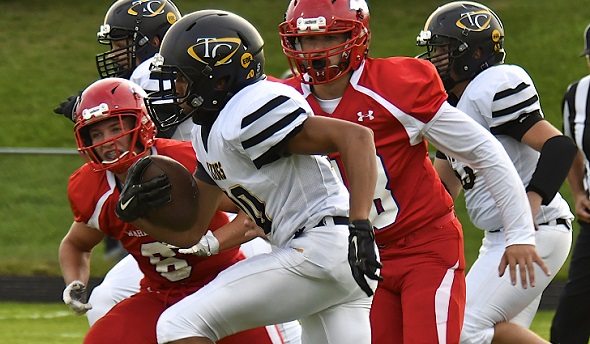
PHOTO: Howard City Tri-County picks up yardage during last week’s win against Remus Chippewa Hills; Tri-County has a key matchup this week with Reed City. (Click to see more from HighSchoolSportsScene.com.)