

Inside Selection Sunday: Mapping the Football Playoffs
October 24, 2011
Sitting on the other side of this process for a number of years, I can admit to occasionally scratching my cynical head over some of the matchups that have come out of Selection Sunday.
How could teams so far from each other play in the same district? Why would two schools in the same town play in different regionals? Are they picking out of a hat at 1661 Ramblewood Drive?
Now, I have answers.
Sunday morning, we filed into headquarters for what might be the most important non-game day on the MHSAA calendar. “We” were made up of half of the MHSAA staff, plus a representative from the Michigan High School Football Coaches Association.
Here’s some of what I learned from being a part of the process:
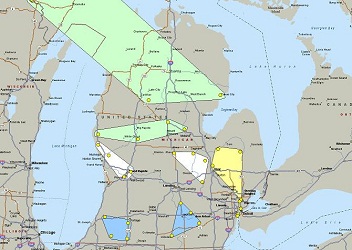
? First, a brief history lesson. In early years (or until the middle of the last decade), lines were drawn by hand. Dots representing qualifying schools were pasted on maps, one map for each division, and those maps were then covered by plastic sheets. Districts and regionals literally were drawn with dry-erase markers. No longer. Using a variety of spreadsheets and mapping software, we’ve gone digital. Staff is split into two teams, each considering four divisions (and the 8-player map) before we reconvene and look at all nine divisions together.
? We are presented digital maps of the state covered in dots. That’s about it. The rule of the day, simply, is “geography rules.” Which teams are represented by the dots is not considered, much less discussed, until lines are drawn. While considering my group’s first map, I began to bring up teams – and immediately was shot down (with good reason). Teams, matchups, rivalries, previous playoff pairings, etc. DO NOT come into play. We draw boxes in what we figure are the most logical ways of making districts and regions work.
? Travel distance and ease DO come into play. This especially is true when considering which districts will include teams from the Upper Peninsula. An example: Marquette is closer to the schools we placed in its district – Fenton, Bay City Western and Okemos – than some other options because those schools are closer to I-75. Schools further north on the map but farther from a main highway would’ve created longer trips.
? Sometimes, maps get ugly. And sometimes, it was a matter of choosing the least ugly situation. Of course, a D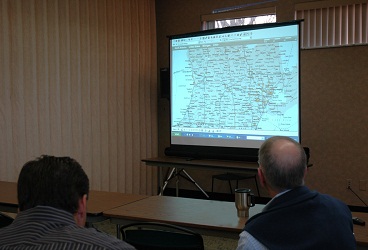 ivision 4 District of Lansing Sexton, Dearborn Heights Robichaud, Battle Creek Pennfield and Vicksburg isn’t ideal. But with no other Division 4 schools within 35 miles of Lansing, we were put in a tough spot. Add in that there were 13 teams in the Detroit area, leaving one as the odd team out of three districts based there. Something had to give, and drawing things up as we did caused the fewest messes.
? Considering how to set up the entire state is different than figuring out what teams make the most sense for just one school or area. And shifting just one dot on a map can change things for all 32.
? Back to “geography rules.” The Division 8 district including Saugatuck, Muskegon Catholic, Mendon and St. Joseph Lake Michigan Catholic might be the most competitive, on paper, in the state. Saugatuck is the reigning MHSAA runner-up in the division, and Muskegon Catholic and Mendon were ranked Nos. 1 and 2, respectively, in the most recent Association Press poll. Seeing that after we’d drawn the line caused a collective “ouch.” But again, the line was drawn based on dots on a map.
I thought back on some of the matchups I’d questioned in the past, and came back to what I’d ask people now: How would you do things differently?
I imagine there would be some creative answers, but I also would guess we considered those scenarios too.
And remember, determining the playoff schedule is just one step in many. Eight state champions must survive it, regardless of which opponents they face along the way.
Drive for Detroit: Week 9 in Review
October 27, 2014
By Geoff Kimmerly
Second Half editor
The biggest news of this weekend undoubtedly came Sunday night, when the field for this season’s MHSAA Football Playoffs was announced.
But before we move on, let’s pay a final homage to another regular season – and some memorable highlights that made their way in before Week 9 came to a close Saturday night.
Consider these appetizers:
- Hanover-Horton defeated Quincy 50-48 in six overtimes Thursday; it was the sixth game in MHSAA history to go at least six overtimes, with the record nine and six tied for second-longest.
- Crystal Falls Forest Park beat rival Lake Linden-Hubbell 36-22 to finish second in the Great Western Conference but remain undefeated in Michigan this fall – the Trojans' lone loss was to league champion Hurley, from Wisconsin.
- Saginaw Arthur Hill beat rival Saginaw High 28-0. Neither of these teams will move on – this was the only win this fall between the two – but this ended a rivalry that began in 1894, as the schools will combine beginning next summer.
Read on for the main course, including some of the details behind the final league championships decided this fall.
West Michigan
Muskegon Mona Shores 48, Muskegon 27
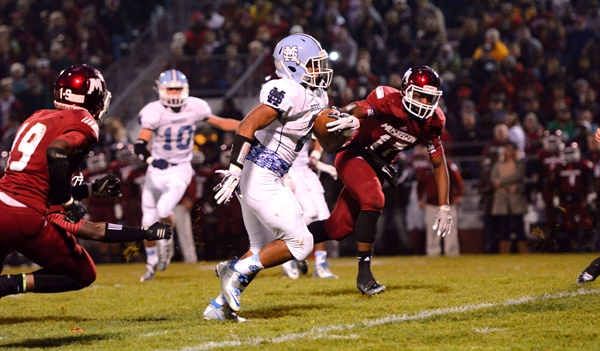
Muskegon has been able to make the argument the last two seasons for being the best of the always-strong west Michigan football scene – the Big Reds (8-1) were a combined 24-4 in 2012 and 2013, finishing Division 2 runner-up both seasons. That’s part of why Mona Shores’ win Friday sent statewide shockwaves. Although the Sailors (8-1) played Muskegon to within six points last season and later earned their first playoff berth ever, and have risen this fall to the cusp of elite as well, defeating the Big Reds gave Mona Shores its first league title since 1968 and a school record for victories with arguably its best win in program history. It also was Mona Shores’ first over Muskegon since 1982 Click for more from the Muskegon Chronicle.
Also noted:
Grand Rapids Catholic Central 26, Middleville Thornapple Kellogg 13 – The Cougars (6-3) added to a now seven-season playoff streak despite opening 2-3.
Caledonia 38, Grand Rapids Christian 14 – Despite its impressive run over the last five weeks, Caledonia (7-2) still could’ve lost its share of the O-K White title against the dangerous Eagles (5-4) – who did make the playoffs with an at-large bid.
Grandville 22, Hudsonville 7 – Five of six O-K Red teams finished with overall winning records this fall, which makes a good case why both of these earned at-large playoff bids with matching 5-4 records.
Muskegon Catholic Central 45, Ravenna 0 – The Crusaders (9-0) have won 21 straight and are the likely Division 8 favorite again with four shutouts including this latest of solid Ravenna (7-2).
Bay and Thumb
Midland Dow 35, Midland 17
There’s joy on one side of this Midland rivalry, but both schools should share a sense of pride. Dow has been solid over the years, but had fallen to its neighbor 11 times in their past 12 games – so beating the Chemics was probably the best possible scenario for Dow as it finished its first perfect regular season since its MHSAA championship year of 1976. The Chargers also helped put to an end one of the most incredible runs in MHSAA regular-season history; Midland finished 4-5 and sub-.500 for the first time since 1976. Click for more from the Midland Daily News.
Also noted:
Fenton 35, Linden 29 – The Tigers (9-0) edged another playoff team in Linden (6-3) to finish perfect for the regular season for the first time since 1985.
Saginaw Michigan Lutheran Seminary 27, Birch Run 20 – The Cardinals (8-1) beat another playoff team in the Panthers (7-2) to guarantee their best finish since 1994.
New Lothrop 35, Montrose 21 – The Hornets (9-0) finished their fifth straight perfect regular season with one of the most impressive wins of the run, over arguably one of the best six-win teams in the state in Montrose (6-3).
Elkton-Pigeon-Bay Port Laker 14, Beal City 13 – The Lakers finished their first 9-0 regular season since 2002 against the two-time reigning Division 8 runner-up Aggies (7-2) after both decided to play instead of claiming forfeit wins from their original Week 9 opponents.
Greater Detroit
Birmingham Brother Rice 35, Orchard Lake St. Mary’s 28
What a way to finish the regular season – the final 11-player game before the start of the 2014 playoffs was even better than billed, considering the Warriors had defeated the Eaglets 28-20 only three weeks ago. Brother Rice (9-0) pulled within 28-27 on Grant Perry’s fourth touchdown catch and with only 24 seconds left in the Detroit Catholic League Prep Bowl at Ford Field, then decided to go for two points and the win. Perry caught the conversion pass from quarterback Alex Malzone to take the lead, and the Warriors added their final points off a turnover on the final play of the game. St. Mary’s only losses in going 7-2 are to Brother Rice. Click for more from the Detroit News.
Also noted:
Detroit Cass Tech 39, Detroit Martin Luther King 7 – The Detroit Public School League championship game matched undefeated teams and proved again the strength of Division 1 contender Cass Tech (9-0), with Martin Luther King (8-1) still expected to contend in Division 2 as well.
Clarkston 31, Farmington Hills Harrison 24 – The Wolves (9-0) have won 22 straight with this against Harrison (7-2) only the third game of that streak decided by seven points or fewer.
Dearborn Fordson 17, Monroe 6 – The Tractors (9-0) held strong again against one of their toughest opponents so far, Monroe (6-3), to finish undefeated for the third regular season over the last seven.
Hudson 34, Hillsdale 14 – The Lenawee County Athletic Association title came down to the final week, and this time Hudson (8-1) clinched it outright after sharing last season with both Hillsdale (7-2) and Ida.
Upper Peninsula
Menominee 48, Marquette 28
Menominee (9-0) is Great Northern Upper Peninsula Conference champion for the second straight season, although not without facing one of its toughest challenges in some time. Second-place Marquette (7-2) gave the Maroons arguably their best regular-season game since a 14-13 loss to Kingsford in 2012 and scored the most points given up by the Maroons in the regular season since 2011. Menominee’s offense keeps churning, averaging 48 points per game with its 48 against Marquette the most the Redmen had given up since 2009. Click for more from the Marquette Mining Journal.
Also noted:
Negaunee 27, Ishpeming Westwood 9 – The Miners (5-4) kept their three-year playoff string going, but needed this win over Westwood (6-3) to take full advantage of the Patriots’ best regular-season finish since 2011.
Bark River-Harris 8, Iron River West Iron County 6 – The Broncos (7-2) added another highlight to their best season since 2009 by handing West Iron (8-1) its first regular-season loss since Week 7 in 2012.
Bessemer 51, Ironwood 6 – The Miners (Bessemer’s nickname as part of its football co-op, Gogebic) won their sixth game to advance to the playoffs for the third straight season.
Iron Mountain 21, Norway 20 – The Mountaineers (6-3) are back in the playoffs after a one-year miss, but needed to edge a Norway (4-5) team that was playing for an at-large bid but still finished with its best record since 2010.
Lower Up North
Cadillac 15, Traverse City Central 14
This is the way a league title should be decided – one-point game between first and second-place teams on the final night of the regular season. Never mind that Cadillac had already earned a share of the Big North Conference title and that Central ended up tied for second with Petoskey; Cadillac’s go-ahead score with 4.6 seconds to play makes this one of the most exciting finishes in Michigan so far this season. The score came after Central had forced Cadillac into a turnover on downs at the Trojans’ 4-yard line a minute and a half prior. A Central win would've made them co-champions. Click for more from the Cadillac News.
Also noted:
Boyne City 55, Grayling 36 – The Ramblers (9-0) celebrated not only their first perfect regular season since 2001, but also the end of a five-game losing streak to the Vikings (4-5).
Johannesburg-Lewiston 42, Indian River Inland Lakes 6 – The South-winning Cardinals (8-1) can call themselves second-best in the Ski Valley Conference overall, having fallen to North champ St. Ignace in Week 5 before beating North runner-up Inland Lakes (7-2) impressively.
Onekama 40, Frankfort 22 – The Portagers (6-3) are headed to the playoffs for the first time since 2007 with also their first winning record since that season; Frankfort (5-3) had previously qualified.
Traverse City West 35, Walled Lake Northern 14 – The Titans earned enough playoff points downing Northern (4-5) to earn an at-large postseason bid and extend its streak to three seasons despite opening this fall 1-3.
Southwest and Border
Gobles 51, Saugatuck 49
This Southwestern Athletic Conference North finale had all kinds of implications. While Fennville cruised into a share of the league title with a 42-0 win over Bloomingdale (after beating Gobles 22-12 in Week 8 and despite losing the Saugatuck the week before that), a Saugatuck win in this one would have changed things substantially by giving the Indians (5-4) both a share of the league title and a playoff berth. Instead, Gobles (7-2) shared the championship with Fennville, and those two will continue into the postseason while Saugatuck will not despite notching an eighth-straight winning season. Click for more from the Kalamazoo Gazette.
Also noted:
Mendon 28, Mount Pleasant Sacred Heart 7 – The Hornets (8-1) beat six teams that finished the regular season .500 or better, including the Irish (5-4), who earned a playoff at-large bid.
Schoolcraft 28, Reed City 14 – Schoolcraft (6-3) closed the season on a 5-1 run to make the playoffs, but still needed to beat a co-league champion in Reed City (7-2) to guarantee a spot.
Berrien Springs 7, Dowagiac 0 – The Shamrocks (6-3) are back in the playoffs after a two-season hiatus also thanks to a 5-1 run to close the regular season and the first win over Dowagiac (3-6) of their recent three-game series.
Battle Creek Central 18, Kalamazoo Loy Norrix 15 – The Bearcats (5-4) didn’t make the playoffs, but did guarantee their first winning season since 2008 and after winning a combined five games over the last five years.
Mid-Michigan
Lansing Catholic 27, Monroe St. Mary Catholic Central 21
The talk about rejuvenated Lansing Catholic (9-0) of late has focused on if the Cougars are set to take the step into MHSAA title contender status. This victory seems to indicate yes. St. Mary (8-1) also entered undefeated and led by a strong group of seniors who should make it a player again in Division 6. Lansing Catholic is looking good to make a similar run in Division 5 after surviving its only game closer than 24 points this season. Click for more from the Lansing State Journal.
Also noted:
Okemos 20, East Lansing 13 – The Chieftains (6-3) secured their first playoff berth since 2011 after a 2-3 start, by riding in part their best defensive performance in a decade (16.7 ppg) despite facing five eventual playoff qualifiers.
Grand Ledge 41, Holt 7 – The Comets (6-3) are another bounce-back playoff team, in after a year off and despite a 1-2 start to this fall and having to face their biggest rival in the finale.
Eaton Rapids 35, Charlotte 6 – Despite new leagues for both this fall, they kept the series alive; Eaton Rapids (6-3) also kept alive a playoff streak after making the postseason for the first time a year ago.
Manchester 47, Union City 27 – This matchup of champions from the Cascades and Big 8 conferences saw Cascades winner Manchester (8-1) hand Union City its lone loss.
8-Player
Lawrence 40, Battle Creek St. Philip 19
Beating St. Philip (8-1) didn’t bump Lawrence (9-0) up enough to get it a home game if these two meet again in the Regional Final – but did push Lawrence past Portland St. Patrick so it will host the Shamrocks this week. The win also showed Lawrence is the team to beat from this quarter of the bracket, regardless of where the games are played. Click for more from the Battle Creek Enquirer.
Also noted:
Rapid River 42, Bellaire 28 – The Rockets (9-0) tuned up for what they hope will be another playoff run with Bridge Football Alliance runner-up Cedarville to start October and third-place Bellaire (7-2) to finish it.
Webberville 44, Burr Oak 16 – This unofficial playoff game got Webberville (4-5) into the field in the 16th and final spot, while Burr Oak (4-5) ended up 17th in playoff point average and just outside.
PHOTO: Muskegon Mona Shores ran away in the third quarter Friday to defeat rival Muskegon for the first time since 1982 and claim its first league title since 1968. (Photo courtesy of Eric Sturr.)