

Inside Selection Sunday: Mapping the Football Playoffs
October 24, 2011
Sitting on the other side of this process for a number of years, I can admit to occasionally scratching my cynical head over some of the matchups that have come out of Selection Sunday.
How could teams so far from each other play in the same district? Why would two schools in the same town play in different regionals? Are they picking out of a hat at 1661 Ramblewood Drive?
Now, I have answers.
Sunday morning, we filed into headquarters for what might be the most important non-game day on the MHSAA calendar. “We” were made up of half of the MHSAA staff, plus a representative from the Michigan High School Football Coaches Association.
Here’s some of what I learned from being a part of the process:
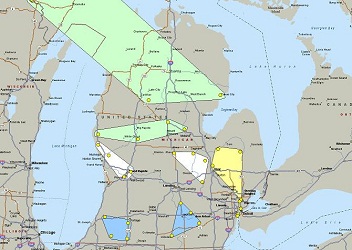
? First, a brief history lesson. In early years (or until the middle of the last decade), lines were drawn by hand. Dots representing qualifying schools were pasted on maps, one map for each division, and those maps were then covered by plastic sheets. Districts and regionals literally were drawn with dry-erase markers. No longer. Using a variety of spreadsheets and mapping software, we’ve gone digital. Staff is split into two teams, each considering four divisions (and the 8-player map) before we reconvene and look at all nine divisions together.
? We are presented digital maps of the state covered in dots. That’s about it. The rule of the day, simply, is “geography rules.” Which teams are represented by the dots is not considered, much less discussed, until lines are drawn. While considering my group’s first map, I began to bring up teams – and immediately was shot down (with good reason). Teams, matchups, rivalries, previous playoff pairings, etc. DO NOT come into play. We draw boxes in what we figure are the most logical ways of making districts and regions work.
? Travel distance and ease DO come into play. This especially is true when considering which districts will include teams from the Upper Peninsula. An example: Marquette is closer to the schools we placed in its district – Fenton, Bay City Western and Okemos – than some other options because those schools are closer to I-75. Schools further north on the map but farther from a main highway would’ve created longer trips.
? Sometimes, maps get ugly. And sometimes, it was a matter of choosing the least ugly situation. Of course, a D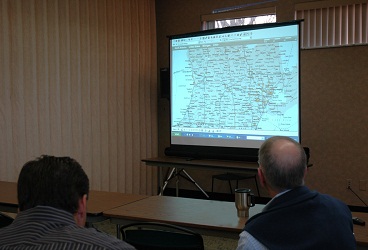 ivision 4 District of Lansing Sexton, Dearborn Heights Robichaud, Battle Creek Pennfield and Vicksburg isn’t ideal. But with no other Division 4 schools within 35 miles of Lansing, we were put in a tough spot. Add in that there were 13 teams in the Detroit area, leaving one as the odd team out of three districts based there. Something had to give, and drawing things up as we did caused the fewest messes.
? Considering how to set up the entire state is different than figuring out what teams make the most sense for just one school or area. And shifting just one dot on a map can change things for all 32.
? Back to “geography rules.” The Division 8 district including Saugatuck, Muskegon Catholic, Mendon and St. Joseph Lake Michigan Catholic might be the most competitive, on paper, in the state. Saugatuck is the reigning MHSAA runner-up in the division, and Muskegon Catholic and Mendon were ranked Nos. 1 and 2, respectively, in the most recent Association Press poll. Seeing that after we’d drawn the line caused a collective “ouch.” But again, the line was drawn based on dots on a map.
I thought back on some of the matchups I’d questioned in the past, and came back to what I’d ask people now: How would you do things differently?
I imagine there would be some creative answers, but I also would guess we considered those scenarios too.
And remember, determining the playoff schedule is just one step in many. Eight state champions must survive it, regardless of which opponents they face along the way.
8 is More than Enough
December 16, 2011
Carsonville-Port Sanilac has been all in since the beginning of 8-player football as an MHSAA sport three seasons ago.
Rapid River made the switch just this season.
But heading into tonight's first-ever MHSAA Final for the sport, both programs can claim similar rewards from embracing this adjusted version of the state's most popular high school sport.
Despite small enrollments, they can still play the game. And although they've struggled at times in recent years, both teams are winning -- and reaping all of the community support and good vibes that come with success.
Both 11-1, Carsonville-Port Sanilac and Rapid River kick off for the championship at 7 p.m. at Northern Michigan's Superior Dome.
"We can't be happier to have the opportunity to play (8-player) this year. The added success has really brought our team together, and I hope it ends on a good note," Rapid River coach Steve Ostrenga said. "It's great for the kids and great for the community. You always talk about hard work. But when we were 1-8 ... the kids who have been through those tough times, I think they appreciate it more."
Both teams can value that statement.
Rapid River won one game each of the last two seasons and hadn't reached the playoffs since 2002. The school has roughly 120 students now -- 40-50 fewer than when it was having its last run of success near the end of the 1990s.
Carsonville-Port Sanilac went 0-9 before leading the charge into 8-player football in 2009. Although the Tigers had made the playoffs as recently as 2005, winning seasons for the team had been few and far between. But Carsonville-Port Sanilac went undefeated a year ago and beat Bellaire in an unofficial state "championship" game that matched the Tigers -- winners of the Mid-Michigan 8-man Football League -- against the winners of the Bridge-Alliance 8-man Conference.
"It's changed the whole culture of the school," said C-PS coach Tim Brabant, who is in his second season running the program and graduated from the school in 2006. "At first, a lot of people didn't buy into it. But as we went undefeated last year, and with what we've done this year, we've gotten complete community support and a buy-in across the board."
Recently, that's included 240 people showing up at last week's pancake breakfast to raise money for this weekend's trip to Marquette. Tigers supports also filled two fan buses headed to NMU.
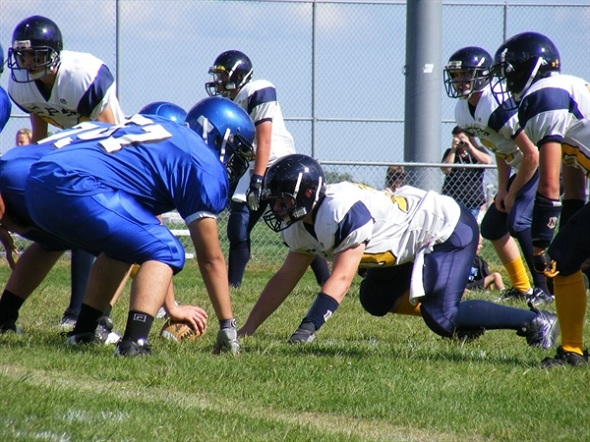
Both coaches also listed a similar adjustment teams that play 8-player football must make: Strong open-field tackling is a must.
Although the field is only 40 yards wide -- instead of the usual 53 -- having six fewer players on the field opens up the offense significantly. Rapid River has scored more than 60 points four times and Carsonville-Port Sanilac put up 70 and 91 in games this fall. Both average 51 points per contest. Ostrenga grew up in Menominee -- known for its single wing offense that doesn't use a quarterback -- but has embraced a spread passing attack that allows for opportunities all over the field.
Both teams suffered their only losses when their quarterbacks were injured briefly in September. Depth always is an issue when numbers are low.
That said, success in this version of the game has planted some roots for the future. C-PS had 50 players out for elementary teams this fall and hopes to have enough down the road for a full junior varsity. Rapid River thinks the move to 8-player will help it sustain the program despite enrollment losses of the last few years.
And the historical context of tonight's game is not lost on either team.
"They understand that. We were the first team in the state of Michigan to have a full 8-man roster," Brabant said. "A lot of people thought we were crazy. These kids understand what's at stake."
(Photo courtesy of Carsonville-Port Sanilac football program)