

Inside Selection Sunday: Mapping the Football Playoffs
October 24, 2011
Sitting on the other side of this process for a number of years, I can admit to occasionally scratching my cynical head over some of the matchups that have come out of Selection Sunday.
How could teams so far from each other play in the same district? Why would two schools in the same town play in different regionals? Are they picking out of a hat at 1661 Ramblewood Drive?
Now, I have answers.
Sunday morning, we filed into headquarters for what might be the most important non-game day on the MHSAA calendar. “We” were made up of half of the MHSAA staff, plus a representative from the Michigan High School Football Coaches Association.
Here’s some of what I learned from being a part of the process:
? First, a brief history lesson. In early years (or until the middle of the last decade), lines were drawn by hand. Dots representing qualifying schools were pasted on maps, one map for each division, and those maps were then covered by plastic sheets. Districts and regionals literally were drawn with dry-erase markers. No longer. Using a variety of spreadsheets and mapping software, we’ve gone digital. Staff is split into two teams, each considering four divisions (and the 8-player map) before we reconvene and look at all nine divisions together.
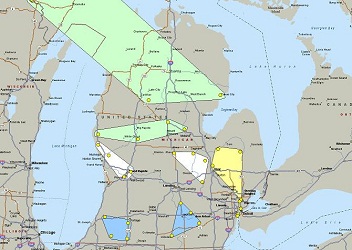
? We are presented digital maps of the state covered in dots. That’s about it. The rule of the day, simply, is “geography rules.” Which teams are represented by the dots is not considered, much less discussed, until lines are drawn. While considering my group’s first map, I began to bring up teams – and immediately was shot down (with good reason). Teams, matchups, rivalries, previous playoff pairings, etc. DO NOT come into play. We draw boxes in what we figure are the most logical ways of making districts and regions work.
? Travel distance and ease DO come into play. This especially is true when considering which districts will include teams from the Upper Peninsula. An example: Marquette is closer to the schools we placed in its district – Fenton, Bay City Western and Okemos – than some other options because those schools are closer to I-75. Schools further north on the map but farther from a main highway would’ve created longer trips.
? Sometimes, maps get ugly. And sometimes, it was a matter of choosing the least ugly situation. Of course, a D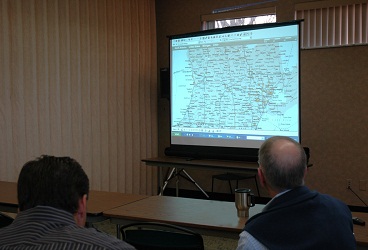 ivision 4 District of Lansing Sexton, Dearborn Heights Robichaud, Battle Creek Pennfield and Vicksburg isn’t ideal. But with no other Division 4 schools within 35 miles of Lansing, we were put in a tough spot. Add in that there were 13 teams in the Detroit area, leaving one as the odd team out of three districts based there. Something had to give, and drawing things up as we did caused the fewest messes.
? Considering how to set up the entire state is different than figuring out what teams make the most sense for just one school or area. And shifting just one dot on a map can change things for all 32.
? Back to “geography rules.” The Division 8 district including Saugatuck, Muskegon Catholic, Mendon and St. Joseph Lake Michigan Catholic might be the most competitive, on paper, in the state. Saugatuck is the reigning MHSAA runner-up in the division, and Muskegon Catholic and Mendon were ranked Nos. 1 and 2, respectively, in the most recent Association Press poll. Seeing that after we’d drawn the line caused a collective “ouch.” But again, the line was drawn based on dots on a map.
I thought back on some of the matchups I’d questioned in the past, and came back to what I’d ask people now: How would you do things differently?
I imagine there would be some creative answers, but I also would guess we considered those scenarios too.
And remember, determining the playoff schedule is just one step in many. Eight state champions must survive it, regardless of which opponents they face along the way.
Port Huron Scores with 'Victory Day'
By
Paul Costanzo
Special for MHSAA.com
August 14, 2018
PORT HURON – The first touchdown of the football season has already been scored at Port Huron High School’s Memorial Stadium.
 In fact, nearly 60 were scored two weeks before the Big Reds are set to take the field in Week 1 against Flint Carman-Ainsworth, and it will be tough to find any that mean more this season.
Port Huron hosted its fourth annual “Victory Day” this past Friday, giving special needs students in the community a chance to experience a Friday night atmosphere in the stadium.
“You have kids from all around that have special needs and they give them one day, and to see them smile and see their faces, to me it’s priceless,” said Aaron Sigafoose, whose 6-year-old son Wesley participated. “To me, it’s priceless as a parent. It’s really cool.”
Wesley was one of a record 67 participants who pre-registered for the event. Individuals ages 5 to 26 are eligible to sign up, but Port Huron football coach Ryan Mullins said his program wouldn’t turn anyone away.
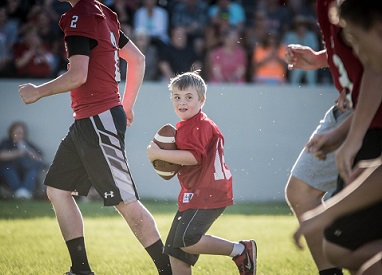
Each participant is matched with a varsity football player or cheerleader as a mentor, runs through the band onto the field after being announced as part of the starting lineup, and participates in one offensive play which ends in a touchdown.
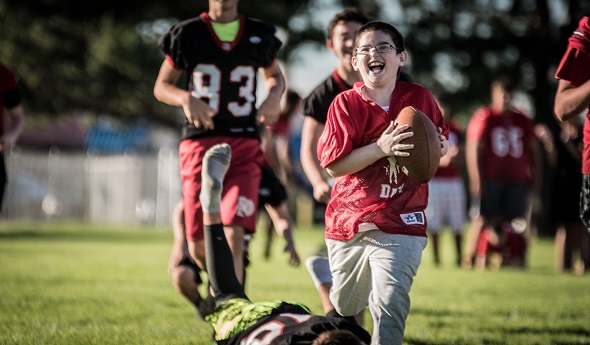
As Wesley and his fellow participants made their way to the goal line, the junior varsity football team provided a skeleton offense around each ball carrier, and the freshman team served as the defense. An announcer boomed and the crowd roared during each run, and when a touchdown was scored, everyone celebrated like it was a game-winner.
 “It was awesome,” said Port Huron sophomore Jace Mullins, Ryan Mullins' oldest son, after helping his buddy Ranger score a touchdown. “Just working with them for the hour we had with them, it was just awesome. It was a blessing. It was fun.
“I think it means a lot. … Just for him to know what it’s like to score, to reach the end zone especially in this stadium, it’s awesome.”
Victory Day was started at Trenton in 2010 by coach Aaron Segedi, a former teammate of Ryan Mullins at Saginaw Valley State University. Segedi was diagnosed with cancer in 2005, and as he battled the disease, his sister Rhonda donated 70 percent of her liver to him. Inspired by his sister’s selflessness, Segedi vowed to make his community a better place and started Victory Day. The event has spread, not only to Port Huron and other parts of Michigan, but into Ohio, Kentucky, Indiana, Maryland, Minnesota and New Jersey, according to the Victory Day website. This year’s Victory Day in Trenton will be Sept. 15.
Port Huron High School counselor Tracey Hopp – Ranger’s mother – brought the idea to Mullins, who didn’t hesitate to start one at their school. That first year, Segedi came to Port Huron to help the Big Reds get the event off the ground.
“Aaron actually goes across the United States and does it,” Mullins said. “He does it at the university level, he does it at the high school level, and along the way he’s been able to get sponsorships to help with uniforms and the medal, so there’s really no cost to participate.”
While the event is meant to bring joy to special needs students in the community, Mullins said his players look forward to it just as much.
“The guys who have done it already, they’re looking to see the player they were paired up with last year,” Mullins said. “We give them a little background information about the player, and they want to know that stuff. We really try to make that connection. They’re taking them through the locker room, playing catch with them, there’s agility bags. There’s a lot of things going on just to try to make a connection and make a friend with them.”
 Seeing the joy on the faces of the participants also helps the players appreciate the opportunity they have to play each week.
“Some of us play for kids like that,” Port Huron sophomore Noah Kindle said. “Just seeing them after the game, giving them a hug, things like that.”
Kindle said he’s looked forward to this part of being a varsity football player at Port Huron, and he’s excited to get to work with Wesley Sigafoose at Victory Day for the next two years. Wesley showed his appreciation immediately after scoring, turning and giving Kindle a hug after he crossed the goal line.
While the players certainly get a lot out of the event, they also know that this one time, the Memorial Stadium bleachers aren’t filled to see them, and they’re perfectly fine with that.
“This event, it’s not about us; it’s not about the Port Huron Big Reds,” Jace Mullins said. “It’s about the kids, it’s about the participants – just for them to get this experience.”
 Paul Costanzo served as a sportswriter at The Port Huron Times Herald from 2006-15, including three years as lead sportswriter, and prior to that as sports editor at the Hillsdale Daily News from 2005-06. He can be reached at [email protected] with story ideas for Genesee, Lapeer, St. Clair, Sanilac, Huron, Tuscola, Saginaw, Bay, Arenac, Midland and Gladwin counties.
PHOTOS: (Top) A Port Huron “Victory Day” participant runs toward the end zone while Port Huron players give chase Friday. (Middle) A Big Reds cheerleader carries her partner and the ball toward the goal line as defenders pursue. (Below) A participant looks back to see Port Huron teammates charging down the field with him. (Photos by Jeremiah May.)