

Inside Selection Sunday: Mapping the Football Playoffs
October 24, 2011
Sitting on the other side of this process for a number of years, I can admit to occasionally scratching my cynical head over some of the matchups that have come out of Selection Sunday.
How could teams so far from each other play in the same district? Why would two schools in the same town play in different regionals? Are they picking out of a hat at 1661 Ramblewood Drive?
Now, I have answers.
Sunday morning, we filed into headquarters for what might be the most important non-game day on the MHSAA calendar. “We” were made up of half of the MHSAA staff, plus a representative from the Michigan High School Football Coaches Association.
Here’s some of what I learned from being a part of the process:
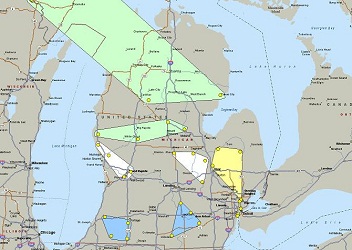
? First, a brief history lesson. In early years (or until the middle of the last decade), lines were drawn by hand. Dots representing qualifying schools were pasted on maps, one map for each division, and those maps were then covered by plastic sheets. Districts and regionals literally were drawn with dry-erase markers. No longer. Using a variety of spreadsheets and mapping software, we’ve gone digital. Staff is split into two teams, each considering four divisions (and the 8-player map) before we reconvene and look at all nine divisions together.
? We are presented digital maps of the state covered in dots. That’s about it. The rule of the day, simply, is “geography rules.” Which teams are represented by the dots is not considered, much less discussed, until lines are drawn. While considering my group’s first map, I began to bring up teams – and immediately was shot down (with good reason). Teams, matchups, rivalries, previous playoff pairings, etc. DO NOT come into play. We draw boxes in what we figure are the most logical ways of making districts and regions work.
? Travel distance and ease DO come into play. This especially is true when considering which districts will include teams from the Upper Peninsula. An example: Marquette is closer to the schools we placed in its district – Fenton, Bay City Western and Okemos – than some other options because those schools are closer to I-75. Schools further north on the map but farther from a main highway would’ve created longer trips.
? Sometimes, maps get ugly. And sometimes, it was a matter of choosing the least ugly situation. Of course, a D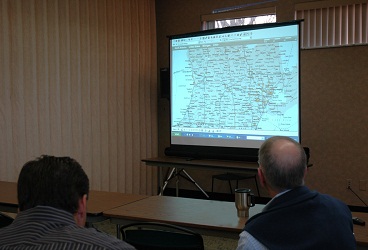 ivision 4 District of Lansing Sexton, Dearborn Heights Robichaud, Battle Creek Pennfield and Vicksburg isn’t ideal. But with no other Division 4 schools within 35 miles of Lansing, we were put in a tough spot. Add in that there were 13 teams in the Detroit area, leaving one as the odd team out of three districts based there. Something had to give, and drawing things up as we did caused the fewest messes.
? Considering how to set up the entire state is different than figuring out what teams make the most sense for just one school or area. And shifting just one dot on a map can change things for all 32.
? Back to “geography rules.” The Division 8 district including Saugatuck, Muskegon Catholic, Mendon and St. Joseph Lake Michigan Catholic might be the most competitive, on paper, in the state. Saugatuck is the reigning MHSAA runner-up in the division, and Muskegon Catholic and Mendon were ranked Nos. 1 and 2, respectively, in the most recent Association Press poll. Seeing that after we’d drawn the line caused a collective “ouch.” But again, the line was drawn based on dots on a map.
I thought back on some of the matchups I’d questioned in the past, and came back to what I’d ask people now: How would you do things differently?
I imagine there would be some creative answers, but I also would guess we considered those scenarios too.
And remember, determining the playoff schedule is just one step in many. Eight state champions must survive it, regardless of which opponents they face along the way.
New Field Next Step in Glen Lake Surge
August 31, 2017
By Dennis Chase
Special for Second Half
MAPLE CITY – With school about to begin, Glen Lake will be hosting perhaps its biggest event of the school year tonight.
 Perennial power Traverse City St. Francis heads up to Leelanau County to take on the Lakers in a Week 2 football showdown.
Glen Lake, a 42-20 winner over Kingsley in last week’s season opener, is coming off an 11-3 campaign that ended in the MHSAA Division 6 Final at Ford Field. The Lakers lost the title game to Jackson Lumen Christi 26-14.
St. Francis, a 21-7 victor over Marquette last weekend, finished 11-1 a year ago, losing to eventual Division 7 champion Pewamo-Westphalia 17-14 in the Regional Finals.
“Anytime you play St. Francis – it doesn’t matter if you play them on the beach – it’s a big game,” Lakers coach Jerry Angers said.
The two teams will not be playing in the sand tonight. They’ll be playing on Glen Lake’s new synthetic field, which workers put the finishing touches on to meet a down-to-the-wire deadline this week.
The field is the latest positive for the Glen Lake program.
The school board considered installing a new natural grass field, but opted for the artificial turf because of its “usability.”
“Once you accept the premise that the football field needed to be replaced, it wasn’t that much of a leap to go to artificial turf (over natural grass) given how much more we can use it,” superintendent Sander Scott said. “Usability – that was the determining factor.”
The field will be used by other sports teams as well as physical education classes.
“That’s the beauty of it,” athletic director Jennifer Johnston added. “Our entire student body and community can reap the benefits of having a field like that.”
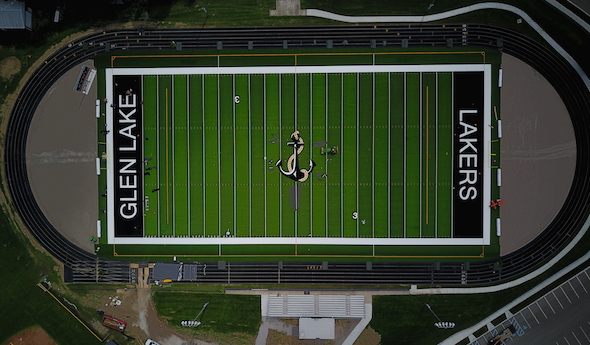 The school board approved spending nearly $850,000 on the surface, but Scott said “it’s looking like it’s going to come in well below that.”
Scott said officials put added emphasis on drainage, an issue that’s plagued Traverse City’s Thirlby Field.
“We’re aware of the challenges Thirlby Field has had (with its synthetic surface), so we really made sure we did not duplicate whatever mistake that was done there,” he said. “We probably overbuilt for drainage.”
The field is not the only new enhancement fans will notice tonight. Officials “beefed up” the wireless network at the field and brought back the berms on the home side for those who prefer lawn seating to bleachers.
The upgrades add to the momentum that’s building in the athletic program. Glen Lake was named the Traverse City Record-Eagle’s School of Year in 2016-17 after the football team reached the MHSAA Finals and the girls basketball team the Semifinals. In addition, Nichole Cox won a third consecutive individual MHSAA Finals golf championship.
“We’re on an upswing,” Angers said. “Everybody is upbeat.
“I know we savored it (last year’s football tournament run). Hopefully, it will fuel us this year – and in years to come.”
Johnston said her message to fall coaches was “keep doing what you’re doing because it’s working.”
“We have a vision and that’s to work hard to improve every day with pride, class and integrity,” she added.
It’s that motto that the school emphasized in ads that ran in the Record-Eagle fall sports tab and in the Leelanau Enterprise.
“We wanted to promote and brand our athletic department,” Johnston said.
Still, Johnston noted, the school has goals other than winning for its student athletes.
“We want to prepare our students to be successful in the real world and contribute to society in a positive way,” she said. “We have high expectations on the playing field, but it starts in the classroom.”
 Speaking of the classroom, Glen Lake is on a roll there, too. The school conducted a search this summer for two secondary math teachers with proven records of increasing student achievement. The school even offered a signing bonus. Forty-six teachers applied, compared to 14 for a similar position at another local high school.
Glen Lake ended up hiring two teachers with more than 20 years of experience.
“The one thing we do that distinguishes us from other schools,” Scott said, “is that we will give teachers credit for all their years. When I was part of other districts, the highest they typically go is six years. If you’re a teacher with 20-plus years, you’re not going to take a huge pay cut to move. We wanted to eliminate that (obstacle). We just posted an elementary opening and had 153 applicants.”
For Johnston, she had another reason to celebrate the 2016-17 sports season. Her father, Roy, who coaches basketball at Beaverton, became the state’s all-time winningest coach in that sport last winter.
“I was really excited for him,” she said. “He’s definitely stood the test of time. He’ll be the first to tell you that you’re not put in that position, to reach a milestone like that, without a lot of good players and without the support of a great community and school. To me, the entire Beaverton community earned that accolade.”
When Glen Lake was making its run to Ford Field last fall, Johnston was quick to mention to Angers that he should enjoy every minute of it.
“I said, ‘Jerry, you have to realize my dad’s been coaching 46 years and the furthest he’s made it is to the Semifinals,” she said. “You never know. (The Finals are) quite an accomplishment. Enjoy it to the fullest.”
One game into the new season, Angers already is raving about the support his team is receiving from the student body and community.
“The crowd we had at Kingsley was unbelievable,” he said. “And I expect it will continue to grow.”
Especially with St. Francis coming to town tonight.
 But for all the good cheer, Glen Lake is also without a familiar face this season. Paul Christiansen stepped down as girls golf coach after last season, ending a coaching career that started at the school in 1973.
“I texted him after our coaches meeting in August,” Johnston said. “I said, ‘It was sure weird not having you at that coaches meeting.’ He texted me back and said, ‘Trust me, it was sure weird not being there.’”
When Christiansen started in the fall of 1973, he was an assistant varsity football coach and boys JV basketball coach. By the next year, he had become the head football and boys varsity track coach, in addition to coaching JV basketball for his close friend Don Miller.
“After the second year, our superintendent said three (coaching jobs) is too many, especially with two as a head coach at the varsity level,” Christiansen recalled. “He said, ‘I don’t care which ones you do, but pick two. I think you’ll be better off.’”
Christiansen gave up football. But he later picked up a third sport again when he coached girls middle school basketball. He would end up coaching boys JV basketball for 25 years and boys and girls varsity track 20 years apiece. In all, he coached 92 sports seasons at Glen Lake.
“It’s an odd feeling after 44 years,” Christiansen said. “It’s like, ‘Whoa!’ But it was time to move on.”
Christiansen went out on a high note after Cox became just the third girl in MHSAA history to win three consecutive individual golf titles. She’s now at Bowling Green University.
“I didn’t script it that way, but if you were to script it, going out with an individual or team championship would be the way,” he said.
Glen Lake had just three golfers last season, not enough to compete as a team. The school dropped the sport this season.
“For Glen Lake to allow us to keep competing (last season), even though we didn’t have a full complement of players to count as a team score, I was really thankful for that,” Christiansen said. “And Nichole was especially thankful.”
Cox’s title was part of a “wave of success” that highlighted the last school year.
But this is a new year. New teams. New challenges.
Angers, for one, is hoping to keep that momentum rolling, although he lost some talented players to graduation, including eight defensive starters.
“The key is you want to retool (not rebuild) every year and I think that’s where we are right now with the program,” he said.
St. Francis will be a good test.
 Dennis Chase worked 32 years as a sportswriter at the Traverse City Record-Eagle, including as sports editor from 2000-14. He can be reached at [email protected] with story ideas for Manistee, Wexford, Missaukee, Roscommon, Ogemaw, Iosco, Alcona, Oscoda, Crawford, Kalkaska, Grand Traverse, Benzie, Leelanau, Antrim, Otsego, Montmorency, Alpena, Presque Isle, Cheboygan, Charlevoix and Emmet counties.
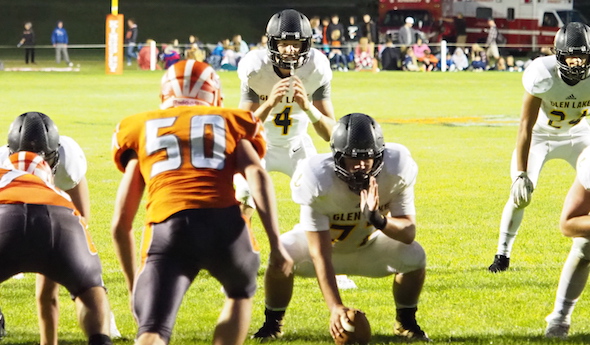
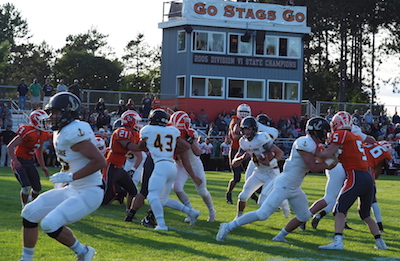
PHOTOS: (Top) Maple City Glen Lake quarterback Cade Peterson prepares to take a snap last season. (Middle top) A drone's view of the new artificial turf field at Glen Lake, set to debut Friday. (Middle below) Peterson breaks through a hole following a block by teammate Max Guilbeau (43). (Below) Recently retired coach Paul Christiansen. (Photos courtesy of Greg Guilbeau [action] Scott Jozwiak [drone] and Don Miller [Christiansen].)