

Kicker Steps Into Historic Moment
December 8, 2020
By Doug Donnelly
Special for Second Half
CLINTON – After what Jonathan Baughey has gone through, kicking a football through two yellow goal posts doesn’t seem like a very big deal.

But, when it came against an undefeated, state-ranked team on the last play of the Division 6 District championship game, it was just that.
“It was definitely a scary moment,” said Baughey, a junior from Clinton High School in Lenawee County.
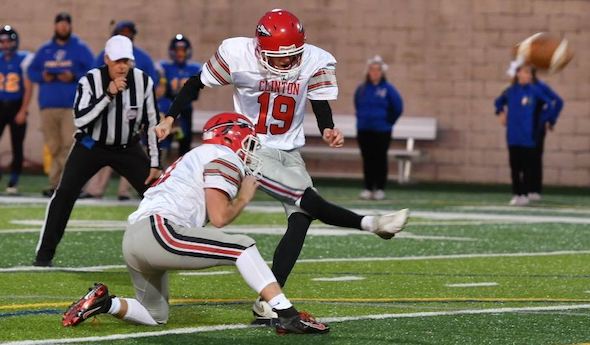
Baughey’s 22-yard field goal as time expired gave Clinton a 16-13 victory over Blissfield and sent his team into a Regional Final against Warren Michigan Collegiate.
It’s been a long road for Baughey, who thought that after a successful kidney transplant in 2015 that his football career was over. At the urging of a family friend and Clinton middle school coach, however, Baughey tried kicking. It was a good choice as he’s now etched his name into Clinton football lore by making probably the biggest field goal in school history.
 “He’s been through so much, and I couldn’t be happier for him,” said Clinton football coach Jeremy Fielder. “We had a lot confidence in him kicking in that situation. There was no hesitation.”
Baughey was born with one kidney functioning at 25 percent and the other at 75.
“From birth he always had kidney issues,” said his mother, Kelly Baughey. “We knew growing up he would need a transplant. They tested his father and I, and we were both matches. His dad (Kevin) decided that he wanted to do it for him. He was his donor.”
Kevin Baughey never hesitated.
“It wasn’t a decision at all,” he said. “I would have given him both if I needed to.”
For years, dealing with the kidney issue was just part of Jonathan’s life. He would tire easier than other kids, but he learned to cope with it.
“I was more of a tired kid,” Baughey said. “When I was younger, it wasn’t about contact, it was about how tired I would get. I couldn’t keep up with a lot of other kids. It was hard.”
He had a kidney removed in December of 2012. After that, he said, “it was a roller coaster.” The transplant didn’t come until June of 2015, soon after he finished the sixth grade.
It took roughly six weeks in the hospital for Baughey to recover from the transplant.
“As soon as I had the transplant, I started feeling better than I had felt,” he said. “I had more energy.”
Baughey played flag football as a kid and had started playing tackle football. But when he neared the time for a transplant, he figured his football days were done. That’s when family friend and Clinton middle school coach Keith Tschirhart suggested he try kicking for the Clinton middle school team.
“I had played soccer and thought it was something I could do, so I tried it,” Baughey said. “I went out with him to the football field to see how I would do. It was pretty rough at the beginning. It took some time.”
He didn’t get much practice that first season.
“We never really kicked extra points,” he said.
Baughey kept working at it though and made it through his eighth-grade season. As a freshman he figured he would continue kicking, most likely for the Clinton JV team. He went to the tryouts.
“I kicked my first football and the coach said I was on the varsity,” he said.
Fielder said Baughey made an immediate impact.
“We didn’t have a kicker,” he said. “We had no one. I even told the coaches, ‘What are we going to do?’ Then, I saw him kick the ball and it was like, ‘He’s our kicker.’”
 It was big adjustment for Baughey. Not only had he once thought he would never play football again – but he found himself suddenly on the varsity as a freshman, not knowing anyone on the team. And, being exclusively a kicker, meant he practiced mainly by himself.
“That was the struggle that I went through,” he said. “I didn’t know anyone. The only kids I knew were the snapper and the holder.”
Clinton grad Erik Bouse stepped in to help Baughey. Bouse had been a standout kicker for Clinton for three seasons before graduating in 2017.
“He was the one who I mainly worked with,” Baughey said. “He helped me a lot. He really started me out not creating bad habits and helped with the mental part of it.”
As a freshman, Baughey made 42 of his 50 extra-point attempts and a 21-yard field goal. As a sophomore he made 48 of 54 with a 19-yard field goal. This season he has made 29 of 37 extra-point attempts. The winning field goal against Blissfield was his only field goal of the season, on two tries.
Baughey is exclusively a kicker because of the potential risk of injury following the transplant. He wears a special pad on his stomach under his uniform because that is where doctors put his new kidney.
His mother said the no-contact rule causes some angst for her.
“He knows there is a chance he could get hit,” she said. “He wears a shield for padding. The transplant team has okayed him to play.”
Baughey practices every day, often by himself. He goes to the game field and starts at the extra point yardage and works his way back, making at least two kicks at each distance before moving on to the next level. He’ll use his cell phone to record himself, then watch the videos to make sure he is kicking correctly and not developing bad habits.
“The biggest part for me is to go out and know that I can do it,” he said. “You have to know you are going to kick it through the uprights, not just think you are going to. I like to pick out a small target, even a leaf or something, and just clear my mind and just kick the ball.”
When Clinton got the ball back with just over three minutes to go in the District Final against Blissfield, Baughey started thinking the game might come down to his foot.
“I went to the net and started kicking,” he said.
Clinton drove the ball inside the Blissfield 10-yard line, but did not reach the end zone. Fielder called a timeout on fourth down with only a few seconds left. Baughey jogged onto the field and lined up when Blissfield called a timeout.
“I remember walking to the sidelines and taking a deep breath,” he said. “People came up and talked to me and told me I could do it”
Baughey blocked everything out.
“I was really mentally focused,” he said. “After I made the kick, I started clapping. I turned around and all my teammates were jumping up and down. I ran to our coaches and everyone started hugging.”
His father, his donor, could not have been happier to see the ball go through the uprights.
“I was beside myself happy,” Kevin Baughey said. “Thinking about all of the time he spent working in the offseason, and then seeing the confidence his coaches showed with making the call to go for the field goal ... I was as proud as I could possibly be.”
 Doug Donnelly has served as a sports and news reporter and city editor over 25 years, writing for the Daily Chief-Union in Upper Sandusky, Ohio from 1992-1995, the Monroe Evening News from 1995-2012 and the Adrian Daily Telegram since 2013. He's also written a book on high school basketball in Monroe County and compiles record books for various schools in southeast Michigan. E-mail him at [email protected] with story ideas for Jackson, Washtenaw, Hillsdale, Lenawee and Monroe counties.
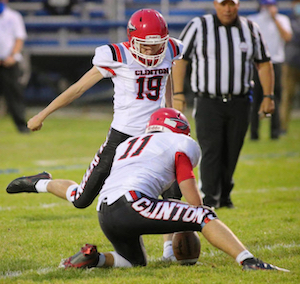
PHOTOS: (Top) Clinton's Jonathan Baughey connects on a kick. (Middle) Baughey, following through on another kick this season, clinched his team's District title with a game-winning field goal. (Photos courtesy of the Clinton football program.)
Rouge Primed for 1st-Time Repeat Attempt
By
Tom Markowski
Special for Second Half
September 17, 2020
Mareyohn Hrabowski has a tough act to follow after a historic season for the River Rouge football program.
 All the same, Hrabowski, now a senior quarterback for coach Corey Parker, is just thankful he and his teammates will get that opportunity.
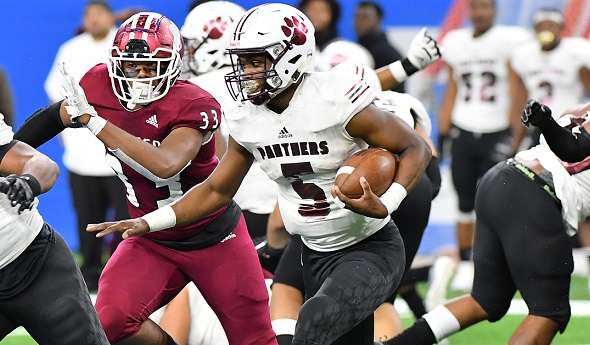
Hrabowski’s three rushing touchdowns led the Panthers to a 30-7 victory over Muskegon in the Division 3 title game last November at Ford Field. The title was the school’s first in football, and the win over the Big Reds to earn it shocked many football enthusiasts throughout the state.
“It was awesome,” Hrabowski said. “To think the year before I was playing (on the junior varsity). To make the move up, the game was faster and the energy we got throughout the season was amazing.
“Before the season we talked about a state championship. When we got to the (MHSAA) playoffs we knew we had to put the foot on the gas.
“This year, expectations are the same. We don’t want to push anything. We don’t want to make this a one-man show. That title made us hungrier.”
River Rouge weathered a rugged schedule in 2019 finishing 13-1, highlighted in part by a 16-3 victory over state power Detroit Catholic Central in Week 8. Of its five playoff wins, only one, a 14-7 victory over Chelsea, came by fewer than 23 points.
With more than half his starters returning, Parker was optimistic heading into this season. Then COVID-19 hit. Normal preparations were all but cancelled, and until schools were given the go-ahead to begin preseason practice midway through the summer it looked like this season would be cancelled or postponed. The ups and downs continued when football shut down after the first week of practice and before teams were to begin training in full pads.
Earlier this month, Governor Gretchen Whitmer relaxed restrictions that in turn opened up the opportunity to play football again, and the MHSAA Representative Council voted to allow programs to resume practice with the start of the season pushed back to Sept. 18. What we’re left with is a shortened season, six regular-season games for most teams, with the playoffs set to begin Oct. 30.
“You’re setting up dates, scrimmages, games, then you’re shut down,” Parker said. “We didn’t know what was happening. Then we had to deal with the parents and fans, and explaining to them what we would do.
“(The virus) is very scary. Some of our players live with their grandparents. Some have younger siblings at home. (If you get infected) you don’t want to bring that home to them. I have (three) young children at home. We had one player who said he was in contact with someone who had tested positive. We couldn’t let him practice with us. He said he might transfer if he couldn’t practice and I said if that’s your best option, go ahead.”
Parker’s practices are highly monitored. He has what he terms a sanitation station for the players where, when they’re finished with a drill, they wash down and are told to keep their distance.
With its classrooms empty, River Rouge has adopted a virtual classroom schedule for all students from 8 a.m. until 1 p.m. As the dean of students and athletic director, Parker’s responsibilities have changed. In addition to the virtual classroom, students have the opportunity to safely meet with teachers, face-to-face, from 2-4 p.m.
“We call it a drop-in center,” Parker said. “It’s like a Q&A. If a student has a question about the work they did (virtually), they can come in and meet with their teacher. We allow two or three students, something like that, in an area at one time.”
 This is Parker’s 12th season as football coach and dean of students. In addition, four years ago he became athletic director. Since his arrival, the football program has taken off and the high school’s enrollment has more than doubled to more than 1,000 students.
In the six football seasons prior to Parker’s first (2009), the Panthers were a combined 13-41 with no playoff appearances. Before Parker arrived, over its football history, Rouge had made the playoffs four times with one playoff win.
River Rouge has made the playoffs the last 10 seasons including runs to Division 5 Regional finals in 2012 and 2014, Division 4 Semifinals in 2016 and 2017, and to a Division 5 runner-up finish at Ford Field in 2015.
Success has equated to an increase in participation. Parker had approximately 20 players in the program the first four seasons. This season he has 130 including a freshman team for the first time (River Rouge will not play a freshman schedule due to the lack of freshman teams in the area).
“When I got here, football was something they did before basketball,” Parker said. “We were successful and in 2012 our goal was to win a playoff game then a District title, and we did that. We beat Almont (44-22). That was a turning point. We kept it simple back then. We ran the ball. We’re still a single wing, but we spread it out now.
“(Defeating Muskegon) was huge. (Muskegon) is the cream of the crop. If you talk about football in Michigan, you have to talk about Muskegon. Winning a title changes everything. Our numbers are up, the most ever, and the fan base is different. We have people in their cars in the parking lot now watching practice. It puts our players under a microscope. They realize they’re representing something bigger than yourself.
“Sure there’s pressure. Pressure either bursts pipes or creates diamonds.”
The strength of this year’s team is experience on the offensive and defensive lines plus the play of Hrabowski. Many of River Rouge’s linemen are college-bound players like Jalen Johnson, Chance Moore and Tyler McMillan on the offensive side; Mark Gilbert, Pius Odjugo and Deavontae Miles on defense. Safety Armorion Smith is a playmaker. He had six sacks in the victory over Detroit Catholic Central.
Offensively the Panthers will pin their hopes on Hrabowski, who at 6-foot-3 and 215 pounds can control a game with his strength and athleticism. Hrabowski answered the bell time and time again during last year’s Final. He rushed for 175 yards on 15 carries and completed half of his 12 pass attempts for 45 yards. River Rouge did not commit a turnover.
“(Hrabowski) does not believe in turning it over,” Parker said. “He’s a bigtime teammate. He’s old school. At lunch, he’s always sitting with his offensive linemen. He’s a great runner and a better passer. When he has the opportunity to run, he makes plays.”
Lurking in the back of everyone’s mind is the virus. Coaches and players know they must be constantly on their guard, adhering to protocol and using caution at all times.
“I’m an only child, so there isn’t that many I come in contact with at home,” Hrabowski said. “I have my childhood friends, but I’ve noticed I’m not around as many people as I used to. I know my limits. Coach does a great job of reminding us of social distancing and wearing masks.”
River Rouge, which plays an independent schedule, opens the season at Ecorse on Friday. East Lansing is scheduled the following week and, later, Detroit Catholic Central and Detroit Renaissance.
As the COVID crisis continues to evolve, players are expected to wear masks, not only on the sidelines but while participating as well. As difficult as this sounds, Parker said his players are ready for the challenges that await.
“(Wearing masks) is going to be uncomfortable,” he said. “But we don’t mind dealing with that discomfort for these seniors to have a chance to perform and earn a scholarship to move out of their parents’ house.”
 Tom Markowski is a correspondent for the State Champs! Sports Network and previously directed its web coverage. He also covered primarily high school sports for the The Detroit News from 1984-2014, focusing on the Detroit area and contributing to statewide coverage of football and basketball. Contact him at [email protected] with story ideas for Oakland, Macomb and Wayne counties.
PHOTOS: (Top) River Rouge quarterback Mareyohn Hrabowski finds a path during last season's Division 3 Final against Muskegon. (Middle) Panthers coach Corey Parker and his players prepare to except their championship trophy at Ford Field.