

Loyola Learns Championship Lessons
November 29, 2014
By Geoff Kimmerly
Second Half editor
DETROIT – Saturday’s celebration began with respect, senior linebacker Paul Engram said, for an opponent that had become familiar and frustrating.
Detroit Loyola hasn’t lost a regular-season game since 2010. But the Bulldogs also hadn’t solved Ishpeming in their first two MHSAA Division 7 Final matchups, falling to the Hematites to end both of the last two seasons despite obvious size and arguable speed advantages.
“We know they could beat us, and they thought they could beat us, and we had to recognize that,” Engram said. “We knew what we can do. We had to believe in ourselves and play as a team.
“Football isn’t always about just playing a game. It’s about life. We really learned a lesson about how to stick together and trust, what love and trust are really all about. Because that’s what we were missing the last couple of years.”
Loyola had all of the above Saturday morning in defeating Ishpeming 29-8 to claim its first MHSAA title.
Just as in 2012 and 2013, Ishpeming scored first. But this time, the Bulldogs responded with 29 unanswered points dominating with the physicality that has helped it build a 65-10 record under coach John Callahan since he took over the program in 2009.
“Passion, motivation. Us losing two times in a row, we just really had a goal,” said senior running back Marvin Campbell, who like Engram had played prominent roles on all three Finals teams. “We just knew we had to get this done.”
 Campbell finished with 215 yards on 21 carries with all four of Loyola’s scores – on runs of 47 and eight yards in the second quarter, 66 in the third and five yards in the fourth.
The first touchdown would’ve come earlier – a two-yard scoring run was called back because of a penalty – and Ishpeming junior Thomas Finegan intercepted a Loyola pass on the next play. With junior quarterback Ozzy Corp either running or completing passes on 10 plays, the Hematites responded with a 13-play, 90-yard drive capped by his 1-yard scoring run and two-point conversion pass with 1:03 to go in the first quarter.
But Loyola (14-0) made adjustments – taking opposite tacks for each side of the field.
Callahan had traveled to watch Ishpeming twice this season, including against eventual Division 8 semifinalist Beal City when those teams met in Week 6. Callahan noticed how the Aggies tried to defend Ishpeming’s powerful run – and came back to a defense he’d used coaching Pontiac Notre Dame to a league title before moving to Loyola. The “nitro” defense took all of his players off the line and gave a look of seven linebackers able to range side to side.
Loyola finished Saturday with six tackles for losses and three sacks, with junior lineman Anthony Fitzpatrick leading with 11 tackles.
“(Nitro) gives us better vision,” Callahan said. “With what they ran, they were going one way or the other. It gave our guys the opportunity to move as quick as they were and get to the spot.”
Meanwhile, the Bulldogs did just about the opposite offensively, as the game wore on getting back to the fundamentals of its base power running game that had served so well the last four seasons.
 Loyola finished with 297 yards on the ground, with senior Mideyin Wilson picking up 75 on 16 carries.
“Those guys are seniors now, all those guys we played before,” Ishpeming coach Jeff Olson said. “They’re big. They’re strong. They were better than us. There are only so many things you can do, and we tried a lot of different things, a lot of different blocking schemes. They just dominated us at times.”
Corp turned in another courageous performance without senior teammate and top back Ozzy Hakkarinen to assist – the latter was injured in last week’s Semifinal. Corp ran for 198 yards in that game, and added 111 yards passing to the team’s lone score Saturday.
Senior Dominic Suardini had 14 tackles for the Hematites (12-1), which had won 33 straight games entering Saturday – good to tie for eighth-longest winning streak in MHSAA football history and fourth longest among streaks to take place entirely during the playoff era (beginning in 1975).
“People don’t understand how hard it is to get here. When you do it three times in a row and win two, people think it gets easy,” Olson said. “We had some tough teams we had to play along the way, and you’ve got to beat those teams. And those teams are giving you everything they have. You can’t just have talent; you’ve got to have great kids, got to have competitors. We had that.”
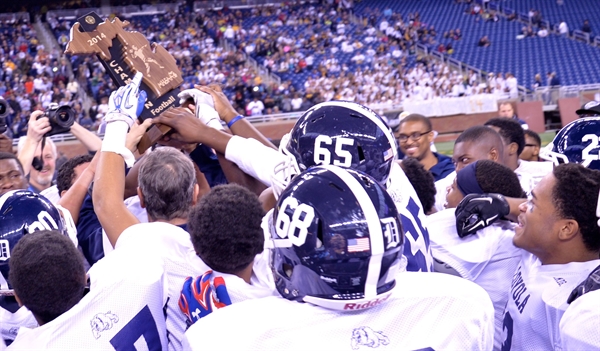
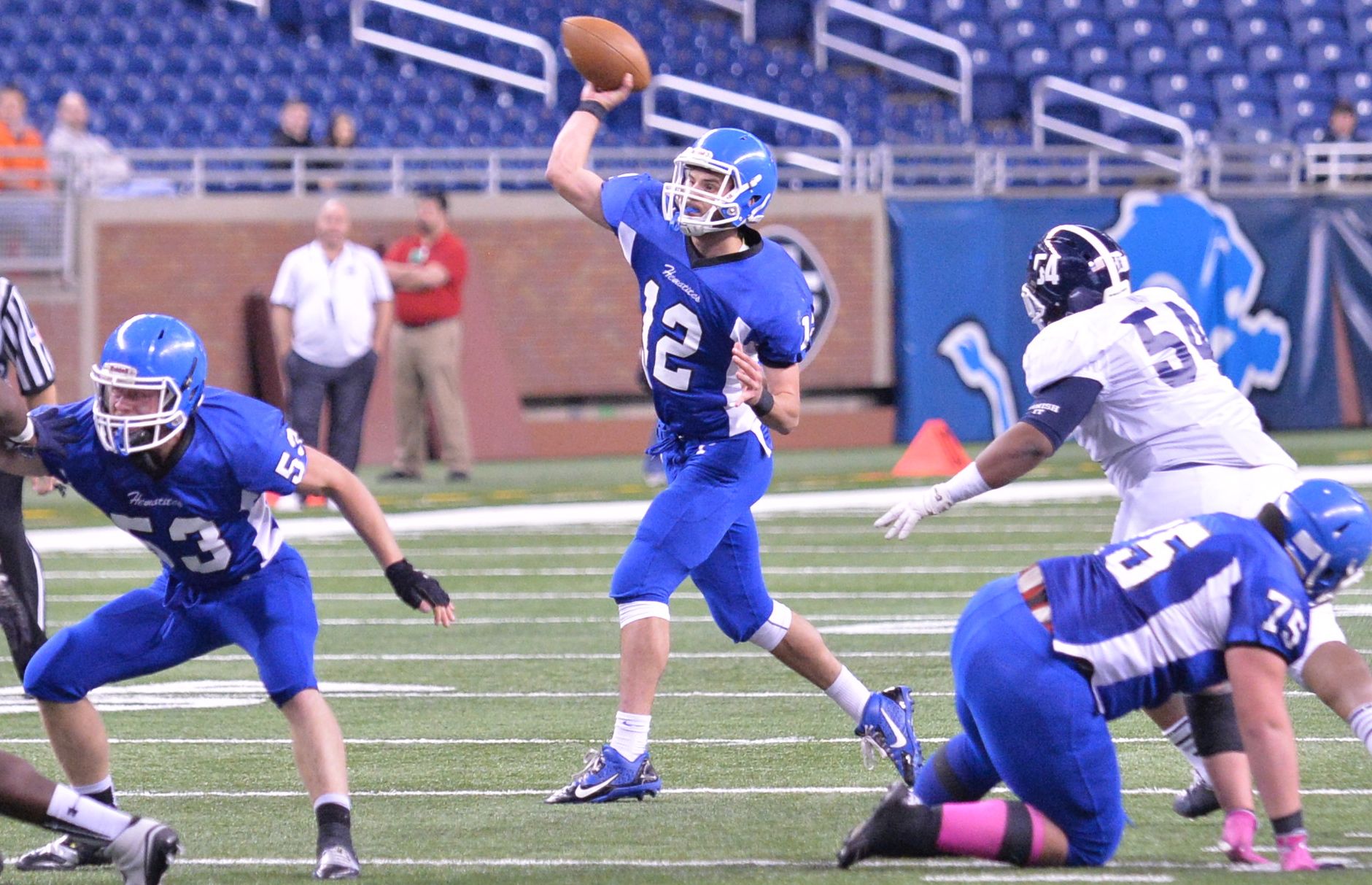
PHOTOS: (Top) Detroit Loyola celebrates its first MHSAA football championship at Ford Field. (Middle) Ishpeming quarterback Ozzy Corp prepares to throw with the Bulldogs pressuring. (Below) Loyola’s Marvin Campbell runs away from tacklers for some of his 215 rushing yards. (Click for action photos and team photos from Hockey Weekly Action Photos.)
VIDEO HIGHLIGHTS:
ISHPEMING PICK - The Ishpeming defense stopped a long game-opening Detroit Loyola drive when Thomas Finegan intercepted a Nicholas Lee pass. The Hematites scored on the ensuing drive.
MARVELOUS MARVIN - Marvin Campbell rushed for 215 yards and four touchdowns for Detroit Loyola in its 29-8 Division 8 victory over Ishpeming. Here's the third score on a 66-yard run.
Watch the entire game and order DVDs by Clicking Here.
As Football Launches Again, Reeths-Puffer Fueled for Fresh Start
By
Geoff Kimmerly
MHSAA.com senior editor
August 9, 2021
MUSKEGON – A Reeths-Puffer running back tripped and plowed into the Kit Kat-shaped bags he was supposed to be hurdling Monday, and his teammates laughed. The offensive line coach wore a shirt, like line coaches always do, that read “No One Works Harder Than The Offensive Line.” The sun came out about halfway through, but the breeze kept the weather just right, and after a hands-in, all-together “R-P!” someone shouted, “I’ve missed that!”
The setting was as typical as could be for the first day of football practice at any high school across Michigan over the last many years … except for 2020.
Remember a year ago? When COVID-19 precautions meant little to no contact for the most contact-filled sport? When locker rooms were closed and footballs were wiped down after every snap? And the possibility of the season ending at any moment hung in the air?
“I was telling the team (last year) we could play our first game and the rest of the season could get canceled, so you don’t know,” Rockets senior lineman Marco Fields recalled. “The seniors only got to play half their season, and some got hurt.
“Now that we know we have a full senior season ahead of us, for us seniors, all we can do now is stay focused.”
 Indeed, although there’s little debate that COVID-19 is still lingering, just about everything Monday at Reeths-Puffer felt differently from the first day of football practice a year ago. And although varsity head coach Matt Bird thought he might have an answer to what remained the same from 2020 … he really didn’t.
“The same is … (searching for his thought)
“… that you are … (pause)
“Kids … (trailed off)
“Actually, I don’t feel that anything is the same,” he admitted. “Other than we have a football, and we have some things involved from that standpoint.”
Monday marked a fresh start for high school football across Michigan, after last season included multiple COVID-related delays before finishing up in late January – which followed also an abbreviated regular season during which the conversation was forced at times into much more serious topics than the highlights on the field.
But every first day of practice means starting anew. And when it comes to fresh starts, Reeths-Puffer is a great place to begin Fall 2021.
Start with Bird, something of a master when it comes to building from a clean slate.
Way back in 2000, he was an offensive assistant when Grand Ledge won the Division 1 championship, the only Division 1 title that’s been won by a Lansing-area team. Six years later, he took over the Comets program and debuted with back-to-back 3-6 seasons (which predictably didn’t go over too well) before rattling off 10 winning seasons over the next 12 including a Semifinals trip in 2015. That eventually led to a rarely-seen career move after the 2018 season – leaving an established power for a new challenge, as Bird took the Reeths-Puffer job and took on a program that was coming off a second-straight 5-4 finish but accomplished with just under 30 players on the roster.
Bird led his first Rockets team to another 5-4 finish in 2019 … and then 2020 hit. Reeths-Puffer finished 2-5, but all things considered there were plenty of positives to take away.
When practice started, Bird was just finishing up recovery from COVID-19. And despite the unpredictability the season promised, the varsity still managed to grow to 53 players.
“As a coach you have to acknowledge it,” Bird said Monday, recalling 2020. “But the thing that is frustrating to me is you want to acknowledge it, but when you look at it everything was done so differently; it didn’t even feel like a season. At times you’d get started, then kicked back, then started and kicked back. We couldn’t do team dinners, we couldn’t do a lot of the bonding things we do as a group, and that hurt us.”
Monday was the beginning of another fresh start for the Rockets. Set aside that the great majority of COVID restrictions are off – the program is still emphasizing a number of hygiene and health-related concepts to help players avoid illness – and the football-related details provide plenty of excitement.
 On one hand, Reeths-Puffer still plays in the Ottawa-Kent Conference Green – which includes the winningest program in MHSAA history in Muskegon High, back-to-back Division 2 champion Mona Shores and powerful neighbors Zeeland West and East. Grand Rapids Union, Holland and Wyoming all provide some intriguing possibilities as well heading into the new season.
But Bird’s varsity roster looks to push past 50 again, with 20 seniors including four returning senior starters on both sides of the ball. Fields is a Division I-caliber college line prospect, and the sophomore class is shaping up to be special with 6-foot-7 Travis Ambrose of particular note.
“I know every coach says their sport is the best team sport, but there’s something about football where you’ve got 11 guys out there and everybody can contribute,” Bird said. “The 6-5 kid to the 5-7 kid, and you can find a way to make that come together. I’ve always been a big fan, where it’s ‘Tell me that we can’t do something, and let me prove that (we can).’ … We compete using our strengths rather than focusing on some of the things that we don’t have.”
And there are lessons learned last season which, despite its wildness, should pay off. For example, last year teams were forced to focus more on technique with contact cut down substantially, and then rely on technology to cut down on face-to-face conversation. On Monday, Bird was recording his quarterbacks’ footwork with a tablet so he could share the video later over Google Meet, the new norm in communication but something Bird considers a valuable teaching tool brought on by the last 18 months.
The players, for their part, could allow themselves to feel a little lighter than a year ago. Fields and his teammates got to have more fun this time. And they were able talk about the expectations and aspirations that always make the first day a special one.
“I’ve heard people are expecting a normal Reeths-Puffer, and some say ‘Rocket failure again,’ which is just us going 2-5 or whatever they’re trying to say,” Fields said. “But I think we’re going to take this thing all the way.”
“This is normalcy, to an extent,” was Bird’s take on the day. “And it’s just really nice.”
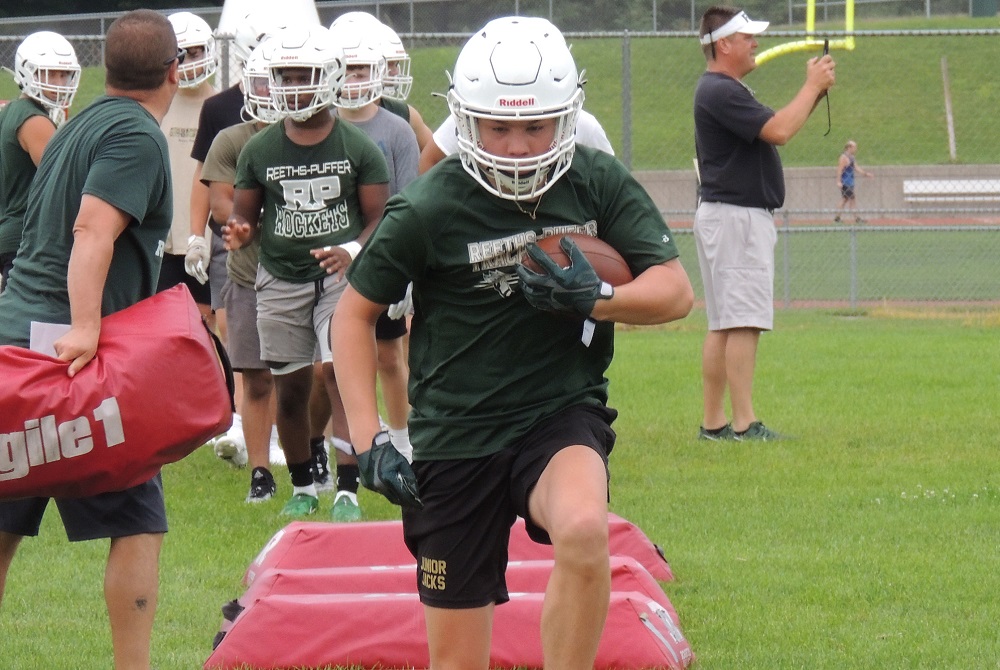
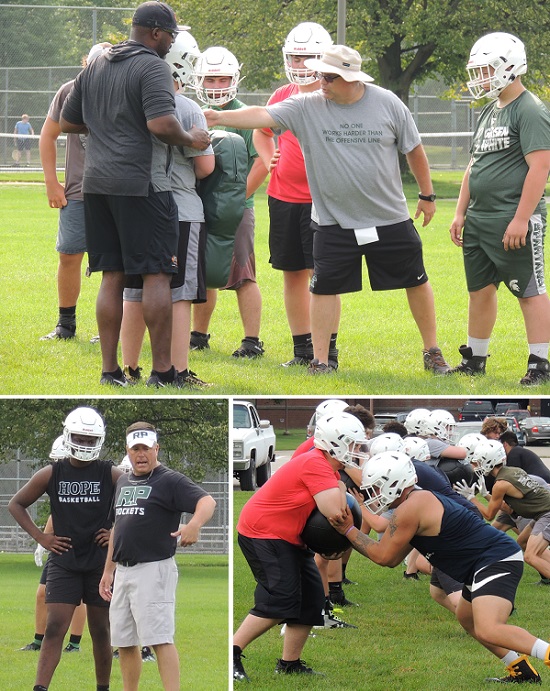
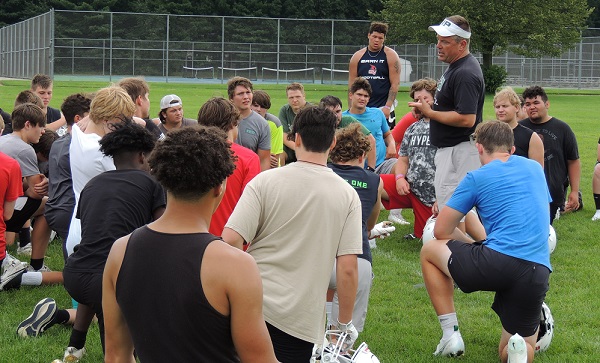
PHOTOS: (Top) Reeths-Puffer running backs hurdle a series of bags during a busy first practice Monday. (Middle) Clockwise from top: Assistant coaches Jari Brown (left) and Jeff Uganski work with the linemen; senior Marco Fields (front, blue sleeveless shirt) is among those working on his form; varsity coach Matt Bird works with one of his quarterbacks and their receivers. (Below) Bird gathers with his team at the end of their first practice of the season. (Photos by Geoff Kimmerly.)