


Menominee football's Hofer retires
June 11, 2012
Longtime Menominee football coach Ken Hofer retired today. He finished with a career record of 342-136-3 and led his team to three MHSAA championships.
But he is best known as the state's guru of the single win offense, which doesn't include a traditional quarterback and puzzled opponents who almost always hadn't seen the attack until running into the Maroons in the playoffs.
From Menominee Area Public Schools:
Ken Hofer, Head Varsity Football Coach of the Menominee Maroons, has announced his retirement today.
Coach Hofer first took control of the Maroon Football program in 1966, and led it to 300+ wins in 41 seasons at the helm, including MHSAA championships in 1998, 2006 and 2007.
More importantly, Menominee High School students and the greater Menominee community have been the beneficiaries of his work with young people. Coach Hofer served as teacher, athletic director, assistant principal, coach and mentor in his association with the school. He had helped to shape the adult lives of hundreds of young people through the years. The students, staff, administration and Board of Education of the Menominee Area Public Schools join in congratulating Coach Hofer on his outstanding service to young people. His impact has been felt for generations, and his legacy will continue to inspire students into the future.
--Erik Bergh, Superintendent
Drive for Detroit: Week 5 Preview
September 20, 2018
By Geoff Kimmerly
Second Half editor
As we dive into the midpoint of the 2018 high school football regular season, there’s more than meets the eye to many of our Week 5 matchups.
 Sure, we’ve got some of the usual regulars on this week’s preview list – Clinton Township Chippewa Valley vs. Macomb Dakota among them – but it’s fair to say a number of others discussed below are a bit off the usual board, but with plenty of significance upon further view.
Games below are tonight unless noted. Check out the MHSAA Score Center for the full schedule and results as games are completed. MHSAA.tv will broadcast 15 games this weekend, including our top game from the “Bay & Thumb” area. Our “Drive for Detroit” previews are powered by MI Student Aid.
Bay & Thumb
Davison (4-0) at Grand Blanc (4-0)
The Saginaw Valley League Blue is topped by three undefeated teams – these two and Lapeer – and this one will go a long way toward determining the eventual champion. But it also could have playoff implications down the road – the Bobcats are tied for fourth and Davison is tied for ninth in playoff point average among teams that traditionally fall into Division 1 for the postseason.
Others that caught my eye: FRIDAY Swartz Creek (4-0) at Flint Hamady (4-0), Ubly (3-1) at Harbor Beach (3-1), Harrison (2-2) at Beaverton (3-1), Richmond (3-1) at Yale (2-2).
Greater Detroit
Clinton Township Chippewa Valley (4-0) at Macomb Dakota (4-0)
Like Davison and Grand Blanc mentioned above, these two rank highly among likely Division 1 playoff teams – Chippewa Valley first in playoff point average and Dakota tied for seventh – and they’ve seen each other in the postseason as well five of the last six seasons. The Big Reds won both meetings in 2017 and this season have handed the only losses to Saline and Roseville. Dakota is averaging 45 points per game during its best start since its 2013 league title season.
Others that caught my eye: FRIDAY Detroit Cody (4-0) at Detroit Mumford (3-1), Garden City (3-1) at Dearborn Heights Crestwood (4-0), Auburn Hills Avondale (3-1) at Farmington (4-0), SATURDAY Detroit Catholic Central (3-1) at Birmingham Brother Rice (3-1).
Mid-Michigan
DeWitt (4-0) at East Lansing (4-0)
They have two of the richest traditions in the Lansing area and will meet as members of the same league for the first time. The winner will earn a strong upper hand in an otherwise middling Capital Area Activities Conference Blue, and these two also met in the playoffs as recently as 2016. DeWitt still scores a bunch and East Lansing has offensive firepower too, but the defenses could emerge as the stars of this meeting – DeWitt has given up only 7.8 points per game, and East Lansing a respectable 16 ppg.
Others that caught my eye: FRIDAY Lansing Catholic (4-0) at Portland (4-0), Canton (3-1) at Brighton (3-1), Ovid-Elsie (3-1) at New Lothrop (4-0), Haslett (4-0) at Williamston (3-1).
Northern Lower Peninsula
Traverse City Central (3-1) at Gaylord (4-0)
First-year coach and former assistant Shawn Sargent has the Blue Devils off to their first 4-0 start since their last playoff season in 2015. Gaylord has some solid wins, but Central will provide the strongest test to date. The Trojans have to be revved up after a close loss to rival Traverse City West last week. Central shines especially on defense, giving up only 9.5 points per game.
Others that caught my eye: FRIDAY Oscoda (3-1) at Rogers City (4-0), Traverse City St. Francis (4-0) at Grayling (2-2), Leroy Pine River (4-0) at McBain (2-2), Traverse City West (2-2) at Alpena (2-2).
Southeast & Border
Athens (3-0) at Adrian Lenawee Christian (4-0)
The Southern Central Athletic Association has only four 11-player teams but two of the most intriguing matchups in the region this weekend. (Pittsford and Climax-Scotts line up on the other side.) Lenawee Christian is 4-0 for the first time ever; the Cougars are in their 11th season as a varsity program. And Athens? The Indians didn’t have an opponent Week 2, but have outscored their three this season by a combined 107-0.
Others that caught my eye: FRIDAY Jackson (4-0) at Chelsea (3-1), Concord (3-1) at Springport (4-0), Union City (2-2) at Reading (4-0), Addison (2-2) at Grass Lake (4-0).
Southwest Corridor
Watervliet (2-2) at Kalamazoo United (4-0)
Watervliet has won outright or shared seven straight league titles, but enters Southwestern Athletic Conference Valley play with a pair of close losses – their first regular-season defeats since Week 6 of 2016. United also was 4-0 coming into this league opener a year ago, and Watervliet won 52-34. But United – giving up only 27 points total over four games this time, might have the defense to slow down a Watervliet offense averaging 43 points per game.
Others that caught my eye: FRIDAY Paw Paw (3-1) at Three Rivers (4-0), Muskegon Catholic Central (2-2) at Cassopolis (4-0), Stevensville Lakeshore (2-2) at Portage Central (3-1), Battle Creek Central (3-1) at Benton Harbor (1-2).
Upper Peninsula
Harbor Springs (4-0) at St. Ignace (2-2)
With their best start since 1999, the Rams have equaled last season’s win total and are lined up to chase their best record since going 6-4 in 2000. But St. Ignace, despite losing to Johannesburg-Lewiston last week, has experienced a turn as well after uncharacteristically winning just a game a year ago. The Saints not only have more wins than last season already, but with 23 more points will eclipse last year’s output.
Others that caught my eye: FRIDAY Norway (2-2) at Calumet (4-0), Negaunee (2-2) at Ishpeming (4-0), Maple City Glen Lake (2-2) at Gladstone (2-2), Petoskey (2-2) at Marquette (2-2).
West Michigan
Grand Rapids NorthPointe Christian (3-1) at Hopkins (3-1)
The Ottawa-Kent Conference Silver has the smallest schools of the league’s seven divisions and doesn’t get the attention of the other high-profile leagues. But the Silver’s best have had big moments too over the years, and these two teams are hoping to ride fast starts into more over the next two months. NorthPointe started 5-0 a year ago before hitting the tough part of the league schedule – but did make the playoffs. Hopkins is seeking its first playoff berth since 2014 and already has avenged Silver losses from last season to Belding and Wyoming Godwin Heights.
Others that caught my eye FRIDAY Hudsonville (4-0) at Jenison (3-1), Whitehall (3-1) at Montague (3-1), Muskegon Oakridge (4-0) at Ravenna (3-1), Grand Rapids South Christian (3-1) at Hudsonville Unity Christian (4-0).
8-Player
Onekama (4-0) at Wyoming Tri-unity Christian (4-0), Saturday
The Portagers seemed on the verge of something special last season, when they finished 9-2 losing in the 8-Player Division 2 Regional Finals. So far this fall they’ve outscored opponents by a combined 196-6, with only reigning Division 1 champion Central Lake getting on the board. Tri-unity is coming off its first challenge of the season – a 38-27 win over Suttons Bay – and could next provide Onekama’s best test to date, and with the Midwest Central Michigan West championship perhaps on the line.
Others that caught my eye: FRIDAY Morrice (4-0) at Mount Pleasant Sacred Heart (3-1), Battle Creek St. Philip (3-1) at Camden-Frontier (3-1), Cedarville (3-1) at Engadine (3-1), Mayville (3-1) at Kinde-North Huron (3-1).
Second Half’s weekly “Drive for Detroit” previews and reviews are powered by MI Student Aid, a part of the Student Financial Services Bureau located within the Michigan Department of Treasury. MI Student Aid encourages students to pursue postsecondary education by providing access to student financial resources and information, including various student financial assistance programs to help make college more affordable for Michigan students. MI Student Aid administers the state’s 529 savings programs (MET/MESP) and eight additional aid programs within its Student Scholarships and Grants division. Click for more information and connect with MI Student Aid on Facebook and Twitter @mistudentaid.
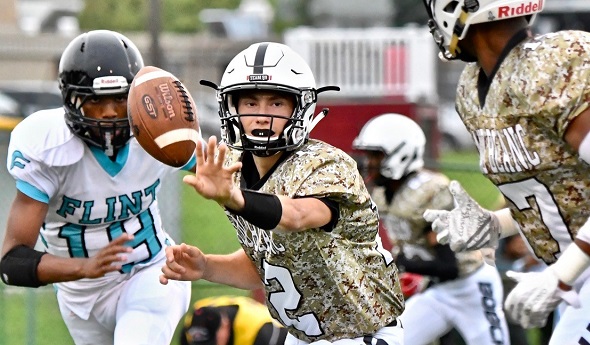
PHOTO: Grand Blanc quarterback Tylor Leedom pitches to a teammate during the Bobcats’ Week 3 win over Flint Southwestern. (Photo by Terry Lyons.)