


MHSA(Q&)A: NFL official Ronald J. Winter
July 19, 2012
By Brian Spencer
Second Half
 Kalamazoo's Ron Winter has officiated in the National Football League for nearly two decades, and became a referee in 1999. But long before he joined the highest level of the game, he got his start on Michigan's high school fields.
Winter has officiated that sport at all three levels and also high school and college basketball. He's also served as a source of knowledge for officials around the state -- and an example for those hoping to start at the high school level and climb to the pros.
Winter remains registered as an MHSAA official, as he's been for 42 years. An associate professor emeritus of human performance and health education at Western Michigan University, Winter was appointed earlier this month to serve a two-year term on the Governor's Council on Physical Fitness, Health and Sports. The council focuses on increasing physical activity and health improvements.
He served on the WMU faculty first beginning in 1969 and then again from 1992-2008. Winter earned bachelor and master's degrees at Michigan State University.
Did you play any sports in high school or college?
I played football, basketball, baseball, and track in high school. However, once I got to Michigan State University, I started playing lacrosse. A couple guys that lived near me played lacrosse and asked me to come out to throw the ball around. After throwing with them a couple times they asked me to come out for the team. I ended up playing lacrosse for MSU for four years.
How did you decide to choose football as the sport you would officiate?
I started officiating as a student at MSU in their intramural program, officiating touch football and basketball. The next logical step was to then officiate in the high school leagues. From there, I began to proceed to all the different levels.
Are there specific requirements for becoming an NFL official?
The biggest requirement is experience. The progression that I went through went like this:
After officiating high school games, I went to the MIAA (Michigan Intercollegiate Athletic Association). They (MIAA) were looking for people that had 3-5 years of experience at the high school level. From there I went to the Mid-Continent conference. I wasn’t able to go to the Mid-American Conference because I was employed at Western Michigan University.
From there I went to the Big Ten. The Big Ten was looking for people with 5 to 10 years of experience in high school and people that had experience at different positions as an official. I ended up officiating in as a Big Ten football official for 10 years and a Big Ten basketball official for 15 years. I then submitted an application to the National Football League. Coincidentally, the NFL was scouting officials, and had followed me for four years before they finally asked me to be a part of the staff. The NFL decides on who they want to pursue through recommendations and personal interest. They look for personality traits as well as how (officials) carry themselves through different situations.
What has been your favorite level to officiate; High school, college or professional?
I enjoyed officiating all of them, but for different reasons.
I found high school to be the most fascinating because it’s all about the kids; they are playing the game for the love of the game. That is the purest sense of the sport. I loved being involved with kids simply because they love the game.
I found the Big Ten to be most exciting because of the kind of atmosphere that exists on a Big Ten campus on a Saturday afternoon. It’s electric. You don’t get that same sense or the same feel on Sunday afternoon in a pro stadium.
I found the NFL to be most intense. The NFL really has three or four different levels of play during the season. There is preseason play, the first third of the season, the second third of the season, and the last five games of the season. Each level is ramped up another notch as the season progresses. Playoffs are entirely different all together. In terms of the intensity and pure speed of the game, there is nothing like the NFL playoffs.
How important is getting along with your fellow officials on the field?
It’s imperatively important if you want to have a smooth and well-run game. This doesn’t mean that you have to buddy-buddy off the field, but on the field you have to be committed to one goal. We spend two or three hours on meetings Saturday afternoon to go over rules tests, tape, and more to prepare for the next game (and) to get over rough patches that develop on a personal level in a previous week. I need to know that the other six guys are focused and thinking about football like me. Everyone has to have confidence in one another. We spend plenty of time on Saturday to get to the point that we need to on Sunday.
What has been the most exciting game you’ve officiated?
I’ve been in plenty of exciting games from NFL playoff games, to the first Orange Bowl game, to the Rose Bowl, to the Division III Hope vs. Calvin basketball game, to when Indiana played Purdue in basketball. All of them were incredible to be a part of. During the Indiana vs. Purdue game, the arena was electric. The players, coaches, fans were intense. Everybody is totally focused on the game. Each coach had a tremendous respect for one another. Neither one wanted to show up or embarrass their counterpart. This game wasn’t that drastically different at the Division III level, however. The intensity of both was very similar.
Are there games that you get excited to officiate more than others, presently?
Not in terms of specific teams. It really just depends on the circumstances, of course. Pittsburgh vs. Baltimore is an intense game. The Jets vs. Patriots game is great. There are clearly rivalries that are very exciting to be a part of. The level of play and intensity of the athletes in the NFL is unmatched and can provide excitement every week.
What is the most difficult aspect of being a NFL official?
I would say that preparation and being able to maintain intensity on the field on Sunday are key aspects. The preparation is difficult because it’s time-consuming. It is a misconception that we simply show up on Sunday to work the game. By the time Sunday rolls around, I’ve spent over 20 hours during the week trying to prepare for a Sunday game. It isn’t hard in terms of physical labor, but difficult in terms of a time commitment. You have to have an understanding family to be in the occupational field that I am in.
Do you have any advice for aspiring officials who hope to make it to the league?
Practice, practice, practice. Be able to work any game at any level and get as much experience as you can. Be a good partner on the field. It takes time; it isn’t something that just happens. Like anything else, it takes practicing your trade to be able to make it to the top level.
VanderVelde Officiating Tree Branches Into 2nd Generation, Top-Tier College Football
By
Steve Vedder
Special for MHSAA.com
February 28, 2025
Mike VanderVelde always knew the apple wasn't going to fall far from the tree.
The longtime West Michigan football and basketball official correctly guessed that his son, Michael, who had accompanied his father to countless Friday night football games before he was even out of elementary school, would eventually pick up the family mantle of officiating. VanderVelde said he saw in his young son many of the key attributes an official must possess: a keen eye for details, an overwhelming desire to improve, patience and a love of sports.
Put it all together, and VanderVelde has seen his son evolve into one of the nation's top NCAA football officials.
"I think it was just like with any kid, he liked the competition," said Mike VanderVelde, who retired three years ago at the age of 78 after officiating in the Grand Rapids area for 61. "I guess it would be crazy to say now, but even then there was something about Michael that was going to make him a good official. It wasn't (following) me."
Michael, a Grandville High School and Hope College graduate, has gone from working middle school football games to make extra money in college to officiating eight college bowl games, including this year's Sugar Bowl national quarterfinal Jan. 2 in New Orleans and the semifinal Jan. 9 at the Orange Bowl in Miami. VanderVelde's first bowl game was the 2017 Bahamas Bowl, and he also officiated the 2024 Rose Bowl, the national semifinal between eventual champion Michigan and Alabama.
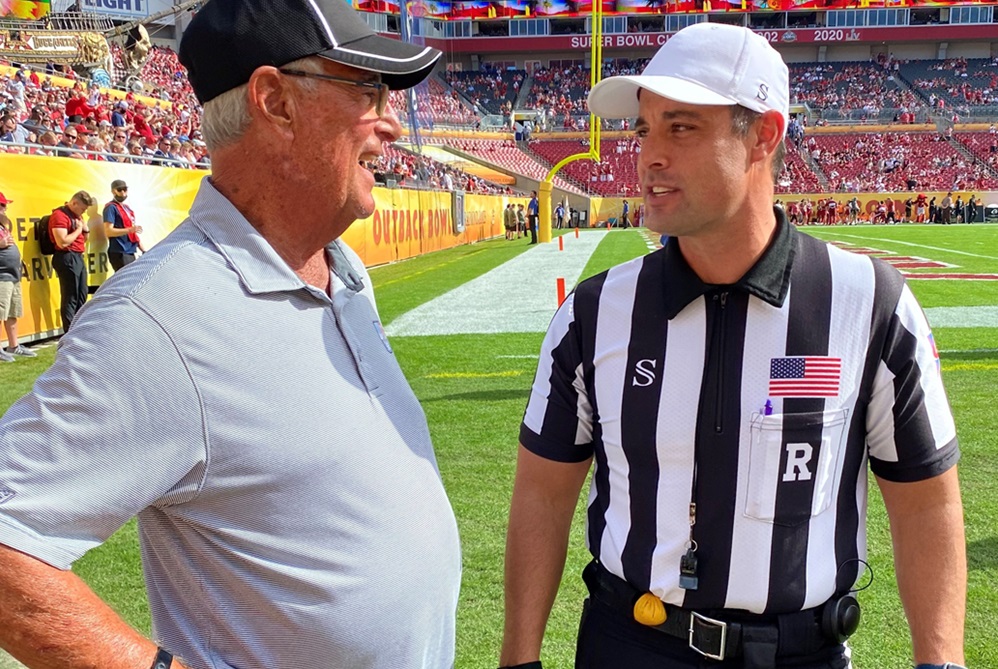
 Before reaching those heights, Michael said some of his earliest sporting moments came when he was a ball boy jogging along the sideline while his father was working on the field. VanderVelde figures he was barely 8 years old, but he remembers being taught by his father to pay attention to detail. He also considers his father a major influence in his decision to pursue football officiating at the highest level.
"I'd buy that, absolutely. I loved spending time with my dad on Friday nights. That was definitely a common bonding time,” Michael VanderVelde said. “I'd see the smile on his face and see his passion for football. I'd see subtle little hints, and I'd pick up on that. The seed was definitely planted.”
Even as a youngster who was yet to see middle school, Michael said he understood the necessity of being where he was supposed to be as a ball boy. It was one of his first lessons in accepting responsibility and that actions had consequences.
"I would hand the ball to the umpire and pay attention to the game, and do what they needed me to do," he said. "And then I'd hang out with the crew after the games. Just being around the game and watching and being close to it, I loved it."
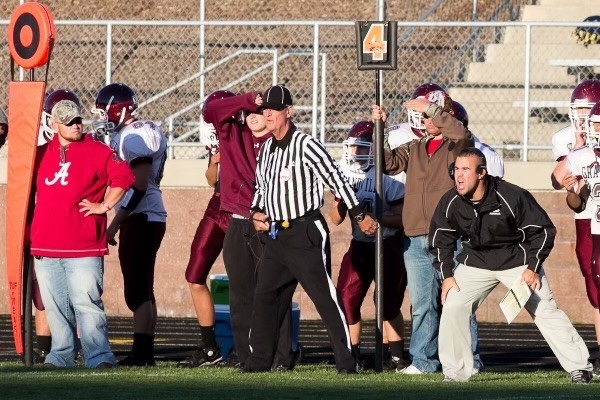
Both VanderVeldes entered officiating on the ground floor. Mike began doing YMCA fifth and sixth grade and church league basketball games at Grand Rapids' Franklin Park during the 1950s. He eventually graduated to working about 75 high school football and basketball games a year along with officiating Great Lakes Intercollegiate Athletic Conference and Michigan Intercollegiate Athletic Association football games. VanderVelde also coached football, tennis and junior high basketball at Wyoming Kelloggsville High School for 30 years.
"I've always been involved with athletics; I've really enjoyed it," Mike said. "I always thought of (officiating) as a challenge. I wanted to see what I could do. It intrigued me, trying something new. It just clicked with me, and I kept going and I never really stopped."
The younger VanderVelde also started at the youngest levels, officiating fourth through sixth-grade football games before he graduated from high school in 2003. Then to make extra money while in college, VanderVelde took on freshman, junior varsity and his first varsity football game at Saranac. He eventually worked high school basketball games before moving to Colorado and doing Southland Conference games for three years beginning in 2013. VanderVelde went on to work for three years in the Mountain West Conference and now officiates Big 12 games while living in Louisiana.
While many fans often fail to grasp the pressures an official faces while working major college football bowl games, VanderVelde said he's thrilled to reach that elite level of officiating.
 "It's a blast," he said. "To be there with other officials and doing things like working with the replays, getting the calls correct, 11 on 11 football and being on the biggest stage, I love it."
As for the recently completed college season, VanderVelde was honored that the NCAA – in a rare break from tradition – chose his crew to work back-to-back Notre Dame games in the Sugar and Rose Bowls. The NCAA typically will not assign the same crew to the same team two weeks in a row. It was an extraordinary gesture signaling the high esteem in which the crew is held, not only by the NCAA but with the blessing of all teams involved.
"It's tough to work back-to-back games like that, but I think the crew did an excellent job," he said. "There was no controversy, and I think we felt comfortable being assigned those games."
Considering his officiating success, VanderVelde said there is one step yet to take, one more hurdle to leap: the NFL. VanderVelde. who works United Football League games in the spring, has been part of the league's Mackie Development Program for the last two years. He's already worked Hula Bowl games and would gladly consider moving along to working on Sundays.
"I'd love to have that opportunity if it was ever presented to me," he said. "It'd be cool, but there are no guarantees. You know that snap by snap, you're only as good as your last game. But it's something I'd like to do some day.
"In football all you can do is look at your next assignment and try to do it well. It's exciting, but you're always trying to go on to the next game without a hitch."
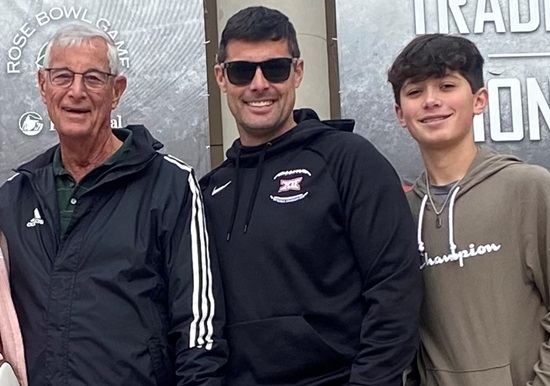
PHOTOS (Top) Longtime MHSAA official Mike VanderVelde, left, and son Michael share a moment during Michael’s officiating assignment at the 2021 Outback Bowl in Tampa Bay, Fla. (Middle) Mike VanderVelde officiates a Grandville High school game. (Below) From left: Mike VanderVelde, Michael VanderVelde, and Michael’s son Hayden. (Photos provided by the VanderVelde family.)