


MHSA(Q&)A: NFL official Ronald J. Winter
July 19, 2012
By Brian Spencer
Second Half
 Kalamazoo's Ron Winter has officiated in the National Football League for nearly two decades, and became a referee in 1999. But long before he joined the highest level of the game, he got his start on Michigan's high school fields.
Winter has officiated that sport at all three levels and also high school and college basketball. He's also served as a source of knowledge for officials around the state -- and an example for those hoping to start at the high school level and climb to the pros.
Winter remains registered as an MHSAA official, as he's been for 42 years. An associate professor emeritus of human performance and health education at Western Michigan University, Winter was appointed earlier this month to serve a two-year term on the Governor's Council on Physical Fitness, Health and Sports. The council focuses on increasing physical activity and health improvements.
He served on the WMU faculty first beginning in 1969 and then again from 1992-2008. Winter earned bachelor and master's degrees at Michigan State University.
Did you play any sports in high school or college?
I played football, basketball, baseball, and track in high school. However, once I got to Michigan State University, I started playing lacrosse. A couple guys that lived near me played lacrosse and asked me to come out to throw the ball around. After throwing with them a couple times they asked me to come out for the team. I ended up playing lacrosse for MSU for four years.
How did you decide to choose football as the sport you would officiate?
I started officiating as a student at MSU in their intramural program, officiating touch football and basketball. The next logical step was to then officiate in the high school leagues. From there, I began to proceed to all the different levels.
Are there specific requirements for becoming an NFL official?
The biggest requirement is experience. The progression that I went through went like this:
After officiating high school games, I went to the MIAA (Michigan Intercollegiate Athletic Association). They (MIAA) were looking for people that had 3-5 years of experience at the high school level. From there I went to the Mid-Continent conference. I wasn’t able to go to the Mid-American Conference because I was employed at Western Michigan University.
From there I went to the Big Ten. The Big Ten was looking for people with 5 to 10 years of experience in high school and people that had experience at different positions as an official. I ended up officiating in as a Big Ten football official for 10 years and a Big Ten basketball official for 15 years. I then submitted an application to the National Football League. Coincidentally, the NFL was scouting officials, and had followed me for four years before they finally asked me to be a part of the staff. The NFL decides on who they want to pursue through recommendations and personal interest. They look for personality traits as well as how (officials) carry themselves through different situations.
What has been your favorite level to officiate; High school, college or professional?
I enjoyed officiating all of them, but for different reasons.
I found high school to be the most fascinating because it’s all about the kids; they are playing the game for the love of the game. That is the purest sense of the sport. I loved being involved with kids simply because they love the game.
I found the Big Ten to be most exciting because of the kind of atmosphere that exists on a Big Ten campus on a Saturday afternoon. It’s electric. You don’t get that same sense or the same feel on Sunday afternoon in a pro stadium.
I found the NFL to be most intense. The NFL really has three or four different levels of play during the season. There is preseason play, the first third of the season, the second third of the season, and the last five games of the season. Each level is ramped up another notch as the season progresses. Playoffs are entirely different all together. In terms of the intensity and pure speed of the game, there is nothing like the NFL playoffs.
How important is getting along with your fellow officials on the field?
It’s imperatively important if you want to have a smooth and well-run game. This doesn’t mean that you have to buddy-buddy off the field, but on the field you have to be committed to one goal. We spend two or three hours on meetings Saturday afternoon to go over rules tests, tape, and more to prepare for the next game (and) to get over rough patches that develop on a personal level in a previous week. I need to know that the other six guys are focused and thinking about football like me. Everyone has to have confidence in one another. We spend plenty of time on Saturday to get to the point that we need to on Sunday.
What has been the most exciting game you’ve officiated?
I’ve been in plenty of exciting games from NFL playoff games, to the first Orange Bowl game, to the Rose Bowl, to the Division III Hope vs. Calvin basketball game, to when Indiana played Purdue in basketball. All of them were incredible to be a part of. During the Indiana vs. Purdue game, the arena was electric. The players, coaches, fans were intense. Everybody is totally focused on the game. Each coach had a tremendous respect for one another. Neither one wanted to show up or embarrass their counterpart. This game wasn’t that drastically different at the Division III level, however. The intensity of both was very similar.
Are there games that you get excited to officiate more than others, presently?
Not in terms of specific teams. It really just depends on the circumstances, of course. Pittsburgh vs. Baltimore is an intense game. The Jets vs. Patriots game is great. There are clearly rivalries that are very exciting to be a part of. The level of play and intensity of the athletes in the NFL is unmatched and can provide excitement every week.
What is the most difficult aspect of being a NFL official?
I would say that preparation and being able to maintain intensity on the field on Sunday are key aspects. The preparation is difficult because it’s time-consuming. It is a misconception that we simply show up on Sunday to work the game. By the time Sunday rolls around, I’ve spent over 20 hours during the week trying to prepare for a Sunday game. It isn’t hard in terms of physical labor, but difficult in terms of a time commitment. You have to have an understanding family to be in the occupational field that I am in.
Do you have any advice for aspiring officials who hope to make it to the league?
Practice, practice, practice. Be able to work any game at any level and get as much experience as you can. Be a good partner on the field. It takes time; it isn’t something that just happens. Like anything else, it takes practicing your trade to be able to make it to the top level.
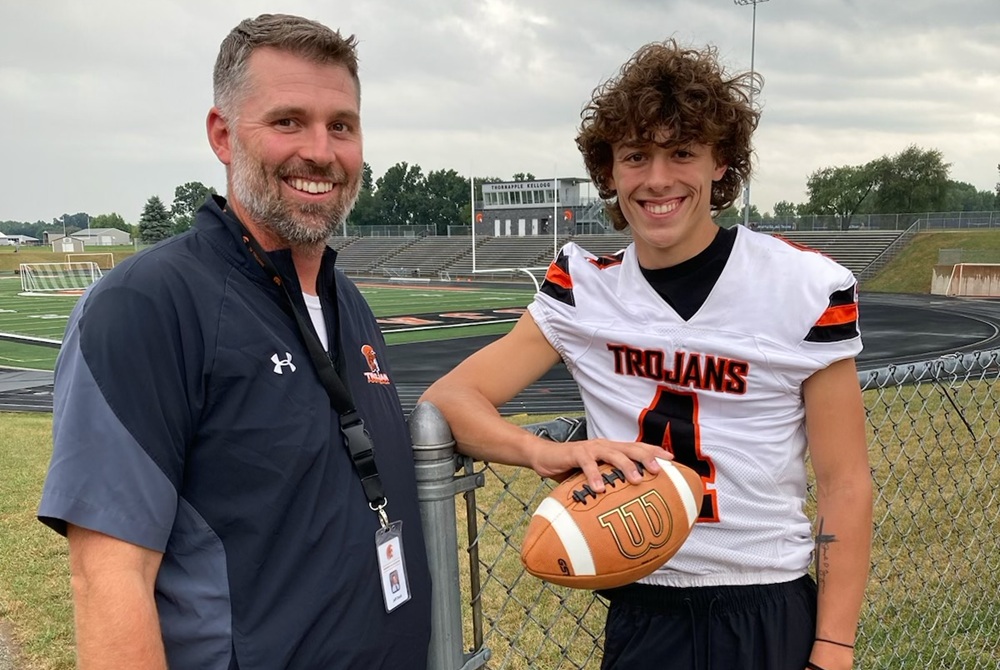
Dock Putting Dad's Coaching Lessons to Work as Middleville TK Continues Climb
By
Steve Vedder
Special for MHSAA.com
November 3, 2025
MIDDLEVILLE – Denny Dock can't pinpoint the exact moment he thought his football-loving son would follow him into coaching, but the signs were there all along.
 For starters, there were the countless hours spent tossing a football around the backyard. Or when his young son, Jeff – not even old enough for middle school at the time – eagerly joined other Stevensville Lakeshore coaches watching film on weekends.
Maybe it was all those Friday nights spent trekking along the sideline as a ball boy for Lancers teams. Another clue might have been the Saturday afternoons the two spent together watching college football, or taking in the NFL on Sundays.
When Jeff got older, it may have been how he readily absorbed tips that helped him become a better quarterback in high school and then at Grand Valley State. It could have even been an early, uncanny ability to grasp the importance of fundamentals.
Put it all together, and it seemed inevitable coaching football loomed in Jeff Dock's future.
"That's very fair to say," said Denny Dock, who is 19th on the state's list of all-time winningest football coaches while also the winningest high school softball coach in the country. "The younger years in football were really positive for Jeff, and that doesn't happen all the time. There are negative things that can happen."
While there might have been multiple signs the younger Dock would one day join the coaching ranks, he admits it was far from a done deal. There were thoughts of becoming a biology teacher, a pastor or maybe even an orthopedic surgeon.
But coaching? Even with his father as a classic example of the positive impact a good coach could spread, Dock said it took years for him to eventually land in coaching.
"It dawned on me that there were a lot of all three of those things in being a coach," he said. "Growing up in sports is what I knew, and I ended up developing a passion for it."
That passion is actually the highest it's been in years as his Middleville Thornapple Kellogg football team this past weekend improved to 7-3, continuing the program's first winning season since 2020 and the best fall since the Trojans went 7-3 in 2018. The Trojans defeated Hastings 28-20 in a Division 2 playoff opener, and a win this Friday at Lowell would give Middleville its first District championship since 2001.
Denny Dock coached football at Hartford from 1981-83, Dowagiac from 1984-87, and then Lakeshore from 1988-2013, returning to lead the Lancers for one more season in 2020 and all together totaling a 270-79 career record, 15 league titles and five runner-up MHSAA Finals finishes.
He has kept his hand in football in aiding his son's Trojans program. He's at all the games to add support, critique, advice, strategy, tips on how practices can best be organized and long talks discussing how continual improvement can be furthered.
It's a two-way street as an old football coach who never had a losing season, and is a member of the Michigan High School Football Coaches Association Hall of Fame, can remain invested in the game while his son benefits from three decades worth of experience.
Jeff Dock said his father's real value is his ability to spot from the stands the little things that less experienced coaches may miss.
 "Play calling, how players are used, maybe a little bit about strategy," Dock said.
After playing for his father, Dock said there's no doubt he's transferred the best of what he learned into his own coaching. The older Dock was not only a highly successful football coach, he's compiled a 1,319-345-2 record in softball with eight Finals titles.
Whether it's about football or the philosophy Dock stresses in his softball program, the advice accepted from his father – who still attends softball clinics for tips on improving the Lakeshore program – is virtually across the board. It begins, however, with how a coach should treat his players.
"I was a manager growing up, and I saw his intensity and a love of his players," Dock said. "He never pushed me in any direction, but he told me about education. He always let me figure it out. One of the coolest things my parents did in raising me was to allow me to figure things out."
As far as the Xs and Os of coaching, Dock said his father prizes an organized practice. In fact, it could even be argued that both Docks enjoy a spirited and productive practice session over the microscope of Friday Night Lights.
"He never had a losing season, and it was ingrained in us just to go back to work and that that work never stops," he said. "He loves practices and being organized. Rule No. 1 with him was to make sure the players are prepared, and that you have to communicate with them. Dad would never belittle us or cuss us out.
"I saw the work he put in, how he'd wake up every Saturday thinking about the game. I saw the nitty gritty of coaching and how it was going to take work."
It was that seemingly endless work, in fact, that Denny Dock made sure his young son understood. Denny had no illusions over the pitfalls of coaching, and the pros and the cons. But before he could teach that to his son the coach, he made sure his son the quarterback understood how athletics worked.
There were challenges as a player and now for his son as a coach.
"He was always a quarterback because I think he liked the ball in his hands," Denny Dock said. "I think he liked the leadership part of the game, understanding the team part, and knowing what he had to do. That always challenged him."
While the challenge of playing is long gone for the younger Dock, the next challenge is building a program which is annually competitive. To do that, Jeff Dock said he accepts what his father knew 30 years ago.
"I'm willing to learn anything from anyone at any time," he said. "I know my dad has always thought about what he can do to become a little better every year. I'm always looking for ways to communicate and do things better. It can always be done better, but how can you get there? How can we do the little things better. That's what I learned."
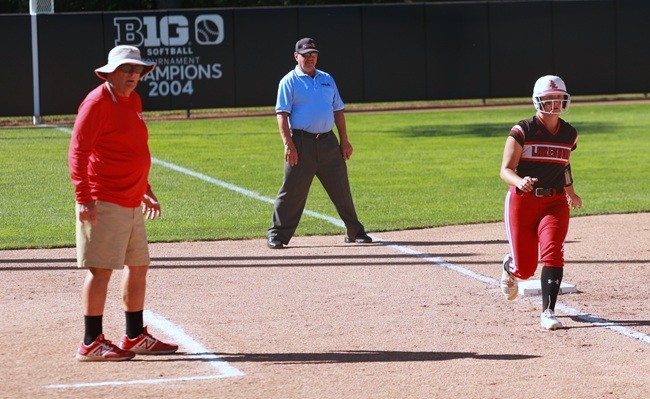
PHOTOS (Top) Jeff Dock, left, and son Micah – Middleville Thornapple Kellogg’s quarterback this season – stand for a photo at their home field. (Middle) Denny Dock, far left, coaches a base runner during Stevensville Lakeshore’s 2022 Semifinal win. (Top photo by Steve Vedder.)